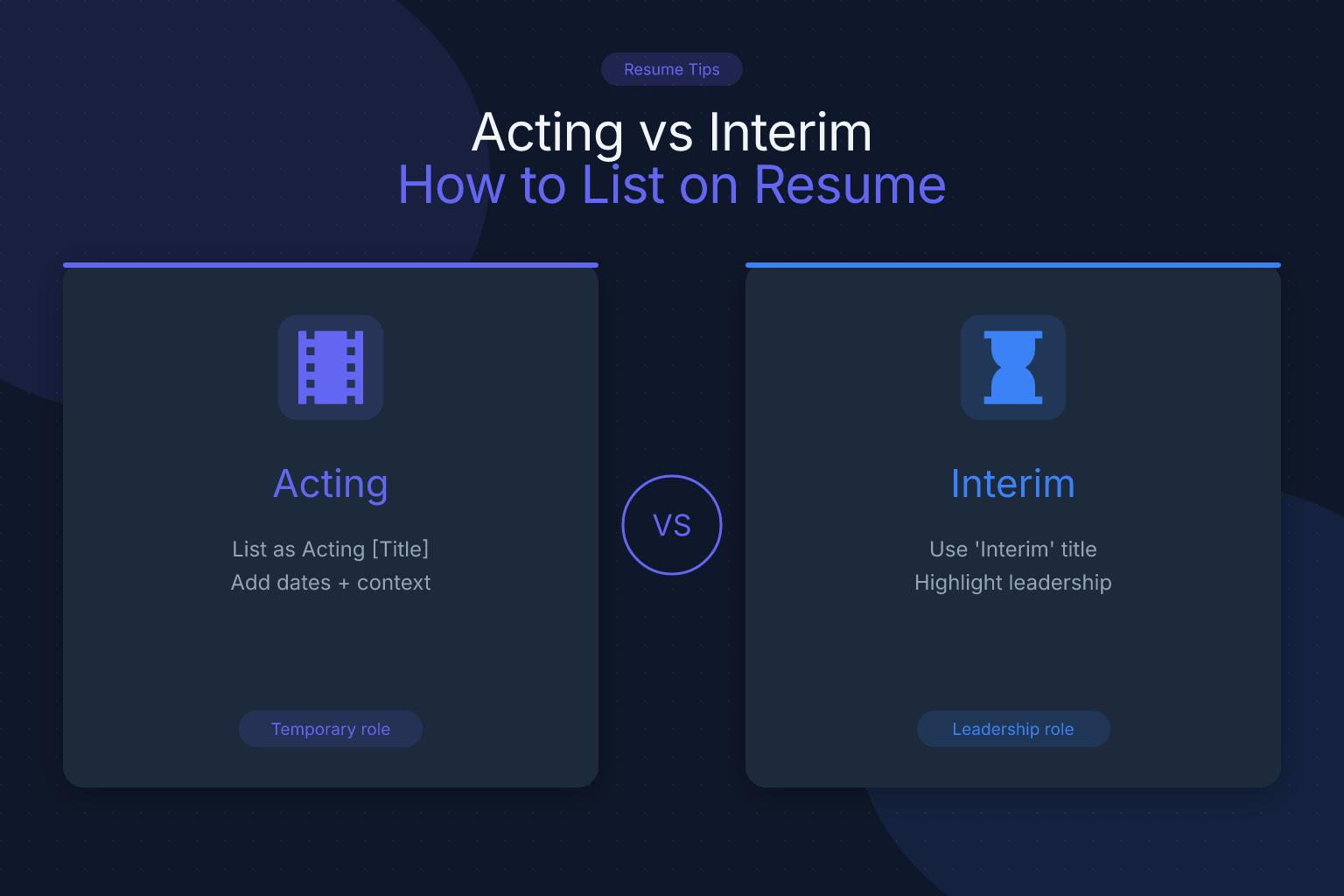
Acting vs Interim: How to List on Your Resume (With Examples)
You’ve stepped into a bigger role temporarily — maybe your manager left, or a project needed a lead — and now you’re wondering how to list that acting role or interim title on your resume without looking like you’re inflating your experience. Done right, an interim position shows you can handle more responsibility, adapt quickly, and deliver results under pressure. Done wrong, it can confuse recruiters or make it seem like you were demoted when the assignment ended.
This guide covers exactly how to format acting and interim roles, when to use each term, and how to describe your achievements so they strengthen your resume — not raise questions.
Key Takeaways
- List the acting or interim title as your primary job title, with the permanent title in parentheses or on a separate line — never hide the acting nature.
- Use “Acting” when filling a vacant position temporarily; use “Interim” when the role is expected to become permanent or you’re bridging a gap.
- Focus bullet points on results and leadership, not the temporary status — quantify what you achieved while in the role.
- If you later earned the permanent title, show the progression clearly with separate entries or a combined entry that highlights the promotion.
- Avoid common mistakes like omitting the acting label, burying it in a footnote, or using a slash format that confuses ATS software.
| What to Do | Why It Matters | Time |
|---|---|---|
| Use “Acting” or “Interim” in the job title line | Recruiters and ATS see the elevated responsibility immediately | 1 minute |
| Add a parenthetical note explaining the context | Prevents the assumption that you were demoted when the role ended | 2 minutes |
| Quantify achievements from the acting period | Proves you performed at the higher level, not just held the title | 10–15 minutes |
| Show career progression if you later got the permanent role | Demonstrates that your performance was recognized and rewarded | 5 minutes |
| Use a clean, single-column resume template | Ensures ATS parses your acting title and dates correctly | 5 minutes |
How to List an Acting Role or Interim Title on a Resume
When you temporarily fill a higher-level position, your resume must make that clear without undermining the experience. The most common — and effective — approach is to list the acting or interim title as your primary job title, then clarify the temporary nature in a subtitle or parenthetical. This puts the more impressive title front and center for both recruiters and applicant tracking systems (ATS).
For example:
Acting Director of Marketing
ABC Corporation (while Director was on parental leave)
March 2025 – September 2025
Or:
Interim Team Lead, Software Engineering (covering vacant position)
XYZ Tech
January 2025 – June 2025
If you held the permanent title before or after the acting period, you can show the progression within the same company entry:
ABC Corporation
Senior Marketing Manager (September 2025 – Present)
Acting Director of Marketing (March 2025 – September 2025)
Marketing Manager (June 2023 – March 2025)
This format makes your career growth obvious and shows you were trusted with increasing responsibility. It also prevents the ATS from misreading your job titles as separate, unrelated roles.
When to Use “Acting” vs. “Interim” on Your Resume
Though often used interchangeably, “acting” and “interim” carry slightly different connotations. Choosing the right word can add precision to your resume.
- Acting: Use when you temporarily assume the duties of a vacant position, typically because the incumbent is absent (e.g., on leave, secondment, or sick leave). The role is expected to revert to the original person. Example: “Acting Department Head while the Department Head was on medical leave.”
- Interim: Use when you fill a role that is vacant with no immediate permanent replacement, often during a hiring process or organizational transition. The interim period may last months, and you might be a candidate for the permanent role. Example: “Interim CFO during the executive search process.”
In practice, many hiring managers don’t distinguish sharply between the two. What matters is that you clearly signal the role was temporary and why. If your official HR title used one term, stick with that for consistency during background checks.
Formatting Acting and Interim Roles: 3 Proven Approaches
There’s no single right way, but these three formats cover most situations. Choose the one that best fits your career story.
1. Parenthetical Clarification
Place the acting or interim label directly in the job title line, with a brief explanation in parentheses.
Acting Sales Director (covering maternity leave)
Global Retail Inc. | April 2025 – October 2025
This is the most scannable format. It works well when the acting role is your most recent or most relevant experience.
2. Subtitle or Secondary Line
Use a subtitle immediately below the company name to explain the context.
Regional Operations Manager
Interim assignment while permanent manager was recruited
LogiCorp | February 2025 – August 2025
This approach keeps the job title clean while still providing context. It’s ideal if you want the title to stand alone in ATS searches.
3. Stacked Entries Under One Company
If you held multiple roles at the same company, including the acting position, list them in reverse chronological order under a single company header.
TechNova Solutions
Senior Product Manager (November 2025 – Present)
Interim Head of Product (May 2025 – November 2025)
Product Manager (March 2023 – May 2025)
This format clearly shows a promotion path and the temporary nature of the interim role. It’s the best choice when you later earned the permanent title or returned to your original role at a higher level.
No matter which format you pick, keep the design simple. Multi-column layouts can confuse older ATS, so a single-column template is the safest bet. You can build one in minutes with ResumeMate’s free resume builder and export a clean, ATS-friendly PDF. For more on ATS-friendly formatting, read our guide on ATS resume formatting.
How to Describe Acting Role Achievements Without Underselling Yourself
The biggest mistake candidates make is writing bullet points that focus on the temporary nature of the role rather than the impact they had. Phrases like “filled in for the director” or “held the fort” sell you short. Instead, write accomplishments the same way you would for a permanent position — with numbers, scope, and results.
Before:
- Filled in as acting team lead while manager was on leave.
- Handled day-to-day operations.
After:
- Led a 12-person engineering team through two product releases, delivering both on schedule during the manager’s six-month leave.
- Redesigned the sprint planning process, cutting cycle time by 20% and reducing missed deadlines to zero.
If you don’t have hard metrics, estimate conservatively or describe the scope: “Managed a $2M budget,” “Supervised 8 direct reports,” “Presented quarterly results to the C-suite.” The key is to show you performed at the higher level, not just kept the seat warm.
For more on quantifying achievements when data is scarce, read our guide on how to add numbers to your resume when you don’t have data.
Should You List the Permanent Title or the Acting Title?
This is a strategic decision. In most cases, list the acting or interim title as your primary job title for that period. It immediately signals that you operated at a higher level. Recruiters scanning for leadership experience will see “Acting Director” and take you seriously.
However, if the acting role was very brief (under two months) or the permanent title is more relevant to the job you’re targeting, you might list the permanent title and mention the acting assignment in a bullet point. For example:
Senior Accountant
Also served as Acting Finance Manager for 3 months during system implementation, leading a team of 4.
This approach works when the acting experience is a minor part of your story. But if the acting role represents a significant portion of your responsibilities or is the closest thing you have to management experience, give it the title line.
A word on ATS: most modern systems parse the job title field and match it against keywords. If a job description asks for “team lead” experience, having “Acting Team Lead” in your title line will help you rank higher than burying it in a bullet. After you’ve drafted your resume, run it through the ResumeMate score checker to see how well your titles and keywords align with the roles you’re targeting.
Common Mistakes When Listing Interim Positions on a Resume
Even well-intentioned formatting can backfire. Avoid these errors:
- Omitting the “acting” or “interim” label entirely. If a background check reveals your official title was “Senior Analyst” but your resume says “Manager,” you risk looking dishonest. Always indicate the temporary nature.
- Burying the context in a footnote or tiny font. Recruiters skim; if they miss the explanation, they may assume you were demoted when you returned to your previous title. Make the context visible.
- Using a slash format like “Manager/Acting Director.” This is ambiguous and can confuse ATS software, which may parse it as a single garbled title. Stick to clear, separate lines or parentheses.
- Writing bullet points that sound like a job description for a placeholder. Avoid “assumed responsibilities of…” and instead lead with action verbs and results.
- Failing to show what happened after the acting role ended. If you returned to your old title, explain why (e.g., “Returned to Senior Engineer role after successful hire of permanent CTO”). If you were promoted, make that the headline.
How to Show Career Progression After an Acting Role
An acting role can be a powerful stepping stone. How you present the transition on your resume can either highlight growth or create a confusing gap.
If you were promoted to the permanent role:
List the acting period and the permanent role as separate entries under the same company, with the permanent role first (reverse chronological order). This shows a clear upward trajectory.
Global Finance Corp
Director of Finance (January 2026 – Present)
Interim Director of Finance (June 2025 – January 2026)
Senior Financial Analyst (2022 – June 2025)
If you returned to your original role:
Frame the return positively. You can note that you successfully handed off the role or that the assignment was always intended to be temporary. For example:
Senior Project Manager
Served as Acting PMO Director for 8 months during restructuring; transitioned back to senior PM role after new director was onboarded.
This shows you were trusted to lead during a critical time and that you’re a team player — not that you were passed over.
For more strategies on demonstrating growth when your title doesn’t change, see our article on how to show career growth on a resume without promotions.
Resume Examples: Acting and Interim Roles in Different Industries
Here are a few before-and-after examples across fields.
Example 1: Healthcare Administration
Before:
- Interim Nurse Manager, Jan 2025 – Jun 2025
- Helped out while manager was away.
After:
Interim Nurse Manager (covering sabbatical leave)
City General Hospital | January 2025 – June 2025
- Managed a 45-bed medical-surgical unit with 32 FTE nurses, maintaining staffing ratios during a nationwide nursing shortage.
- Led Joint Commission readiness prep, resulting in zero findings during the survey.
- Reduced patient falls by 30% through a new hourly rounding protocol.
Example 2: Technology
Before:
- Acting Engineering Lead, Q2 2025
After:
TechStart Inc.
Senior Software Engineer (July 2025 – Present)
Acting Engineering Lead (March 2025 – July 2025)
Software Engineer (2023 – March 2025)
- Stepped up to lead a 7-person team during the CTO’s unexpected departure; maintained sprint velocity and shipped a customer-facing dashboard on time.
- Mentored two junior engineers who were later promoted.
Example 3: Education
Before:
- Interim Principal, Lincoln Elementary
After:
Interim Principal (while district conducted permanent search)
Lincoln Elementary School | August 2025 – December 2025
- Oversaw 600 students and 70 staff members; implemented a new literacy curriculum that raised third-grade reading scores by 12%.
- Managed a $3.2M school budget and led successful fundraising for a new playground.
In each case, the revised version treats the interim role as a real leadership position with measurable impact.
Frequently Asked Questions
Q: Can I leave “acting” or “interim” off my resume if I performed the full duties?
A: It’s not recommended. Even if you did the exact same work as the permanent role, your official employment record will show the acting title. Omitting the label can be seen as misrepresentation during a background check. Instead, list the acting title and use your bullet points to demonstrate that you performed at the full level.
Q: How do I list an acting role if I held it multiple times at the same company?
A: You can either list each instance as a separate entry under the company header with dates, or combine them into one entry with a note like “Served as Acting Team Lead on three separate occasions (2024–2025) during manager transitions.” Choose the approach that makes your resume less cluttered while still showing the repeated trust placed in you.
Q: Should I put the acting role in my resume summary?
A: Yes, if it’s relevant to your target job. For example: “Senior marketing professional with experience as Acting Marketing Director leading a 10-person team through a rebrand.” This immediately signals leadership capability.
Q: What if my acting role was only for a few weeks?
A: For very short stints (under a month), it’s usually better to mention it in a bullet point under your permanent role rather than creating a separate entry. For example: “Stepped in as Acting Store Manager for three weeks during inventory audit, supervising 15 employees.”
Q: Does an interim title help or hurt my chances for a permanent leadership role?
A: It helps — if you present it correctly. It proves you can handle the next level up. Recruiters often view successful interim assignments as strong evidence of readiness. Just make sure your resume tells the story of what you accomplished, not just that you held the title.
Q: How do I handle an acting role on LinkedIn compared to my resume?
A: LinkedIn allows you to add multiple positions under the same company. Use the same format as your resume: list the acting title with dates, and in the description, briefly note it was an interim assignment. Consistency between your resume and LinkedIn profile is important because recruiters will cross-check.
Track Every Application While You Job Hunt
Stop losing track of where you’ve applied. The ResumeMate Job Tracker is a free Chrome extension that tracks every application, deadline, and follow-up in one place — right from your browser.