How to Answer ‘Where Do You See Yourself in 5 Years?’ (Examples)
Mastering how to answer ‘Where do you see yourself in 5 years?’ is essential — when an interviewer asks this, they’re not looking for a crystal-ball prediction. They’re testing your career ambition, alignment with the role, and whether you’re likely to stay. A well-crafted answer can turn a tricky question into a chance to show you’re the right fit.
Key Takeaways
- The question isn’t about a literal 5-year plan — it’s about showing ambition, realism, and alignment with the company’s goals.
- Structure your answer around skills you want to build, not just job titles you want to hold.
- Tailor your response to the specific role and company, referencing growth opportunities they offer.
- Avoid vague answers like “I want to be in management” — be specific about the impact you want to make.
- If you don’t have a detailed plan, focus on the direction you’re heading and the value you’ll bring.
| What to Do | Why It Matters | Time |
|---|---|---|
| Focus on skills and impact, not titles | Shows you’re growth-oriented and realistic | 1 min prep |
| Research the company’s career paths | Proves you’ve done your homework and see a future there | 5–10 min |
| Connect your goals to the role’s responsibilities | Demonstrates immediate value and long-term fit | 2 min |
| Practice out loud with a timer | Builds confidence and keeps answer under 2 minutes | 5 min |
| Be honest but strategic | Avoids overpromising and builds trust | 1 min |
Why Interviewers Ask (and What They’re Really Looking For)
This question isn’t a trap — it’s a tool. Hiring managers use it to uncover three things:
- Ambition and drive. Do you have a vision for your career, or are you just looking for a paycheck?
- Retention risk. Will you stick around long enough for the company to get a return on its investment in you? According to the U.S. Bureau of Labor Statistics, the median tenure for workers aged 25 to 34 is just 2.8 years. Five years is a significant commitment, and employers want to know you’re not already planning your exit. Replacing an employee can cost up to 150% of their annual salary, so retention is a bottom-line concern.
- Cultural and role fit. Do your goals align with what the company can realistically offer? If you want to become a chief technology officer but the role is in customer support with no technical ladder, there’s a mismatch.
Beyond these surface reasons, interviewers are also evaluating:
- Self-awareness. Can you honestly assess where you are now and what you need to learn?
- Realism. Are your goals achievable within the company’s structure, or are you chasing a fantasy?
- Alignment with the team’s needs. Will your growth help the department hit its targets?
- A reason to invest in you. If they hire you, will you grow into a more valuable contributor over time?
A strong answer doesn’t require a detailed roadmap. It requires a clear direction that overlaps with the employer’s interests. For example, saying “I want to deepen my expertise in data analysis and eventually lead projects that influence product strategy” shows ambition and a path that benefits the company — without locking you into a specific title.
How to Structure Your Answer (The 3-Part Framework)
Use this simple, repeatable structure to build your response in under two minutes:
- Acknowledge the present. Start with what excites you about the role you’re interviewing for. This grounds your answer in the here and now. Mention a specific responsibility or project from the job description to show you’ve done your homework.
- Describe the growth you want. Focus on skills, responsibilities, and impact — not job titles. Talk about the kind of work you want to be doing, the problems you want to solve, and the expertise you’ll build. For example, instead of “I want to be a senior manager,” say “I want to lead cross-functional initiatives that improve customer onboarding and reduce churn.”
- Connect it to the company. Show how that growth can happen right where you’re sitting. Reference the company’s projects, values, or career paths. If you’ve researched a specific leadership development program or a new product launch, mention it here.
Template:
“In five years, I hope to have deepened my expertise in [skill] and taken on [type of responsibility], ideally within a company like [Company Name] where I can [specific contribution]. Right now, I’m excited to [something about the current role], and I see a clear path to grow into [larger impact] as I prove myself.”
This framework works because it’s flexible, honest, and always ties back to the employer’s needs. If you’ve already practiced answering “Tell me about yourself”, you’ll find the rhythm similar — present, past, future — but focused on forward momentum.
Alternative template for career changers:
“I’m transitioning from [old field] into [new field], so my five-year goal is to become a [target role] who can [unique value from past experience]. I’m excited to start as a [entry role] and learn from the team. I’ve already [completed certification/course], and I plan to keep building my [portfolio/skills]. At [Company Name], I see a chance to work on [specific project or product] and eventually contribute to [larger impact].”
5-Year Plan Examples by Career Stage
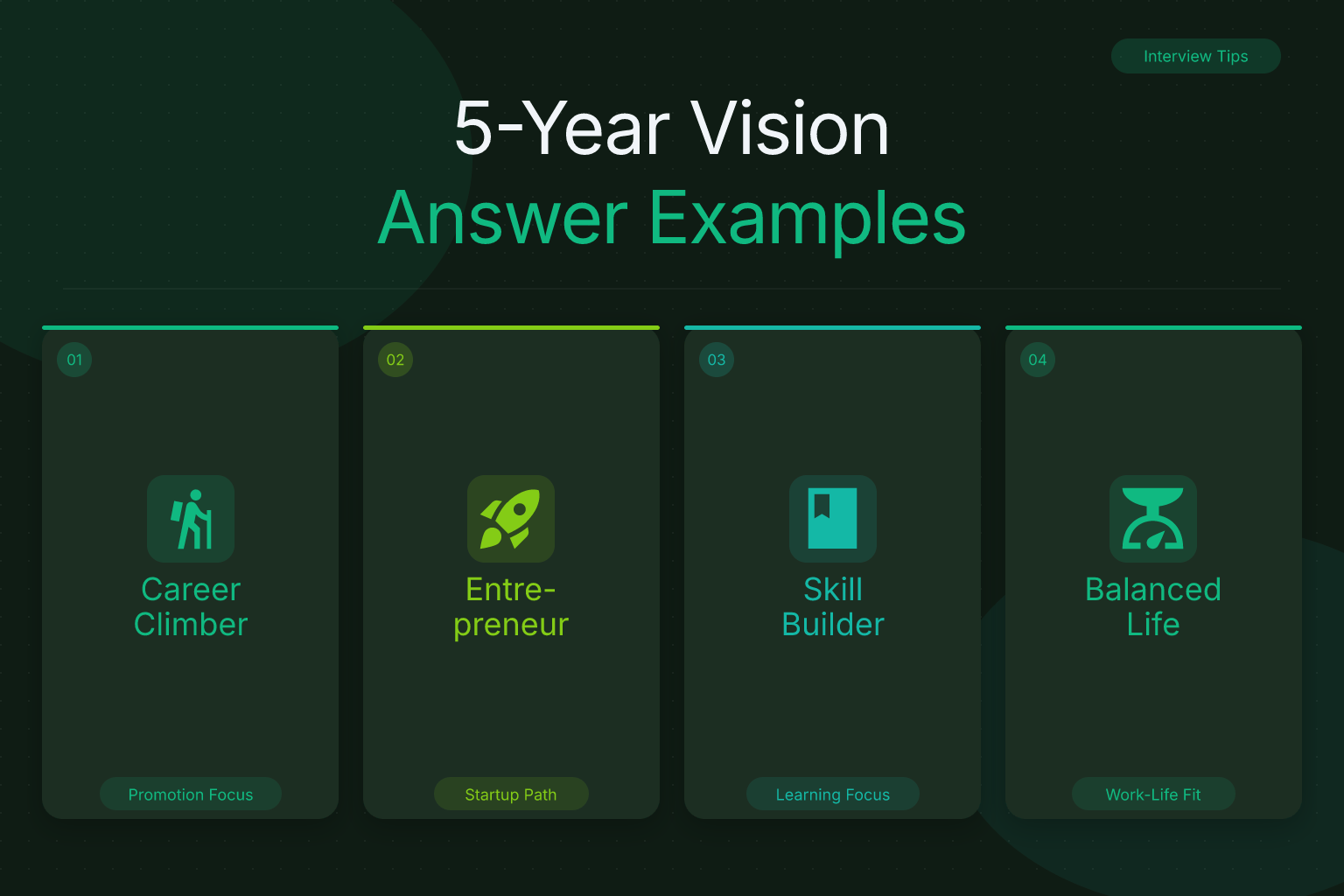
Here are four sample answers tailored to different points in a career. Adapt them to your industry and the specific company.
Entry-Level Candidate
“In five years, I want to be the go-to person on my team for [specific skill, e.g., social media analytics]. I’m excited to start as a coordinator and learn from the senior strategists here. I’d love to eventually manage campaigns end-to-end and mentor new hires, because I’ve seen how much [Company Name] invests in developing talent through programs like [mention a real program if you’ve researched it].”
Why it works: It shows eagerness to learn, a realistic timeline, and a desire to give back — all tied to the company’s culture.
Mid-Career Professional
“I’ve spent the last six years building a strong foundation in project management. In five years, I see myself leading larger, cross-functional initiatives — maybe even shaping how our department approaches agile workflows. I know [Company Name] is expanding its product lines, and I’d love to be part of that growth by driving projects that directly impact customer retention. Right now, I’m focused on delivering the [specific project] you mentioned in the job description and learning from the senior leadership team here.”
Why it works: It acknowledges past experience, sets a logical next step, and connects to a concrete company initiative.
Career Changer
“I’m transitioning from sales into UX design, so my five-year goal is to become a well-rounded product designer who can bridge user needs and business goals. I’m excited to start as a junior designer and absorb everything I can from the team. I’ve already completed a certification in interaction design, and I plan to keep building my portfolio. At [Company Name], I see a chance to work on consumer-facing apps — something I’ve been passionate about since my sales days — and eventually contribute to design systems that scale.”
Why it works: It addresses the career change head-on, shows proactive learning, and maps a path that benefits the employer.
Aspiring Leader
“I’d like to grow into a team lead role where I can help junior engineers develop their skills while still staying hands-on with architecture decisions. I’m not in a rush for a title — I want to earn that trust by consistently delivering quality code and mentoring peers. I’ve noticed that [Company Name] has a strong culture of internal promotion, and I’d love to follow a path similar to [name of a current leader if appropriate], who started as an engineer and now runs a department.”
Why it works: It shows ambition without entitlement, references the company’s promotion culture, and emphasizes contribution over status.
Common Mistakes and Delivery Tips
Mistakes to Avoid
Even a well-intentioned answer can backfire if you fall into these traps:
- Being too vague. “I want to grow and learn” tells the interviewer nothing. Specify the skills or impact you’re after.
- Being too specific about titles. “I want to be a Senior Director of Marketing at this exact company” can sound presumptuous or rigid. Focus on the work, not the org chart.
- Focusing only on personal goals. “I want to travel the world and start a side business” signals you’re not committed to the job. Keep the answer career-focused and company-relevant.
- Not mentioning the company at all. If your answer could apply to any employer, you haven’t shown why you want to grow here. Always tie it back.
- Sounding unambitious. “I haven’t really thought about it” or “I’m happy just doing this job” can make you seem disengaged. Even if you’re content, frame it as deepening expertise.
- Overpromising. Don’t claim you’ll single-handedly double revenue or become CEO. Keep goals realistic and within the realm of what the role can lead to.
If you’ve struggled with other common interview questions, our guide on answering “What are your weaknesses?” can help you avoid similar pitfalls.
How to Deliver Your Answer Smoothly
How you say it matters as much as what you say. Use these techniques to deliver your answer smoothly:
- Keep it under two minutes. A concise answer shows you’ve prepared and respect the interviewer’s time. Practice with a timer.
- Use a conversational tone. Don’t recite a script. Know your key points and speak naturally.
- Maintain eye contact and open body language. This builds trust and shows confidence in your future.
- Pause before answering. A brief pause (2–3 seconds) shows you’re thoughtful, not stumped.
- Record yourself. Listen for filler words (“um,” “like”) and rambling. Adjust until your answer sounds like you, just more polished.
- Tie it back to the role. End by reaffirming your excitement for the current opportunity. This brings the conversation full circle.
- Prepare for follow-up questions. Interviewers may ask, “How do you plan to get there?” or “What steps have you already taken?” Have a concrete example ready — a course, a side project, or a mentor you’ve sought out. This turns a hypothetical into proof of initiative.
- Practice with a friend. A mock interview can reveal nervous habits and help you refine your delivery under pressure.
If you’re preparing for a panel or second interview, check out our advice on handling second interview questions — the 5-year question often resurfaces with more depth.
How to Tailor Your Answer to the Company and Role
Generic answers get generic results. Spend 10 minutes tailoring your response:
- Research the company’s career paths. Look at LinkedIn profiles of people who’ve been at the company for 3–5 years. What roles did they move into? What skills did they develop?
- Read the job description again. Identify the “preferred qualifications” and “nice-to-haves.” Those are often skills the company hopes you’ll grow into.
- Find a specific growth opportunity. Does the company have a mentorship program, tuition reimbursement, or internal hackathons? Mention it. For example: “I’d love to take advantage of your leadership development program to eventually manage a small team.”
- Align with the company’s mission. If the company values sustainability, say you want to deepen your expertise in sustainable supply chains. This shows you’ve done your homework and share their values.
- Use recent news or projects. Reference a product launch, a new market expansion, or a community initiative the company announced. For instance, “I saw that you’re opening a new office in Berlin — I’d love to eventually contribute to that international growth by applying the cross-cultural collaboration skills I’ll build in this role.”
Example of tailoring:
Generic: “I want to be a manager.” Tailored: “I’ve read that [Company Name] is launching a new customer success platform next year. In five years, I’d love to be leading a team that supports enterprise clients on that platform, using the client feedback skills I’ll build starting in this role.”
For more on articulating your career goals in a way that resonates with employers, see our guide on answering career goals interview questions. If you’re also preparing for questions about your availability, check out our availability start date sample answers for additional frameworks.
What If You Don’t Have a 5-Year Plan?
Many people don’t — and that’s okay. The key is to talk about direction, not destination. Focus on:
- Skills you want to build. “I want to become an expert in data visualization and storytelling with data.”
- Types of problems you want to solve. “I’m drawn to complex operational challenges — I’d love to be the person who streamlines processes that save the company time and money.”
- The kind of environment you thrive in. “I see myself in a collaborative, fast-paced team where I can take on increasing responsibility for client relationships.”
Sample answer for the uncertain:
“I don’t have a specific title in mind, but I know I want to keep building my analytical skills and eventually take ownership of projects that directly impact revenue. I’m excited about this role because it’s a chance to work with large datasets, and I can see a path here where I grow from supporting reports to leading strategy recommendations. I’m committed to staying curious and saying yes to stretch assignments that push me in that direction.”
This answer is honest, shows ambition, and reassures the interviewer that you’re not a flight risk. If you’re still exploring what direction feels right, consider framing your answer around the value you want to create rather than a specific ladder. For example, “I want to be known as someone who can take a messy process and turn it into a smooth, scalable system — wherever that leads me in the organization.”
FAQ
Q: What if I don’t know where I see myself in 5 years?
A: Focus on the direction you’re heading, not a specific destination. Talk about skills you want to build, problems you want to solve, and the type of work that energizes you. Employers value self-awareness and a growth mindset more than a rigid plan.
Q: Should I mention wanting to go back to school?
A: Only if it directly benefits the company and you can frame it as a long-term investment they’ll benefit from. For example, “I’d like to pursue a part-time MBA in the next few years to bring stronger strategic thinking to my role here.” Avoid making it sound like you’ll leave the moment you’re accepted.
Q: Is it okay to say I want to be in a leadership role?
A: Yes, if you tie it to earning that role through performance and contribution. Say “I’d like to grow into a team lead position by consistently delivering results and mentoring others” rather than “I want to be a manager.”
Q: How long should my answer be?
A: Aim for 60–90 seconds, and never more than two minutes. A concise, well-structured answer leaves a stronger impression than a rambling monologue.
Q: Can I say I want to start my own business eventually?
A: Generally, no. This signals you view the job as a temporary stepping stone. If you must mention entrepreneurial goals, frame them as intrapreneurship: “I’d love to eventually lead a new initiative or product line within the company.”
Q: What if my 5-year plan doesn’t involve this company?
A: You don’t have to promise forever, but you should show you see a meaningful chapter here. Focus on what you can learn and contribute over the next few years. If you’re certain you’ll leave in two years, it’s better to be honest about your timeline without oversharing.
Q: How do you see yourself in 5 years sample answer?
A: A strong sample answer follows the 3-part framework: acknowledge the present, describe growth, and connect to the company. For example: “In five years, I hope to have deepened my expertise in digital marketing analytics and taken on ownership of multi-channel campaigns. I’m excited to start as a marketing coordinator here and learn from the senior team. I can see a path where I grow from supporting reports to leading strategy recommendations that directly impact customer acquisition — especially as [Company Name] expands into new markets.” Adapt the skills and company details to your situation.
Q: How to answer where you see yourself in 5 years?
A: Use a simple structure: (1) Start with what excites you about the current role. (2) Describe the skills and impact you want to build over five years — avoid fixating on job titles. (3) Tie that growth to specific opportunities at the company. Practice out loud until your answer sounds natural and stays under two minutes. For more detailed guidance, see the “How to Structure Your Answer” section above.
Q: Where do I see myself in 5 years examples?
A: Here are a few quick examples you can adapt:
- Entry-level: “I want to become the go-to person for social media analytics, eventually managing campaigns end-to-end and mentoring new team members.”
- Mid-career: “I see myself leading cross-functional projects that improve customer retention, using the project management skills I’ve built over the last six years.”
- Career changer: “I’m transitioning into UX design, so in five years I aim to be a product designer who bridges user needs and business goals, contributing to design systems that scale.”
- Aspiring leader: “I’d like to grow into a team lead role where I can mentor junior engineers while staying hands-on with architecture decisions.”
Q: How do you see yourself 5 years from now?
A: This is the same question phrased differently. Focus on the direction of your career, not a precise job title. Talk about the expertise you’ll build, the kind of problems you’ll solve, and how that growth aligns with the company’s future. Use the 3-part framework to keep your answer structured and employer-focused.
Q: After 5 years where you see yourself?
A: This variation asks for a forward-looking snapshot. Answer by describing the role you’d like to be in, the skills you’ll have mastered, and the impact you’ll be making — all while showing how the company can help you get there. For example: “After five years, I see myself as a senior data analyst who not only delivers insights but also shapes how the team uses data to make decisions. I’m excited to start here because your mentorship program and focus on professional development give me a clear path to that future.”
Track Every Application While You Job Hunt
Stop losing track of where you’ve applied. The ResumeMate Job Tracker is a free Chrome extension that tracks every application, deadline, and follow-up in one place — right from your browser.