How to Answer “How Do You Prioritize Your Work?” (With Examples)
Interviewers ask how do you prioritize your work because every role has more tasks than hours in a day. They want to see whether you have a repeatable system for deciding what gets done first — and whether you can explain that system clearly under pressure. A weak answer (“I just work hard and get everything done”) signals you haven’t thought about trade-offs. A strong answer names your method, gives a concrete example, and shows you communicate when priorities shift.
Key Takeaways
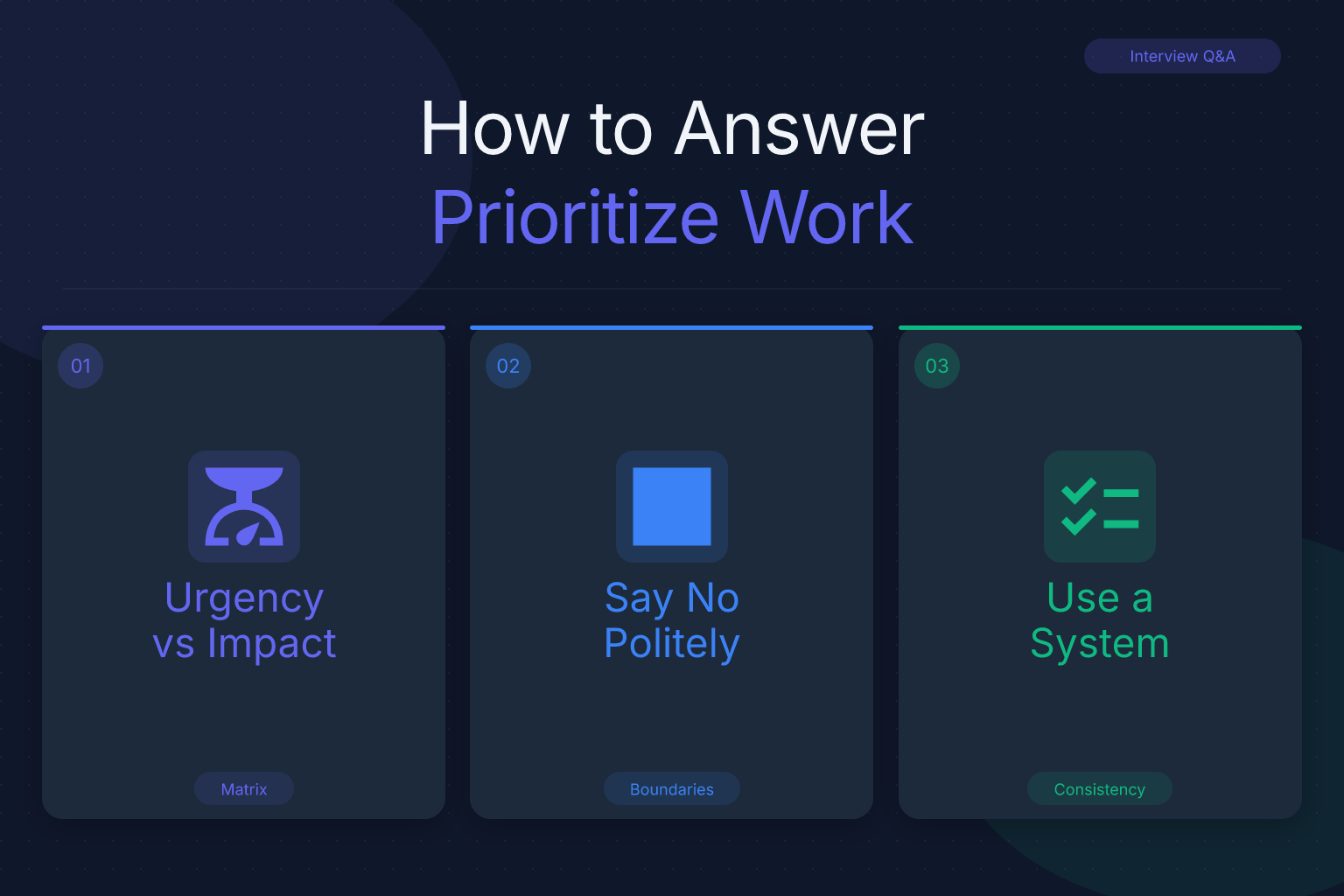
- Use a simple three-step framework — clarify impact, sequence by deadline and dependency, and communicate trade-offs — to answer “how do you prioritize your work” without rambling.
- Give one specific example with a measurable outcome instead of listing generic time-management tools.
- Mention how you handle urgent vs. important tasks and what you do when priorities conflict.
- Avoid saying you “work on everything at once” or that you never miss deadlines; interviewers want honest trade-off thinking.
- Tie your method to the role’s actual demands, such as customer-facing deadlines or cross-team dependencies.
| What to Do | Why It Matters | Time |
|---|---|---|
| Name your prioritization method (e.g., impact vs. urgency) | Shows a repeatable system, not luck | 30 sec |
| Share a concrete example with numbers | Proves you’ve applied it under pressure | 60 sec |
| Explain how you communicate reprioritization | Demonstrates stakeholder management | 30 sec |
| Connect to the job’s priorities | Shows you understand the role | 30 sec |
How to Answer “How Do You Prioritize Your Work” With a Simple Framework
The question is behavioral, not hypothetical. Interviewers don’t want a textbook definition of time management. They want evidence that you’ve faced competing deadlines and made a defensible choice. The easiest way to deliver that evidence is to walk through a three-step framework: impact, sequence, communicate.
Start by naming the framework in one sentence. For example: “I prioritize by impact first, then by deadline and dependency, and I communicate any trade-offs to my manager.” That single sentence tells the interviewer you have a system — not just a vague intention to work hard.
Then give a concrete example. Keep it under 90 seconds. Describe a time when you had multiple tasks, explain how you ranked them, and share the result. The result doesn’t need to be a dramatic revenue figure. “The launch stayed on schedule” or “the customer issue was resolved before the weekly report was due” is enough.
Finally, connect the method to the role you’re interviewing for. If the job involves customer-facing deadlines, say you prioritize anything that affects a customer first. If it’s a cross-functional role, say you sequence work that unblocks teammates before work that only affects you. This shows you’ve thought about the specific job, not just generic productivity advice.
The 3-Step Formula: Impact, Sequence, Communicate
Here’s how to apply the framework in detail.
Step 1: Clarify impact. Before you touch a task list, ask what outcome matters most. Is the goal revenue, customer retention, a product launch, or a compliance deadline? If you’re unsure, ask your manager or stakeholder. Saying “I asked my manager which of these two projects had the bigger business impact before I started” demonstrates judgment — not indecision.
Step 2: Sequence by deadline, dependency, and effort. Once you know the impact, order the work. Use a simple mental model:
- Deadline: What’s due first?
- Dependency: What blocks someone else’s work?
- Effort: What can you finish quickly to clear mental space?
A common mistake is treating every task as equally urgent. Instead, separate urgent from important. An urgent task has a hard deadline or a waiting stakeholder. An important task moves a long-term goal forward but can be scheduled. Say that out loud: “I separate urgent from important, and I don’t let urgent-but-low-impact tasks crowd out important work.”
Step 3: Communicate trade-offs. When you can’t do everything, say what will slip and propose an alternative. For example: “I told my manager I could finish the client report by Tuesday or the internal dashboard by Wednesday, but not both by Monday. She chose the client report, and I delivered the dashboard a day later.” That answer shows you don’t silently drop work — you renegotiate deadlines with evidence.
Sample Answers for Different Roles
Here are four sample answers you can adapt. Replace the specifics with your own experience.
Customer support: “I prioritize by customer impact. If a ticket affects multiple users or a paying account, it goes to the top of my queue. I also check for any SLA deadlines. Last month I had a backlog of 30 tickets and a new product bug report. I triaged the bug first because it was affecting every user on a specific plan, then worked through the backlog by severity. I kept the team updated in Slack so no one was surprised by the order.”
Software engineer: “I sequence by dependency and deadline. If my code unblocks another engineer or a release, I do that before refactoring or nice-to-have improvements. I also flag when a task will take longer than estimated. During our last sprint, I had a bug fix and a feature request due the same week. I fixed the bug first because QA couldn’t test the release without it, then started the feature. I told the product manager the feature would slip by a day, and she adjusted the sprint plan.”
Marketing coordinator: “I use a simple impact-versus-effort grid. High-impact, low-effort tasks get done first. High-impact, high-effort tasks get scheduled in blocks. Low-impact tasks get batched or delegated. When two campaigns had the same launch date, I asked the director which one drove more qualified leads. She said the webinar, so I finished the webinar landing page and email sequence first, then moved to the social campaign. Both launched on time because I front-loaded the higher-impact work.”
Project manager: “I prioritize by what’s on the critical path. I look at the project plan and ask which tasks, if delayed, would push the whole timeline. Those get my attention first. I also hold a quick daily standup to surface blockers. On a recent website migration, the content team was waiting on the design team for page templates. I reprioritized the design work so content could start writing, which kept the migration from slipping a week.”
Each answer names a method, gives a specific situation, and shows communication. That’s the pattern to copy.
How to Structure Your Example Using STAR
If you freeze when asked to give an example, use the STAR method: Situation, Task, Action, Result. It’s the same structure you’d use for questions like “What is your problem-solving style?” or “Tell me about a time you failed.”
Here’s a filled-in STAR example for prioritization:
- Situation: “In my last role, I supported two sales managers who both needed reports by Friday.”
- Task: “I had to deliver both, but one report fed into a board presentation and the other was for internal tracking.”
- Action: “I asked the sales director which report had the bigger impact that week. She said the board report. I finished that first, then used a template to speed up the internal report. I also told the second manager his report would arrive Friday afternoon instead of Friday morning.”
- Result: “The board presentation went smoothly, and the second manager had his report in time for his Monday meeting. No one had to chase me for an update.”
Keep the whole story under 90 seconds. If you ramble, you’ll sound disorganized — the exact opposite of what the question is testing.
Common Mistakes That Make You Sound Disorganized
Avoid these five answers.
1. “I just work on everything at once.” That’s not prioritization; that’s multitasking. Interviewers hear it as “I have no system and I’ll burn out.”
2. Listing tools without explaining your logic. Saying “I use Trello and Asana” doesn’t answer the question. Tools are not a method. Explain how you decide what goes into the tool and in what order.
3. No example. A framework without a story sounds theoretical. Interviewers want proof you’ve applied it under real pressure.
4. “I never miss a deadline.” This is either untrue or a sign you’ve never had a real workload. A better answer acknowledges trade-offs: “I rarely miss deadlines because I renegotiate early when I see a conflict.”
5. Blaming others for shifting priorities. Saying “my manager kept changing everything” makes you sound passive. Instead, say “when priorities shifted, I asked for a clear ranking and adjusted my plan.”
If you’re also preparing for questions like “Why should we hire you?”, use the same principle: name a method, give evidence, connect to the role.
How to Adapt Your Answer for Remote and Hybrid Roles
Remote work changes how prioritization is visible. In an office, your manager can see you working. Remotely, you have to communicate your priorities in writing.
Mention these specifics if the role is remote or hybrid:
- Async updates: “I post a weekly priority list in our project channel every Monday so my manager can see what I’m working on and flag anything that should move up.”
- Time zone awareness: “I sequence work that needs a teammate in another time zone first, so I don’t block their morning.”
- Calendar blocking: “I block two hours each morning for high-impact work before meetings start, then handle lower-priority tasks in the afternoon.”
- Written trade-off requests: “When two deadlines conflict, I send a short message with the options and my recommendation, so the decision is documented.”
A remote-specific example might sound like: “I had a client deliverable due at 5 p.m. my time and a teammate in London waiting on a data pull. I did the data pull first because it was already 9 a.m. in London and he needed it to start his day. Then I finished the client deliverable before my deadline. I updated both in our shared tracker.”
Turn Your Prioritization Story Into a Resume Bullet
The same example you use in an interview should appear on your resume — just compressed into one line. A strong resume bullet follows this pattern: action verb + task + result. For example:
- Before: “Responsible for managing multiple projects and meeting deadlines.”
- After: “Prioritized 15+ concurrent client requests by impact and deadline, cutting average turnaround time by two days.”
If you don’t have hard numbers, use qualitative results like “kept a product launch on schedule” or “reduced escalations by flagging trade-offs early.” For more on quantifying without data, see how to add numbers to your resume when you don’t have data.
Once you’ve rewritten a few bullets, run your resume through the free ResumeMate score checker to see if your prioritization examples are clear and ATS-friendly. You can also build a clean, single-column resume with the free ResumeMate resume builder so your story is easy to scan.
How to Practice and Get Feedback
You don’t need to memorize a script, but you should practice out loud until the framework feels natural.
- Write down three real situations where you had to prioritize.
- For each, fill in the STAR structure in one or two sentences per step.
- Record yourself answering the question on your phone. Listen for rambling, filler words, or missing results.
- Ask a friend or mentor to ask the question cold, then answer without notes.
- Time yourself. If you’re over 90 seconds, cut the situation details and get to the action faster.
If you’re actively job hunting, keep your prioritization examples in the same document as your other interview prep. When you update your resume, make sure the bullet matches the story you tell. A hiring manager will often ask about a resume bullet, and your answer should be the same example — not a new one you have to invent on the spot.
FAQ
Q: How do you answer “How do you prioritize your work”?
A: Name a simple method (impact, deadline, dependency), give one specific example with a result, and explain how you communicate when priorities shift. Keep the answer under 90 seconds and connect the method to the role you’re interviewing for.
Q: What is a good answer to “How do you prioritize your work”?
A: A good answer sounds like this: “I prioritize by impact and deadline. I ask which task affects customers or unblocks teammates first, then sequence the rest. Last month I had two reports due the same day, so I asked my manager which one fed a board meeting, finished that first, and told the other stakeholder their report would arrive the next morning.”
Q: How do you prioritize your work examples?
A: Examples include triaging customer tickets by severity, sequencing code that unblocks a release before refactoring, using an impact-versus-effort grid for marketing tasks, or focusing on critical-path tasks in a project plan. Each example should name the method, the situation, and the outcome.
Q: How do you answer “How do you prioritize your workload”?
A: Treat it the same as “How do you prioritize your work.” Explain how you rank tasks by impact, deadline, and dependency, then give a concrete example of a time you reordered your workload and communicated the change to your manager or team.
Q: How do you organize and prioritize your work?
A: Start by separating urgent from important, then sequence by deadline and dependency. Use a written system — a task list, project board, or calendar blocks — so your priorities are visible to others. Communicate any trade-offs in writing, especially in remote or hybrid roles.
Q: What should you not say when asked how you prioritize your work?
A: Don’t say you work on everything at once, that you never miss deadlines, or that you just use a tool like Trello without explaining your decision logic. Also avoid blaming your manager for shifting priorities. Instead, show how you renegotiate deadlines when conflicts arise.
Q: How do you prioritize when everything is urgent?
A: Ask your manager or stakeholder to rank the tasks by business impact. If no one can rank them, use deadline and dependency as tiebreakers. Then communicate what will slip and propose a new timeline. The key is to make the trade-off visible instead of silently dropping work.
Track Every Application While You Job Hunt
Stop losing track of where you’ve applied. The ResumeMate Job Tracker is a free Chrome extension that tracks every application, deadline, and follow-up in one place — right from your browser.