Available Start Date: 2026 Sample Answers & Expert Tips
When an interviewer asks about your availability start date, they’re not just making small talk—they’re gauging how soon you can fill the role and whether your timeline aligns with their needs. Your answer can influence the hiring decision, especially if the company is trying to fill the position urgently. This guide covers exactly what to say, with sample answers for every situation, so you can respond confidently and keep the offer moving forward.
Key Takeaways
- Always provide a specific start date or a clear timeframe (e.g., ’two weeks after accepting the offer’) to show professionalism and help the employer plan.
- If currently employed, mention your standard notice period and express willingness to discuss an earlier start, but never imply you’ll leave without proper notice.
- If you’re immediately available, frame it as readiness (e.g., ‘I’ve completed my previous commitments and am eager to start’) rather than sounding desperate or unemployed.
- Avoid vague answers like ‘whenever you need me’ or ‘as soon as possible’ without a date, and never tie your start date to salary negotiations.
- If you need to negotiate a later start date after receiving an offer, first express enthusiasm, then propose a specific later date with a brief reason, and offer a compromise like a part-time or remote start if possible.
| What to Do | Why It Matters | Time |
|---|---|---|
| State your availability clearly and confidently | Shows professionalism and helps the employer plan | 30 seconds |
| If employed, mention standard notice period | Sets realistic expectations and avoids burning bridges | 30 seconds |
| If flexible, express willingness to accommodate | Demonstrates eagerness without overcommitting | 30 seconds |
| Avoid vague or negative phrasing | Prevents red flags and keeps the conversation positive | 30 seconds |
| Align your answer with the job’s urgency | Shows you’ve done your research and are a good fit | 30 seconds |
What to Say When Asked About Availability Start Date: The Core Answer
The best answer to “When can you start?” is a specific date or a short, realistic timeframe that matches your situation. Employers ask this question for three main reasons: to see if you can start when they need you, to check if you’ll honor commitments to a current employer (a sign of professionalism), and to plan onboarding logistics.
A strong core answer follows this structure:
- State your availability directly. Give a concrete date or a range (e.g., “two weeks from the offer date”).
- Briefly explain the reason if it’s not obvious—like a notice period, a planned move, or finishing a project.
- Show flexibility if you genuinely have it, but don’t overpromise.
Here’s a template you can adapt:
“I can start on [specific date], which is two weeks after accepting the offer. That gives me time to wrap up my current responsibilities and provide a smooth handoff. If you need someone sooner, I’m open to discussing an earlier start date.”
This answer works because it’s honest, professional, and leaves room for negotiation. It also signals that you’re the kind of person who doesn’t leave a team in the lurch—a trait most hiring managers value.
If you’re still preparing for the interview itself, make sure you’ve practiced other common questions too. Our guide on how to answer “tell me about yourself” can help you build a confident opening.
Sample Answers for Different Availability Scenarios
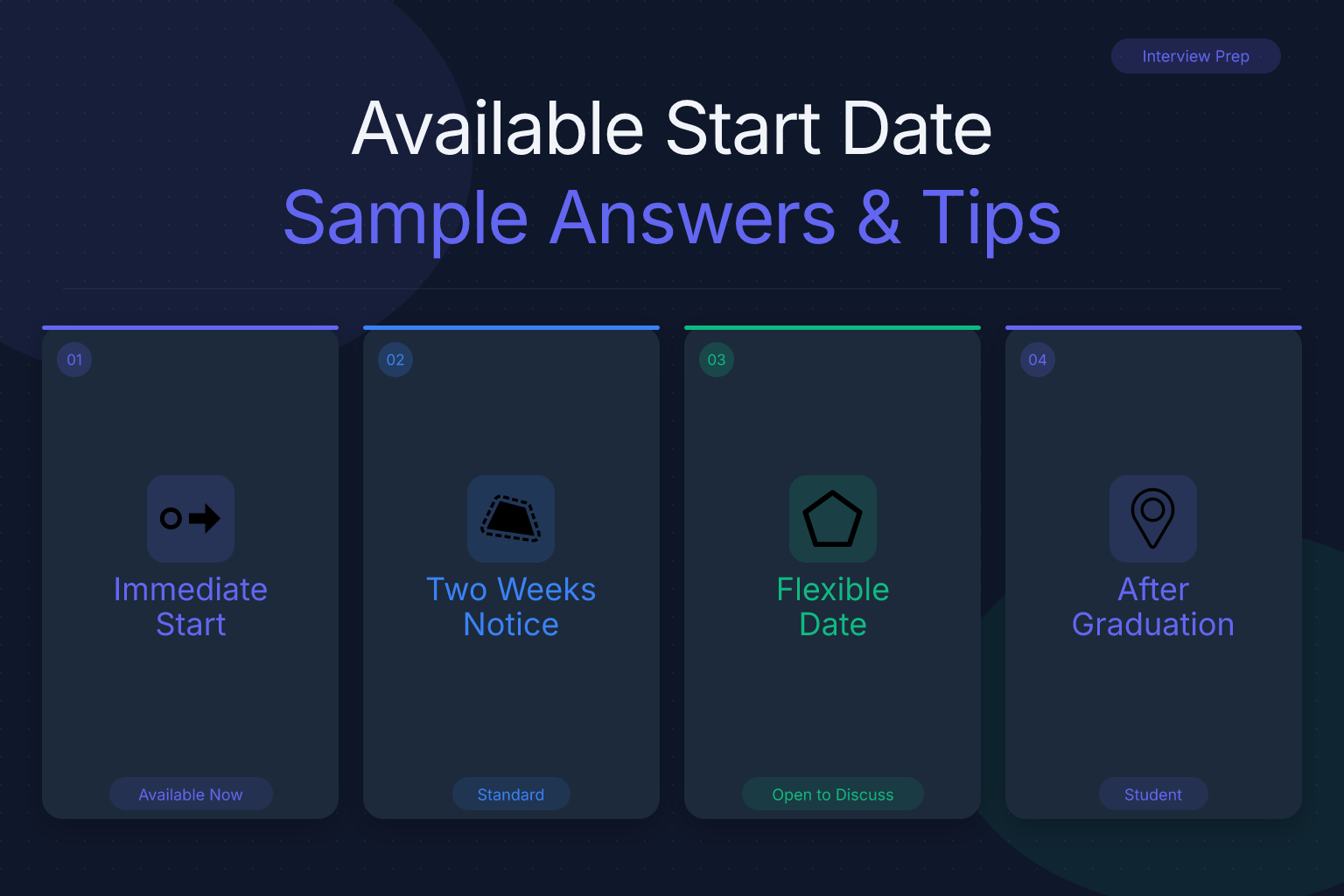
Your answer changes depending on whether you’re currently employed, between jobs, a student, or relocating. Below are word-for-word sample answers for the most common situations.
If You’re Currently Employed (Two-Week Notice Standard)
Most professionals need to give at least two weeks’ notice. Frame it as a standard practice, not an obstacle.
“I’d need to give my current employer two weeks’ notice, so I could start on [date two weeks from now]. I want to make sure I leave on good terms and complete my handover. If there’s any flexibility on your side, I’m happy to discuss an earlier start.”
If your notice period is longer—say, one month—be upfront. Some companies will wait for the right candidate.
“My current role requires a 30-day notice period, so the earliest I could start is [date]. I understand if that’s a challenge, and I’m willing to see if we can negotiate a shorter transition.”
If You’re Immediately Available
Being able to start right away can be a strong selling point, but you need to phrase it carefully so you don’t sound like you were fired or are desperate.
“I’m available to start immediately. I’ve already wrapped up my previous commitments, so I can hit the ground running as soon as you need me.”
If you were laid off or your contract ended, you can add a brief, positive context:
“My last contract ended two weeks ago, so I’m ready to start right away. I’ve used the time to refresh my skills and I’m excited to jump into a new role.”
If You’re a Student or Recent Graduate
Your availability might be tied to graduation, exams, or an internship end date.
“I graduate on May 15th, so I’d be available to start full-time on May 20th. I can also begin part-time or remotely before that if it helps with the transition.”
If You’re Relocating
Moving takes time. Be realistic about the logistics.
“I’m relocating to the area and expect to be settled by [date]. I can start remotely before then if that works for your team, and be in the office full-time starting [date].”
If You Need Flexibility (Caregiving, Health, or Personal Reasons)
You don’t have to disclose private details. Keep it professional and focus on the timeline.
“I have a personal commitment that wraps up on [date], so I’d be available to start the following Monday. I’m fully committed to this role and can use the time before then to complete any pre-onboarding tasks.”
How to Answer If You’re Currently Employed or Immediately Available
If You’re Currently Employed Without Burning Bridges
When you’re leaving one job for another, how you handle the availability question tells the new employer a lot about your character. They’ll assume you’ll treat them the same way someday.
Do:
- Mention your notice period as a matter of professional courtesy.
- Emphasize that you want to leave your current team in a good place.
- Offer to help with a transition plan if the start date needs to be sooner.
Don’t:
- Badmouth your current employer or imply you can’t wait to leave.
- Say you’ll quit without notice unless it’s truly an emergency.
- Lie about your notice period to seem more available—background checks can reveal the truth.
If the new employer pushes for an earlier start, you can say:
“I understand the urgency. Let me see if I can negotiate a shorter notice period with my current manager. I’ll get back to you within 24 hours.”
This shows initiative without making promises you can’t keep.
If You’re Immediately Available (Without Sounding Desperate)
Immediate availability can be a double-edged sword. On one hand, you can solve the employer’s problem fast. On the other, some hiring managers wonder why you’re not currently working.
To frame it positively:
- Focus on readiness, not unemployment. Say you’re “ready to start” rather than “out of work.”
- Mention what you’ve been doing—freelancing, upskilling, volunteering, or job searching strategically.
- Tie it to the role. Explain why you’re excited to start this specific job right away.
Example:
“I’m available to start immediately. After leaving my last role, I took a few weeks to complete a certification in [skill] and have been actively looking for the right fit. This role is exactly what I’ve been waiting for, so I’m ready to dive in.”
If you were laid off, it’s okay to mention it briefly—most employers understand that layoffs happen. Keep it forward-looking.
What Not to Say When Asked About Start Date
Some answers can raise red flags even if you’re a strong candidate. Avoid these common mistakes.
1. “Whenever you want me to start.” This sounds like you have no boundaries or haven’t thought it through. Even if you’re flexible, give a specific date or range.
2. “I need to check with my partner/parents/friends first.” It’s fine to need time to decide, but don’t imply you can’t make decisions independently. Say, “I’d like to review the offer details and get back to you by [date].”
3. “As soon as possible” with no date. Vagueness frustrates hiring managers who are trying to plan. Always attach a calendar date or a number of days/weeks.
4. “I have a vacation planned in two weeks, so I’d need that off.” Don’t lead with time-off requests before you have an offer. If you have pre-planned travel, wait until you’re discussing the offer, then mention it professionally.
5. “I can start tomorrow if you pay me more.” Never tie your start date to salary negotiations in the same breath. It comes across as transactional and unprofessional.
How to Negotiate Your Start Date After the Offer
Sometimes the employer’s ideal start date doesn’t work for you. Maybe you need a break between jobs, have a pre-planned trip, or want to finish a project. You can negotiate—but only after you have a written offer.
Step 1: Acknowledge the offer enthusiastically.
“Thank you so much for the offer. I’m really excited about joining the team.”
Step 2: State your preferred start date and the reason (keep it brief).
“I’d like to propose a start date of [date] instead of [their date]. I have a prior commitment that wraps up on [date], and starting after that will let me give 100% from day one.”
Step 3: Offer a compromise if possible.
“If that’s too late, I could start part-time or remotely on [earlier date] and transition to full-time on [preferred date].”
Step 4: Reassure them of your commitment.
“I’m fully committed to this role and want to make sure I start off on the right foot.”
Most employers will accommodate a reasonable request, especially if you’ve been transparent and professional throughout the process. If you’re waiting to hear back after an interview, our guide on what to do when there’s no response after an interview can help you follow up without being pushy.
How to Prepare Your Resume and Interview for the Availability Question
Update Your Resume to Reflect Availability
If you’re immediately available or have a flexible start date, your resume can subtly reinforce that message before you even get to the interview. While you should never put “available immediately” in your resume summary (it can look desperate), there are smarter ways to signal readiness.
1. End your resume with a current date or “Present” for your most recent role. If your last job ended in March 2026, listing the end date as “March 2026” shows you’re not currently employed without screaming it. If you’re still working, “2022–Present” is standard.
2. Add a “Projects” or “Freelance” section for any gap. If you’ve been doing contract work, consulting, or even a side project, list it. It fills the gap and shows you’ve been active.
3. Use a clean, ATS-friendly format. When you update your resume quickly to reflect your latest situation, make sure the formatting doesn’t break. Run it through a free ATS resume checker to confirm it parses correctly. Modern ATS systems handle clean, text-based PDFs without issue—just avoid scanned documents or heavy graphics.
4. Tailor your resume summary to the role’s urgency. If the job posting says “urgent hire” or “immediate start,” your summary can hint at readiness:
“Results-driven project manager with 5 years of experience, available to start within two weeks and eager to contribute to a fast-paced team.”
Need to refresh your resume quickly? The free ResumeMate resume builder lets you create a professional, ATS-safe PDF in minutes—no design skills required.
Prepare for the Availability Question Before the Interview
You can’t predict every question, but the availability question is one you should absolutely rehearse. Here’s a pre-interview checklist:
- Know your exact earliest start date. Look at a calendar and pick a specific Monday or date. Don’t guess on the spot.
- Check your current employment contract for any notice period, non-compete clauses, or restrictions.
- Research the company’s timeline. If the job posting says “urgent” or “immediate hire,” be prepared to explain how you can meet that need.
- Plan for follow-up questions. If you say “two weeks,” they might ask, “Can you start sooner?” Have a yes/no answer ready.
- Practice out loud. Say your answer until it sounds natural, not rehearsed.
If you’re in the middle of multiple interview rounds, you might also face second-interview questions that dig deeper into your logistics. Our guide on second interview questions and how to answer them covers what to expect when the conversation gets serious.
FAQ
Q: What if I don’t know my availability yet?
A: If you genuinely don’t know—for example, you’re waiting on a relocation date or a spouse’s job offer—be honest but give a timeframe for when you’ll have an answer. Say, “I’m finalizing a few personal logistics and will have a firm start date by [day of the week]. I’ll update you as soon as I know.” This shows you’re organized and respectful of their time.
Q: Can I say I’m available immediately if I’m still employed?
A: You can, but it’s risky. Quitting without notice can burn bridges and may violate your employment contract. Most hiring managers will respect you more if you honor your notice period. If the new employer insists on an immediate start, ask if you can begin part-time or on weekends while wrapping up your current job.
Q: Should I mention a pre-planned vacation during the interview?
A: Not during the initial interview. Wait until you have an offer in hand, then disclose it professionally. Say, “I’m thrilled about the offer. I want to be transparent: I have a pre-planned trip from [date] to [date]. I’m happy to start before or after, and I’ll make sure all my onboarding tasks are complete.” Most employers will accommodate a one-time trip if you’re upfront.
Q: What if the employer asks for a start date that’s too soon?
A: Don’t agree to a date you can’t meet just to please them. Instead, say, “I’d love to start on [their date], but I have a prior commitment that makes [your date] more realistic. Can we find a middle ground?” Offer a compromise, like starting remotely or working a reduced schedule for the first week.
Q: Does my availability affect my chances of getting the job?
A: It can, especially for roles that need to be filled urgently. If two candidates are equally qualified and one can start immediately while the other needs a month, the immediate candidate may have an edge. However, for most professional roles, a standard two- to four-week notice period is expected and won’t hurt your chances.
Q: How do I answer if I’m interviewing while still in school?
A: Give your graduation date and the earliest date you can start full-time. If you can work part-time or intern before graduating, mention that. Example: “I graduate on June 10th and can start full-time on June 15th. I’m also available for part-time remote work starting in May if that helps with the transition.”
Track Every Application While You Job Hunt
Stop losing track of where you’ve applied. The ResumeMate Job Tracker is a free Chrome extension that tracks every application, deadline, and follow-up in one place — right from your browser.