Awards on Resume: 25+ Examples for High School Students
Knowing which awards to put on a resume for high school students can turn a thin, one-page resume into a compelling snapshot of your potential. When you’re in high school, you don’t have years of work experience to lean on — but awards and honors prove you have the discipline, talent, and drive that employers and colleges look for. This guide covers exactly which awards to include, which to skip, and how to format them so your resume stands out for the right reasons.
Key Takeaways
- Academic awards like honor roll, National Honor Society, and subject-specific prizes are strong choices for high school resumes.
- Leadership and extracurricular awards (student council, debate, sports captain) show soft skills employers and colleges value.
- Skip participation trophies and elementary school awards; focus on achievements from grades 9–12 that demonstrate growth or excellence.
- Format awards in a dedicated section with the award name, issuing organization, and date (or year) to keep it ATS-friendly.
- Use ResumeMate’s free resume builder to create a clean, single-column layout that highlights your awards without clutter.
| What to Do | Why It Matters | Time |
|---|---|---|
| List academic honors like honor roll or AP Scholar | Shows consistent effort and intellectual ability | 5 minutes |
| Include leadership awards (student council, club president) | Demonstrates responsibility and teamwork | 5 minutes |
| Add competition wins (science fair, debate, sports) | Proves you can perform under pressure | 5 minutes |
| Skip middle school or participation-only awards | Keeps resume focused and relevant | 2 minutes |
| Use a clean single-column format | Ensures ATS and human readers can scan easily | 10 minutes |
What Awards to Put on a Resume for High School Students (and Why)
Awards on a high school resume serve one purpose: they replace the work experience you don’t have yet. A hiring manager at a retail store or a college admissions officer doesn’t expect you to have a five-year career history. They want evidence that you show up, work hard, and can handle responsibility. Awards are that evidence.
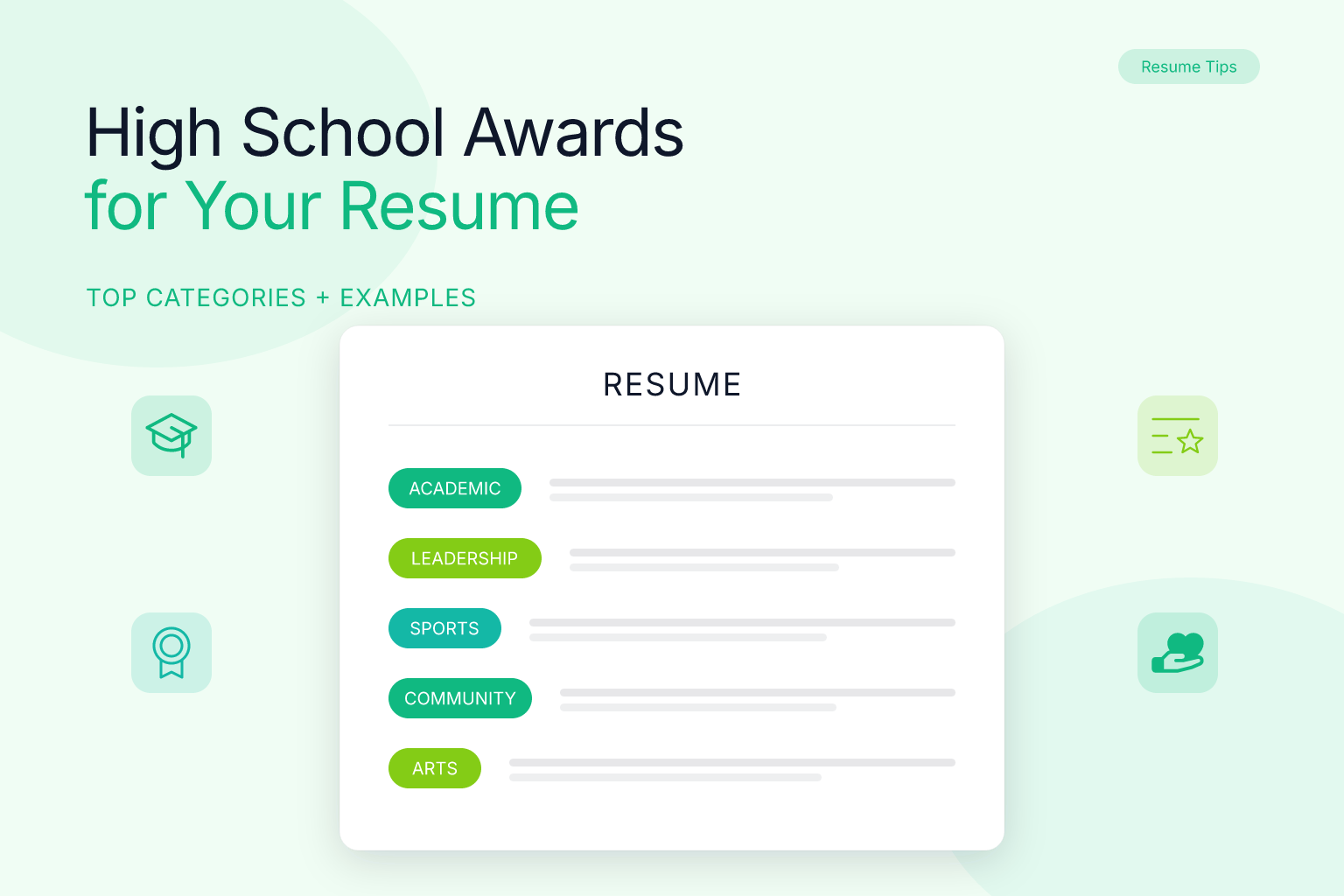
Think of awards in three buckets:
- Academic awards prove you can learn, retain information, and meet standards.
- Leadership and extracurricular awards prove you can work with others, take initiative, and manage your time.
- Competition and performance awards prove you can perform under pressure and commit to a craft.
Each bucket maps to a skill employers and colleges care about. A student who won a regional science fair has demonstrated problem-solving and persistence. A student who was elected student council treasurer has demonstrated trustworthiness and organization. A student who made varsity soccer captain has demonstrated teamwork and resilience.
When you list awards, you’re not just bragging. You’re translating your high school experience into the language of the working world.
Academic Awards That Belong on a High School Resume
Academic awards are the backbone of a high school resume. They’re objective, verifiable, and universally understood. Here are the ones worth including:
- Honor roll / principal’s list — Even a single semester on honor roll shows you maintain a baseline of academic performance. List the semesters or years you achieved it.
- National Honor Society (NHS) — Membership requires a minimum GPA, service hours, and character recommendations. It’s a strong signal of well-roundedness.
- Subject-specific awards — “Outstanding Student in Biology,” “Excellence in Creative Writing,” or “Math Department Award” show depth in a particular area. These are especially valuable if you’re applying for a job or program related to that subject.
- AP Scholar / IB Diploma — Advanced Placement or International Baccalaureate recognition demonstrates you took on challenging coursework and succeeded.
- Academic scholarships — If you earned a merit-based scholarship, list it. It’s a third-party endorsement of your abilities.
- Perfect attendance — This is a gray area. If you have no other awards, perfect attendance shows reliability. But if you have stronger achievements, skip it to save space.
Format each award as a single line: award name, issuing organization (if not obvious), and year. For example:
- National Honor Society, Member — 2026
- Honor Roll, Fall and Spring Semesters — 2025–2026
- AP Scholar with Distinction — 2026
If you’re unsure whether your GPA is worth listing alongside these awards, check out our guide on when to include GPA on a resume.
Leadership and Extracurricular Awards
Leadership awards show you don’t just participate — you take charge. For high school students, these often come from clubs, student government, sports, or community service. They’re especially valuable for part-time jobs, where managers want employees who can be trusted to handle responsibility without constant supervision.
Include awards like:
- Student council positions — President, vice president, treasurer, or secretary. Even a class representative role shows you were elected by peers.
- Club leadership — Founder or president of a club (robotics, debate, environmental, coding, etc.). Founding a club is a strong signal of initiative.
- Team captain — Varsity or junior varsity captain in any sport. Captains manage teammates, communicate with coaches, and model work ethic.
- Community service awards — President’s Volunteer Service Award, school service awards, or recognition from a nonprofit. These show empathy and commitment.
- Scouting awards — Eagle Scout (Boy Scouts) or Gold Award (Girl Scouts) are widely recognized as indicators of leadership, perseverance, and community involvement.
When listing these, include the role or award name, the organization, and the year or years. For example:
- Varsity Soccer Team Captain — 2025–2026
- President, Student Council — 2025–2026
- Eagle Scout, Boy Scouts of America — 2026
These awards translate directly to soft skills: communication, teamwork, time management, and problem-solving. If you’re applying for a part-time job, these are exactly the skills a hiring manager wants to see. For more on building a resume for a part-time job, see our guide on how to write a resume for a part-time job.
Competition and Performance Awards
Competition awards prove you can perform when it counts. They show you set a goal, prepared, and delivered under pressure — a skill that matters in any job, from cashier to intern to college applicant.
Include awards from:
- Science fairs — Regional, state, or national science fair placements. Even a third-place finish at a regional fair shows research and presentation skills.
- Academic competitions — Math olympiad, debate tournaments, Model UN, spelling bees, or quiz bowl. These demonstrate quick thinking and communication.
- Music and arts — All-State band or choir, art show awards, theater awards, or writing contest wins. These show creativity and discipline.
- Athletics — MVP, all-conference, all-region, or state qualifier. Athletic awards show physical discipline, teamwork, and the ability to handle both practice and academics.
- Robotics or coding competitions — FIRST Robotics, hackathons, or coding challenges. These are gold for tech-related jobs or college applications.
Format these the same way: award name, competition or organization, and year. For example:
- First Place, Regional Science Fair — 2026
- State Qualifier, Varsity Track and Field — 2026
- All-State Choir, Tenor Section — 2026
If you have multiple competition wins, list the most impressive or most recent ones first. You don’t need to list every single medal — two or three strong entries are better than ten weak ones.
Awards to Leave Off Your High School Resume
Not every award belongs on a resume. Including the wrong ones can make you look unfocused or immature. Here’s what to skip:
- Participation trophies — “Participant, Youth Soccer League” tells a hiring manager nothing. Everyone who showed up got one. Skip it.
- Middle school or elementary school awards — Unless you won a national competition in 8th grade that’s still relevant, leave anything before 9th grade off. High school is your current context.
- Generic “most improved” awards — These can be meaningful, but they often read as “wasn’t good, then got slightly better.” If you have stronger awards, skip this one.
- Perfect attendance (usually) — As mentioned, it can show reliability, but it’s a weak award. If you have honor roll or a leadership role, perfect attendance is redundant.
- Awards from a single class project — “Best PowerPoint in History Class” is not a resume-worthy award. It’s too narrow and doesn’t demonstrate sustained achievement.
- Anything from a paid program that everyone completes — Some summer programs give every participant a “certificate of completion.” That’s not an award; it’s a receipt.
The rule of thumb: if the award required effort, skill, or selection by others, it’s worth considering. If you got it just for showing up, leave it off.
How to Format Awards on a High School Resume
Formatting matters as much as content. A messy awards section is hard to scan, and an ATS (applicant tracking system) may not parse it correctly. Follow these steps:
- Create a dedicated section — Title it “Awards & Honors” or just “Awards.” Place it after your education section (more on placement below).
- List each award on its own line — Use bullet points or a simple list. Don’t cram multiple awards into one paragraph.
- Include the award name, organization, and date — The date can be just the year. For ongoing roles, use a range like “2025–2026.”
- Use reverse chronological order — Most recent first. This shows your current achievements.
- Keep it concise — One line per award. No need for full sentences or explanations. If an award needs context (e.g., “selected from 200 applicants”), add a brief parenthetical.
- Avoid tables, graphics, or columns — These can confuse ATS software. Use plain text with standard bullet points.
Here’s a clean example:
Awards & Honors
- National Honor Society, Member — 2026
- First Place, Regional Science Fair — 2026
- Varsity Soccer Team Captain — 2025–2026
- Honor Roll, All Semesters — 2023–2026
Where to place awards on a high school resume:
Placement depends on what else is on your resume. For most high school students, the order should be:
- Contact information — Name, phone, email, city/state.
- Education — High school name, expected graduation date, GPA (if strong).
- Awards & Honors — Your dedicated awards section.
- Experience — Part-time jobs, internships, volunteer work, or significant projects.
- Skills — Hard and soft skills relevant to the job or program.
Why awards before experience? Because as a high school student, your awards are often more impressive than your work history. A hiring manager scanning your resume will see “National Honor Society” and “Science Fair Winner” before they see “Cashier at McDonald’s.” That’s a good first impression.
If you have substantial work experience (e.g., you’ve worked part-time for two years), you can move awards below experience. But for most high schoolers, awards near the top is the right call.
If you want to check whether your awards section (and the rest of your resume) is ATS-friendly, use ResumeMate’s free resume score checker. It gives you section-by-section feedback on formatting and content.
For a deeper dive on listing awards in general — including how to handle awards from work or college — see our guide on how to list awards and honors on a resume.
High School Resume Example with Awards
Here’s a sample resume snippet for a high school junior applying for a part-time retail job. Notice how the awards section sits right after education and uses a clean, single-column format.
Jordan Lee
(555) 123-4567 | jordan.lee@email.com | Austin, TX
Education
Westlake High School, Austin, TX
Expected Graduation: May 2027
GPA: 3.8/4.0
Awards & Honors
- National Honor Society, Member — 2026
- First Place, Regional Science Fair — 2026
- Varsity Soccer Team Captain — 2025–2026
- Honor Roll, All Semesters — 2023–2026
Experience
Volunteer, Austin Food Bank — Summer 2026
- Sorted and packed food donations for 200+ families weekly
- Coordinated with a team of 10 volunteers during high-volume shifts
Skills
- Microsoft Office, Google Workspace
- Basic Spanish (conversational)
- Time management, teamwork, customer service
This resume is one page, scannable, and puts Jordan’s strongest assets — academic and leadership awards — front and center. You can build a similar resume in minutes using ResumeMate’s free AI resume builder, which offers clean, ATS-safe templates designed for students and early-career job seekers.
FAQ
Q: Should you put high school awards on resume?
A: Yes, especially if you’re a current high school student or recent graduate with limited work experience. Awards demonstrate skills and achievements that employers and colleges value. Once you have several years of professional experience, you can phase out high school awards, but for now they’re a strong addition.
Q: Can I put high school achievements on resume?
A: Absolutely. High school achievements like honor roll, leadership roles, and competition wins are legitimate resume content. They show initiative, work ethic, and specific skills. Just make sure they’re from grades 9–12 and relevant to the job or program you’re applying to.
Q: What awards to put on resume for high school student?
A: Focus on academic honors (honor roll, National Honor Society), leadership awards (student council, team captain), and competition wins (science fair, debate, sports). Skip participation trophies and anything from middle school or earlier.
Q: What can a high school student put on a resume?
A: A high school student can include education, awards and honors, extracurricular activities, volunteer work, part-time jobs, skills (like computer skills, languages, or certifications), and a brief objective or summary. The key is to highlight transferable skills and achievements.
Q: What to put on resume for high school student with no work experience?
A: If you have no work experience, lead with education, then awards, extracurricular activities, volunteer work, and skills. Emphasize leadership roles, projects, and any recognition you’ve received. Use a functional or combination resume format to highlight strengths.
Q: What skills to put on resume for high school student?
A: Include both hard skills (Microsoft Office, Google Workspace, basic coding, foreign languages) and soft skills (communication, teamwork, time management, problem-solving). Tie skills to specific activities or awards where possible, like “led a team of 10 as debate captain.”
Q: What to put on a job resume for high school student applying to first job?
A: For a first job, include your education, any awards or honors, volunteer experience, extracurricular activities, and relevant skills. Emphasize reliability, willingness to learn, and any customer service or teamwork experience from clubs or sports.
Track Every Application While You Job Hunt
Stop losing track of where you’ve applied. The ResumeMate Job Tracker is a free Chrome extension that tracks every application, deadline, and follow-up in one place — right from your browser.