Azure Developer Israel Hiring: How to Land a Cloud Role in 2025
The azure developer israel hiring landscape is expanding as more Israeli companies move infrastructure to the cloud. Whether you’re a local engineer or an international candidate eyeing Tel Aviv’s tech scene, landing an Azure developer role requires a targeted resume, the right skills, and a smart job search strategy. This guide walks you through what Israeli employers look for, where to find openings, and how to stand out — from your first application to the final offer.
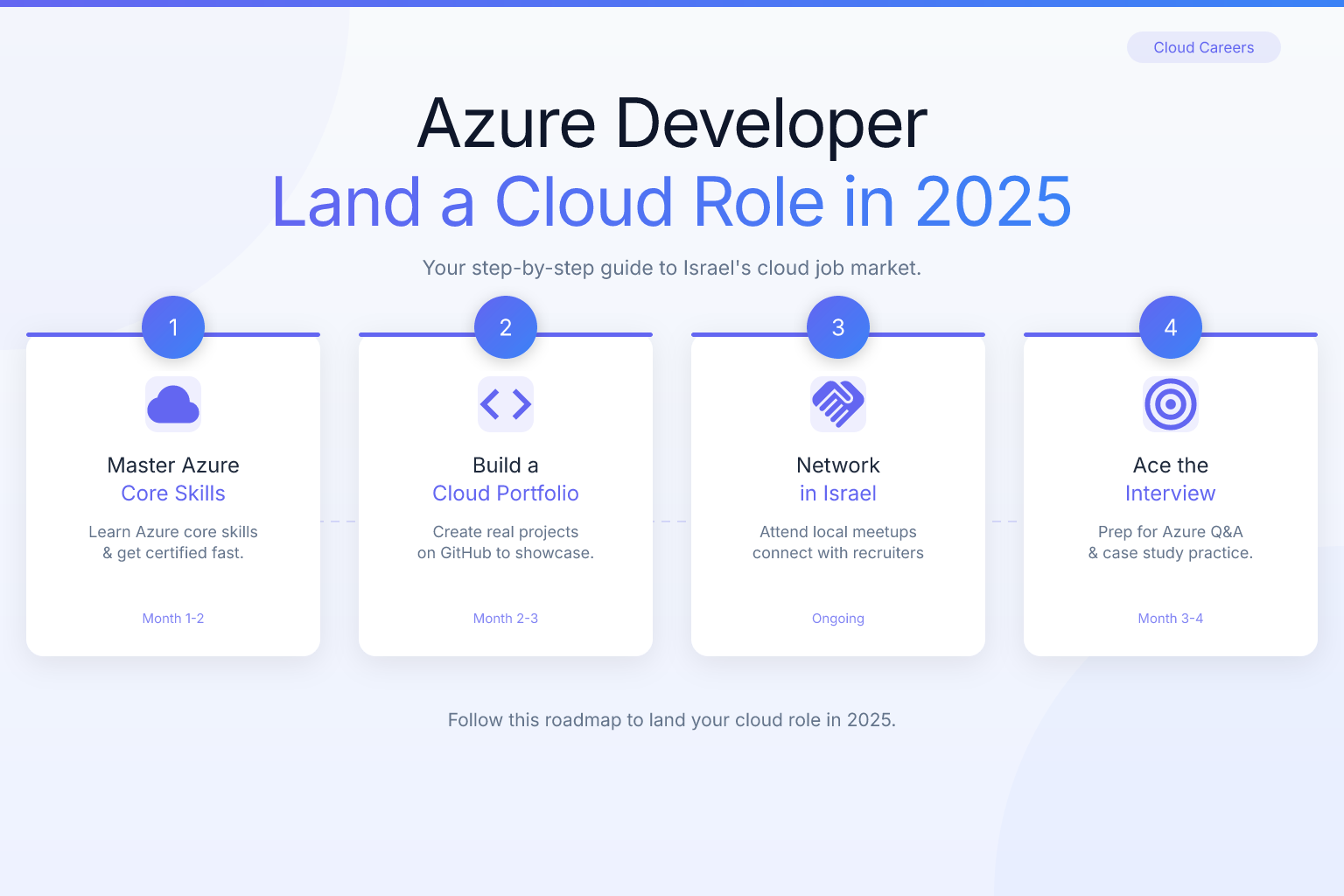
| What to Do | Why It Matters | Time |
|---|---|---|
| Tailor your resume to highlight Azure certifications and Israel-relevant projects | Israeli recruiters scan for cloud-specific keywords and local experience | 1–2 hours |
| Build a portfolio with Azure DevOps, Functions, and Kubernetes examples | Demonstrates hands-on ability beyond certifications | Ongoing (2–3 projects) |
| Use Israeli job boards, LinkedIn, and networking events | Many Azure roles are filled through referrals and niche platforms | 30 min/day |
| Track every application and follow up within 5–7 days | Follow-ups can double your interview chances | 5 min per application |
| Prepare for technical interviews with Azure architecture scenarios | Israeli tech interviews often include live coding and system design | 2–3 weeks prep |
What Azure Developer Israel Hiring Looks Like in 2025
Israel’s tech sector remains one of the most dynamic in the world. According to the Israel Innovation Authority, high-tech employs roughly 10% of the country’s workforce, and cloud computing roles are among the fastest-growing segments. Microsoft itself operates a major R&D center in Israel, and local startups and enterprises — from cybersecurity firms to fintech unicorns — are increasingly building on Azure.
This means azure developer israel hiring isn’t limited to a handful of big names. You’ll find openings at global companies with Israeli offices, homegrown SaaS platforms, and government digital transformation projects. The common thread: employers need developers who can design, deploy, and manage cloud-native solutions using Azure services.
Hybrid work is the norm. Most Israeli tech companies expect some in-office presence, especially during onboarding, but many offer flexible remote days. Fully remote Azure roles exist, though they’re less common than in North America. If you’re applying from abroad, be ready to discuss relocation or visa sponsorship early in the process.
Skills Israeli Employers Want in an Azure Developer
Job postings for Azure developers in Israel consistently ask for a mix of core cloud skills and local context. Here’s what to prioritize:
- Azure compute and storage: Azure Functions, App Service, Azure Kubernetes Service (AKS), Blob Storage, and Cosmos DB.
- DevOps and CI/CD: Azure DevOps, GitHub Actions, Infrastructure as Code (Bicep or Terraform), and monitoring with Application Insights.
- Security and identity: Azure Active Directory, managed identities, Key Vault, and role-based access control — especially important in Israel’s security-conscious tech culture.
- Programming languages: C# (.NET) is heavily used, but Python, JavaScript/TypeScript, and Java also appear. Many Israeli teams work with .NET, so familiarity is a strong plus.
- Certifications: While not mandatory, Microsoft certifications like AZ-204 (Azure Developer Associate), AZ-400 (DevOps Engineer Expert), or AZ-305 (Solutions Architect Expert) are frequently listed in Israeli job descriptions. Even the fundamentals AZ-900 can help entry-level candidates stand out.
- Soft skills: English fluency is essential — most Israeli tech companies operate in English. Hebrew is a bonus but rarely required for R&D roles. Direct communication, quick problem-solving, and comfort in fast-paced startup environments are valued.
If you’re missing a few services, don’t panic. Employers often care more about your ability to learn quickly and your foundational cloud understanding than about ticking every box.
How to Tailor Your Resume for Azure Developer Roles in Israel
A generic resume won’t cut it when recruiters are scanning for Azure-specific keywords and any hint of local relevance. Here’s how to sharpen yours:
- Lead with a technical skills section: List Azure services, certifications, and programming languages in a dedicated block near the top. Use the exact terms from job descriptions — “Azure Functions,” “AKS,” “Bicep” — so ATS filters catch them.
- Quantify your cloud impact: Instead of “worked on Azure migrations,” write “migrated 12 on-premise applications to Azure App Service, cutting hosting costs by 30%.” Israeli hiring managers respond to concrete results.
- Mention any Israel connection: If you’ve worked with Israeli teams, clients, or technologies common in the local ecosystem (like cybersecurity tools), include it. Even a short note like “collaborated with Tel Aviv-based DevOps team” signals cultural fit.
- Keep the format ATS-friendly: A single-column, text-based PDF is the safest choice for Israeli applicant tracking systems. Avoid tables, graphics, and multi-column layouts that can confuse parsers. You can use a free tool like ResumeMate’s AI resume builder to generate a clean, ATS-optimized PDF that highlights your Azure expertise in minutes.
- Check your score before applying: Upload your resume to ResumeMate’s score checker to see how it performs against common ATS filters. It gives section-by-section feedback so you can fix weak spots before a recruiter sees them.
If you’re an international candidate, add a line about visa status or willingness to relocate — Israeli employers appreciate transparency.
Where to Find Azure Developer Jobs in Israel
Relying on one job board limits your reach. Spread your search across multiple channels:
- LinkedIn: Still the top platform for Israeli tech hiring. Set your location to Tel Aviv, Herzliya, or “Israel” and use keywords like “Azure Developer,” “Cloud Engineer,” or “DevOps Azure.” Turn on the “Open to Work” feature discreetly.
- Israeli job boards: AllJobs (alljobs.co.il) and Drushim (drushim.co.il) list many tech roles in Hebrew and English. Nisha (nisha.co.il) focuses specifically on tech and startup jobs.
- Company career pages: Check directly at Microsoft Israel, Wix, Check Point, Monday.com, and similar companies. Many post roles only on their own sites.
- ResumeMate job board: The ResumeMate job board aggregates tech openings and lets you filter by role, location, and remote options — a quick way to spot new Azure listings without hopping between sites.
- Networking and meetups: Join “Azure Israel Meetup,” “Cloud & DevOps Israel,” or similar groups on Meetup.com or Facebook. In-person events in Tel Aviv and Herzliya are back in full swing, and many hires happen through referrals.
Once you start applying, you’ll need a system to keep track. The free ResumeMate Job Tracker Chrome extension logs every application, deadline, and follow-up automatically from your browser — so you never lose sight of where you stand.
Building a Portfolio That Gets You Noticed
Certifications and resume keywords get you through the door, but a live portfolio proves you can actually build on Azure. Israeli technical interviewers often ask to see code or discuss past projects in detail.
Aim for 2–3 public GitHub repositories that demonstrate:
- A serverless API: Use Azure Functions with HTTP triggers, connect to Cosmos DB or SQL Database, and include a README with architecture decisions.
- A CI/CD pipeline: Show a GitHub Actions or Azure DevOps pipeline that builds, tests, and deploys an application to Azure App Service or AKS. Include infrastructure-as-code with Bicep or Terraform.
- A real-world scenario: For example, a cost-optimization dashboard that queries Azure consumption APIs, or a multi-region disaster recovery setup.
Deploy everything so it’s live — a working URL impresses more than a code dump. Link to your portfolio from your resume and LinkedIn profile. If you’re unsure how to present projects on a resume, check out our guide on showcasing projects for students and career changers — the same principles apply to cloud portfolios.
Navigating the Israeli Interview Process
Israeli tech interviews are known for being direct, fast-paced, and technically deep. Expect this flow for most Azure developer roles:
- HR screen (15–30 minutes): A phone or video call to check logistics, salary expectations, and basic fit. They’ll ask about your Azure experience and why you’re interested in the company.
- Technical interview (45–60 minutes): Live coding or a take-home assignment. You might be asked to write an Azure Function that processes a queue, design a CI/CD workflow, or troubleshoot a deployment issue. Practice on platforms like Pramp or do mock interviews with a friend.
- System design or architecture panel (60 minutes): “Design a scalable e-commerce backend on Azure” is a typical prompt. Walk through compute, data, networking, security, and monitoring choices. Use the STAR method (Situation, Task, Action, Result) to structure your answers.
- Team or culture fit (30 minutes): Israeli teams value directness, initiative, and the ability to push back constructively. Be ready to discuss how you handle disagreements, tight deadlines, and ambiguous requirements.
Throughout, emphasize hands-on experience over theory. If you’ve built the portfolio projects from the previous section, reference them as concrete examples.
Follow-Up and Offer Negotiation Tips
Israeli hiring processes can move quickly — sometimes from application to offer in two weeks — but they can also stall. A strategic follow-up keeps you on the radar.
- After applying: If you haven’t heard back in 5–7 days, send a brief LinkedIn message or email to the recruiter. Reference the role and one specific reason you’re a strong fit.
- After interviews: Send a thank-you note within 24 hours. Mention a specific topic you discussed to show you were engaged.
- Tracking it all: Use the ResumeMate Job Tracker to log dates and set follow-up reminders. It’s free and works right from your browser.
When an offer arrives, research salary benchmarks. Glassdoor and local surveys suggest junior Azure developers in Israel earn around 18,000–25,000 ILS per month, while senior developers can reach 35,000–50,000 ILS. Startups often add stock options or equity. Don’t be shy about negotiating — Israeli employers expect it, especially if you have competing offers or specialized Azure skills.
For a deeper dive on follow-up strategies, read our guide on mastering post-application follow-ups.
Using AI Tools to Speed Up Your Job Search
Tailoring resumes, writing cover letters, and tracking dozens of applications eats up hours. AI tools can compress that work into minutes.
- Resume tailoring: Instead of manually tweaking your resume for each Azure job description, use an AI resume builder. ResumeMate’s free builder analyzes job descriptions and adjusts your resume’s keywords and phrasing to match — while keeping the format ATS-safe.
- Cover letters: AI can draft a first version that you then personalize. Focus on connecting your Azure projects to the company’s specific tech stack.
- Application tracking: The ResumeMate Chrome extension automatically captures job details when you apply on LinkedIn, company sites, or job boards, so you don’t have to fill out a spreadsheet manually.
For a full walkthrough of AI-powered job hunting, see our post on using AI tools to speed up your job search in 2025.
FAQ
Q: Do I need to speak Hebrew to work as an Azure developer in Israel?
A: Most Israeli tech companies operate in English, and R&D teams often include international members. Hebrew is a plus for social integration and client-facing roles, but it’s rarely a requirement for Azure developer positions. Focus on strong English communication and technical skills.
Q: What Azure certifications are most valued by Israeli employers?
A: The AZ-204 (Azure Developer Associate) is the most directly relevant. AZ-400 (DevOps Engineer Expert) and AZ-305 (Solutions Architect Expert) also appear frequently in senior job postings. Even the entry-level AZ-900 can help newcomers demonstrate foundational cloud knowledge.
Q: Is remote work common for Azure developers in Israel?
A: Hybrid arrangements are typical — 2–3 days in the office, the rest remote. Fully remote Azure roles exist but are less widespread than in the US or Europe. If remote work is a priority, filter for it explicitly on job boards and ask early in the interview process.
Q: How do Azure developer salaries in Israel compare to the US or Europe?
A: Israeli tech salaries are competitive. Junior Azure developers can expect roughly 18,000–25,000 ILS per month, while senior roles range from 35,000 to 50,000 ILS. These figures are higher than most European markets but lower than Silicon Valley. Keep in mind that Tel Aviv’s cost of living is high, so negotiate accordingly.
Q: What’s the typical hiring timeline for Azure developer roles in Israel?
A: It varies. Startups may extend an offer within 2–3 weeks, while larger enterprises can take 4–6 weeks. If you haven’t heard back after applying, a polite follow-up after 5–7 days can speed things up.
Q: Can international candidates apply for Azure developer jobs in Israel?
A: Yes. Many Israeli companies sponsor work visas for skilled tech professionals, especially in cloud and cybersecurity. Highlight your Azure expertise, any multinational experience, and your willingness to relocate. Some employers may ask about your visa status early, so be prepared to discuss it.
Track Every Application While You Job Hunt
Stop losing track of where you’ve applied. The ResumeMate Job Tracker is a free Chrome extension that tracks every application, deadline, and follow-up in one place — right from your browser.