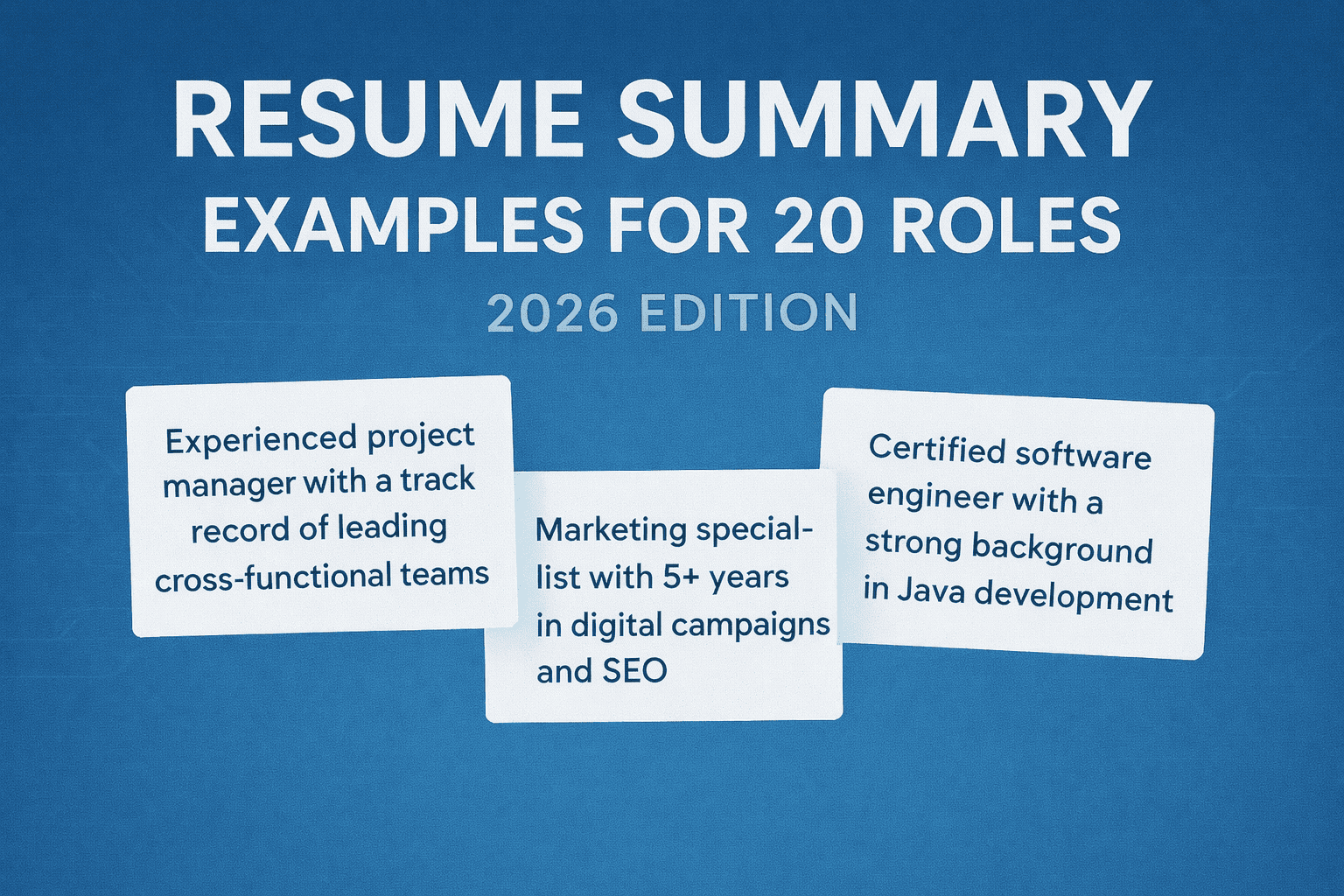
Best Professional Summary Examples for Resume 2026 (20 Roles)
A resume summary is a brief section at the top of your resume that highlights your key skills, experience, and career goals. It grabs recruiters’ attention and sets the tone for your application. This guide is packed with copy-ready resume summary examples for 20 roles, tailored for 2025 job market trends and ATS standards.
| What to Do (Short Checklist) |
|---|
| Keep summaries 3-5 lines long, focused and relevant |
| Use keywords from the job description naturally |
| Highlight measurable achievements and skills |
| Avoid generic or vague statements |
| Tailor summaries per role and industry |
Who This Guide Is For
This guide helps mid-career applicants and professionals across industries who want to draft or refresh their resume summaries. Whether you are changing roles, updating your resume for 2025 ATS, or writing your first resume summary, these examples and tips will elevate your application.
Resume Summary Examples for 20 Roles (2025 Edition) — Definition & Purpose
Your resume summary serves to:
- Quickly showcase your core competencies and achievements
- Provide a snapshot of your professional brand
- Include critical keywords that ATS can detect
- Connect your experience with the employer’s needs
Best-Practice Rules (Do / Don’t)
| Do | Don’t |
|---|---|
| Use specific achievements and metrics | Use generic phrases like “hardworking” |
| Incorporate job-specific keywords | Overstuff keywords unnaturally |
| Keep it concise and powerful | Write lengthy paragraphs |
| Tailor for each application | Use the same summary for all jobs |
| Start with strong action verbs or descriptors | List duties without impact |
Resume Summary Examples by Level & Industry
1. Software Engineer
“Detail-oriented software engineer with 5+ years of experience designing scalable web applications using JavaScript and Python. Proven track record improving system performance by 30% through innovative coding solutions and agile project management.”
2. Marketing Manager
“Results-driven marketing manager with 7 years leading digital campaigns that boosted customer engagement by 25%. Expert in SEO, content marketing, and Google Analytics with a passion for data-driven growth.”
3. Registered Nurse
“Compassionate registered nurse with 10 years of clinical experience in high-acuity hospital settings. Skilled in patient care management, emergency response, and electronic health record (EHR) documentation.”
4. Project Manager
“Certified PMP project manager with 8 years of managing cross-functional teams delivering projects on time and under budget. Adept at risk management, stakeholder communication, and Agile methodologies.”
5. Sales Executive
“Dynamic sales executive with a record of exceeding annual targets by an average of 20%. Skilled in B2B sales, CRM software, and client relationship management.”
6. Data Scientist
“Analytical data scientist with 4 years of experience building machine learning models in Python and R that improved forecasting accuracy by 35%. Adept at transforming raw datasets into actionable business insights through statistical modeling and data visualization.”
7. Human Resources Manager
“Strategic HR manager with 9 years of experience in talent acquisition, employee relations, and organizational development. Reduced time-to-hire by 28% by redesigning recruitment workflows and implementing structured interview frameworks across 3 business units.”
8. Financial Analyst
“Detail-driven financial analyst with 6 years of experience in FP&A, budgeting, and variance reporting for mid-size manufacturing firms. Developed financial models that identified $1.2M in annual cost savings through operational efficiency analysis.”
9. Graphic Designer
“Creative graphic designer with 5 years producing brand identities and digital marketing assets for consumer brands. Delivered campaign visuals that supported a 45% increase in click-through rates across paid social channels.”
10. Customer Service Manager
“Customer-focused service manager with 8 years building and coaching front-line support teams in high-volume SaaS environments. Improved CSAT scores from 78% to 94% by introducing a tiered escalation model and weekly coaching sessions.”
11. UX Designer
“User-centered UX designer with 4 years creating intuitive digital experiences for fintech and e-commerce products. Reduced checkout abandonment by 18% through iterative usability testing and evidence-based design changes.”
12. Operations Manager
“Results-oriented operations manager with 10 years streamlining supply chain and logistics processes in retail distribution. Cut order fulfillment time by 22% and reduced inventory carrying costs by $400K annually through lean process redesigns.”
13. Elementary School Teacher
“Dedicated elementary educator with 7 years developing engaging curricula for grades 3–5 in Title I schools. Raised average reading proficiency scores by 31% over two years through differentiated instruction and targeted intervention programs.”
14. Civil Engineer
“Licensed civil engineer (PE) with 8 years designing and managing infrastructure projects including highway expansions and stormwater systems. Delivered a $12M municipal road rehabilitation project 3 weeks ahead of schedule and 5% under budget.”
15. Digital Marketing Specialist
“Performance-driven digital marketing specialist with 5 years managing PPC, SEO, and email campaigns for B2C e-commerce brands. Grew organic search traffic by 120% in 12 months and achieved a 4.2x ROAS on Google Ads campaigns.”
16. Business Analyst
“Detail-oriented business analyst with 6 years bridging stakeholder requirements and technical teams in financial services. Documented 60+ requirements and process flows that reduced post-launch change requests by 40% on an enterprise CRM implementation.”
17. Mechanical Engineer
“Innovative mechanical engineer with 7 years designing precision components for automotive OEM suppliers. Reduced material waste by 18% through tolerance analysis improvements and contributed to 3 patents in fluid dynamics applications.”
18. Social Worker
“Compassionate licensed clinical social worker (LCSW) with 10 years providing case management and crisis intervention services in urban community health settings. Managed a caseload of 75+ clients and achieved a 92% housing retention rate among transitional housing participants.”
19. Supply Chain Analyst
“Supply chain analyst with 5 years optimizing procurement and inventory management for a global consumer electronics company. Reduced procurement cycle time by 35% and negotiated supplier contracts saving $800K annually.”
20. Content Writer / Copywriter
“Strategic content writer with 6 years producing long-form articles, landing pages, and email sequences for SaaS and fintech brands. Increased organic blog traffic by 85% in 8 months through SEO-optimized editorial planning and consistent publishing cadence.”
How to Customize to a Job Description
- Analyze the job posting for keywords and phrases.
- Mirror the language and terminology in your summary.
- Highlight your relevant achievements that align with job priorities.
- Replace vague terms with specific metrics or results.
- Maintain natural flow and readability.
Formatting Tips (ATS + Readability)
- Use bullet points sparingly; summaries typically read better as short paragraphs.
- Choose clear fonts and size consistent with your resume body.
- Avoid special characters or excessive punctuation.
- Start with a strong descriptor or role title for instant clarity.
- Maintain 3-5 concise lines focusing on impact and relevance.
Checklist & Templates
| Resume Summary Checklist |
|---|
| Is the summary tailored to the job? |
| Are key skills and accomplishments included? |
| Does it include measurable results? |
| Is the language clear and keyword-optimized? |
| Is it concise and easy to read? |
Fill-in-the-blank template:
“[Adjective/Descriptor] [profession/role] with [X years] of experience in [industry/field]. Proven ability to [key achievement or skill] resulting in [measurable result]. Skilled in [relevant skills/technologies].”
FAQ
Q: How long should a resume summary be?
A: Typically 3-5 lines or about 50-100 words.
Q: Should I include keywords?
A: Yes, but naturally woven into your summary.
Q: Can I use bullet points?
A: Usually, a short paragraph is preferred, but bullet points are acceptable if concise.
Q: What if I am changing careers?
A: Focus on transferable skills and adaptability. Lead with what you bring to the new field rather than what you are leaving behind. For example: “Operations manager with 8 years of process improvement experience transitioning to project management, with PMP certification completed in 2025.”
Q: Should I write a resume summary or a resume objective?
A: A summary is better for anyone with relevant experience in their target field. An objective statement (“Seeking a role where I can…”) is only appropriate for first-time job seekers or major career pivots where you have no directly transferable experience to highlight.
Before and After: Resume Summary Transformations
Seeing a weak summary become strong makes the principles concrete.
Before (generic): “Hardworking professional with experience in marketing and communications. Good team player looking for a new challenge.”
After (specific): “Results-oriented content marketing manager with 6 years driving organic growth for B2B SaaS companies. Grew pipeline-attributed blog traffic by 3x in 12 months through SEO strategy, editorial planning, and content distribution across LinkedIn and email.”
Before (duties-focused): “Registered nurse with experience in hospitals. Responsible for patient care and documentation.”
After (impact-focused): “ICU-trained registered nurse with 8 years managing complex patient care in Level 1 trauma centers. Recognized for maintaining a zero medication error rate over 3 years while mentoring a cohort of 6 new graduate nurses.”
Before (too long and vague): “I am a data analyst who is passionate about data and numbers and has worked with various companies in different industries on many data-related projects and tasks over the course of my career.”
After (concise and powerful): “Data analyst with 5 years translating complex datasets into executive-ready dashboards using SQL, Python, and Tableau. Identified pricing inefficiencies that recovered $650K in annual margin for a retail client.”
Common Mistakes Writers Make on Their Resume Summary
1. Opening with “I am.” Never start your summary with “I am” — it wastes the most-read line on the page. Start with your title or a strong descriptor: “Certified PMP project manager…” or “Patient-centered registered nurse…”
2. Copying the same summary across every application. A hiring manager for a startup and a hiring manager at a Fortune 500 are looking for different signals. Spend 5 minutes adjusting two or three keywords and your lead achievement for each application.
3. Making it too long. More than 5 lines is rarely read in full. If you cannot summarize your value proposition in 50–80 words, the summary is doing too much work — move specifics into your bullets.
4. Using superlatives without evidence. “Exceptional communicator,” “highly motivated,” “proven leader” are empty without context. Replace them with specific examples or cut them entirely.
5. Forgetting to include your target role title. ATS systems match job titles. If you are applying for “Senior Data Analyst” roles, those exact words should appear in your summary.
6. Writing the summary last and treating it as an afterthought. Your summary is the single most-read section of your resume. Write it after completing the rest of the document so you have your best bullets to draw from, but spend real time refining it.
Build, Score & Track Your Job Search with ResumeMate
Resume Builder → — Create an ATS-ready resume in minutes.
Resume Score Checker → — See how your resume scores against ATS systems instantly.
Job Board → — Browse jobs matched to your resume.
Job Tracker Chrome Extension → — Track every application, deadline, and follow-up in one place — free.