Best Time to Post on LinkedIn for Job Seekers (2026 Guide)
If you’re a job seeker, knowing the best time to post on LinkedIn for job seekers can mean the difference between your content reaching a recruiter’s feed or disappearing into the void. LinkedIn’s algorithm rewards posts that get early engagement, and that engagement depends heavily on when your target audience — recruiters, hiring managers, and your professional network — is actually scrolling. This guide breaks down the optimal days, times, and strategies to make your LinkedIn posts work harder for your job search.
Key Takeaways
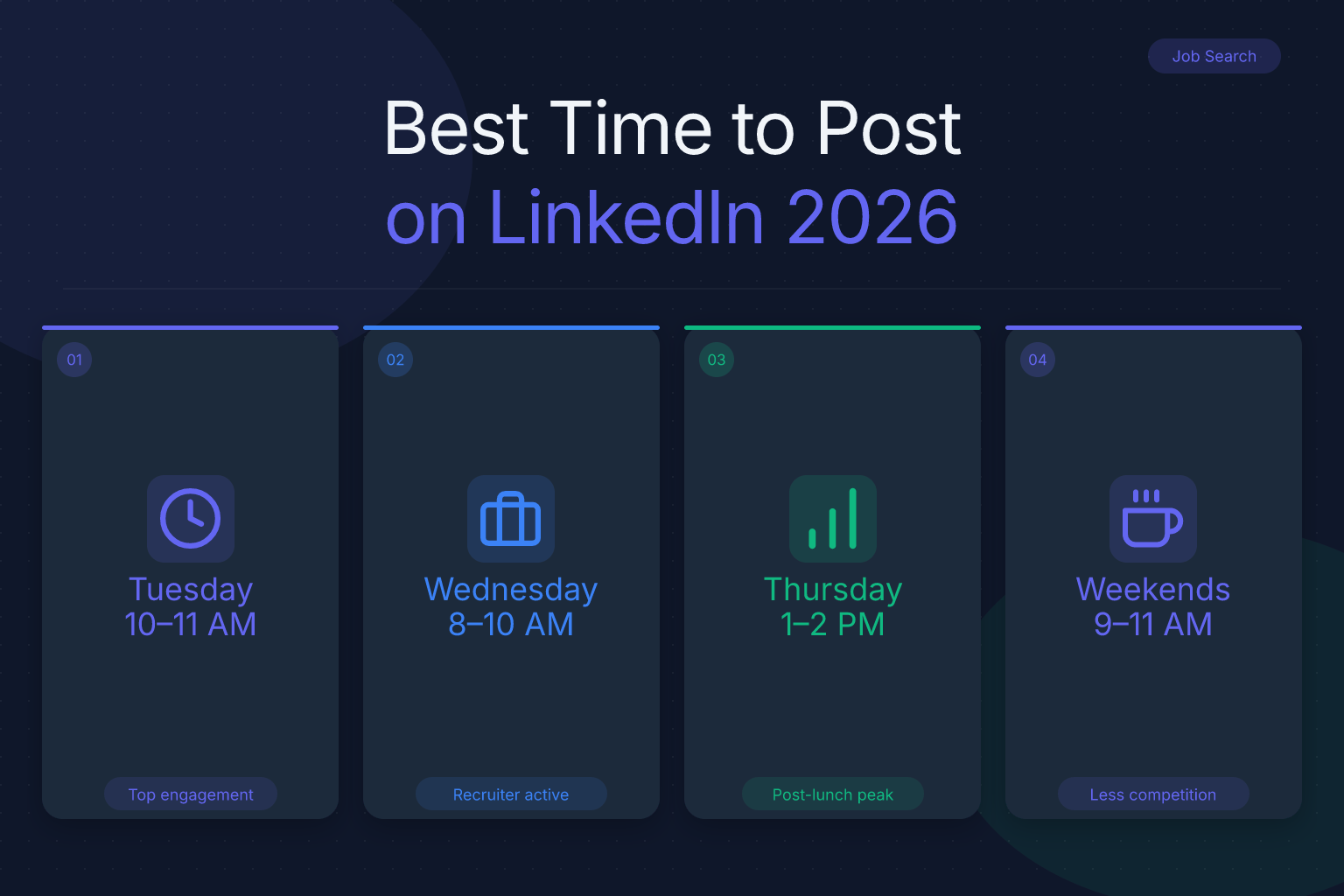
- The best days to post on LinkedIn for job seekers are Tuesday, Wednesday, and Thursday, with mornings between 8:00 and 10:00 AM local time typically generating the most recruiter visibility.
- Posting during business hours in your target employer’s time zone — not your own — is critical if you’re applying to jobs in a different region.
- LinkedIn’s algorithm prioritizes posts that get comments and shares within the first hour, so timing your post to when your network is active directly boosts reach.
- You don’t need to post daily; 2–3 high-quality posts per week at consistent times outperform daily low-effort updates.
- Use LinkedIn’s built-in post analytics to find your specific audience’s peak hours, then schedule posts accordingly.
Summary Table
| What to Do | Why It Matters | Time |
|---|---|---|
| Post Tuesday–Thursday, 8–10 AM local time | Recruiters check LinkedIn during morning work hours | 5 minutes to schedule |
| Adjust posting time to your target employer’s time zone | Ensures your post appears when hiring managers are online | 2 minutes to check time zone |
| Post 2–3 times per week consistently | Builds algorithm trust and keeps you top-of-mind | 15–30 minutes per post |
| Engage with comments within the first hour | Boosts post visibility through early interaction | 10 minutes after posting |
| Test different times using LinkedIn analytics | Finds your unique audience’s peak engagement window | 5 minutes weekly review |
Why Timing Matters for Job Seekers on LinkedIn
When you post on LinkedIn as a job seeker, you’re not just sharing an update — you’re competing for attention in a feed that refreshes constantly. LinkedIn’s algorithm shows your post to a small initial audience, and if those people engage quickly (like, comment, share), the algorithm expands your reach to second- and third-degree connections, including recruiters who don’t follow you yet.
For job seekers, this is crucial. A post that gets 50 comments from your network is far more likely to be seen by a recruiter searching for candidates than a post that gets 2 likes. And the single biggest factor you control in that early engagement window is when you publish.
Recruiters and hiring managers are not scrolling LinkedIn at 2 AM. They check the platform during work hours, often in the morning before meetings start, during lunch breaks, or in the late afternoon. If you post when they’re active, your content has a fighting chance. If you post when they’re asleep or in back-to-back meetings, your post may be buried by the time they log on.
The Best Days to Post on LinkedIn for Job Seekers
LinkedIn’s own data and consistent third-party analyses point to the same pattern: Tuesday, Wednesday, and Thursday are the strongest days for engagement. Monday mornings are often consumed by catching up on email and planning the week, while Friday afternoons see a sharp drop in professional activity as people mentally check out for the weekend.
Here’s a day-by-day breakdown for job seekers:
- Monday: Lower engagement overall. People are busy, and your post competes with a flood of “Monday motivation” content. If you must post, aim for late morning (10–11 AM) after the initial email rush.
- Tuesday: One of the best days. Professionals are settled into the week and more likely to browse LinkedIn between tasks. Morning posts (8–10 AM) perform well.
- Wednesday: The peak day for many industries. Midweek is when recruiters often schedule sourcing time and when professionals take short breaks to scroll. Post between 8 AM and noon.
- Thursday: Strong, nearly as good as Tuesday and Wednesday. Many decision-makers are still active, and posts in the late morning (10–11 AM) can catch people before lunch.
- Friday: Engagement drops after noon. If you post, do it early (8–9 AM) and keep it light — but don’t expect the same reach as midweek.
- Saturday and Sunday: Generally the lowest engagement for professional content, but there’s a caveat. Some job seekers find that weekend posts get less competition and can still reach recruiters who browse casually. If you post on weekends, aim for Saturday morning (9–11 AM) or Sunday evening (7–9 PM) when people are relaxing but still online.
Bottom line: For maximum recruiter visibility, schedule your most important posts — job search updates, portfolio highlights, industry insights — for Tuesday through Thursday mornings.
The Best Times of Day to Post on LinkedIn
Within those strong days, the time of day matters just as much. LinkedIn’s user base is largely professionals who check the platform during work hours, not late at night. The most commonly cited optimal windows are:
- 8:00–10:00 AM local time: Professionals often start their day by checking LinkedIn, either on their commute or before diving into work. This is the single best window for job seekers because recruiters frequently review their feed first thing.
- 12:00–1:00 PM: The lunch break window. People scroll while eating, and engagement can spike. This is a solid secondary option if you miss the morning.
- 5:00–6:00 PM: The end-of-day check. Some professionals browse LinkedIn before leaving the office or during their commute home. Engagement is lower than morning but still meaningful.
Avoid posting between 10 PM and 6 AM in your target audience’s time zone. Those posts get minimal early engagement and are often buried by the time the workday begins.
Important: These times are based on general user behavior, but your specific audience may differ. If you’re targeting recruiters in a specific industry, test different times and watch your analytics.
How to Find Your Audience’s Peak Hours
Generic advice is a starting point, but the real answer to “best time to post on LinkedIn for job seekers” depends on your network and your target employers. Here’s how to find your unique sweet spot:
- Check your LinkedIn post analytics: After you’ve posted a few times, go to your post and click “View analytics.” LinkedIn shows you when your audience is most active, broken down by day and hour. This is the most reliable data you can get.
- Look at your connections’ activity: Notice when the recruiters and hiring managers you follow are commenting on or liking posts. If a recruiter you want to impress consistently engages at 9:15 AM on Tuesdays, that’s a signal.
- Experiment deliberately: For two weeks, post at different times — Monday 9 AM, Wednesday 1 PM, Thursday 8 AM, etc. Track which posts get the most comments and shares (not just likes, which are low-effort). Then double down on the winning window.
- Consider your content type: A quick tip or question may perform well in the morning, while a longer story or case study might do better in the evening when people have more time to read. Adjust timing based on what you’re posting.
If you’re just starting and have no analytics yet, default to Tuesday–Thursday, 8–10 AM in your target employer’s time zone. That’s the safest bet.
Time Zone Strategy for Remote and Global Job Searches
One of the biggest mistakes job seekers make is posting according to their own time zone when their target employers are in a different one. If you’re in New York and applying to companies in San Francisco, posting at 8 AM Eastern means your post goes live at 5 AM Pacific — before most West Coast recruiters are awake.
Here’s how to handle time zones:
- Identify your target market: Are you applying to local jobs, remote jobs with a specific company headquarters, or a mix? If you’re targeting a specific city or region, post during that region’s business hours.
- Use a time zone converter: Before scheduling a post, check what time it will be in your target employer’s location. Tools like World Time Buddy or a simple Google search can help.
- For fully remote roles with no fixed location: Aim for a compromise. Posting between 10 AM and 12 PM Eastern (which is 7–9 AM Pacific and 3–5 PM in London) can catch a broad swath of US and European recruiters. If you’re targeting both US coasts, 11 AM Eastern is a reasonable middle ground.
- Don’t overthink it: If you’re applying to jobs in multiple time zones, pick the time zone of the majority of your target companies and post consistently there. Consistency matters more than hitting every time zone perfectly.
What to Post (and When) to Get Recruiter Attention
Timing is only half the equation. If your content doesn’t resonate, even the perfect posting time won’t help. As a job seeker, your LinkedIn posts should position you as a competent, engaged professional — not just someone begging for a job. Here are content ideas that pair well with optimal timing:
- Industry insights or commentary: Share a relevant article with your take. Post this Tuesday–Thursday morning when professionals are in a work mindset.
- Project highlights or portfolio pieces: Show, don’t just tell. A short case study of a project you completed can catch a recruiter’s eye. Post midweek, late morning.
- Questions that spark discussion: Ask a thoughtful question about your field. Engagement drives reach, so post when your network is most active (Tuesday or Wednesday, 9–11 AM).
- Job search updates (use sparingly): A brief, positive update like “I’m excited to be interviewing for roles in [field]” can work, but don’t post daily job-hunt pleas. One or two per week max, posted on Tuesday or Wednesday morning.
- Engagement with others’ posts: This isn’t a post of your own, but commenting on recruiter posts within the first hour of their publication can get you noticed. For more on this, see our guide on how to engage recruiter posts on LinkedIn and get noticed.
Remember: your LinkedIn profile itself is the foundation. If a recruiter clicks through from your post and finds a weak profile, the timing won’t matter. Make sure your profile is optimized before you invest in posting. Check out our LinkedIn profile optimization guide for job search to get that right.
Scheduling Tools and Automation for Consistent Posting
You don’t need to be glued to your phone at 8:47 AM every Tuesday. Scheduling tools let you write your post when inspiration strikes and publish it at the optimal time automatically. Options include:
- LinkedIn’s native scheduling: Available on company pages, but not for personal profiles. If you’re posting from a personal profile (which most job seekers do), you’ll need a third-party tool.
- Buffer, Hootsuite, or Later: These social media management tools support LinkedIn personal profile scheduling. They let you queue posts for specific days and times, so you can batch-create content on Sunday and let it publish throughout the week.
- A simple calendar reminder: If you don’t want another tool, set a recurring reminder on your phone for Tuesday and Thursday at 8:30 AM. Write your post the night before and copy-paste it when the reminder goes off.
Consistency beats perfection. Posting two solid posts per week at the same time is better than posting five times one week and then going silent for a month. The algorithm rewards regular activity, and recruiters who see your name repeatedly are more likely to remember you.
Common Timing Mistakes to Avoid
Even with the right strategy, these mistakes can sabotage your LinkedIn posting efforts:
- Posting at 11 PM on a Sunday: Your post will be buried by Monday morning. If you have a great idea late at night, write it down and schedule it for Tuesday morning.
- Posting too frequently: Three posts in one day will annoy your network and trigger the algorithm to show your content less. Space posts out by at least a day.
- Ignoring your own analytics: If your data shows that your audience engages most at 2 PM on Thursdays, don’t keep posting at 8 AM because a blog told you to. Trust your numbers.
- Posting only about your job search: Recruiters want to see value, not desperation. Mix in industry content, insights, and engagement with others. For more on building genuine connections, read our guide on how to network on LinkedIn without being awkward.
- Forgetting to engage after posting: The first hour is critical. If someone comments, reply quickly. That interaction signals to LinkedIn that your post is worth showing to more people.
FAQ
Q: What is the best time to post on LinkedIn for job seekers in the US?
A: For US-based job seekers targeting US employers, the best time is Tuesday through Thursday between 8:00 and 10:00 AM in the time zone of your target employers. If you’re on the East Coast applying to West Coast companies, post between 11:00 AM and 1:00 PM Eastern to catch Pacific morning hours.
Q: Does posting time really matter on LinkedIn?
A: Yes, significantly. LinkedIn’s algorithm shows your post to a small initial audience, and early engagement (likes, comments, shares) determines whether it gets shown to a wider network, including recruiters. Posting when your audience is active increases the chance of that early engagement, which directly boosts reach.
Q: Should job seekers post on LinkedIn on weekends?
A: Generally, no. Weekend engagement on LinkedIn is lower because professionals are off work. However, if you have a compelling personal story or portfolio piece, Saturday morning (9–11 AM) can work because there’s less competition. But for maximum recruiter visibility, stick to weekdays.
Q: How often should a job seeker post on LinkedIn?
A: Aim for 2–3 high-quality posts per week. Consistency matters more than volume. Posting daily can lead to low-effort content that hurts your credibility, while posting once a month won’t keep you top-of-mind. Two solid posts on Tuesday and Thursday mornings is a strong baseline.
Q: What time zone should I use for LinkedIn posts when applying to remote jobs?
A: Use the time zone of the company’s headquarters or the majority of your target employers. If you’re applying to remote roles across the US, posting between 10 AM and 12 PM Eastern (7–9 AM Pacific) is a reasonable compromise that catches both coasts during business hours.
Q: Can I schedule LinkedIn posts in advance as a job seeker?
A: Yes, but not natively on personal profiles. LinkedIn’s native scheduling is only for company pages. You can use third-party tools like Buffer, Hootsuite, or Later to schedule posts on your personal profile, or simply set a recurring reminder to post manually at your optimal time.
Track Every Application While You Job Hunt
Stop losing track of where you’ve applied. The ResumeMate Job Tracker is a free Chrome extension that tracks every application, deadline, and follow-up in one place — right from your browser.