How to List Board Membership on a Resume: 2026 Examples for Non-Profit Professionals
If you’re listing board membership on resume non-profit roles, you need to know how to present that experience so it strengthens your candidacy—not just fills space. Board service signals governance experience, strategic thinking, and a commitment to mission-driven work. But many job seekers either bury it in a generic volunteer section or list it without the context that makes it compelling. This guide shows you exactly where to place board roles, how to describe them, and how to tailor them for non-profit job applications.
Key Takeaways
- Board membership belongs in a dedicated “Board Experience” or “Volunteer Leadership” section, not buried under a generic volunteer heading.
- Each entry should include the organization name, your role, dates, and 2–4 bullet points that quantify your impact—funds raised, programs launched, or governance improvements.
- Tailor board descriptions to the non-profit job you’re targeting by mirroring language from the job description and highlighting transferable skills like fundraising, strategic planning, and stakeholder management.
- Avoid listing board titles without context; even a short-term or advisory role can be powerful if you describe what you accomplished.
- Use a clean, single-column format to keep your resume ATS-friendly, and run it through a free resume score checker to catch formatting issues before you apply.
| What to Do | Why It Matters | Time |
|---|---|---|
| Place board membership in a dedicated section | Shows leadership commitment and makes it easy for recruiters to find | 5 minutes |
| Use bullet points with measurable outcomes | Demonstrates real impact, not just a title | 10 minutes |
| Tailor descriptions to the job’s mission | Aligns your experience with the organization’s values | 15 minutes |
| Avoid listing board titles without context | Prevents your resume from looking padded or vague | 5 minutes |
| Run your resume through an ATS score checker | Ensures formatting doesn’t block your board experience from being parsed | 2 minutes |
Where to Place Board Membership on Your Resume
When listing board membership on a resume for non-profit roles, placement matters. Recruiters at non-profits scan for governance and leadership experience quickly, so you need a section that stands out. The most effective approach is to create a separate “Board Experience” or “Volunteer Leadership” section, positioned right after your professional experience or education—depending on which is stronger.
If you have multiple board roles or a long tenure, a dedicated section signals that this isn’t just a one-off volunteer gig. For example:
Board Experience
- Board Member, River City Food Bank (2022–Present)
- Treasurer, Downtown Arts Council (2020–2023)
If you only have one board role and it’s directly relevant to the job, you can also list it under a combined “Leadership & Community Involvement” section. Avoid burying it under a generic “Volunteer Experience” heading unless the role was purely hands-on with no governance responsibilities. Board membership implies fiduciary duty, strategic oversight, and often fundraising—distinct from typical volunteer work.
For ATS compatibility, keep the section heading simple. Use standard terms like “Board Experience” rather than creative labels. If you’re unsure whether your resume’s formatting will parse correctly, upload it to a free resume score checker to see exactly how an ATS reads your sections.
How to Format Board Membership Entries
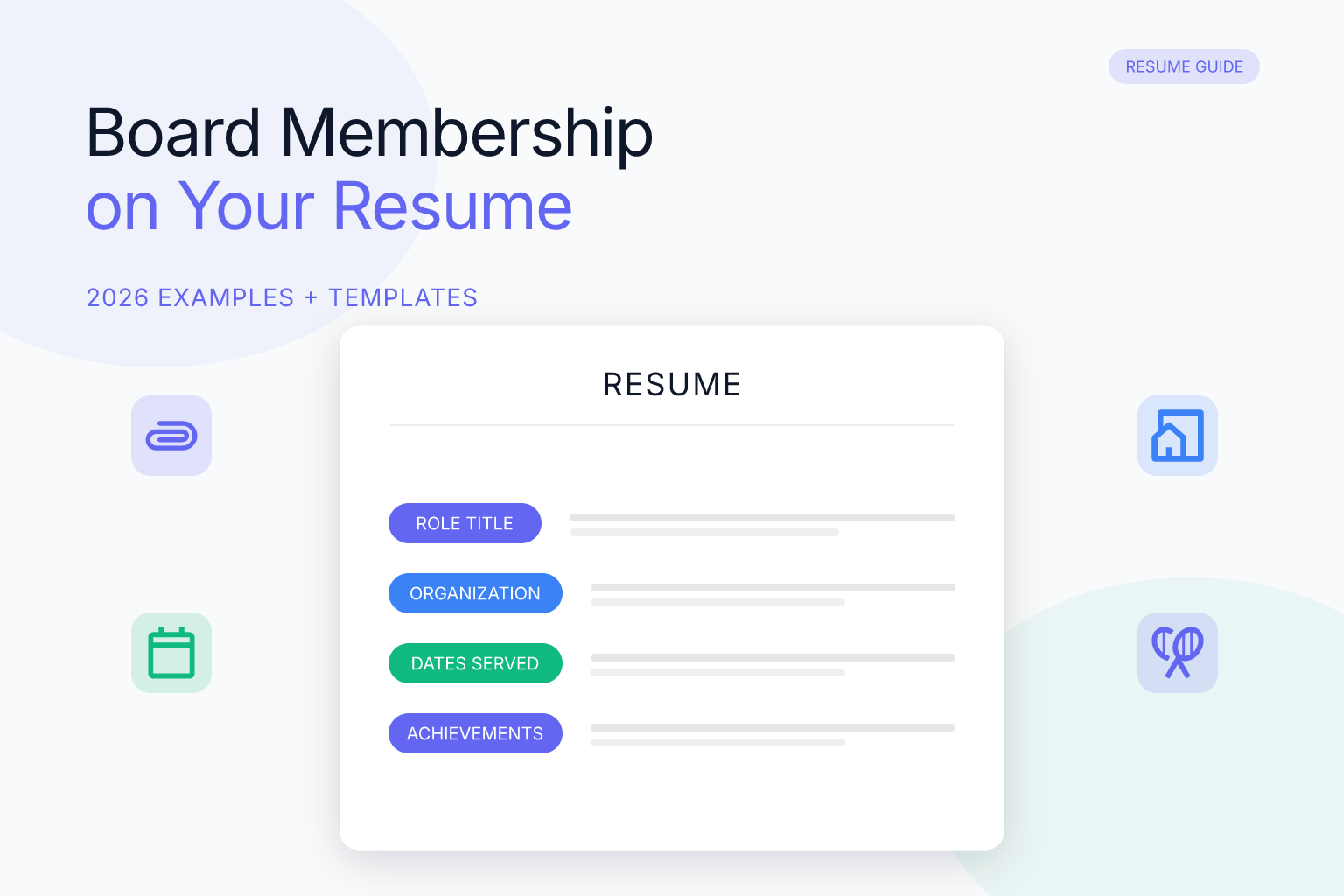
Each board entry should follow a consistent format that mirrors a job entry: organization name, your title, dates, and bullet points. Here’s a template:
Organization Name | City, State (if location is relevant) Board Member | Jan 2022 – Present
- Bullet point describing a key contribution, ideally with a number
- Bullet point showing strategic or governance impact
- Bullet point highlighting collaboration or fundraising
For example:
Sunrise Youth Shelter | Austin, TX Board Secretary | Mar 2021 – Present
- Recorded minutes and maintained compliance documentation for a board overseeing a $2.1M annual budget
- Co-led a governance committee that revised bylaws and reduced board meeting length by 30%
- Organized an annual gala that raised $85,000, a 22% increase over the previous year
Use reverse-chronological order, with your most recent or current board role first. If you hold multiple board positions simultaneously, list them in order of relevance to the job you’re targeting.
Avoid using tables, columns, or graphics to present this information. Modern ATS platforms parse clean, text-based PDFs reliably, but complex formatting can still cause issues. Stick to a single-column layout with clear headings and bullet points. ResumeMate’s templates are designed with this in mind—most are single-column and export as ATS-safe PDFs.
What to Include in Each Board Membership Description
Not all board roles are equal, and a title alone doesn’t tell a recruiter what you actually did. Focus on three categories of impact:
- Governance and strategy – Did you help set the organization’s direction, approve budgets, or oversee executive leadership? Example: “Participated in quarterly strategic planning sessions that resulted in a 3-year expansion roadmap.”
- Fundraising and resource development – Non-profits care deeply about this. Even if you weren’t the development chair, mention any role in donor cultivation, grant writing, or event planning. Example: “Secured $25,000 in corporate sponsorships through personal network outreach.”
- Program or operational oversight – If you chaired a committee or led a specific initiative, describe the outcome. Example: “Chaired the program committee that launched a youth mentorship program serving 120 participants in its first year.”
If your board role was advisory rather than fiduciary, be honest but still frame it around results. For instance, “Advised the executive director on digital marketing strategy, leading to a 40% increase in online donations.”
When you’re applying for a non-profit job, these bullet points become proof that you understand how non-profits operate—budgets, boards, and mission alignment. That’s often more valuable than for-profit experience alone.
Board Membership vs. Volunteer Work: Key Differences
Many job seekers lump board service under volunteer work, but the two are distinct. Volunteer work is typically hands-on—serving meals, tutoring, building houses. Board membership is governance-level: you’re responsible for the organization’s health, compliance, and strategic direction. Treating them the same undersells your leadership.
If you have both, separate them. Create a “Board Experience” section for governance roles and a “Volunteer Experience” section for direct service. This distinction shows recruiters you understand the non-profit structure. For more on listing hands-on volunteer roles, see our guide on how to list volunteer work on a resume with no experience.
If a board role included significant hands-on work (common in small non-profits), you can mention that in the bullet points, but keep the section under board experience. For example: “In addition to governance duties, led monthly volunteer training sessions for 30+ volunteers.”
How to Tailor Board Experience for Non-Profit Job Applications
Generic board descriptions won’t move the needle. You need to connect your board service to the specific non-profit job you want. Start by pulling keywords from the job description. If the role requires “grant writing,” “donor relations,” or “program evaluation,” and you’ve done any of that as a board member, use those exact phrases.
For example, if you’re applying for a Development Manager role, a board bullet point like “Cultivated relationships with major donors” is far stronger than “Attended board meetings.” If the job emphasizes community partnerships, highlight a board initiative where you built partnerships with local businesses or government agencies.
Also consider the organization’s size and mission. A board role at a small grassroots non-profit might emphasize hands-on program work, while a board role at a large foundation might emphasize investment committee experience. Match the scale and language to the employer.
If you’re pivoting from a for-profit career into the non-profit sector, board experience is your bridge. It shows you’ve already operated in a mission-driven environment. Lead with it in your summary and make sure every bullet point translates corporate skills into non-profit impact. For more on translating non-traditional experience, read our guide on how to list contract vs. freelance work on a resume.
Common Mistakes When Listing Board Membership
Even strong board experience can fall flat if you make these errors:
- Listing only the title and dates with no description. A recruiter sees “Board Member, 2020–2023” and learns nothing. Always add at least two bullet points.
- Using insider jargon. Terms like “fiduciary oversight” or “governance committee” are fine, but balance them with concrete outcomes. Instead of “Ensured fiduciary compliance,” write “Reviewed quarterly financial statements and flagged a $15,000 budget discrepancy, saving the organization from a potential audit issue.”
- Including irrelevant or controversial organizations. If a board role is with a politically divisive group, weigh whether it helps or hurts. The same goes for boards that are inactive or purely honorary—if you attended one meeting a year, it may not be worth listing.
- Burying board experience on page two. If board service is your strongest non-profit credential, move it above your for-profit work history. You can even mention it in your professional summary: “Non-profit board member with 5 years of governance and fundraising experience.”
- Using a format that ATS can’t read. If you put board roles in a sidebar or text box, some ATS may skip them entirely. Stick to the main body of the resume in a single-column flow. After you’ve drafted your resume, use a resume score checker to confirm every section is being picked up.
How to List Multiple Board Memberships
If you’ve served on several boards, you have a powerful story to tell—but only if you organize it well. Prioritize the roles most relevant to the job you’re applying for, even if that means breaking reverse-chronological order. You can group them under a single “Board Experience” section with subheadings for each organization.
For example:
Board Experience
Green City Alliance | Board Chair (2021–Present)
- Led a 12-member board through a strategic planning process that doubled program reach
- Oversaw the hiring of a new executive director
Youth Literacy Project | Board Member (2019–2022)
- Chaired the fundraising committee, raising $120,000 over three annual campaigns
- Developed a board recruitment pipeline that increased diversity from 10% to 40%
If you have more than three board roles, consider a summary line at the top: “10+ years of non-profit board service across education, environmental, and arts organizations.” Then list only the most recent or impactful 2–3 roles with details, and mention the others briefly: “Additional board service includes [Organization Name] (2017–2019) and [Organization Name] (2015–2017).”
This approach keeps your resume focused while still showing depth. For more on condensing extensive experience, see our guide on how to list publications on a resume for non-academic jobs—the same principle of selective detail applies.
Should You List Board Membership on LinkedIn Too?
Yes, and you should treat it as seriously as paid employment. LinkedIn has a dedicated “Board Memberships” section under the “Accomplishments” area, but you can also add board roles to your experience section. The latter often gets more visibility because it appears in your main profile timeline.
When adding a board role to LinkedIn’s experience section, use the same format as a job: organization name, title, dates, and a description with bullet points. This ensures it shows up in recruiter searches and reinforces the narrative on your resume.
If the board role is current, mark it as such. If you’re actively seeking a non-profit job, mention your board service in your LinkedIn headline or “About” section. For example: “Marketing Director | Board Member at River City Food Bank | Passionate about food justice.”
Just like your resume, keep the language consistent across both platforms. A recruiter who finds you on LinkedIn will often cross-reference your resume, and discrepancies can raise questions.
FAQ
Q: Should I list board membership on my resume if I’m applying for a non-board role?
A: Absolutely. Board membership demonstrates leadership, strategic thinking, and commitment to a cause—all qualities non-profit employers value in any role. Just make sure the bullet points highlight skills relevant to the job, such as fundraising, program management, or community outreach.
Q: Where should I put board membership on my resume?
A: Create a dedicated “Board Experience” or “Volunteer Leadership” section, placed after your professional experience or education. If the board role is your strongest non-profit credential, move it higher. Avoid burying it under a generic “Volunteer” section.
Q: How do I describe board membership on a resume?
A: Use the same format as a job: organization name, your title, dates, and 2–4 bullet points that quantify your impact. Focus on governance, fundraising, strategic initiatives, and any measurable outcomes. Avoid vague statements like “attended board meetings.”
Q: Can I list board membership under work experience?
A: It’s better to keep board roles in a separate section to distinguish governance-level service from paid employment. However, if the board role was highly relevant and you have limited paid experience, you can include it in your professional experience section with a note that it was a volunteer board position.
Q: How do I list multiple board memberships?
A: List them in a dedicated “Board Experience” section, prioritizing the most relevant roles first. If you have more than three, provide detailed bullet points for the top 2–3 and briefly mention the others. Use a summary line to convey the breadth of your service.
Q: Should I include board membership if it’s not related to the job?
A: It depends. If the board role shows transferable skills like leadership, financial oversight, or event planning, include it. If it’s completely unrelated and you need space for more relevant experience, you can omit it or list it briefly without bullet points.
Q: How do I list board membership on LinkedIn?
A: Add it to the “Board Memberships” section under Accomplishments, or include it in your Experience section with a description. Use the same bullet-point format as your resume, and consider mentioning it in your headline if you’re targeting non-profit roles.
Q: What if my board role was short-term or inactive?
A: If you made a tangible contribution during your tenure, list it with specific accomplishments. If the role was purely honorary with no real involvement, it’s usually better to leave it off. Focus on quality over quantity.
Track Every Application While You Job Hunt
Stop losing track of where you’ve applied. The ResumeMate Job Tracker is a free Chrome extension that tracks every application, deadline, and follow-up in one place — right from your browser.