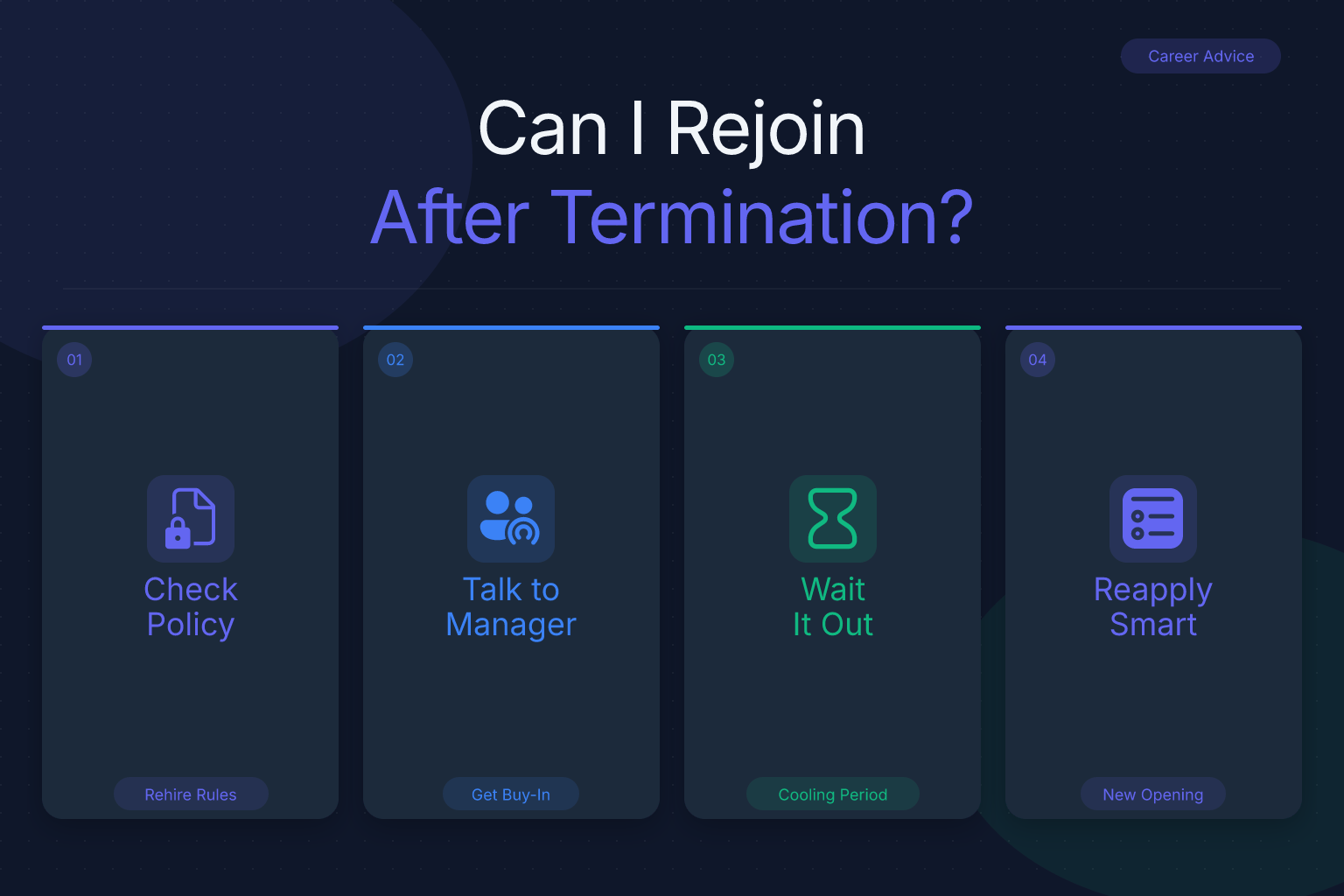
Can I Join the Same Company After Termination? What to Know in 2026
Can I join the same company after termination? In many cases, yes — but it depends on why your employment ended, how the company classifies the termination, and whether their HR system flags you as eligible for rehire. A termination is not automatically a lifetime ban. Some employers rehire former employees after a waiting period, especially if the separation was a layoff or a performance issue you’ve since addressed. Others mark certain terminations — like gross misconduct or policy violations — as permanently ineligible. This guide walks through what determines rehire eligibility, how soon you can try again, and how to position yourself if you decide to reapply.
Key Takeaways
- You can often rejoin the same company after termination, but eligibility depends on the reason for termination and the employer’s rehire policy.
- Layoffs and reductions in force usually keep you eligible for rehire immediately or after a short waiting period, while performance terminations often require 6–12 months.
- Gross misconduct, theft, harassment, or safety violations frequently result in a permanent ’not eligible for rehire’ flag in the HR system.
- Before reapplying, review your separation paperwork, ask HR about your rehire status, and rebuild a professional relationship with your former manager.
- If the same company won’t rehire you, use the same skills to target similar roles elsewhere and explain the termination honestly in interviews.
Summary Table
| What to Do | Why It Matters | Time |
|---|---|---|
| Review your separation letter and employee handbook | Tells you if you’re eligible for rehire and any waiting period | 1 hour |
| Contact former HR or your old manager | Confirms your rehire status and shows you’re serious | 1–2 days |
| Wait out any required cooling-off period | Many companies require 6–12 months before rehire | 6–12 months |
| Update your resume and prepare a termination explanation | Prepares you for the application and interview | 2–3 hours |
| Apply through a referral or direct contact | Employee referrals beat cold applications for rehires | 1 week |
Can I Join the Same Company After Termination? It Depends on the Type of Termination
The first thing to understand is that ’termination’ is an umbrella term. It covers several very different situations, and each one affects your rehire chances differently.
- Layoff or reduction in force (RIF): Your role was eliminated for business reasons, not because of your performance. Most companies treat layoffs as rehire-eligible, often immediately or after a short waiting period.
- Performance termination: You were let go because you didn’t meet expectations. Many employers allow rehire after 6–12 months, especially if you can show you’ve improved or gained new skills.
- Policy violation: You broke a company rule — attendance, internet use, dress code, etc. Rehire eligibility varies. Minor violations may allow rehire after a waiting period; serious ones may not.
- Gross misconduct: Theft, violence, harassment, fraud, or safety violations. These almost always result in a permanent ’not eligible for rehire’ status.
- Resignation in lieu of termination: You were asked to resign instead of being fired. This can be rehire-eligible or not, depending on what HR recorded.
So the answer to ‘can I join same company after termination’ is not a simple yes or no. It depends on which box HR checked when they processed your separation.
How to Check If You’re Eligible for Rehire
Before you spend time applying, find out where you stand.
- Read your separation paperwork. Look for language about rehire eligibility, waiting periods, or ’not eligible for rehire.’ Some companies include this in the termination letter or separation agreement.
- Check the employee handbook. Many handbooks spell out rehire policies, including how long you must wait after different types of termination.
- Contact HR directly. Send a short, professional email asking: ‘Can you confirm my rehire status and any applicable waiting period?’ HR is usually willing to share this.
- Ask your former manager. If you left on decent terms, your manager may know whether the company would consider rehiring you and can advocate for you later.
If HR says you’re marked ’not eligible for rehire,’ that’s usually a hard stop. But if you’re eligible or the status is unclear, you have a path forward.
How Soon Can You Rejoin the Same Company After Termination?
There’s no universal waiting period. It depends on the company and the reason for termination.
- Layoff: Some companies rehire laid-off employees within 30–90 days if a role opens up. Others require 6 months.
- Performance termination: Many employers use a 6-month or 12-month cooling-off period. This gives you time to address the issues that led to the termination.
- Policy violation: Waiting periods can range from 6 months to permanent ineligibility, depending on severity.
- Gross misconduct: Usually no waiting period because rehire is off the table permanently.
The best way to find out is to ask HR or check your separation documents. If a waiting period applies, mark the date on your calendar and use that time to strengthen your candidacy.
Steps to Reapply to a Former Employer After Termination
If you’re eligible and the waiting period has passed, here’s how to approach it.
- Reconnect with your former manager or a trusted colleague. A referral from someone inside the company is far more effective than a cold application. Ask if they’d be willing to recommend you.
- Apply through the company’s career portal or employee referral link. Use the same email and name you used before so HR can match your records.
- Address the termination in your cover letter or application. Don’t ignore it. A short, honest explanation shows maturity. For example: ‘I left in 2025 after a performance improvement period. Since then, I completed a project management certification and led two successful freelance projects.’
- Prepare for the interview question. Expect to be asked why you left and why you want to return. Practice a concise, forward-looking answer.
- Show what’s changed. Bring evidence of new skills, certifications, or results since your termination. This is the strongest way to overcome the old performance concern.
If you’re not sure how to frame a short or difficult tenure, our guide on how to find a job after being fired walks through the exact language to use.
How to Explain a Termination When You Reapply
The way you talk about the termination matters more than the termination itself.
- Be honest but brief. Never lie about why you left. HR can verify the reason. Instead, give a one- or two-sentence explanation and pivot to what you’ve done since.
- Take responsibility where appropriate. If it was a performance issue, say what you learned and how you’ve improved. Avoid blaming your manager or the company.
- Focus on the future. Emphasize why you want to return to this specific company and what you can contribute now.
- Use neutral language. Say ‘my role ended’ or ‘I was let go’ rather than ‘I was fired’ if that feels more comfortable, but don’t obscure the facts.
For example: ‘My previous role ended after I struggled to meet sales targets during a difficult quarter. Since then, I’ve completed a sales methodology course and exceeded quota in two contract roles. I’d like to bring that improved performance back to this team.’
If your termination was due to a company closure or layoff rather than performance, the framing is different. See how to explain short tenure due to company closure for sample answers.
What to Do If the Same Company Won’t Rehire You
Sometimes the answer is no — permanently or for the foreseeable future. That doesn’t mean your career is over.
- Ask for feedback. If HR is willing, ask what would need to change for you to be considered again. Even if the answer is ’never,’ the feedback can help you elsewhere.
- Target similar companies. Your industry knowledge and skills are transferable. Use a job board to find roles at competitors or adjacent companies where your experience is valued.
- Reframe the termination on your resume and in interviews. You don’t need to list ’terminated’ on your resume. Focus on what you accomplished and the skills you built.
- Build new references. Former colleagues, clients, or freelance contacts can vouch for your work even if your former employer won’t.
- Consider a different role or industry. Sometimes a termination is a signal that the role wasn’t the right fit. A lateral move can reset your trajectory.
Before you start applying anywhere, run your resume through a free resume score checker to make sure it’s ATS-ready and highlights your strengths, not your gaps.
How to Strengthen Your Application Before Reapplying
Whether you’re reapplying to the same company or looking elsewhere, use the waiting period to improve your candidacy.
- Update your resume. Add any new skills, certifications, freelance work, or volunteer roles since your termination. Use a clean, single-column format that ATS software can parse.
- Fill the gap. If you’ve been out of work for a few months, add a relevant project, course, or contract role. This shows you stayed active.
- Collect new references. Ask recent clients, collaborators, or instructors to speak to your current abilities.
- Practice your termination explanation. Write it down, say it out loud, and refine it until it sounds confident and forward-looking.
- Research the company’s current openings. Before you reapply, check what roles are available and whether your old team is hiring. Our guide on how to research a company before an interview can help you prepare.
A strong, updated resume is the foundation. If you need a clean, ATS-friendly format, the ResumeMate resume builder lets you create one free in minutes.
FAQ
Q: Can I join same company after termination?
A: Yes, in many cases. Whether you can rejoin depends on the reason for termination and the company’s rehire policy. Layoffs and performance terminations often allow rehire after a waiting period, while gross misconduct usually results in permanent ineligibility.
Q: How soon can I join same company after termination?
A: There’s no universal rule. Layoffs may allow rehire within 30–90 days, while performance terminations often require a 6–12 month cooling-off period. Check your separation paperwork or ask HR for the specific waiting period.
Q: Can I get a job after termination?
A: Yes. A termination does not prevent you from getting another job. Most employers care more about how you explain the termination and what you’ve done since than the fact that it happened. Focus on your skills, results, and growth.
Q: How to get another job after termination?
A: Update your resume to highlight recent accomplishments, prepare a brief honest explanation for interviews, and apply to roles where your skills are a strong match. Use referrals and networking to get past initial screening. A free resume score check can help you spot gaps before you apply.
Q: Does LTD continue after termination?
A: It depends on your policy. If you have employer-provided long-term disability (LTD) coverage, termination usually ends your coverage unless you were already receiving benefits or your policy includes a conversion or portability option. If you’re on an approved LTD claim when your employment ends, benefits may continue under the policy terms — check with your insurer or HR.
Q: How long after a termination can you try again?
A: For the same company, wait until any required rehire waiting period has passed — often 6–12 months for performance terminations. For other employers, you can start applying immediately; there’s no legal waiting period.
Q: Can a company rehire after termination?
A: Yes. No federal law prohibits a company from rehiring a terminated employee. Employers set their own rehire policies, and many rehire former employees after a waiting period, especially for layoffs or performance issues that have been addressed.
Q: What to do after termination?
A: First, review your separation documents and confirm your rehire status. Then update your resume, collect references, and start applying to new roles. If you want to return to the same company, wait out any required period and reconnect with your former manager.
Track Every Application While You Job Hunt
Stop losing track of where you’ve applied. The ResumeMate Job Tracker is a free Chrome extension that tracks every application, deadline, and follow-up in one place — right from your browser.