Canadian Resume Format 2026: Free Templates & Key US Differences
The Canada resume format in 2026 closely resembles the US style but includes specific nuances suited to Canadian employers and privacy laws. Understanding length, sections, photo etiquette, and formatting tailored to Canadian norms helps job seekers optimize their applications and pass ATS screenings effectively. With many Canadian companies adopting modern ATS platforms like Workday and Greenhouse, ensuring your document is both human-readable and machine-parseable is critical.
| Canada Resume Norms at a Glance |
|---|
| Length: 1-2 pages (depending on experience) |
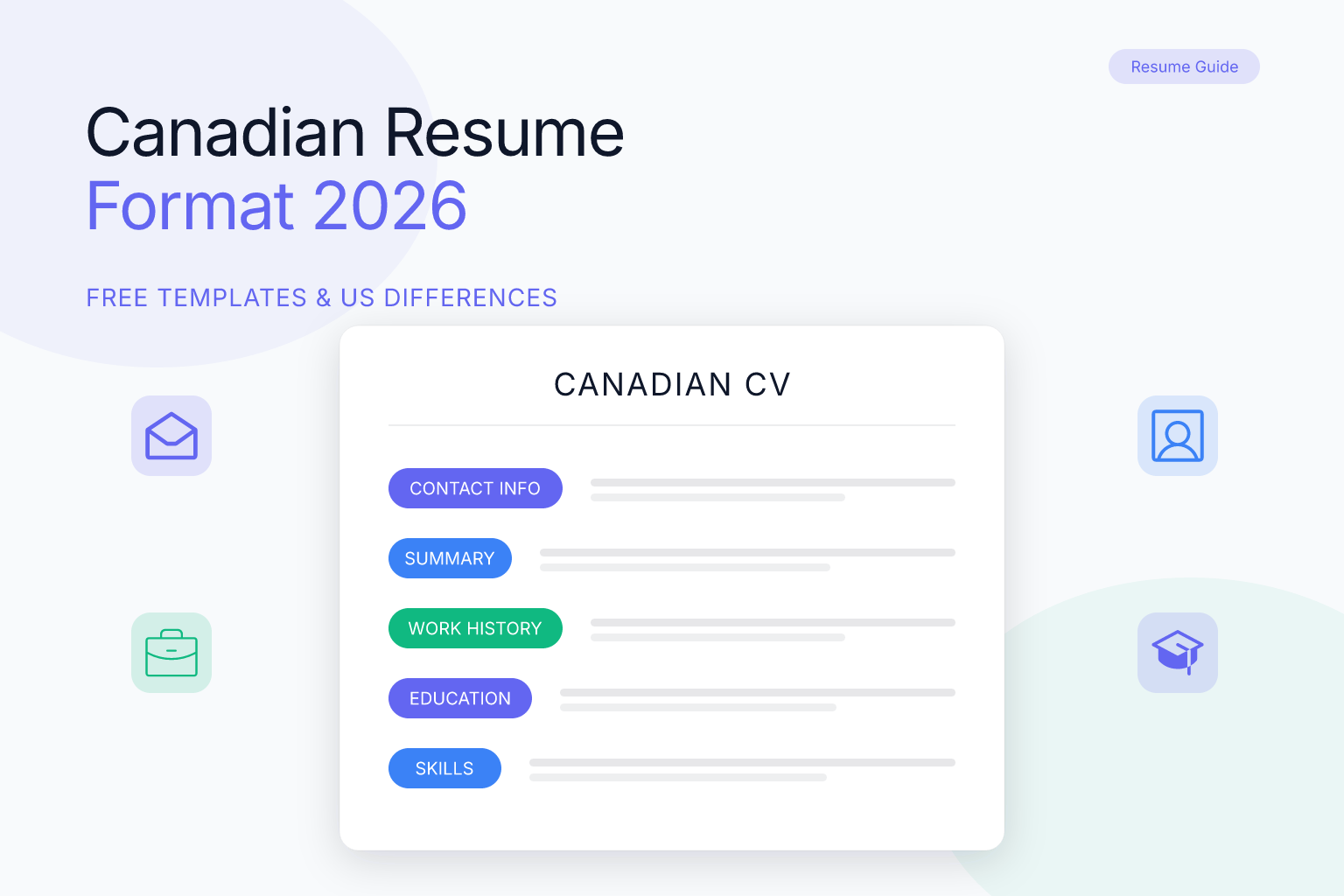
| Key sections: Contact Info, Summary, Experience, Education, Skills |
| Photo: Usually excluded to avoid bias |
| Paper Size: Letter (8.5 x 11 inches) |
| Date Format: YYYY-MM-DD (ISO) or MM/DD/YYYY |
| File Type: PDF preferred (unless DOCX is explicitly requested) |
What’s Different : Canada vs. US Resumes
| Feature | Canada Resume | US Resume |
|---|---|---|
| Length | Often 1-2 pages | Commonly 1 page |
| Photo | Generally excluded | Typically excluded |
| Date Format | YYYY-MM-DD or MM/DD/YYYY | MM/DD/YYYY |
| Contact Information | City, Province (e.g., Toronto, ON) | City, State (e.g., Austin, TX) |
| Language & Spelling | Canadian English (e.g., “centre”, “colour”) | American English |
Canadian resumes emphasize clarity, brevity, and professional tone catering to diverse industries. While the two formats share many similarities, Canadian employers often expect slightly more detail on volunteer work and community involvement. Additionally, Canadian resumes may be more flexible on length—two pages are perfectly acceptable for mid-career professionals, whereas US resumes often stick to one page regardless of experience.
Spelling conventions also differ subtly: Canadian English blends British and American influences, so words like “centre” (vs. “center”) or “colour” (vs. “color”) may appear, though many Canadian workplaces accept either. Always mirror the language used in the job posting. Another key difference lies in privacy expectations; Canadian human rights legislation is strict regarding personal data, so omitting age, marital status, and photos is not just etiquette—it’s compliance.
Beyond the table, Canadian hiring managers often value a resume that demonstrates soft skills through concrete examples—teamwork, adaptability, and communication are highly prized. Volunteer roles, side projects, and community leadership can carry as much weight as paid experience, especially for newcomers building a Canadian network. If you’re applying from abroad, explicitly stating your eligibility to work (e.g., “Permanent Resident” or “Open Work Permit”) near the top of your resume can preempt screening questions and speed up the process.
Formatting & File Setup (Letter, Date Formats)
- Paper Size: Use US Letter size (8.5 x 11 inches) for Canadian applications. A4 is rarely used unless applying to international organizations based in Canada.
- Fonts: Use professional fonts like Arial, Calibri, or Garamond sized 10-12pt. Consistency is key—don’t mix serif and sans-serif fonts arbitrarily.
- Margins: Standard margins of around 2.5 cm (1 inch) recommended. Narrower margins (0.5 inches) can be used sparingly if you need to fit content on a single page, but avoid going smaller.
- Date Formatting: Use ISO format YYYY-MM-DD (preferred by many Canadian employers) or MM/DD/YYYY. Consistency matters more than the specific choice; don’t switch formats between jobs.
- File Type: PDF is preferred for layout consistency. Modern ATS (Workday, Greenhouse, Lever, iCIMS) parse clean, text-based PDFs reliably. Only use DOCX if a specific portal explicitly requests it.
- ATS Compatibility: Avoid headers, footers, complex tables, images, or graphics. Use clear headings and bullet points.
To ensure your resume passes applicant tracking systems (ATS) without hiccups, stick to a single‑column layout and standard section titles like “Work Experience” and “Education.” While some older advice suggests DOCX is safer, clean PDFs are now the industry standard for preserving design integrity across devices. For a collection of templates already optimized for Canadian ATS, see our ATS-Friendly Resume Templates (2026).
Essential Sections in a Canadian Resume
1. Contact Information
- Full name (as it appears on legal documents)
- Phone number with Canadian country code (+1)
- Professional email address (avoid nicknames)
- LinkedIn profile URL (optional but recommended)
- Location: City and Province (e.g., “Toronto, ON”)
- No photos to maintain compliance with anti-discrimination laws
Include your city and province—a full street address is unnecessary and can raise privacy concerns under PIPEDA (Personal Information Protection and Electronic Documents Act). If you are willing to relocate, you can note “Open to Relocation” beneath your city.
2. Professional Summary
Concise overview of skills, experience, and career objectives aligned with the role. Tailor this section to each job by mirroring keywords from the posting; a generic summary will be skimmed or ignored. In 2026, recruiters spend an average of 6-7 seconds on an initial scan, so your summary must hook them immediately with value propositions rather than objectives.
3. Work Experience
- Reverse-chronological order listing job title, employer, location (city, province), and dates (YYYY-MM).
- Focus on measurable achievements and responsibilities. Use strong action verbs and quantify results wherever possible—Canadian recruiters look for concrete impact.
- Contextualize international experience: If your previous employers are not known in Canada, add a brief descriptor (e.g., “Top 5 Retail Bank in Europe”).
4. Education
Include degrees, institutions, graduation dates, and any certifications relevant to the role. If your education was completed outside Canada, mention any credential evaluation (e.g., WES) to help employers understand its Canadian equivalency. This is crucial for regulated professions like engineering, nursing, or accounting.
5. Skills
Highlight technical proficiencies and relevant soft skills. Separate hard skills (software, tools, certifications) from soft skills, and avoid listing generic traits like “hard worker” without evidence elsewhere in the resume. To identify which skills matter most for your target role, review our ATS Resume Keywords for 50+ Jobs for copy-paste lists tailored to specific industries.
6. Additional Sections (Optional)
- Volunteer work: Highly valued in Canada.
- Professional affiliations: e.g., PMP, CPA, CFA.
- Languages: Specify proficiency levels (e.g., Native, Fluent, Intermediate).
- Relevant courses: Especially if upskilling for a career pivot.
Volunteer experience is especially valued in Canada and can set you apart from other candidates. It demonstrates community engagement and soft skills like teamwork and leadership in a real-world context.
Examples/Templates
Canadian Resume Summary Example
Results-driven software developer with 4 years’ experience in full-stack development and agile methodologies. Proven ability to deliver scalable solutions that improved system efficiency by 25%. Seeking to leverage expertise at [Company] to drive digital transformation initiatives.
Canadian Work Experience Example
Marketing Coordinator
ABC Marketing, Toronto, ON | 2021-05 – Present
- Executed digital marketing campaigns across social media platforms increasing audience engagement by 30%.
- Managed client communication and contributed to a 15% rise in client retention through proactive account management.
- Coordinated cross-functional teams to launch 3 major product releases ahead of schedule.
Project Manager (example for mid‑career roles)
XYZ Construction, Vancouver, BC | 2019-03 – 2021-04
- Led cross‑functional teams of 12+ to deliver $2M infrastructure projects on time and under budget.
- Implemented agile workflows that reduced project cycle time by 20%.
- Negotiated vendor contracts saving the company $50K annually in material costs.
For a complete, ready‑to‑use Canadian resume template, browse our ATS‑friendly resume templates—they’re designed to pass both Canadian ATS and human review.
Bilingual Considerations: English and French
Canada is an officially bilingual country. While most job postings are in English, roles in Quebec, the federal public service, and certain industries may require French proficiency or a bilingual resume.
- Federal government jobs often require candidates to demonstrate language proficiency in both official languages. Your resume may need to meet specific Second Language Evaluation (SLE) standards.
- Quebec-based roles are predominantly in French. If applying to companies headquartered in Montreal or Quebec City, submitting your resume in French is strongly recommended unless the posting specifies otherwise.
- Bilingual roles outside Quebec typically require professional proficiency in both languages. List your French and English proficiency clearly in the Skills or Languages section.
If you are applying to a bilingual role, consider submitting two versions of your resume — one in English and one in French — or a single document that presents both languages side by side. When indicating language skills, use clear descriptors like “Fluent,” “Professional Working Proficiency,” or Canadian Language Benchmarks (CLB) levels if known.
If you’re also targeting jobs in other countries, our guide on the Australia Resume Format covers the key differences you’ll need to know.
Step-by-Step Guide: Building a Canadian Resume
- Choose a clean, ATS-compatible template. Stick to single-column layouts or simple two-column designs. Letter-size (8.5 x 11 in) page setup is standard.
- Write your contact block. Include your full name, phone number with the +1 country code, professional email, city and province, and an optional LinkedIn URL. No photo, no date of birth.
- Craft your professional summary. Write 2–4 sentences targeting the specific job. Mention your years of experience, core strength, and one key achievement.
- List work experience in reverse-chronological order. Use the job title, company name, city and province, and employment dates in YYYY-MM format. Start every bullet with a strong action verb.
- Quantify your achievements wherever possible. Canadian employers value measurable results. Replace vague phrases like “responsible for marketing” with “launched three digital campaigns that increased website traffic by 40%.”
- Add your education section. Include your degree, institution name, province, and graduation year. Add any Canadian professional designations (e.g., CPA, P.Eng., PMP).
- Include a skills section. List hard skills (software, tools, certifications) and a few key soft skills. Avoid generic filler like “team player” unless backed by evidence elsewhere.
- Add optional sections. Volunteer work is taken seriously by Canadian employers and demonstrates community engagement. Professional associations and languages spoken are also valuable additions.
- Tailor keywords to each job posting. Canada has a large ATS-driven hiring market. Review the job description carefully and mirror relevant terms in your resume.
- Check your ATS score. Before applying, upload your draft to a Resume Score Checker to identify missing sections or formatting issues that could block interviews.
- Export as PDF. Unless the job posting requests DOCX, always submit as PDF to preserve your formatting. Modern systems handle PDFs securely and accurately.
Role-Specific Canadian Resume Examples
Tech / Software Development
Summary:
Full-stack developer with 6 years of experience building scalable web applications in React and Node.js. Delivered three enterprise-level products on schedule and under budget at a mid-size Toronto startup. Open to remote and hybrid roles across Canada.
Work Experience Bullet:
- Redesigned API architecture, reducing server response time by 45% and cutting infrastructure costs by $12K annually.
Healthcare (Nurse / Allied Health)
Summary:
Registered Nurse (RN) with 8 years of acute care experience in Ontario hospitals. Skilled in patient assessment, care planning, and interdisciplinary team collaboration. Certified in BLS and ACLS.
Skills:
- Electronic Medical Records: Epic, Meditech
- Languages: English (Native), French (Conversational)
- Certifications: BCLS, ACLS, IV Therapy
Skilled Trades
For trades roles, Canadian employers often want to see your Red Seal certification, apprenticeship completion, and provincial licensing details prominently listed near the top of your resume — not buried in the education section.
Example bullet for an Electrician:
- Completed 4‑year apprenticeship (Red Seal endorsed); installed and maintained electrical systems for 200+ residential and commercial projects across Alberta.
Business & Administration
Summary:
Administrative professional with 5 years of experience supporting C‑suite executives in fast‑paced Toronto firms. Streamlined office operations, reducing supply costs by 18% and improving meeting efficiency through digital scheduling tools.
Work Experience Bullet:
- Coordinated travel and logistics for 10+ executives, saving an average of 5 hours per week through centralized booking processes.
Accounting & Finance
Summary:
CPA-designated accountant with 4 years of experience in financial reporting, tax preparation, and audit support for mid-market firms in Vancouver. Reduced month-end close cycle by 3 days through process automation.
Work Experience Bullet:
- Prepared GAAP-compliant financial statements for 20+ clients, ensuring 100% on-time filing and zero compliance issues.
For more detailed examples and keyword strategies specific to accounting roles, see our Accountant Resume Examples with CPA and GAAP Skills.
International Applicants: Tips for Newcomers to Canada
If you’re applying from abroad—whether from South Africa, India, the Philippines, or elsewhere—tailoring your resume to Canadian expectations can significantly improve your callback rate. Canadian employers are accustomed to seeing international experience, but they need help understanding its relevance.
- Credential evaluation: If your degree or certification is from outside Canada, include a line like “Evaluated by WES as equivalent to a Canadian Bachelor’s degree” directly in the Education section. This removes guesswork and shows you’ve taken proactive steps.
- Work eligibility: Clearly state your immigration status near the top of your resume (e.g., “Permanent Resident,” “Open Work Permit – valid until 2027,” or “Eligible for IEC Working Holiday Visa”). This prevents immediate rejection due to uncertainty about your right to work.
- Contextualize employers: For companies not well-known in Canada, add a one-line descriptor (e.g., “Leading telecommunications provider in South Africa with 5,000+ employees”).
- Highlight Canadian connections: If you’ve studied in Canada, completed a co-op placement, or volunteered with a Canadian organization, feature that prominently—it signals local experience and cultural integration.
- Language proficiency: If English or French is not your first language, include a test score (IELTS, CELPIP, TEF) or a clear proficiency level. Even if you’re a native speaker, stating “English (Native)” can be helpful.
- Adapt to Canadian spelling and norms: Use Canadian English spelling and follow the formatting guidelines in this article. Small details like using “colour” instead of “color” can subtly signal your attention to local standards.
Common Mistakes in Canadian Resumes
- Including a photo. Unlike German or some Asian markets, photos are inappropriate on Canadian resumes and can trigger discrimination concerns. Canadian human rights legislation encourages employers to focus on qualifications, not appearance.
- Using American spelling exclusively. Words like “organize,” “color,” and “center” differ from Canadian English spellings (“organise,” “colour,” “centre”) in some conventions — though Canadian English is often closer to American. Always check the job posting’s language for cues. When in doubt, use the spelling that appears in the job ad.
- Writing a generic objective statement. Replace vague objectives with a tailored professional summary that shows specific value. Instead of “Seeking a challenging position where I can grow,” write “Digital marketing specialist with 3 years of experience driving 40% organic traffic growth, seeking to leverage SEO expertise at a Vancouver‑based agency.”
- Leaving off volunteer experience. Canadian culture values community involvement. Even informal volunteer roles can strengthen your application, especially if you’re new to the country or have employment gaps.
- Not mentioning Canadian credentials or equivalencies. If your degree or certification is from outside Canada, state how it has been recognized (e.g., through WES credential evaluation). This removes guesswork for employers and shows you’ve taken steps to meet Canadian standards.
- Using an overly long resume for entry-level roles. Unless you have 5+ years of relevant experience, one page is preferred for early-career candidates. Even for senior roles, two pages is the maximum—Canadian recruiters rarely read beyond that.
- Ignoring ATS Optimization. Using graphics, columns, or tables can confuse parsing software. Stick to standard headings and simple formatting to ensure your content is read correctly.
Compliance and Anti-Bias Notes
Canadian employers are bound by federal and provincial human rights legislation that prohibits discrimination based on race, age, gender, marital status, religion, and other personal characteristics. To support fair hiring, your resume should focus strictly on professional qualifications.
- Do not include a photo, date of birth, marital status, or religious affiliations.
- Avoid mentioning your age indirectly (e.g., by listing decades of experience if it’s not essential).
- Many Canadian organizations use blind recruitment practices, so keeping personal details off your resume aligns with their processes and reduces unconscious bias.
- If you’re unsure whether a piece of information is appropriate, ask yourself: “Does this directly demonstrate my ability to do the job?” If not, leave it out.
FAQ
Q: What is the standard Canada resume format?
A: The standard Canada resume format is reverse-chronological, limited to 1-2 pages, and excludes photos or personal data like age and marital status. It should use US Letter paper size (8.5 x 11 inches) and standard section headings like “Experience” and “Education.”
Q: Is the American resume format the same as Canadian?
A: They are very similar, but Canadian resumes often allow two pages more readily, place higher emphasis on volunteer work, and may use Canadian English spelling. Both formats exclude photos, but Canadian privacy laws make omitting personal data even more critical.
Q: Should I include a photo on a Canadian resume?
A: No. Including a photo on a Canadian resume is considered inappropriate and may raise concerns about compliance with human rights legislation. Employers focus on skills and experience rather than appearance.
Q: How long should a Canadian resume be?
A: One to two pages, depending on your experience. Entry-level candidates should aim for one page; experienced professionals may use two. Recruiters rarely read beyond the second page.
Q: What is the difference between a Canadian CV and resume?
A: In Canada, a CV is typically used for academic, research, or medical roles and can be several pages long, detailing publications and grants. A resume is the standard document for most job applications and is kept to 1–2 pages.
Q: Can I use a US resume for Canadian jobs?
A: Yes, with a few adjustments. Change the spelling to Canadian English if the job posting uses it, add your city and province, and consider expanding to two pages if you have significant experience. Also, highlight any Canadian credentials or equivalencies.
Q: What date format is best for Canada resumes?
A: Use ISO format YYYY-MM-DD or MM/DD/YYYY, depending on the employer. Many Canadian professionals use YYYY-MM for employment date ranges (e.g., 2021-05 to Present) to avoid confusion between day and month.
Q: What are the best Canadian resume templates for 2026?
A: The best templates are ATS-friendly, single-column designs that use standard section headings and avoid graphics or tables. ResumeMate offers a collection of free, Canadian-optimized templates that you can customize and download as PDFs. Browse the ATS-Friendly Resume Templates to find one that fits your industry.
Q: How do I write a Canadian CV for academic or research roles?
A: A Canadian academic CV is comprehensive—include sections for education, research experience, publications, conference presentations, grants, teaching experience, and professional affiliations. Unlike a resume, there is no page limit; detail is expected. Use reverse-chronological order and follow the formatting norms of your specific discipline.
Q: What is the best resume format for Canada in 2026?
A: The reverse-chronological format remains the best choice for most Canadian job seekers. It highlights your career progression clearly and is preferred by both recruiters and ATS. Functional or hybrid formats can be used if you’re changing careers or have employment gaps, but they are less common and may raise questions.
Q: How can I make my resume ATS-friendly for Canadian jobs?
A: Use a clean, single-column layout with standard headings (“Work Experience,” “Education,” “Skills”). Avoid images, tables, text boxes, and headers/footers. Save as a text-based PDF and incorporate keywords from the job description naturally. For a quick check, run your resume through a free resume score checker to see how it parses.
Q: What should international applicants include on a Canadian resume?
A: International applicants should clearly state their work eligibility (e.g., “Permanent Resident” or “Open Work Permit”), include credential evaluations (like WES) for foreign degrees, and contextualize any employers not well-known in Canada. Adding a “Languages” section with proficiency levels is also recommended.
Q: Can you provide a sample Canadian resume format?
A: Yes. A sample Canadian resume typically includes a contact block with city and province, a 2-4 sentence professional summary, reverse-chronological work experience with quantified achievements, an education section with any Canadian equivalencies, and a skills section. The examples in this guide (e.g., Marketing Coordinator, Project Manager) follow this exact structure and can be used as templates.
Q: What is the Canadian resume format for Indian applicants?
A: Indian applicants should follow the standard Canadian resume format but pay extra attention to credential evaluation (WES or similar), work eligibility status, and contextualizing employers not well-known in Canada. Include IELTS or CELPIP scores if English is not your first language, and highlight any Canadian education or work experience prominently.
Q: What is the difference between a Canadian CV format and a resume format?
A: A Canadian CV format is used for academic, research, and medical roles and includes comprehensive sections like publications, grants, and teaching experience with no page limit. A Canadian resume format is the standard 1-2 page document for most jobs, focused on work experience, skills, and education in reverse-chronological order.
Build, Score & Track Your Job Search with ResumeMate
Ready to launch your Canadian job search with confidence? Use our free tools to create, optimize, and track your applications.
Resume Builder → — Create an ATS-ready resume in minutes with Canadian-friendly templates.
Resume Score Checker → — See how your resume scores against ATS systems instantly and get section-by-section feedback.
Job Board → — Browse jobs matched to your resume with filters for role, location, and remote work.
Job Tracker Chrome Extension → — Track every application, deadline, and follow-up in one place — free.