Canadian Resume Format 2026: Key Differences from US + Templates
The Canada resume format in 2025 closely resembles the US style but includes specific nuances suited to Canadian employers. Understanding length, sections, photo etiquette, and formatting tailored to Canadian norms helps job seekers optimize their applications and pass ATS screenings effectively.
| Canada Resume Norms at a Glance |
|---|
| Length: 1-2 pages (depending on experience) |
| Key sections: Contact Info, Summary, Experience, Education, Skills |
| Photo: Usually excluded to avoid bias |
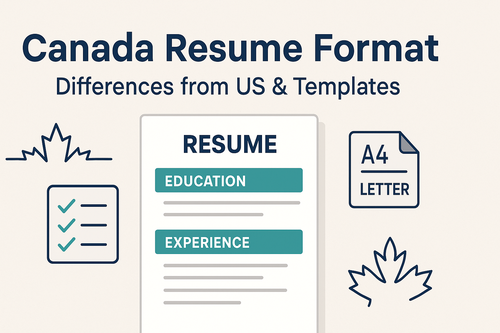
| Paper Size: Letter (8.5 x 11 inches) |
| Date Format: YYYY-MM-DD (ISO) or MM/DD/YYYY |
What’s Different : Canada vs. US Resumes
| Feature | Canada Resume | US Resume |
|---|---|---|
| Length | Often 1-2 pages | Commonly 1 page |
| Photo | Generally excluded | Typically excluded |
| Date Format | YYYY-MM-DD or MM/DD/YYYY | MM/DD/YYYY |
| Contact Information | Full name, phone, email, LinkedIn | Similar, often includes LinkedIn |
| Language & Spelling | Canadian English (e.g., “organize” vs “organise”) | American English |
Canadian resumes emphasize clarity, brevity, and professional tone catering to diverse industries.
Formatting & File Setup (Letter, Date Formats)
- Paper Size: Use US Letter size (8.5 x 11 inches) for Canadian applications.
- Fonts: Use professional fonts like Arial, Calibri, or Garamond sized 10-12pt.
- Margins: Standard margins of around 2.5 cm (1 inch) recommended.
- Date Formatting: Use ISO format YYYY-MM-DD (preferred by many Canadian employers) or MM/DD/YYYY.
- File Type: PDF is preferred for layout consistency; DOCX accepted if specified.
- ATS Compatibility: Avoid headers, footers, complex tables, images, or graphics. Use clear headings and bullet points.
Essential Sections in a Canadian Resume
1. Contact Information
- Full name
- Phone number with Canadian country code (+1)
- Professional email address
- LinkedIn profile URL (optional but recommended)
- No photos to maintain compliance with anti-discrimination laws
2. Professional Summary
Concise overview of skills, experience, and career objectives aligned with the role.
3. Work Experience
- Reverse-chronological order listing job title, employer, location (city, province), and dates (YYYY-MM).
- Focus on measurable achievements and responsibilities.
4. Education
Include degrees, institutions, graduation dates, and any certifications relevant to the role.
5. Skills
Highlight technical proficiencies and relevant soft skills.
6. Additional Sections (Optional)
- Volunteer work, professional affiliations, languages, and relevant courses.
Examples/Templates
Canadian Resume Summary Example
Results-driven software developer with 4 years’ experience in full-stack development and agile methodologies. Proven ability to deliver scalable solutions that improved system efficiency by 25%. Seeking to leverage expertise at [Company].
Canadian Work Experience Example
Marketing Coordinator
ABC Marketing, Toronto, ON | 2021-05 – Present
- Executed digital marketing campaigns across social media platforms increasing audience engagement by 30%.
- Managed client communication and contributed to a 15% rise in client retention.
Bilingual Considerations: English and French
Canada is an officially bilingual country. While most job postings are in English, roles in Quebec, the federal public service, and certain industries may require French proficiency or a bilingual resume.
- Federal government jobs often require candidates to demonstrate language proficiency in both official languages. Your resume may need to meet specific Second Language Evaluation (SLE) standards.
- Quebec-based roles are predominantly in French. If applying to companies headquartered in Montreal or Quebec City, submitting your resume in French is strongly recommended unless the posting specifies otherwise.
- Bilingual roles outside Quebec typically require professional proficiency in both languages. List your French and English proficiency clearly in the Skills or Languages section.
If you are applying to a bilingual role, consider submitting two versions of your resume — one in English and one in French — or a single document that presents both languages side by side.
Step-by-Step Guide: Building a Canadian Resume
- Choose a clean, ATS-compatible template. Stick to single-column layouts or simple two-column designs. Letter-size (8.5 x 11 in) page setup is standard.
- Write your contact block. Include your full name, phone number with the +1 country code, professional email, city and province, and an optional LinkedIn URL. No photo, no date of birth.
- Craft your professional summary. Write 2–4 sentences targeting the specific job. Mention your years of experience, core strength, and one key achievement.
- List work experience in reverse-chronological order. Use the job title, company name, city and province, and employment dates in YYYY-MM format. Start every bullet with a strong action verb.
- Quantify your achievements wherever possible. Canadian employers value measurable results. Replace vague phrases like “responsible for marketing” with “launched three digital campaigns that increased website traffic by 40%.”
- Add your education section. Include your degree, institution name, province, and graduation year. Add any Canadian professional designations (e.g., CPA, P.Eng., PMP).
- Include a skills section. List hard skills (software, tools, certifications) and a few key soft skills. Avoid generic filler like “team player” unless backed by evidence elsewhere.
- Add optional sections. Volunteer work is taken seriously by Canadian employers and demonstrates community engagement. Professional associations and languages spoken are also valuable additions.
- Tailor keywords to each job posting. Canada has a large ATS-driven hiring market. Review the job description carefully and mirror relevant terms in your resume.
- Export as PDF. Unless the job posting requests DOCX, always submit as PDF to preserve your formatting.
Role-Specific Canadian Resume Examples
Tech / Software Development
Summary:
Full-stack developer with 6 years of experience building scalable web applications in React and Node.js. Delivered three enterprise-level products on schedule and under budget at a mid-size Toronto startup. Open to remote and hybrid roles across Canada.
Work Experience Bullet:
- Redesigned API architecture, reducing server response time by 45% and cutting infrastructure costs by $12K annually.
Healthcare (Nurse / Allied Health)
Summary:
Registered Nurse (RN) with 8 years of acute care experience in Ontario hospitals. Skilled in patient assessment, care planning, and interdisciplinary team collaboration. Certified in BLS and ACLS.
Skills:
- Electronic Medical Records: Epic, Meditech
- Languages: English (Native), French (Conversational)
- Certifications: BCLS, ACLS, IV Therapy
Skilled Trades
For trades roles, Canadian employers often want to see your Red Seal certification, apprenticeship completion, and provincial licensing details prominently listed near the top of your resume — not buried in the education section.
Common Mistakes in Canadian Resumes
- Including a photo. Unlike German or some Asian markets, photos are inappropriate on Canadian resumes and can trigger discrimination concerns.
- Using American spelling. Words like “organize,” “color,” and “center” differ from Canadian English spellings (“organise,” “colour,” “centre”) in some conventions — though Canadian English is often closer to American. Always check the job posting’s language for cues.
- Writing a generic objective statement. Replace vague objectives with a tailored professional summary that shows specific value.
- Leaving off volunteer experience. Canadian culture values community involvement. Even informal volunteer roles can strengthen your application.
- Not mentioning Canadian credentials or equivalencies. If your degree or certification is from outside Canada, state how it has been recognized (e.g., through WES credential evaluation).
- Using an overly long resume for entry-level roles. Unless you have 5+ years of relevant experience, one page is preferred for early-career candidates.
Compliance and Anti-Bias Notes
- Canadian employers follow strict human rights legislation; do not include photos or personal details such as age or marital status.
- Focus on your qualifications and experience to reduce unconscious bias in the hiring process.
FAQ
Q: How long should my Canadian resume be?
A: One to two pages, depending on your experience. Entry-level candidates should aim for one page; experienced professionals may use two.
Q: Should I include a photo?
A: No. Including a photo on a Canadian resume is considered inappropriate and may raise concerns about compliance with human rights legislation.
Q: What date format is best?
A: Use ISO format YYYY-MM-DD or MM/DD/YYYY, depending on the employer. Many Canadian professionals use YYYY-MM for employment date ranges (e.g., 2021-05 to Present).
Q: Should I include my address?
A: City and province are sufficient. Providing your full street address is no longer standard practice and adds unnecessary personal detail.
Q: Do I need to include volunteer experience?
A: Yes, if it is relevant or recent. Volunteer work is valued by Canadian employers and can compensate for gaps in paid experience, particularly for newcomers to Canada.
Q: How should I handle international experience on a Canadian resume?
A: List it the same way as domestic experience. Where helpful, briefly clarify the size or context of the employer (e.g., “a 500-person logistics firm based in Germany”). Also mention any Canadian credential recognition steps you have completed.
Build, Score & Track Your Job Search with ResumeMate
Resume Builder → — Create an ATS-ready resume in minutes.
Resume Score Checker → — See how your resume scores against ATS systems instantly.
Job Board → — Browse jobs matched to your resume.
Job Tracker Chrome Extension → — Track every application, deadline, and follow-up in one place — free.