Career Change Resume Format (Combination Template)
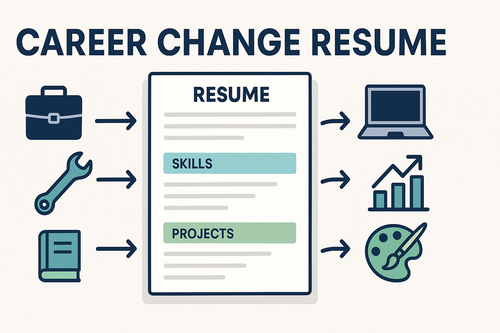
A career change resume using a combination format helps professionals smoothly transition to new fields by emphasizing transferable skills and relevant projects rather than chronological job history. In 2025, this format paired with ATS optimization can mitigate gaps and showcase your potential value to recruiters.
| Key Benefits of Combination Format |
|---|
| Highlights skills & achievements upfront |
| De-emphasizes unrelated or outdated job history |
| Bridges experience and new career goals |
| ATS-friendly structure with clear, scannable layout |
The Challenge (Recruiter Perspective)
Recruiters reviewing career change applicants often face challenges such as:
- Gaps or unrelated roles causing doubts
- Unclear connection between past roles and new field
- Difficulty finding relevant keywords for ATS scanning
A clearly structured resume that prioritizes skills and relevant experience eases this evaluation.
Choose the Right Format to De-Emphasize Gaps
- The combination resume places a Skills/Highlights section at the top, followed by a brief chronological work history.
- Use targeted headings like “Relevant Skills,” “Projects,” or “Volunteer Experience” before “Professional Experience.”
- Keep formatting clean, simple, and ATS-compatible—avoid graphics or complex layouts.
Reframe Experience (Skills, Projects, Volunteering)
- Identify and highlight transferable skills applicable to your new career.
- Showcase projects demonstrating competence in the new field.
- Include volunteering, freelance work, or certifications that support this transition.
- Briefly summarize unrelated jobs focusing on applicable soft skills.
Language Examples You Can Adapt
- Instead of “Managed sales teams,” say “Led cross-functional teams fostering collaboration and goal achievement.”
- Replace “Handled customer complaints” with “Developed conflict resolution skills improving client satisfaction.”
- Use action verbs highlighting adaptability, learning, and leadership.
How to Explain Gaps in Applications
- Be honest but brief. Use cover letters or interviews to provide context.
- Highlight productive activities during gaps such as courses, certifications, or volunteering.
- Avoid over-explaining or defensive language on your resume.
ATS Considerations
- Use keywords from job descriptions for your new industry and role.
- Maintain standard fonts and simple formatting.
- Avoid images, headers/footers, and unusual section titles that ATS may misread.
- Use plain bullet points to list skills and achievements.
Templates & Checklist
| Career Change Resume Checklist |
|---|
| Skills/Highlights section tailored to new role |
| Relevant projects and volunteering listed upfront |
| Concise chronological job history with transferable focus |
| ATS-friendly formatting and keyword usage |
| Clear, concise language emphasizing adaptability |
Copy-Ready Example (Combination Format)
Skills & Highlights
- Project management: Led 3 cross-functional teams in delivering projects on time and under budget.
- Customer relations: Developed strong communication and conflict resolution skills.
- Technical proficiency: Proficient in Microsoft Office, Salesforce, and data analysis tools.
Projects
- Volunteer Website Redesign: Collaborated with a team to redesign a non-profit website, improving user engagement by 50%.
Professional Experience
Sales Associate | RetailCorp | 2018–2024
- Managed daily customer interactions, building rapport and ensuring satisfaction.
- Trained new staff, honing leadership and training abilities.
Common Mistakes Career Changers Make on Their Resume
Even well-qualified career changers can undermine their applications with these common errors.
- Leading with job titles instead of skills: The first thing a recruiter sees should be your value — not a job title from a completely different field. Use a strong skills summary or professional profile at the top.
- Copying job descriptions verbatim: Listing duties from your old role without translating them into transferable skills makes it hard for a recruiter to see the connection to the new field.
- Leaving gaps unexplained: A visible gap with no framing creates doubt. Even a brief mention of a course, certification, or freelance project during a gap helps fill the narrative.
- Using industry-specific jargon from the old field: Terms that are common in one industry can be meaningless in another. Write for the audience of your target field, not your previous one.
- Making the resume too long: Career changers sometimes try to include everything to justify the switch. Keep it to two pages maximum and focus only on what matters for the new role.
- Neglecting the professional summary: This is the most important section for career changers. A well-crafted summary bridges your past and your future in 3–4 focused sentences.
Step-by-Step Guide: Building a Career Change Combination Resume
Use this sequence to build your resume from the ground up.
- Research your target role thoroughly — read at least five job postings and note recurring skills, tools, and qualifications.
- Audit your existing experience — list every role, project, volunteer activity, and certification you have, then map each item to skills the new field values.
- Write a focused professional summary — open with your new career direction, summarize your most transferable strengths, and close with your goal. Keep it to 3–4 sentences.
- Build the skills section first — group transferable skills under clear headings like “Leadership,” “Data Analysis,” or “Project Management” depending on what the target role demands.
- List relevant projects and volunteer work — these go before your formal work history in the combination format. Even a side project or short-term freelance engagement belongs here if it is relevant.
- Write a concise work history — include all past roles but focus each bullet point on transferable outcomes. Quantify where possible.
- Add education and certifications — include any credentials relevant to the new field, especially if you have recently completed courses to support the transition.
- Tailor for each application — use the specific language and keywords from each job description before submitting.
Role-Specific Examples: Combination Resume in Action
Teacher transitioning to Corporate Trainer
Skills & Highlights:
- Curriculum design and instructional content development for groups of 25–30 learners
- Facilitated structured learning programs improving assessment scores by 22%
- Skilled in learning management systems, presentation tools, and adult learning principles
Projects:
- Designed an onboarding training module for a 40-person volunteer organization, reducing ramp-up time by two weeks
Sales Manager transitioning to Product Manager
Skills & Highlights:
- Customer needs analysis and feedback synthesis across 200+ client accounts
- Cross-functional collaboration between sales, engineering, and marketing teams
- Data-driven decision-making using CRM dashboards and sales analytics
Projects:
- Led internal process redesign project that reduced customer onboarding time by 30%
FAQ
Q: Is the combination format best for all career changers?
A: It is ideal for those with transferable skills who need to de-emphasize unrelated experience. If you have strong directly relevant experience in your new field already (through freelance or side projects), a chronological format may also work.
Q: How long should a career change resume be?
A: One to two pages, focused on relevance and clarity. If you have extensive experience in your previous field, prioritize brevity and use the space for what matters in the new field.
Q: Should I address career gaps on my resume?
A: Briefly mention productive activities during gaps — such as coursework, certifications, or freelance work. Save detailed explanations for cover letters or interviews.
Q: Can I include freelance or volunteer work?
A: Yes, especially when it is relevant to your new career path. Treat it with the same formatting and detail as paid employment if it demonstrates genuine skill.
Q: Do I need a cover letter when changing careers?
A: A cover letter is strongly recommended for career changers. It gives you space to explain your motivation, connect your background to the new role, and show that your transition is deliberate rather than accidental.
Q: Should I get new certifications before applying?
A: If a specific certification is commonly listed as a requirement in job postings for your target role, obtaining it before applying significantly strengthens your application. Even in-progress certifications are worth noting.
Build, Score & Track Your Job Search with ResumeMate
Resume Builder → — Create an ATS-ready resume in minutes.
Resume Score Checker → — See how your resume scores against ATS systems instantly.
Job Board → — Browse jobs matched to your resume.
Job Tracker Chrome Extension → — Track every application, deadline, and follow-up in one place — free.