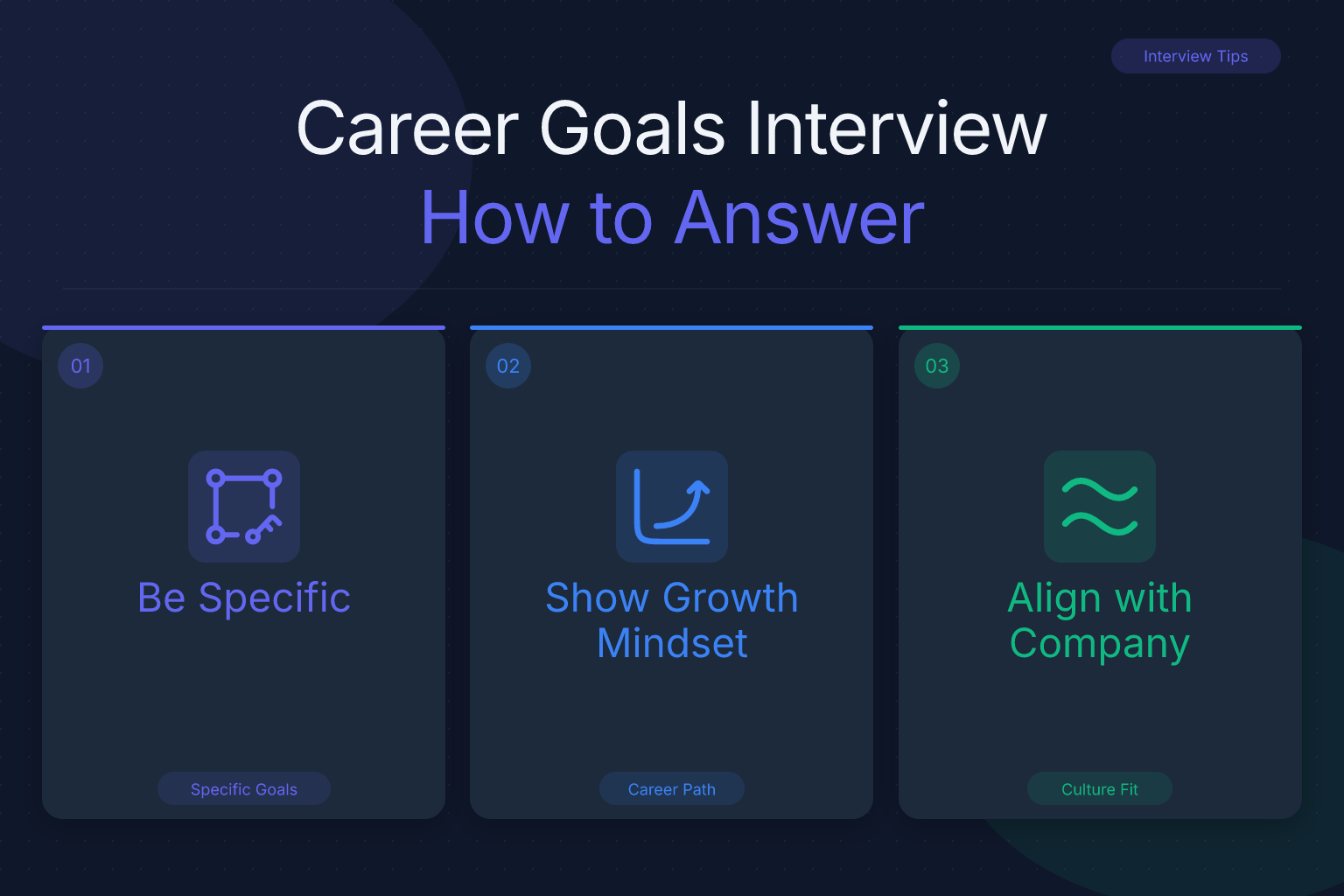
Career Goals Interview: How to Answer (With Examples)
When an interviewer asks “What are your career goals?”, they’re not just making small talk. This question reveals whether your ambitions align with the role and the company’s future. A strong answer shows you’re thoughtful, motivated, and likely to stick around. In this guide, you’ll learn exactly how to structure your response, what to avoid, and get examples for different career stages.
Key Takeaways
Before diving into the details, here are the most important points to remember—each backed by a concrete example so you can see exactly how to apply them.
- The question tests alignment, not a 10-year plan. Interviewers want to see that your goals make sense for this role. For example, if you’re applying for a junior developer role and say your goal is to become a CTO within five years, that might signal you’ll be impatient or leave if you don’t get promoted quickly. Instead, a better goal: “I want to become a senior developer who mentors new hires and contributes to architecture decisions.”
- Structure your answer with a simple framework. Use short-term (1–2 years), mid-term (3–5 years), and how-this-role-fits. For instance, a marketing candidate might say: “In the next year, I’ll master SEO and content analytics. In three years, I want to lead a content team. This role gives me the hands-on SEO ownership I need to get there.”
- Tailor your goals to the job and company. Generic answers like “I want to grow” fail. Research the company’s career ladder. If you’re interviewing at a startup that values ownership, say: “I want to take on increasing responsibility for product launches and eventually own a product line—exactly the kind of growth I see happening here.”
- If you’re unsure about long-term goals, focus on skills and impact. You can say: “I’m still exploring the exact path, but I know I want to become an expert in data visualization and use it to drive business decisions. This role lets me work with real datasets and learn from senior analysts.”
- Avoid goals that conflict with the role. Saying “I plan to go back to school full-time in a year” or “I want to start my own business soon” raises red flags. Instead, if you have entrepreneurial ambitions, frame them as something you’d pursue within the company: “I’m excited to help build new initiatives from the ground up here.”
These takeaways set the foundation. Now let’s explore why interviewers ask this question in the first place.
Why Interviewers Ask “What Are Your Career Goals?”
Hiring managers ask this question for three main reasons, and understanding each one helps you craft an answer that directly addresses their concerns.
- To gauge your ambition and self-awareness. They want to see if you’ve thought about your professional future and can articulate a direction. Someone who has no goals may lack motivation or drift from role to role. For example, a candidate who says “I’ve always been passionate about user experience, and I’ve already started learning Figma and taking on small redesign projects” shows initiative and clarity.
- To check alignment with the role and company. If your goal is to become a data scientist but you’re interviewing for a customer support position with no analytics path, there’s a mismatch. They need to know you’ll be satisfied and engaged in the work you’ll actually do. A well-aligned answer might be: “I want to become a team lead in customer success, and I see that this company promotes from within—several current managers started in this exact role.”
- To assess retention risk. Replacing an employee can cost up to 200% of their annual salary. If your goals suggest you’ll leave in six months (e.g., “I want to go to grad school full-time”), they may hesitate to invest in you. A safer answer: “I’m committed to growing here for the long term and eventually moving into a senior specialist role.”
Understanding these motivations helps you frame an answer that addresses their concerns while staying authentic.
How to Structure Your Answer (The Short-Mid-Long Framework)
A clear, logical structure makes your answer easy to follow and remember. Use this three-part framework:
1. Short-Term Goal (Next 1-2 Years)
Focus on skills you want to build and immediate contributions you can make in the role. This shows you’re ready to hit the ground running.
Example: “In the next year, I want to deepen my expertise in project management methodologies and earn my PMP certification while delivering complex projects on time for the team.”
2. Mid-Term Goal (3-5 Years)
Describe the kind of professional you want to become — a specialist, a team lead, a go-to expert. Tie it to the natural progression within the company if possible.
Example: “Within three to five years, I see myself growing into a senior project manager role where I can mentor junior team members and lead cross-functional initiatives that improve our delivery processes.”
3. How This Role Fits
Explicitly connect the dots. Explain why this specific job is the right next step for your journey. This is where you show you’ve done your homework.
Example: “This role is the perfect next step because it will let me own end-to-end projects, work closely with the engineering and design teams you mentioned, and learn from experienced PMs — all of which are essential for the growth I’m aiming for.”
Keep the entire answer to 60-90 seconds. Practice until it feels natural, not rehearsed.
How to Answer When You Don’t Know Your Career Goals
Not everyone has a five-year plan, and that’s okay. Many successful professionals figure it out as they go. If you’re unsure, pivot the question toward learning, impact, and values rather than a specific job title.
Try this approach:
- Focus on skills, not titles. “I’m still exploring the exact path, but I know I want to build deep expertise in data analysis and eventually use those skills to influence product decisions. This role gives me that opportunity.”
- Talk about the problems you want to solve. “My goal is to work on challenges that improve how teams collaborate remotely. I’m excited about this role because your company is already leading in that space.”
- Emphasize growth and contribution. “I want to keep learning from strong mentors and contribute to projects that have measurable business impact. I see this position as a place where I can do both.”
This reframes uncertainty as curiosity and a desire to add value — traits most employers appreciate.
Career Goals Answer Examples for Different Scenarios
Entry-Level Candidate
“My short-term goal is to absorb as much as I can about digital marketing analytics and become proficient in tools like Google Analytics and Looker Studio. In three to five years, I’d like to lead campaigns independently and eventually manage a small team. This role is ideal because it offers hands-on experience with real client data and mentorship from senior marketers.”
Student or Intern
“As a computer science student, my immediate goal is to apply what I’ve learned in the classroom to real-world software development. I want to contribute to a shipping product, learn agile workflows, and get comfortable with code reviews. In the next few years, I aim to become a full-stack engineer who can own features from front to back. This internship is the perfect launchpad because I’ll be embedded in a cross-functional team and paired with a mentor.”
Mid-Career Professional
“I’ve spent the last six years in software engineering, and now I want to transition into a technical lead role where I can architect solutions and mentor developers. In the next year, I plan to deepen my cloud architecture skills and take on more design responsibilities. This position aligns perfectly because it involves leading a squad and collaborating with product — exactly the blend I’m looking for.”
Career Changer
“After a decade in teaching, I’m pivoting into instructional design. My immediate goal is to master e-learning authoring tools and apply my curriculum development experience to corporate training. In three years, I aim to lead learning experience design projects. This role is the bridge I need — it lets me leverage my education background while building new technical skills.”
Administrative Assistant
“I want to become the go-to person for office operations and executive support. In the next year, I plan to streamline scheduling and travel coordination using tools like Asana and Concur, and eventually take on event planning responsibilities. Long-term, I see myself as an office manager or executive assistant supporting C-suite leaders. This role gives me the foundation to grow in that direction.”
When You Aspire to Leadership
“My goal is to grow into a people management role. In the short term, I want to excel as an individual contributor on the sales team, exceed quota, and learn the coaching techniques your top managers use. Within five years, I hope to lead a regional sales team. I’m drawn to this company because you promote from within and have a clear path from AE to team lead.”
Each example follows the framework and ties back to the specific job. Adapt the details to your industry and the company’s reality.
Common Mistakes to Avoid
Even a well-intentioned answer can backfire if you fall into these traps. Here’s what to watch out for, with examples of what not to say and how to fix it.
- Being too vague. Saying “I want to grow and learn” tells the interviewer nothing. Instead, be specific: “I want to become the go-to person for Salesforce reporting and eventually train new hires on our CRM processes.” The difference is night and day.
- Focusing only on personal benefits. “I want a higher salary and a better title” sounds self-centered. Reframe around contribution: “I’m excited to take on more responsibility and help the team reduce customer churn—which I know will also advance my career.”
- Mentioning goals that conflict with the role. For example, “I plan to launch my own startup in two years” when applying for a permanent position signals you’ll leave soon. If you have entrepreneurial dreams, say: “I’m passionate about building new things, and I’d love to help launch new initiatives within this company.”
- Giving an overly rigid plan. “I must be a VP by 35” can make you seem inflexible. A better approach: “I hope to grow into a leadership role where I can drive strategy, but I’m open to the path that makes the most impact for the business.”
- Forgetting to connect to the company. Your answer should make it clear why you want to achieve those goals here. For instance, “I want to lead a design team” is okay, but “I want to lead a design team at a company that values user research as much as yours does” shows you’ve done your homework. For more on avoiding interview pitfalls, check out our guide on common interview mistakes.
- Sounding too rehearsed or robotic. Even a well-structured answer can fall flat if it sounds like you’re reading a script. Use bullet points, not a full script, and practice until the words feel like your own. A conversational tone builds trust.
How to Tailor Your Answer to the Company and Role
Generic answers get generic results. Before the interview, do this research—and use these concrete examples to make your answer stand out.
- Study the job description. Highlight the key skills and responsibilities. Your short-term goal should directly address one or two of them. For example, if the JD emphasizes “data-driven decision making,” say: “In the next year, I want to build advanced Excel and SQL skills so I can provide the team with actionable insights.”
- Look at the company’s career page or LinkedIn. See what career paths exist. If they have a “senior” version of the role, mention that as a natural progression. For instance, at a company like HubSpot, you might say: “I noticed that many team leads started as individual contributors here. My goal is to follow a similar path and eventually lead a content strategy team.”
- Read recent news or earnings calls. If the company is expanding into a new market or launching a product, tie your goals to that initiative. For example: “With your expansion into Europe, I’d love to help build the local marketing strategy and eventually lead regional campaigns.”
- Use the interviewer’s own words. If they mention a challenge the team is facing, weave it in: “You mentioned the team is scaling its data infrastructure — that’s exactly the kind of challenge I want to tackle and grow from.” Another example: if they say “we need someone who can hit the ground running with client presentations,” respond with: “That’s exactly what I want to do—become the person clients trust to deliver compelling presentations.”
How to be brief and avoid sounding generic (a real-world example): Many candidates worry their answer will sound like everyone else’s. The fix is to anchor your goals in the specific job description. Suppose the posting asks for someone who can “improve onboarding workflows.” A generic answer: “I want to grow in operations.” A tailored, brief answer: “My goal is to reduce onboarding time by 30% in my first year by streamlining the workflows you mentioned. Longer term, I want to own the entire employee experience journey here.” This directly mirrors the job description, shows you’ve done your homework, and keeps it under 30 seconds. Just as you tailor your resume to each application, your career goals answer should be customized. If you need a resume that tells a cohesive career story, our AI resume builder can help you create a clean, ATS-friendly PDF in minutes.
This level of tailoring shows you’re not just reciting a script; you’ve genuinely thought about how you fit into their world. For a deeper dive into researching companies, read our company research tips.
What If You’re Asked About Long-Term Goals (5-10 Years)?
Some interviewers push further: “Where do you see yourself in 10 years?” If you’re early in your career, a decade-long plan can feel absurd. Here’s how to handle it—with a full example answer you can adapt. (For a dedicated guide on the 5-year version of this question, see our article on answering “Where do you see yourself in 5 years?”.)
- Acknowledge the uncertainty. “It’s hard to predict that far out, but here’s the direction I’m heading…”
- Describe the kind of professional you want to be. “I want to be known as someone who can take a product from idea to launch, who mentors others, and who deeply understands the customer. Whether that’s as a director, a principal PM, or something else, I’m open to the path that gets me there.”
- Tie it back to the company’s mission. “In 10 years, I hope to still be contributing to a company that values innovation and sustainability — which is why I’m so excited about the work you’re doing.”
Complete example for a marketing role: “It’s tough to say exactly where I’ll be in 10 years, but I know I want to be a marketing leader who has launched multiple successful campaigns and built high-performing teams. I’m drawn to this company because you’re already pushing boundaries in content marketing, and I’d love to grow into a role where I can shape the content strategy and mentor the next generation of marketers. Whether that’s as a director of content or a head of brand, I’m committed to making a long-term impact here.”
This approach shows ambition without locking yourself into a title that may not exist yet.
How to Practice and Deliver Your Answer Confidently
A great answer falls flat if you stumble through it. Use these techniques—and a concrete practice example—to sound polished and natural.
- Write bullet points, not a script. You want to sound conversational, not like you’re reading. Jot down the key points: short-term skill, mid-term role, why this job. For example, your notes might look like: “1) Next year: master Salesforce reporting, reduce manual work. 2) 3-5 years: lead CRM admin, train team. 3) This role: hands-on Salesforce, mentorship from senior admin.”
- Record yourself on your phone. Listen for filler words (“um,” “like”), pacing, and whether you sound enthusiastic. Adjust until you sound natural. Try recording a 60-second answer and then transcribe it to spot areas to improve.
- Time it. Aim for 60-90 seconds. If you’re over two minutes, you’re likely giving too much detail. Use a stopwatch and trim unnecessary backstory.
- Practice with a friend or use a mock interview tool. Get feedback on whether your answer makes sense and feels genuine. For more structured practice, explore our list of mock interview tools.
- Prepare for follow-ups. The interviewer might ask, “How do you plan to achieve that?” Have a concrete next step ready. For instance: “I’ve already enrolled in a Google Analytics certification course and plan to complete it within three months. I’ll also seek out a mentor on the analytics team to guide me.”
Confidence comes from preparation. The more you internalize your story, the more authentic you’ll sound.
FAQ
Q: How to answer what are your career goals when you don’t know?
A: Shift the focus from a specific job title to skills you want to build and problems you want to solve. Say something like, “I’m still exploring the exact path, but I know I want to become an expert in [skill] and use it to drive [business outcome]. This role is a great place to start because…” This shows direction without a rigid plan.
Q: How to answer what are your career goals in an interview?
A: Use a three-part structure: short-term goal (1-2 years), mid-term goal (3-5 years), and how this role fits. Be specific about the skills you’ll develop and the contributions you’ll make. Tailor it to the company’s needs and keep it under 90 seconds.
Q: How to answer what are your career goals for administrative assistant?
A: Emphasize operational excellence and support. Example: “I want to master office coordination and executive support, eventually taking on event planning or office management. This role lets me build those skills while directly supporting a team I admire.” Connect it to the company’s administrative career ladder if one exists.
Q: How to answer what are your career goals and aspirations?
A: Treat “aspirations” as the bigger-picture impact you want to have. Combine a concrete goal (e.g., “lead a design team”) with a broader aspiration (“create products that make healthcare more accessible”). This shows both practicality and passion.
Q: How to answer what are your career goals interview question with examples?
A: Use the examples in this guide as templates. For entry-level: focus on learning and contributing. For mid-career: highlight a transition to leadership or specialization. For career changers: bridge past experience to new goals. Always customize the details to the job you’re applying for.
Q: How to answer what are your career goals question if I’m not sure about the future?
A: It’s okay to say you’re open to different paths. Frame it as: “I’m committed to growing in [area] and making a measurable impact. I’m excited to see where that leads within a company like yours that values internal mobility.” This shows flexibility and a long-term mindset.
Q: What are your career goals best answer?
A: The best answer is specific, aligned with the role, and shows you’ve researched the company. A strong template: “In the next year, I’ll [specific skill/contribution]. In 3-5 years, I aim to [role/impact]. This position is the ideal next step because [connection to job/company].” Customize it with details from the job description and company career paths.
Q: How can I describe my career goals briefly and avoid sounding generic?
A: Anchor your answer in the job description. Instead of “I want to grow in marketing,” say “I want to increase email open rates by 20% in my first year by applying the A/B testing skills you’re looking for.” Use the company’s own language and mention a specific challenge or initiative. Keep it to 2-3 sentences that directly connect your goal to their needs.
Q: What are some career goals examples for a resume?
A: The same principles apply to a resume objective or summary. For example: “Aspiring data analyst seeking to leverage SQL and Tableau skills to drive business insights, with a long-term goal of leading analytics strategy.” Keep it concise and tailored to the job. For a resume that presents your career narrative clearly, try our free AI resume builder.
Q: What is a career interest statement and how does it differ from career goals?
A: A career interest statement expresses what you’re passionate about and the type of work you want to do, often used in applications or networking. Example: “I’m interested in leveraging technology to improve healthcare access.” Career goals are more concrete and time-bound: “I want to become a product manager in health tech within three years.” Both can be combined to show passion and direction.
Track Every Application While You Job Hunt
Stop losing track of where you’ve applied. The ResumeMate Job Tracker is a free Chrome extension that tracks every application, deadline, and follow-up in one place — right from your browser.