Artificial Intelligence Careers: Top 10 High-Paying Roles, Skills, and Salaries in 2026
Careers for artificial intelligence are no longer limited to research labs — they now span every industry, from healthcare and finance to retail and entertainment. Whether you’re a seasoned engineer or pivoting from a non-technical background, the AI job market in 2026 offers more entry points than ever. This guide breaks down the most in-demand AI roles, the skills you actually need, realistic salary ranges, and a step-by-step plan to land a job — even without a PhD.
Key Takeaways
- AI careers include engineering, data science, research, product management, and ethics roles — you don’t need to be a coder to work in AI.
- Median salaries for AI professionals range from $120,000 to over $200,000, with applied roles often paying as well as research positions.
- You can break into AI without a PhD by building a project portfolio, targeting applied roles, and tailoring your resume with measurable results.
- ResumeMate’s free AI resume builder and score checker help you create an ATS-friendly resume that highlights the right AI keywords and achievements.
| What to Do | Why It Matters | Time |
|---|---|---|
| Identify your target AI role (engineer, scientist, product, etc.) | Focuses your skill-building and resume on what employers actually want | 1–2 hours |
| Build a project portfolio with real-world data | Demonstrates practical ability to hiring managers | 2–4 weeks |
| Tailor your resume with AI-specific keywords and metrics | Passes ATS filters and catches recruiter attention | 1–2 hours per application |
| Prepare for technical and behavioral interviews using the STAR method | Shows you can solve problems and communicate clearly | Ongoing |
| Track every application and follow-up systematically | Prevents missed opportunities and improves your response rate | 5 minutes per application |
What Are the Careers for Artificial Intelligence? An Overview
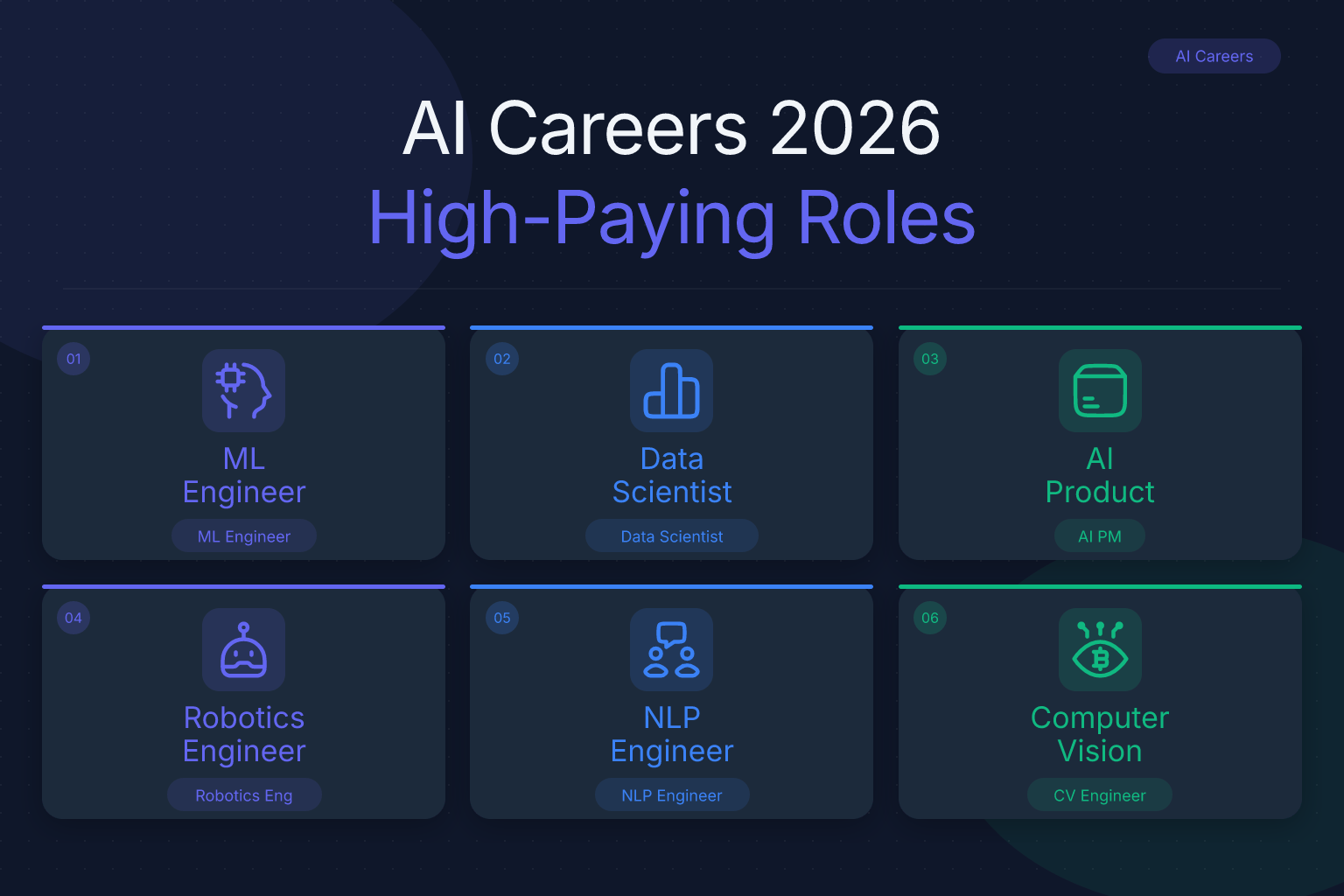
When people ask “what are the jobs for artificial intelligence,” they often picture a researcher in a lab. The reality is far broader. AI careers fall into several buckets:
- Engineering roles — building and deploying AI systems (AI/ML engineer, NLP engineer, computer vision engineer, MLOps engineer).
- Data science roles — extracting insights and building predictive models (data scientist, machine learning scientist, analytics engineer).
- Research roles — advancing the state of the art (AI research scientist, deep learning researcher, robotics researcher).
- Product and strategy roles — defining what to build and why (AI product manager, AI strategist, technical program manager).
- Ethics and governance roles — ensuring responsible AI use (AI ethicist, AI policy analyst, compliance specialist).
- Support and operations roles — keeping AI systems running (AI data annotator, AI quality assurance, AI solutions architect).
Each path requires a different mix of technical depth, domain knowledge, and soft skills. The common thread: you don’t need a PhD to get started. Many applied roles value hands-on project experience over academic credentials. The demand for AI talent has exploded, with the World Economic Forum predicting 97 million new AI-related jobs by 2025. Companies are actively hiring for these roles, and many offer remote or hybrid work options. Whether you’re interested in building models, shaping strategy, or ensuring ethical deployment, there’s a path for you.
Top AI Job Roles and What They Do
Here’s a closer look at the most common careers for artificial intelligence, including typical responsibilities, required skills, and salary ranges based on 2026 market data.
AI/ML Engineer
AI engineers design, build, and deploy machine learning models into production. They work closely with data scientists and software engineers to turn prototypes into scalable systems.
- Core skills: Python, TensorFlow or PyTorch, cloud platforms (AWS, GCP, Azure), containerization (Docker, Kubernetes), MLOps.
- Typical salary: Glassdoor reports average base pay around $130,000, with senior roles exceeding $180,000. At top tech companies, total compensation can reach $250,000+.
Data Scientist (AI/ML Focus)
Data scientists with an AI focus analyze large datasets, build predictive models, and communicate findings to stakeholders. They often serve as the bridge between raw data and business decisions.
- Core skills: Python, SQL, statistics, machine learning, data visualization, storytelling.
- Typical salary: According to the U.S. Bureau of Labor Statistics, data scientists earned a median annual wage of $108,020 in 2024; AI-specialized data scientists typically command 15–25% more.
AI Research Scientist
Research scientists push the boundaries of what AI can do. They publish papers, develop novel algorithms, and often work in industry labs (Google DeepMind, Meta AI, OpenAI) or academia.
- Core skills: Advanced mathematics, deep learning theory, research methodology, Python, often a PhD in a related field.
- Typical salary: Entry-level research scientist roles start around $150,000, with experienced researchers earning $200,000–$350,000+.
NLP Engineer
Natural Language Processing engineers build systems that understand and generate human language — chatbots, translation tools, sentiment analysis.
- Core skills: Python, transformer models (BERT, GPT), spaCy, Hugging Face, linguistics fundamentals.
- Typical salary: $125,000–$175,000, with demand surging as generative AI becomes mainstream.
Computer Vision Engineer
These engineers develop AI that interprets visual data — used in autonomous vehicles, medical imaging, and augmented reality.
- Core skills: Python, OpenCV, convolutional neural networks, image processing, 3D geometry.
- Typical salary: $130,000–$180,000.
AI Product Manager
AI product managers define the vision and roadmap for AI-powered products. They translate technical capabilities into user value and coordinate between engineering, design, and business teams.
- Core skills: Product management fundamentals, understanding of ML lifecycle, data-driven decision-making, stakeholder communication.
- Typical salary: $140,000–$200,000, often with equity.
AI Ethicist / Responsible AI Specialist
These roles ensure AI systems are fair, transparent, and aligned with regulations. They conduct bias audits, develop governance frameworks, and advise on policy.
- Core skills: Ethics, policy, law, or social science background; understanding of AI systems; risk assessment.
- Typical salary: $110,000–$160,000, growing as regulations tighten.
AI and Data Science Careers: Where They Overlap
Many job seekers ask about “jobs for artificial intelligence and data science” as if they’re separate fields. In practice, they’re deeply intertwined. Data science provides the foundation for most AI work — cleaning data, exploring patterns, and building baseline models. AI extends that with more complex algorithms and deployment.
Common hybrid roles include:
- Machine Learning Engineer (sits between data science and software engineering)
- Data Scientist, Machine Learning (focuses on model development rather than just analytics)
- Applied Scientist (a blend of research and engineering, common at Amazon and Microsoft)
If you’re coming from a data science background, you can transition into AI by strengthening your engineering skills (model deployment, MLOps) and learning deep learning frameworks. If you’re on the engineering side, adding statistics and experimental design will make you a stronger AI candidate. In fact, many job postings now list both AI and data science skills, expecting candidates to handle everything from data wrangling to model deployment. Understanding the full pipeline — from data collection to production monitoring — makes you a more versatile and competitive candidate. Additionally, tools like Jupyter notebooks, SQL, and cloud-based ML platforms are common to both fields, so building proficiency in these areas can open doors to either career path.
Skills You Need for a Career in Artificial Intelligence
AI job descriptions can look intimidating, but the core skills break down into three categories.
Technical Skills
- Programming: Python is non-negotiable. R, Java, or C++ are nice-to-haves for specific roles.
- Machine Learning: Understand supervised and unsupervised learning, model evaluation, and feature engineering.
- Deep Learning: Frameworks like PyTorch and TensorFlow; architectures like transformers, CNNs, RNNs.
- Data Handling: SQL, pandas, data cleaning, and working with large datasets.
- Cloud & MLOps: Deploying models on AWS SageMaker, GCP Vertex AI, or Azure ML; using Docker and CI/CD pipelines.
- Math & Statistics: Linear algebra, calculus, probability — enough to read a research paper and debug a model.
Soft Skills
- Problem-solving: AI projects rarely follow a straight line. You need to diagnose why a model isn’t learning and iterate.
- Communication: Explaining technical results to non-technical stakeholders is a superpower.
- Collaboration: AI systems are built by cross-functional teams; you’ll work with engineers, designers, and domain experts.
Domain Knowledge
AI in healthcare requires different context than AI in finance. Pick an industry you’re interested in and learn its data, regulations, and pain points. This makes you far more valuable than a generic AI generalist.
How to Get a Job in AI Without a PhD
The myth that every AI job requires a doctorate is outdated. Here’s a practical path to landing an AI role with a bachelor’s or master’s degree — or even through self-study.
- Choose a specialization. Don’t try to learn everything. Pick one area (NLP, computer vision, MLOps, AI product) and go deep.
- Build a portfolio of projects. Use public datasets to solve real problems. For example: build a sentiment analysis tool for product reviews, or a image classifier for plant diseases. Host your code on GitHub and write a short README explaining your approach and results.
- Contribute to open source. Fix bugs or add features to popular ML libraries. This shows you can work with production code and collaborate with other developers.
- Target applied roles. Look for titles like “ML Engineer,” “AI Developer,” or “Data Scientist — AI” rather than “Research Scientist.” These roles prioritize practical skills over publications.
- Network strategically. Attend AI meetups, join online communities (e.g., r/MachineLearning, AI Discord servers), and reach out to people in roles you want. Informational interviews can uncover unposted jobs. (See our guide to informational interviews for templates.)
- Tailor your resume for each application. Use the exact keywords from the job description, quantify your project impact, and highlight relevant skills. ResumeMate’s free AI resume builder and score checker can help you create an ATS-optimized resume in minutes.
Resume Tips for AI Job Applications
Your resume is often the first filter. Here’s how to make sure it gets you to the interview.
Use Action Verbs and Quantify Results
Instead of “Worked on a chatbot project,” write “Built a customer service chatbot using GPT-4 that reduced response time by 40%.” Strong action verbs make your bullet points pop. Check out our list of 200 action verbs for resumes grouped by impact for inspiration.
Include Publications and Projects
If you’ve published papers, list them — even on arXiv. For non-academic roles, a well-documented GitHub project can carry as much weight as a publication. Our guide on how to list publications on a resume for non-academic jobs shows you exactly how to format them.
Optimize for ATS with AI Keywords
Most large companies use applicant tracking systems (ATS) to screen resumes. Include keywords like “Python,” “TensorFlow,” “model deployment,” “A/B testing,” and any specific tools mentioned in the job description. For a ready-made list, see our ATS resume keywords for 50+ jobs.
Keep the Format Clean
Stick to a single-column layout, use standard section headings, and export as a text-based PDF. Modern ATS parse clean PDFs reliably — just avoid scanned documents, tables, and graphics. ResumeMate’s templates are designed with ATS compatibility in mind, and the score checker gives you instant feedback on how your resume will perform.
Industries Hiring for AI Careers in 2026
AI jobs aren’t confined to Silicon Valley. Here’s where the demand is growing fastest:
- Healthcare: Medical imaging analysis, drug discovery, clinical decision support.
- Finance: Fraud detection, algorithmic trading, risk modeling, personalized banking.
- Automotive & Robotics: Autonomous vehicles, warehouse automation, drone navigation.
- Retail & E-commerce: Recommendation engines, inventory forecasting, customer service chatbots.
- Government & Defense: Cybersecurity, intelligence analysis, public policy modeling.
- Entertainment & Media: Content generation, deepfake detection, personalized streaming.
Each industry has its own data types, regulations, and tooling. Tailoring your resume and portfolio to a specific vertical can give you a significant edge.
How to Prepare for AI Job Interviews
AI interviews typically have three components: technical, behavioral, and case-based.
Technical Interviews
Expect coding challenges (data structures, algorithms) and ML-specific questions. You might be asked to:
- Explain how a transformer works.
- Debug a model that’s overfitting.
- Design an end-to-end ML system for a given problem.
- Write SQL queries to extract training data.
Practice on platforms like LeetCode and Kaggle, and be ready to whiteboard your thought process.
Behavioral Interviews
Companies want to see how you handle ambiguity, collaborate, and learn from failure. Use the STAR method (Situation, Task, Action, Result) to structure your answers. For a deep dive, read our guide to mastering the STAR method.
Case Studies and Take-Home Projects
Many AI roles include a take-home assignment — building a model, analyzing a dataset, or proposing an AI solution. Treat it like a real project: document your approach, justify your decisions, and present results clearly.
Stay Organized
Juggling multiple applications, deadlines, and follow-ups is chaotic. The ResumeMate Job Tracker Chrome extension logs every application automatically and reminds you when to follow up — so nothing slips through the cracks.
FAQ
Q: What are the jobs for artificial intelligence?
A: AI jobs span engineering (AI/ML engineer, NLP engineer, computer vision engineer), data science (data scientist, ML scientist), research (AI research scientist), product (AI product manager), ethics (AI ethicist), and operations (MLOps, AI solutions architect). The field is broad enough that both technical and non-technical professionals can find a fit.
Q: What are the jobs for artificial intelligence and data science?
A: Many roles blend AI and data science, including machine learning engineer, data scientist (ML focus), and applied scientist. These positions require both data analysis skills (SQL, statistics, visualization) and AI-specific skills (deep learning, model deployment).
Q: What are the jobs for artificial intelligence salary?
A: Salaries vary by role and experience. AI engineers average $130,000–$180,000, data scientists with AI skills earn $120,000–$160,000, research scientists can make $150,000–$350,000+, and AI product managers often earn $140,000–$200,000. Total compensation at top tech firms can be significantly higher due to equity.
Q: What jobs use artificial intelligence?
A: Beyond core AI roles, many jobs now use AI as a tool. Software engineers integrate AI APIs, marketers use generative AI for content, financial analysts use ML for forecasting, and healthcare professionals use AI-assisted diagnostics. AI literacy is becoming a baseline skill across industries.
Q: What are the jobs available for artificial intelligence?
A: The most available AI jobs in 2026 are AI/ML engineer, data scientist, NLP engineer, MLOps engineer, and AI product manager. These roles have the highest number of open positions and are often accessible without a PhD.
Q: Do I need a PhD to work in AI?
A: No. While research scientist roles often require a PhD, the majority of AI jobs — especially in engineering, product, and applied data science — are open to candidates with a bachelor’s or master’s degree and a strong project portfolio.
Q: How do I start a career in AI with no experience?
A: Start by learning Python and the basics of machine learning through free online courses. Build 2–3 projects using public datasets, host them on GitHub, and contribute to open-source AI tools. Then apply for entry-level roles like junior ML engineer or AI data analyst, and tailor your resume to highlight your projects and skills.
Track Every Application While You Job Hunt
Stop losing track of where you’ve applied. The ResumeMate Job Tracker is a free Chrome extension that tracks every application, deadline, and follow-up in one place — right from your browser.