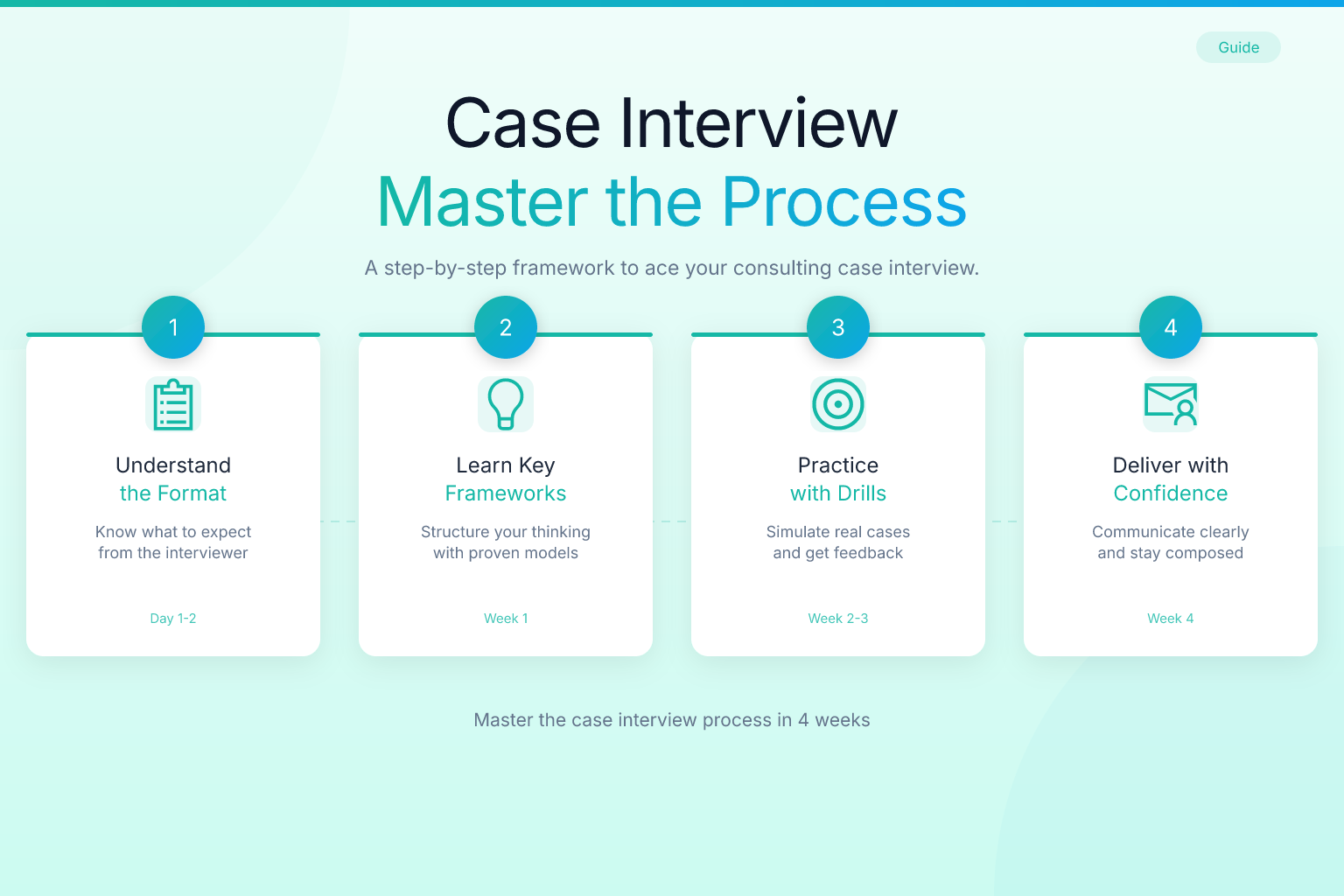
Case Interview Prep Guide for Consultants: Master the Process
A case interview preparation guide for consultants is your roadmap to landing a role at top firms like McKinsey, BCG, and Bain. Unlike standard behavioral interviews, case interviews test your problem-solving structure, quantitative agility, and communication under pressure — all in real time. This guide breaks down exactly what to expect, how to build your skills, and a week-by-week plan to walk into the room confident and ready.
Key Takeaways
- A case interview is a collaborative problem-solving simulation where you must structure your approach, perform quantitative analysis, and deliver a clear recommendation—not just find the right answer.
- Learn 3–5 core business frameworks (profitability, market entry, M&A, pricing, growth) as starting points, but always customize them to the specific case rather than force-fitting a memorized structure.
- Complete at least 30 live practice cases with a partner to build pattern recognition, conversational fluency, and the ability to drive the case under pressure.
- Practice mental math daily with drills on percentages, break-even analysis, and market sizing to eliminate calculation errors and build speed without a calculator.
- Your communication and demeanor are evaluated as much as your analysis; think aloud, signpost your logic, and prepare concise behavioral stories using the STAR method to demonstrate leadership and teamwork.
Key Takeaways & Summary
- A case interview simulates a real client problem; you must structure your approach, perform analysis, and deliver a recommendation — not just give the right answer.
- Mastering 3–5 core business frameworks (profitability, market entry, M&A, pricing, growth) gives you a starting point, but you must adapt them to each case rather than force-fit.
- Deliberate practice with a partner, not solo reading, is the single highest-impact activity — aim for 30+ live cases before your interview.
- Mental math speed and accuracy are non-negotiable; practice daily with drills on percentages, break-even, and market sizing.
- Your communication and demeanor matter as much as your analysis; interviewers evaluate you as a future colleague they’d put in front of a client.
| What to Do | Why It Matters | Time Investment |
|---|---|---|
| Learn 4–5 core business frameworks | Gives you a starting structure for any case type | 2–3 hours upfront, then ongoing refinement |
| Complete 30+ live practice cases with a partner | Builds pattern recognition and conversational fluency | 20–30 hours over 4–6 weeks |
| Drill mental math daily (10–15 minutes) | Eliminates calculation errors and builds speed | 10–15 minutes per day |
| Record and review your case performances | Identifies tics, filler words, and structural gaps | 5 minutes after each practice session |
| Prepare concise “fit” stories using STAR | Consulting firms weigh behavioral answers equally with case performance | 5–6 hours total |
What Is a Case Interview?
A case interview is a job interview format where you’re presented with a business problem and asked to solve it collaboratively with the interviewer. Unlike a traditional Q&A, you drive the conversation: you ask clarifying questions, structure your approach, perform quantitative analysis, and deliver a recommendation. The interviewer acts as a client, providing data when you ask for it and sometimes challenging your logic.
Top consulting firms — McKinsey, BCG, Bain, Deloitte, and others — use case interviews because they reveal how you think, not just what you know. They assess:
- Structuring: Can you break a messy problem into logical components?
- Analytical ability: Can you interpret data, spot trends, and do math on the spot?
- Business judgment: Do your insights make sense in the real world?
- Communication: Can you explain your thinking clearly and concisely?
- Poise: Do you stay calm when the interviewer pushes back or throws a curveball?
A typical case lasts 20–40 minutes. You might get one or two cases per interview round, often paired with behavioral questions. The case itself is usually based on a real client engagement, stripped of confidential details.
The Case Interview Process: Step by Step
Understanding the flow removes surprises. Here’s how a case interview unfolds:
- The Prompt – The interviewer reads a short scenario: “Our client is a regional bank considering entering the online lending market. Should they do it?”
- Clarifying Questions – You ask 2–3 targeted questions to understand the client’s objectives, constraints, and context. Don’t jump into a framework yet.
- Structure – You lay out a roadmap: “I’d like to look at this in three parts — market attractiveness, internal capabilities, and financial impact. Does that work for you?”
- Analysis – You dive into each bucket, requesting data, performing calculations, and interpreting results. The interviewer provides information as you ask for it.
- Synthesis & Recommendation – You summarize your findings and give a clear, actionable recommendation: “I recommend the bank enter the online lending market because the market is growing at 15% annually, they have the technology platform, and the NPV is positive. However, they should monitor regulatory changes.”
Throughout, the interviewer evaluates not just your answer but how you got there. Did you structure before diving in? Did you check your math? Did you pivot when new information emerged?
Essential Frameworks for Case Interviews
Frameworks give you a starting point, but the key is to customize them to the case. Never say, “I’ll use Porter’s Five Forces.” Instead, tailor it: “I’d like to look at the competitive intensity in this market by examining the number of players, differentiation, and switching costs.”
1. Profitability Framework
Use when a client’s profits are declining or they want to improve margins. Break profit into revenue and costs, then drill down:
- Revenue: price per unit × quantity sold. Explore pricing strategy, customer segments, market share.
- Costs: fixed vs. variable. Examine labor, materials, overhead, and potential efficiencies.
2. Market Entry Framework
Use when a client considers entering a new market, launching a product, or expanding geographically. Assess:
- Market attractiveness (size, growth, trends, competition)
- Internal capabilities (resources, expertise, brand fit)
- Entry strategy (organic, acquisition, joint venture)
- Financial viability (investment, payback, risks)
3. M&A Framework
For acquisition targets. Evaluate:
- Strategic rationale (synergies, market position)
- Target assessment (financial health, culture, customer base)
- Valuation and deal structure
- Integration risks
4. Pricing Framework
When a client wants to set or change a price. Consider:
- Cost-based (floor price)
- Competitor-based (benchmarking)
- Value-based (willingness to pay)
- Price sensitivity and segmentation
5. Growth Strategy Framework
For clients seeking revenue growth. Explore:
- Existing products to existing customers (penetration)
- New products to existing customers (development)
- Existing products to new customers/markets (expansion)
- New products to new markets (diversification)
Memorize these as mental checklists, not scripts. The best candidates use them to generate hypotheses, then follow the data.
How to Practice Case Interviews Effectively
Reading cases is not practicing. You must simulate the live experience. Here’s a progression:
Solo Drills (First Week)
- Read a case prompt, then write out your structure on paper in 2 minutes. Compare to a sample answer.
- Practice market sizing questions aloud: “How many gas stations are in the US?” Walk through your logic step by step.
- Do mental math drills (see next section).
Partner Practice (Core Phase)
Find a case partner — a friend, classmate, or someone from online platforms like Preplounge or case coaching groups. Take turns giving and receiving cases. After each case, debrief:
- What worked well?
- Where did I get stuck?
- Did I communicate clearly?
- Did I drive the case or just react?
Aim for 30+ live cases. Start with untimed, then add time pressure. Record a few sessions to spot verbal tics (“um,” “like”) and pacing issues.
Mock Interviews (Final Week)
Schedule 2–3 mock interviews with someone experienced — a current consultant, a career coach, or a peer who has already gone through the process. Treat these as dress rehearsals: wear your interview outfit, use a quiet room, and follow the exact timing.
Mastering the Mental Math
Case interviews require quick, accurate calculations without a calculator. You’ll estimate market sizes, calculate profit margins, and do break-even analysis. Common operations:
- Percentages (e.g., 15% of $4.2M)
- Multiplication and division with large numbers
- Compound growth (e.g., 10% annual growth over 5 years)
- Break-even volume (fixed costs / unit margin)
Daily Drill Routine (10–15 minutes):
- Mental Math Warm-up: Use apps like “Mental Math Cards” or websites like Victor Cheng’s math tool. Do 20 rapid-fire problems.
- Market Sizing: Pick a random topic (e.g., number of coffee cups consumed in New York City daily) and estimate top-down. Write your assumptions, calculate, then check reasonableness.
- Case Math from Real Cases: Take a calculation from a practice case and redo it faster. Aim to complete any case math in under 60 seconds.
Pro tip: Round numbers aggressively. If the market is $4.2B, round to $4B for quick estimates, then adjust. Interviewers care about your logic, not precision to the decimal.
Communication Tips & Common Mistakes
Your delivery can make or break a case. Even a brilliant analysis fails if you can’t walk the interviewer through it. Key habits:
- Think aloud: Narrate your thought process. “I’m going to start by looking at the revenue side. I’ll break it into price and volume, then segment by customer type.”
- Signpost: Use verbal markers to guide the interviewer. “So far we’ve covered the market size and competitive landscape. Next, I’d like to examine the client’s capabilities.”
- Synthesize, don’t summarize: At the end, don’t just repeat what you did. Give a recommendation with supporting reasons and risks. “I recommend entering the market because X, Y, Z. The main risk is A, which can be mitigated by B.”
- Manage the whiteboard/page: If in person, write legibly and organize your space. If virtual, share your screen and use a clean digital notepad.
- Stay conversational: It’s a dialogue, not a monologue. Ask, “Does that make sense?” or “Would you like me to go deeper on any of these?”
For more on handling the behavioral portion that often accompanies case interviews, review our guide on mastering the STAR method for behavioral interview questions.
Even strong candidates stumble on these pitfalls:
- Jumping to a framework without clarifying: You miss the client’s real objective. Always ask, “What is the client’s primary goal? Are there any constraints I should know?”
- Force-fitting a memorized framework: The interviewer will notice. Adapt your structure to the specific problem.
- Math errors from rushing: Slow down, write numbers clearly, and sanity-check your answer. “That would mean each customer spends $10,000 a month on coffee — that seems high, let me recheck.”
- Not driving the case: Waiting for the interviewer to lead. You should propose next steps: “Now I’d like to look at the cost side. Can you give me a breakdown of fixed vs. variable costs?”
- Weak recommendation: Ending with “It depends.” Give a clear yes/no with conditions. “Yes, enter the market, but only if they can achieve 10% market share within two years.”
- Ignoring the “fit” portion: Many candidates focus entirely on the case and bomb the behavioral questions. Prepare 5–7 stories that demonstrate leadership, teamwork, and problem-solving. Our tips to prepare for an interview cover the full spectrum.
Your 4-Week Case Interview Preparation Plan
Consistency beats cramming. Here’s a realistic schedule assuming you have 10–15 hours per week.
Week 1: Foundations
- Learn the case interview format and 5 core frameworks.
- Read through 5 sample cases and their solutions to understand structure.
- Start daily mental math drills (10 min).
- Practice 2–3 market sizing questions solo.
Week 2: Skill Building
- Complete 5–7 live cases with a partner, focusing on structure and math.
- After each case, write down one thing to improve.
- Continue daily math drills.
- Draft your “fit” stories using the STAR format.
Week 3: Intensity
- Complete 8–10 live cases, mixing case types (profitability, market entry, M&A, etc.).
- Add time pressure: finish each case in 25–30 minutes.
- Record one case and review your communication.
- Do 2–3 mock behavioral interviews with a friend.
Week 4: Polish
- Complete 5–7 final cases with experienced partners or coaches.
- Focus on seamless transitions, confident recommendations, and handling curveballs.
- Do a full mock interview (fit + case) in a realistic setting.
- Review your resume and ensure it’s updated and ATS-friendly.
FAQ
Q: How many case interviews do I need to practice before I’m ready?
A: Most successful candidates complete 30–50 live cases. The number matters less than the quality of practice and the feedback you receive. Aim for at least 30 with a partner who can give honest, detailed critiques.
Q: What’s the difference between a case interview at McKinsey vs. BCG vs. Bain?
A: The core format is similar, but McKinsey places heavy emphasis on structuring and hypothesis-driven thinking. BCG often includes more quantitative analysis and graph interpretation. Bain tends to focus on business judgment and actionable recommendations. Research each firm’s style and practice with cases from their websites.
Q: Can I use a calculator during a case interview?
A: No. You must do all calculations mentally or with pen and paper. The interviewer wants to see your numerical reasoning, not your ability to punch numbers into a device.
Q: How long should my recommendation be at the end of a case?
A: Aim for 60–90 seconds. State your recommendation clearly, give 2–3 supporting reasons, mention the biggest risk and how to mitigate it, and propose next steps. Practice delivering it without rambling.
Q: What if I get stuck during the case?
A: Pause, take a breath, and structure your thoughts aloud. “Let me take a moment to organize my thinking.” You can also ask the interviewer for a moment to jot down notes. If you’re truly lost, ask a clarifying question to get back on track. Interviewers expect you to handle ambiguity — it’s part of the test.
Q: Do I need to know specific industries for case interviews?
A: No. Cases are designed to be solved with general business logic, not specialized knowledge. If industry-specific data is needed, the interviewer will provide it. However, staying current on business news (e.g., major M&A deals, tech trends) can give you more confidence and context.
Track Every Application While You Job Hunt
Juggling multiple consulting applications? It’s easy to lose track of deadlines, follow-ups, and interview stages. The ResumeMate Job Tracker is a free Chrome extension that automatically logs every job you apply to, right from your browser. For example, when you submit your application to McKinsey, the tracker captures the job title, company, date, and even the job description. It then creates a visual pipeline so you can see at a glance where each application stands: applied, phone screen, case interview, final round, offer. You can set custom reminders for follow-ups—say, a nudge to send a thank-you email two days after your BCG interview. The tracker also stores notes for each application, so you can jot down key details from your networking calls or specific case feedback. No more spreadsheets or forgotten deadlines. With the ResumeMate Job Tracker, you’ll stay organized and focused on preparing for your case interviews, not on administrative chaos.