A strong CDL driver resume that highlights safety records and routes can mean the difference between getting a callback and getting passed over. Trucking companies don’t just want a driver with a license—they want proof you can haul freight safely, on time, and across the routes they run. This guide shows you exactly how to write a resume that puts your safety record and route experience front and center, with examples you can copy and adapt.
Key Takeaways
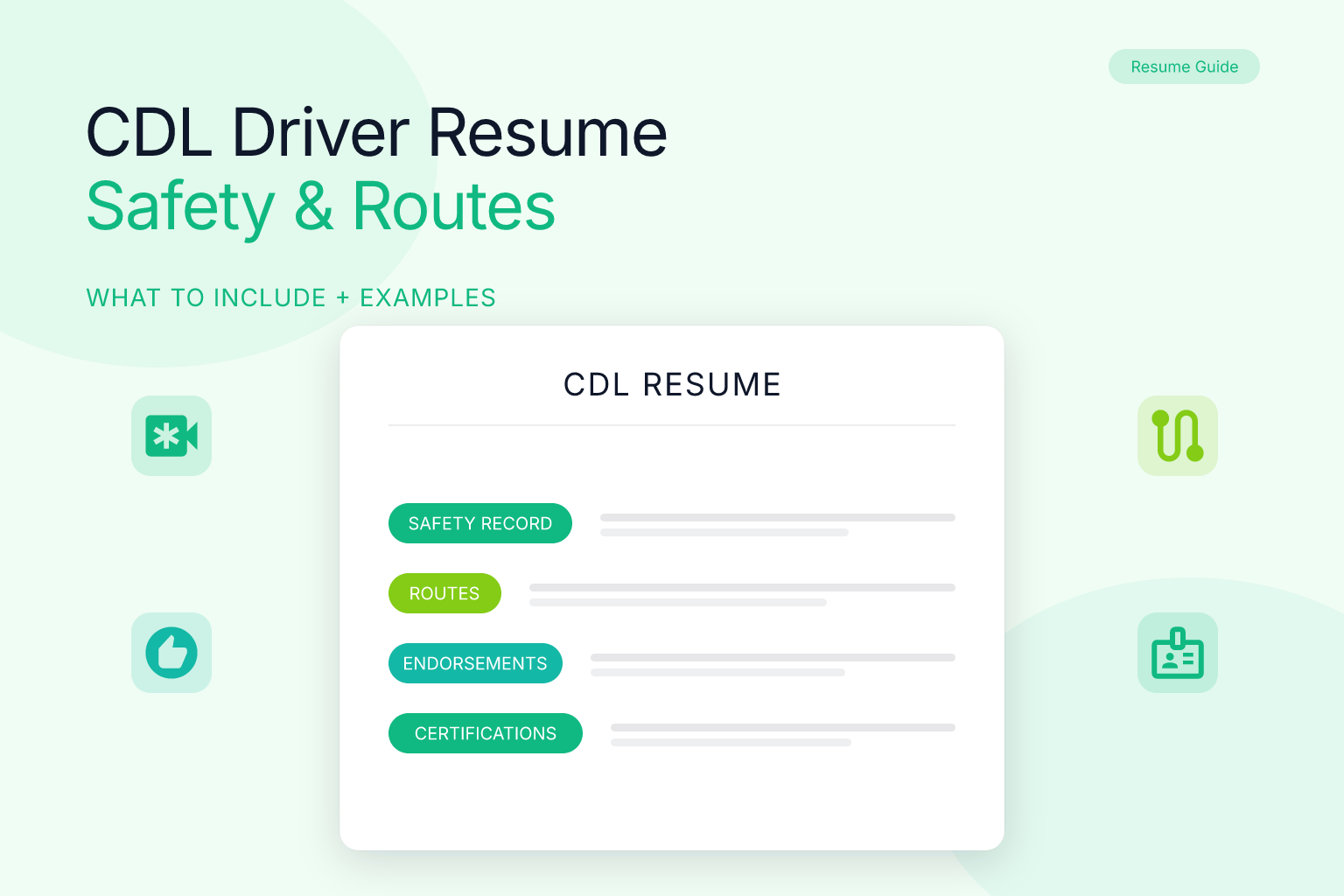
- List your CDL class, endorsements, and years of experience in the top third of your resume so recruiters and ATS see them immediately.
- Quantify your safety record with specific numbers like accident-free miles, clean inspection results, and safety awards instead of vague claims like ‘safe driver.’
- Name the specific routes, regions, and freight types you’ve hauled to demonstrate you can handle the company’s geography and cargo.
- Use a single-column, text-based PDF format to ensure your resume parses correctly in trucking company applicant tracking systems.
- Tailor your resume for each job by matching required endorsements, route experience, and safety keywords from the posting.
How to Write a CDL Driver Resume That Highlights Safety and Routes
Most CDL driver resumes fail because they read like a list of job duties: “Drove truck, delivered freight, followed dispatch.” That tells a recruiter nothing about whether you’re a safe, reliable driver who can handle their lanes. The fix is to build your resume around two things every trucking company cares about: safety records and routes.
Here are the key points to keep in mind:
- List your CDL class, endorsements, and years of experience in the first section of your resume so recruiters see them immediately.
- Quantify your safety record with accident-free miles, clean inspection results, and any safety awards you’ve earned.
- Name the specific routes, regions, and freight types you’ve hauled to show you can handle the geography and cargo the company needs.
- Use a single-column, ATS-safe PDF format so your resume parses correctly in trucking company applicant tracking systems.
- Tailor your resume for each job by matching the required endorsements, route experience, and safety keywords from the posting.
Start by structuring your resume in this order:
- Contact information — name, phone, city/state, email, and CDL class.
- Professional summary — two to three sentences that state your CDL class, years of experience, primary routes, and a standout safety metric.
- Core qualifications — a bulleted list of your endorsements, certifications, and key skills (Hazmat, Tanker, Doubles/Triples, TWIC, etc.).
- Work experience — reverse chronological, with each job showing safety metrics and route details in bullet points.
- Education and training — CDL school, defensive driving courses, and any company-specific training.
This order puts your most important qualifications where a recruiter or ATS will see them in the first five seconds. Don’t bury your CDL class or safety record at the bottom.
Start With a Strong CDL Driver Resume Summary
Your resume summary is the first thing a recruiter reads after your name. It should answer three questions in two or three sentences: What license do you hold? How long have you been driving? What routes and safety record do you bring?
Here’s a weak summary:
“Experienced truck driver looking for a new opportunity. Hard worker and team player.”
That says nothing. Compare it to this:
“Class A CDL driver with 8 years of OTR experience across the Midwest and Southeast. 750,000+ accident-free miles, clean CSA score, and Hazmat and Tanker endorsements. Specialized in reefer and dry van freight with a 99.2% on-time delivery rate.”
The second version gives a recruiter everything they need to decide to keep reading. It names the license class, years, routes, safety metrics, endorsements, and freight type. If you’re unsure how to write a summary for your specific background, check out resume summary examples for 20 roles for more templates you can adapt.
List Your CDL, Endorsements, and Certifications Up Front
Trucking companies filter applicants by license class and endorsements before they ever read a work history. If you have a Class A CDL with Hazmat and Tanker endorsements, that needs to appear in the top third of your resume—not buried in a skills section at the bottom.
Create a “Core Qualifications” or “Licenses & Endorsements” section right after your summary. List each item on its own line or as a compact bulleted list:
- Class A CDL with Hazmat (H), Tanker (N), and Doubles/Triples (T) endorsements
- TWIC card (Transportation Worker Identification Credential)
- Clean driving record — no moving violations in 5 years
- Passport (for cross-border runs)
- Forklift certification (if relevant to dock work)
If you’ve held multiple roles at the same trucking company—say, you started as a local driver and moved to OTR—list each role separately under the same company header. That shows progression and gives you more room to highlight different routes and safety records. For guidance on formatting that, see how to list multiple roles at the same company on a resume.
Quantify Your Safety Record and Showcase Routes
“Safe driver” is a claim. “750,000 accident-free miles” is proof. Trucking companies live and die by their safety scores, so they want to see hard numbers on your resume. Here are the metrics that carry the most weight:
- Accident-free miles — the single most powerful number you can include. If you’ve driven 500,000 miles without an accident, say so.
- Years without a preventable accident — even if you don’t know your exact mileage, “5 years with zero preventable accidents” is strong.
- CSA score or BASIC percentiles — if your company’s scores are public and yours are good, you can mention “maintained a clean roadside inspection record” or “no out-of-service violations in 3 years.”
- Inspection results — “passed 12 consecutive Level 1 inspections with no violations” shows consistency.
- Safety awards — many carriers give annual safety bonuses or recognition. List them: “Recipient of the 2025 Million Mile Safety Award.”
Don’t guess at numbers. If you don’t know your exact accident-free mileage, estimate conservatively or use a range (“over 400,000 accident-free miles”). Never fabricate a metric—background checks and DAC reports will catch it.
Here’s how to turn a vague bullet into a quantified one:
Weak: “Drove safely and followed all regulations.”
Strong: “Logged 620,000 accident-free miles over 6 years with zero preventable accidents and zero out-of-service violations.”
Put at least one safety metric under every job you list. If you worked through a temp agency or staffing firm, you can still include those metrics—just make sure to format the agency and the client company correctly. See how to list temp agency work on a resume for a step-by-step guide.
A driver who has run the I-80 corridor through Wyoming winters is not the same as a driver who has only done local deliveries in Florida. Companies want to know you can handle their specific geography, weather, and freight. So name your routes.
Instead of writing “drove OTR,” write:
- “Ran OTR routes across the Midwest and Northeast, including Chicago to Boston and Minneapolis to Detroit.”
- “Dedicated regional driver for the Texas Triangle (Dallas–Houston–San Antonio) with 2–3 turns per week.”
- “Local P&D driver in the Denver metro area, 15–20 stops per day.”
Also list the freight types you’ve hauled. Reefer, flatbed, tanker, dry van, hazmat, oversized—each requires different skills and endorsements. If you’ve pulled doubles or triples, say so. If you’ve done cross-border runs into Canada or Mexico, mention that too.
Here’s a bullet that combines route, freight, and safety:
“Hauled reefer freight on dedicated lanes from California to the Pacific Northwest, averaging 2,800 miles per week with a 99.5% on-time delivery rate and zero temperature-related claims.”
That one bullet tells a recruiter you can handle long-haul reefer, you know the West Coast geography, and you’re reliable. That’s exactly what they’re looking for.
Full CDL Driver Resume Example (With Safety and Route Details)
Here’s a complete resume example for a Class A CDL driver with OTR and regional experience. Use it as a template, but replace every detail with your own real numbers and routes.
JAMES RODRIGUEZ
Dallas, TX | (555) 123-4567 | james.rodriguez@email.com | Class A CDL

PROFESSIONAL SUMMARY
Class A CDL driver with 9 years of OTR and regional experience across the South and Midwest. 800,000+ accident-free miles, clean CSA record, and Hazmat, Tanker, and Doubles/Triples endorsements. Specialized in dry van and reefer freight with a 99.1% on-time delivery rate.

CORE QUALIFICATIONS
- Class A CDL with Hazmat (H), Tanker (N), and Doubles/Triples (T) endorsements
- TWIC card
- Clean driving record — no moving violations in 7 years
- Passed 14 consecutive Level 1 inspections with zero violations
- 2024 and 2025 Company Safety Award recipient

WORK EXPERIENCE

Long Haul Trucking, Dallas, TX
OTR Driver | March 2020 – Present
- Logged 520,000 accident-free miles on OTR routes from Texas to the Midwest and Southeast, including Dallas–Chicago, Houston–Atlanta, and San Antonio–Memphis.
- Hauled dry van and reefer freight with a 99.3% on-time delivery rate and zero cargo claims in 5 years.
- Maintained a clean roadside inspection record with no out-of-service violations.
- Trained 4 new drivers on company safety protocols and electronic logging device (ELD) compliance.

Regional Express, Fort Worth, TX
Regional Driver | June 2017 – February 2020
- Ran dedicated regional routes across the Texas Triangle (Dallas–Houston–San Antonio) with 2–3 turns per week.
- Hauled Hazmat tanker loads, maintaining 100% compliance with all placarding and routing regulations.
- Achieved 280,000 accident-free miles and received the 2019 Regional Safety Award.

EDUCATION & TRAINING
- CDL Training Program, Roadmaster Drivers School, Dallas, TX — 2017
- Defensive Driving Course, National Safety Council — 2022
- Hazmat Endorsement Training, FMCSA-approved provider — 2019
Notice how every job includes a safety metric and a route description. That’s the pattern to follow.
ATS Tips and Common Mistakes to Avoid
Most trucking companies—especially large carriers like Schneider, J.B. Hunt, and Swift—use applicant tracking systems (ATS) to screen resumes before a human ever sees them. If your resume doesn’t parse correctly, you’re out of the running no matter how good your safety record is.
Follow these rules:
- Use a single-column layout. Multi-column templates can confuse older ATS software. A clean, single-column format is the safest choice.
- Export as a PDF. Modern ATS parse text-based PDFs reliably. The problems come from scanned or image-based PDFs, not the format itself. ResumeMate’s free resume builder exports clean, ATS-safe PDFs automatically.
- Avoid tables, graphics, and text boxes. They can break parsing. Use simple headings like “Work Experience” and “Skills.”
- Include keywords from the job posting. If the job asks for “Hazmat endorsement,” “OTR experience,” or “reefer freight,” use those exact phrases in your resume.
- Don’t use headers or footers for contact info. Some ATS ignore content in those areas. Put your name and contact details in the main body.
Before you submit, run your resume through a free ATS score checker to see how it parses and get section-by-section feedback. It takes two minutes and can catch formatting issues you’d never notice on your own.
Even experienced drivers make these common mistakes. Avoid them:
- Vague safety claims. “Safe driver” means nothing. Always attach a number: accident-free miles, years without a violation, inspection results.
- No route details. “Drove OTR” doesn’t tell a recruiter where you’ve been. Name the regions, corridors, or dedicated lanes.
- Listing every job you’ve ever had. If you worked at a warehouse 15 years ago, it doesn’t belong on a CDL resume. Keep the last 10 years of relevant driving experience.
- Using a two-column or graphic-heavy template. It looks pretty but often fails ATS parsing. Stick to single-column.
- Not tailoring to the job. A Hazmat tanker job needs different keywords than a dry van OTR job. Adjust your summary and skills for each application.
- Forgetting endorsements. If you have a Tanker endorsement and the job requires it, that should be in the top third of your resume—not hidden in a skills list.
Fix these six issues and your resume will immediately stand out from the stack.
FAQ
Q: What should a CDL driver put on a resume for safety?
A: Include accident-free miles, years without a preventable accident, clean inspection results, CSA score (if favorable), and any safety awards. Quantify every claim—“620,000 accident-free miles” beats “safe driver” every time.
Q: How do I list routes on a CDL resume?
A: Name the specific regions, corridors, or dedicated lanes you’ve driven. Instead of “OTR,” write “OTR routes from Texas to the Midwest, including Dallas–Chicago and Houston–Atlanta.” Also mention freight types (reefer, flatbed, tanker) and any cross-border experience.
Q: What endorsements should I include on my CDL resume?
A: List every endorsement you hold: Hazmat (H), Tanker (N), Doubles/Triples (T), Passenger (P), School Bus (S), etc. Put them in a “Core Qualifications” section near the top so recruiters see them immediately.
Q: How do I write a resume summary for a truck driver?
A: State your CDL class, years of experience, primary routes, and one standout safety metric in two to three sentences. Example: “Class A CDL driver with 8 years of OTR experience across the Midwest. 750,000+ accident-free miles, Hazmat and Tanker endorsements, and a 99.2% on-time delivery rate.”
Q: Should I include my CSA score on my resume?
A: Only if it’s favorable and you can verify it. A clean CSA score or “no out-of-service violations in 3 years” is a strong selling point. If your score is average or you’re unsure, focus on accident-free miles and inspection results instead.
Q: What format is best for a CDL driver resume?
A: A single-column, text-based PDF. It parses correctly in ATS and looks professional. Avoid multi-column templates, tables, and graphics. Use a free tool like ResumeMate’s resume builder to generate an ATS-safe PDF in minutes.
Track Every Application While You Job Hunt
Stop losing track of where you’ve applied. The ResumeMate Job Tracker is a free Chrome extension that tracks every application, deadline, and follow-up in one place — right from your browser.