ChatGPT Job Interview Prompts: How to Use AI to Prepare and Practice
If you’re walking into an interview, you want to feel ready — not just with a polished resume, but with sharp, tailored answers that show you’ve done your homework. ChatGPT job interview prompts can help you get there faster. By using the right prompts, you can turn ChatGPT into a personal interview coach that researches the company, generates likely questions, and even runs a mock interview with you. This guide gives you the exact prompts to use, step by step, so you can walk into any interview with confidence.
According to a 2023 JDP survey, 93% of job seekers experience interview anxiety. The best antidote isn’t luck — it’s preparation. And with AI, you can prepare more thoroughly in less time than ever before. The table below maps out a complete prep workflow you can follow in a single afternoon.
| What to Do | Why It Matters | Time |
|---|---|---|
| Research the company and role with AI | Tailor your answers to what the employer actually cares about | 15–20 min |
| Generate likely interview questions | Anticipate what you’ll be asked and avoid blanking | 10 min |
| Practice behavioral answers with STAR prompts | Structure your stories so they’re clear and convincing | 20–30 min |
| Run a mock interview with ChatGPT | Build fluency and get feedback on your answers | 30–45 min |
| Refine your “Tell me about yourself” pitch | Nail the most common opening question | 15 min |
Why ChatGPT Is a Powerful Interview Prep Tool
ChatGPT can’t replace a real mock interview with a trusted friend or career coach, but it fills a gap that most job seekers face: you need someone (or something) to bounce ideas off, generate questions you hadn’t considered, and give you immediate, judgment-free feedback. When you use ChatGPT job interview prompts strategically, you get:
- Unlimited practice — no scheduling, no cost, no awkwardness. You can run as many mock sessions as you need without worrying about burdening a friend or mentor.
- Role-specific questions — feed it a job description and it will pull out the skills and scenarios the interviewer is likely to probe. This is far more targeted than generic interview question lists.
- Company research summaries — it can digest a company’s website, recent news, and values so you can weave that knowledge into your answers. This helps you demonstrate genuine interest beyond just needing a job.
- STAR answer drafts — you describe a situation, and ChatGPT helps you structure it into a clear Situation, Task, Action, Result format. This is critical for behavioral questions where structure matters.
- Interviewer-style adaptability — you can ask it to act like a tough hiring manager, a friendly peer, or a technical lead, so you’re ready for different personalities. Some interviewers drill deep; others prefer conversational flow.
- Follow-up question generation — it can simulate the natural back-and-forth of a real conversation, pushing you deeper on your answers. This prepares you for the pressure of on-the-spot thinking.
- Post-interview material — it can even help you draft a thank-you email that references specific points from the conversation. A well-timed thank-you can reinforce your candidacy.
Before you start, make sure you have a strong foundation. If you haven’t already tailored your resume to the job, check out our guide on how to tailor a resume to a job description. A targeted resume gets you the interview; targeted prep helps you pass it. You can also run your resume through our free resume score checker to see how it stacks up against ATS filters before you walk in the door. If you’re still building your resume from scratch, our AI resume builder generates clean, ATS-safe PDFs with professional templates.
How to Write Effective ChatGPT Prompts for Interview Prep
The quality of what you get back depends entirely on the prompt. Vague input like “help me prepare for an interview” will give you generic advice you could find anywhere. Instead, treat ChatGPT like a smart assistant that needs context. Every strong prompt includes:
- The job title and company (or paste the job description).
- The type of interview (screening, technical, panel, behavioral).
- What you want (a list of questions, a mock interview, feedback on an answer).
- Any constraints (e.g., “keep questions focused on leadership and conflict resolution”).
Here’s a template you can adapt:
“I’m interviewing for a [Job Title] role at [Company]. Here’s the job description: [paste]. I want you to act as an experienced hiring manager for this role. Generate 10 behavioral interview questions that test the key competencies listed in the description. For each question, explain what the interviewer is looking for.”
To see the difference context makes, compare these two prompts:
- Weak: “Give me interview questions.”
- Strong: “I’m interviewing for a Senior Product Manager role at a B2B SaaS company. The job description emphasizes stakeholder management, data-driven decision making, and product launches. Act as the hiring manager and give me 8 behavioral questions that test those three areas, plus one curveball question.”
The strong prompt will produce questions that feel custom-made for your interview. Always include the job description — it’s the single most important piece of context you can provide. The more specific you are about your background, industry, and the company’s challenges, the more useful ChatGPT’s output becomes.
Now let’s get into the specific prompts that will make the biggest difference.
Prompts for Researching the Company and Role
Walking into an interview without understanding the company’s priorities is a fast way to sound generic. Use these prompts to build a cheat sheet of insights you can reference in your answers. After you get the output, cross-check any factual claims on the company’s website or recent news articles — ChatGPT can occasionally hallucinate details.
Prompt 1: Company deep dive
“Summarize [Company]’s business model, main products or services, target customers, and any major news from the last six months. Then list three challenges the company might be facing right now and how the [Job Title] role could help address them.”
Prompt 2: Values and culture decoder
“Based on [Company]’s website, mission statement, and recent press releases, describe the company culture and core values. Give me three examples of how I could demonstrate alignment with those values in my interview answers.”
Prompt 3: Role-specific priorities
“Here’s the job description for a [Job Title] role: [paste]. Identify the top five skills or experiences the hiring manager will care about most. For each, suggest a question they might ask to test it.”
Prompt 4: Interviewer research (if you know who you’re meeting)
“I’m interviewing with [Interviewer Name], who is the [Title] at [Company]. Based on their LinkedIn profile and any public interviews they’ve given, what topics or leadership principles are they likely to care about? Suggest 3 questions I could ask them that show I’ve done my homework.”
Take the output and turn it into a one-page prep sheet. You’ll reference it when you practice answers later. Having this ready means you can quickly refresh your memory before the interview without scrambling through multiple tabs or documents.
Prompts for Crafting Your “Tell Me About Yourself” Answer
“Tell me about yourself” is almost always the first question, and it sets the tone. A rambling, unfocused answer loses the room. A tight, 60–90 second narrative that connects your past to this specific role wins attention. ChatGPT can help you draft and refine it.
Prompt 4: Draft your pitch
“I’m interviewing for a [Job Title] role at [Company]. Here’s my background in bullet points: [paste 3–5 key career highlights]. Write a ‘Tell me about yourself’ answer that’s 90 seconds long. Start with my current role, briefly mention a past achievement that’s relevant, and end with why I’m excited about this opportunity at [Company].”
Prompt 5: Polish and tighten
“Here’s my draft ‘Tell me about yourself’ answer: [paste]. Make it more concise and conversational. Remove any jargon. Keep it under 90 seconds when spoken aloud.”
Prompt 6: Adapt for different company cultures
“I have a ‘Tell me about yourself’ answer that works for a corporate environment. Adapt it for a startup that values scrappiness and speed. Keep the same facts but change the tone and emphasis.”
Once you have a draft, practice saying it out loud — not reading it. Record yourself and listen for awkward phrasing or sections where you lose energy. For a deeper dive on structuring this answer, read our guide on how to answer “Tell me about yourself” in an interview. If you’re also preparing for questions about your future plans, check out our examples for answering “Where do you see yourself in 5 years?” and our tips on discussing career goals in interviews.
Prompts for Behavioral Questions (STAR Method)
Behavioral questions (“Tell me about a time when…”) are where most candidates stumble. The STAR method (Situation, Task, Action, Result) gives you a reliable structure. ChatGPT can help you mine your own experience for stories and shape them into STAR format.
Prompt 6: Mine your experience for stories
“I’m preparing for behavioral interview questions for a [Job Title] role. Here’s a summary of my work history: [paste resume bullets or a paragraph]. Identify 5 experiences from my background that could be used to answer common behavioral questions about teamwork, leadership, conflict, failure, and problem-solving. For each, suggest which competency it demonstrates.”
Prompt 7: Structure a story in STAR format
“Take this experience: [describe a specific situation in 2–3 sentences]. Turn it into a STAR-format answer for a behavioral interview question about [competency, e.g., handling a difficult stakeholder]. Make sure the Result includes a measurable outcome if possible.”
Prompt 8: Generate likely behavioral questions
“Based on this job description for a [Job Title] role: [paste], generate 8 behavioral interview questions that are most likely to come up. For each, note which competency it tests and what a strong answer would include.”
Prompt 9: Tackle the classic “weakness” question
“I’m interviewing for a [Job Title] role. Help me craft an answer to ‘What is your greatest weakness?’ that is honest, shows self-awareness, and demonstrates growth. Use a real weakness (not a humblebrag) and structure it with the STAR method.”
If you’re new to the STAR method, our master the STAR method for behavioral interview questions guide walks you through it with examples. For help with specific common questions, see our sample answers for “Where do you see yourself in 5 years?”. When questions come up about your availability, our guide on availability start date answers has practical examples you can adapt.
Prompts for Technical and Role-Specific Questions
For roles that require hard skills — coding, marketing analytics, financial modeling, design — ChatGPT can generate practice problems and even evaluate your answers.
Prompt 9: Technical question bank
“I’m interviewing for a [Job Title] role that requires [list 3–5 key technical skills from the job description]. Generate 10 technical interview questions that test these skills, ranging from basic to advanced. Include the answer or solution approach for each.”
Prompt 10: Case study or take-home simulation
“Create a short case study or scenario that a [Job Title] candidate might be asked to walk through during an interview. The scenario should involve [specific skill, e.g., analyzing a dataset, debugging a piece of code, creating a marketing campaign]. After I provide my approach, give me feedback on what I did well and what I could improve.”
Prompt 11: Explain a concept simply
“I need to explain [technical concept] to a non-technical interviewer in under two minutes. Write a clear, jargon-free explanation that uses an analogy. Then give me a version that’s more detailed for a technical interviewer.”
Prompt 12: System design or whiteboard practice
“Act as a senior engineer interviewing me for a [Job Title] role. Give me a system design problem appropriate for my level. After I outline my approach, ask probing questions about scalability, trade-offs, and edge cases. Then provide feedback.”
If you’re facing a case interview, our case interview prep guide breaks down the frameworks you’ll need. For technical roles, consider practicing your explanations multiple times — clarity under pressure often separates strong candidates from the rest.
Prompts for Mock Interviews and Follow-Up Questions
A full mock interview with ChatGPT is one of the highest-value ways to use it. You can simulate the back-and-forth of a real interview, get follow-up questions, and receive feedback on your answers.
Prompt 12: Full mock interview
“Act as a hiring manager for a [Job Title] role at [Company]. Conduct a mock interview with me. Start with ‘Tell me about yourself,’ then ask 5 behavioral questions and 3 technical questions based on this job description: [paste]. After each of my answers, ask one follow-up question before moving on. At the end, give me overall feedback: what was strong, what was weak, and one thing to improve.”
How to run it: Paste the prompt, then respond to each question ChatGPT asks. After you answer, it will give a follow-up. Keep the conversation going. At the end, ask for the feedback.
Prompt 13: Answer evaluation
“Here’s an answer I gave to the interview question ‘[question]’: [paste your answer]. Evaluate it on clarity, relevance, and use of the STAR method. Suggest a revised version that’s stronger.”
Prompt 14: Generate questions to ask the interviewer
“Based on this job description and what I know about [Company], generate 5 smart questions I can ask the interviewer at the end of the interview. The questions should show I’ve done my research and am thinking about the role strategically — not just about perks or salary.”
Prompt 15: Panel interview simulation
“I have a panel interview with a hiring manager, a peer from the team, and an HR representative. Act as all three, each with a distinct perspective. Ask me questions in turn, occasionally building on each other’s points. Afterward, give me feedback from each panelist’s viewpoint.”
To track which companies you’ve applied to and keep your interview prep organized, consider using the ResumeMate Job Tracker Chrome extension. It logs every application, deadline, and follow-up directly from your browser — helpful when you’re juggling multiple interview processes at once.
What ChatGPT Can’t Do (and How to Fill the Gaps)
ChatGPT is a tool, not a replacement for human judgment. Here’s where it falls short and what to do instead:
- It can’t read body language or tone. Record yourself on video answering questions and watch it back, or practice with a friend who can give you real-time feedback on your delivery. Pay attention to your pace, filler words, and eye contact.
- It may generate overly generic or idealized answers. Always edit ChatGPT’s output to sound like you. If an answer feels scripted, rewrite it in your own voice. Authenticity resonates more than perfection.
- It doesn’t know the interviewer’s personality. Use ChatGPT to build a foundation, then adapt on the fly. The goal is preparation, not memorization. Stay flexible and read the room.
- It can hallucinate company details. Double-check any facts ChatGPT gives you about a company — visit the company’s website, read recent news, and verify. Incorrect information can undermine your credibility instantly.
- It can’t assess cultural fit. Only you can decide if the team’s values and working style align with yours. Use the interview to ask questions that reveal culture, not just to answer them. This is a two-way evaluation.
- It may miss niche industry context. For highly specialized fields, supplement ChatGPT’s output with insights from industry forums, LinkedIn groups, or mentors who work in that space. Domain expertise still matters.
- It won’t build genuine rapport. The human connection you create with your interviewer matters. Use ChatGPT to reduce anxiety and sharpen your content, but bring your authentic self to the conversation. People hire people, not scripts.
FAQ
Q: What is the best ChatGPT prompt for interview preparation?
A: The most effective prompt combines role context, company details, and a clear objective. Try: “Act as a hiring manager for [Job Title] at [Company]. Using this job description [paste], conduct a full mock interview with me. Start with ‘Tell me about yourself,’ ask 5 behavioral and 3 technical questions, give follow-ups, and end with detailed feedback.” This covers research, practice, and feedback in one session.
Q: How can I use ChatGPT for a mock interview?
A: Tell ChatGPT to act as the hiring manager, provide the full job description, and ask it to simulate a complete interview with follow-up questions. Respond to each question in the chat as you would in real time, then request feedback at the end. You can also specify the interviewer’s style (tough, friendly, technical) to make the practice more realistic and varied.
Q: Can ChatGPT conduct a realistic mock interview?
A: It can simulate the structure and flow of an interview, including follow-up questions and written feedback on your answers. The limitation is that it can’t assess your nonverbal communication, tone, or create the genuine pressure of a live conversation. Use it as a low-stakes practice round, then do a live mock with a friend or mentor for the full experience.
Q: How do I avoid sounding scripted when I use ChatGPT to prepare?
A: Never memorize ChatGPT’s output word-for-word. Use it to generate ideas, structure, and phrasing options, then rewrite the answers in your own voice. Practice out loud until the key points feel natural, not recited. Record yourself and listen for robotic phrasing or unnatural pauses.
Q: What’s the best prompt for a last-minute interview prep session?
A: If you have 30 minutes, use this prompt: “I have an interview in 30 minutes for a [Job Title] role at [Company]. Here’s the job description: [paste]. Give me the 5 most likely questions, a bullet-point outline for answering each, and 3 smart questions I can ask the interviewer. Keep everything concise.” Focus on high-probability questions and key talking points.
Q: Can I use ChatGPT during a video interview?
A: Using ChatGPT or any AI tool in real time during an interview is risky and often considered dishonest. Interviewers can tell when you’re reading or looking off-screen, and it undermines trust. It’s far better to prepare thoroughly beforehand so you can engage authentically and answer confidently from your own knowledge.
Q: How do I use ChatGPT to prepare for an interview step by step?
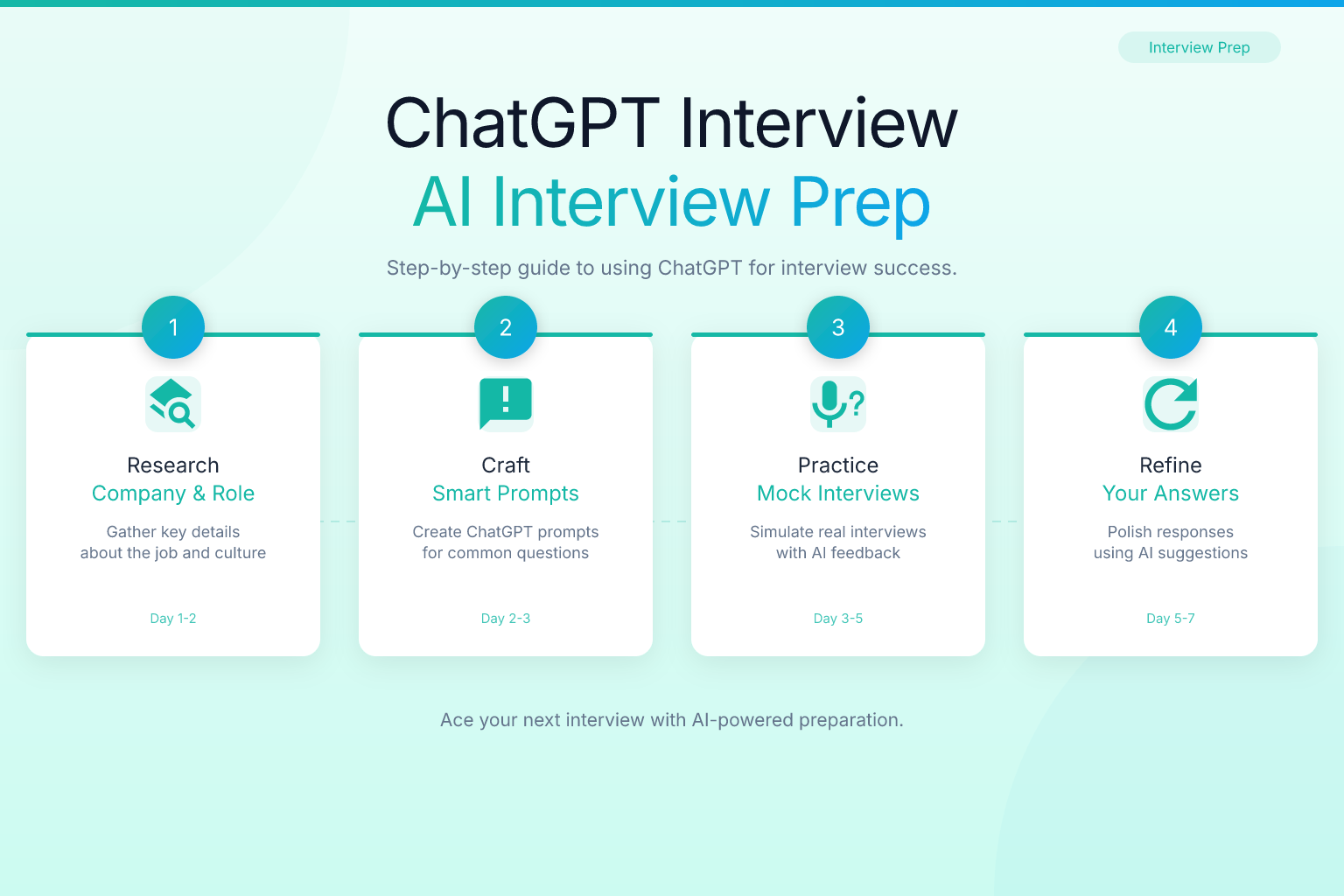
A: Follow this workflow: (1) Research the company and role with company deep-dive prompts, (2) Generate likely questions based on the job description, (3) Draft and refine your “Tell me about yourself” pitch, (4) Structure behavioral stories using the STAR method, and (5) Run a full mock interview with follow-up questions. This sequence builds your knowledge, content, and confidence in order.
Related articles:
- How to Prepare for Panel Interview Questions
- Answer ‘Where Do You See Yourself in 5 Years?’ Examples
- Availability Start Date: Sample Answers
Track Every Application While You Job Hunt
Stop losing track of where you’ve applied. The ResumeMate Job Tracker is a free Chrome extension that tracks every application, deadline, and follow-up in one place — right from your browser.
Install ResumeMate Free on Chrome →
Ready to Build a Resume That Gets Interviews?
Great interview prep starts with a resume that passes ATS filters and catches hiring managers’ attention. ResumeMate’s free tools help you create, score, and optimize your resume in minutes.
- AI Resume Builder — Generate clean, ATS-safe PDF resumes with professional templates
- Resume Score Checker — Get instant feedback on your resume’s ATS-readiness with section-by-section improvements
- Job Board — Find openings filtered by role, location, and remote options
All tools are 100% free. Start building your interview-ready resume today.