Academic Projects in Resume: 2026 Examples, Coursework & Skills for College Students
A college student resume that effectively showcases your projects, relevant coursework, and skills can open doors even without extensive work experience. In 2025, combining ATS-friendly formatting with clear examples of your academic achievements and capabilities helps you stand out to recruiters and hiring managers. With entry-level roles becoming more competitive, your resume must act as a proof of potential, demonstrating not just what you know, but how you apply it.
| What Hiring Managers Look For at a Glance |
|---|
| Relevant coursework and academic projects |
| Transferable skills like communication and teamwork |
| Problem-solving and leadership in school or clubs |
| Willingness to learn and grow |
Choose a Simple Format
Your resume’s layout is the first thing a recruiter notices — and the first thing an ATS parses. For college students, a clean, single-column design is the safest choice because it ensures every section is read in the correct order by both humans and machines. While many modern ATS can handle two-column layouts, single-column templates eliminate any risk of misread content, ensuring your projects and skills aren’t scrambled during parsing.
- Use a reverse-chronological format if you have internships, part-time jobs, or a consistent work history. This puts your most recent experience first and is the format recruiters expect. If you are pivoting majors or industries, a combination resume format might help highlight transferable skills over timeline gaps.
- Choose a functional (skills-based) format if your experience is mostly academic projects, volunteer work, and coursework. This groups your qualifications by skill area rather than by date, making it easier to highlight what you can do.
- Keep fonts readable and layout clean without graphics or tables. Stick to standard fonts like Arial, Calibri, or Times New Roman at 10–12pt. Ensure margins are set between 0.5" and 1" to maximize space without looking cramped.
- Use straightforward section headings: Objective, Education, Projects, Skills, Activities. Avoid creative labels like “My Journey” or “What I’ve Done” that might confuse an ATS.
- Export your resume as a PDF. Modern ATS (Workday, Greenhouse, Lever, etc.) parse text-based PDFs reliably. Only submit a DOCX if the application portal specifically requests it. For a deeper dive into what really trips up ATS, see our ATS myths vs. facts guide.
- File Naming: Save your file as
FirstName_LastName_Resume.pdf. Avoid generic names likeResume.pdforFinal_Draft_v2.pdfwhich look unprofessional in a recruiter’s folder.
What to Include (Projects, Coursework, Skills)
Every section of your resume should answer the question: “Why should I hire this student?” Here’s how to make each element count, specifically tailored to compensate for limited work history.
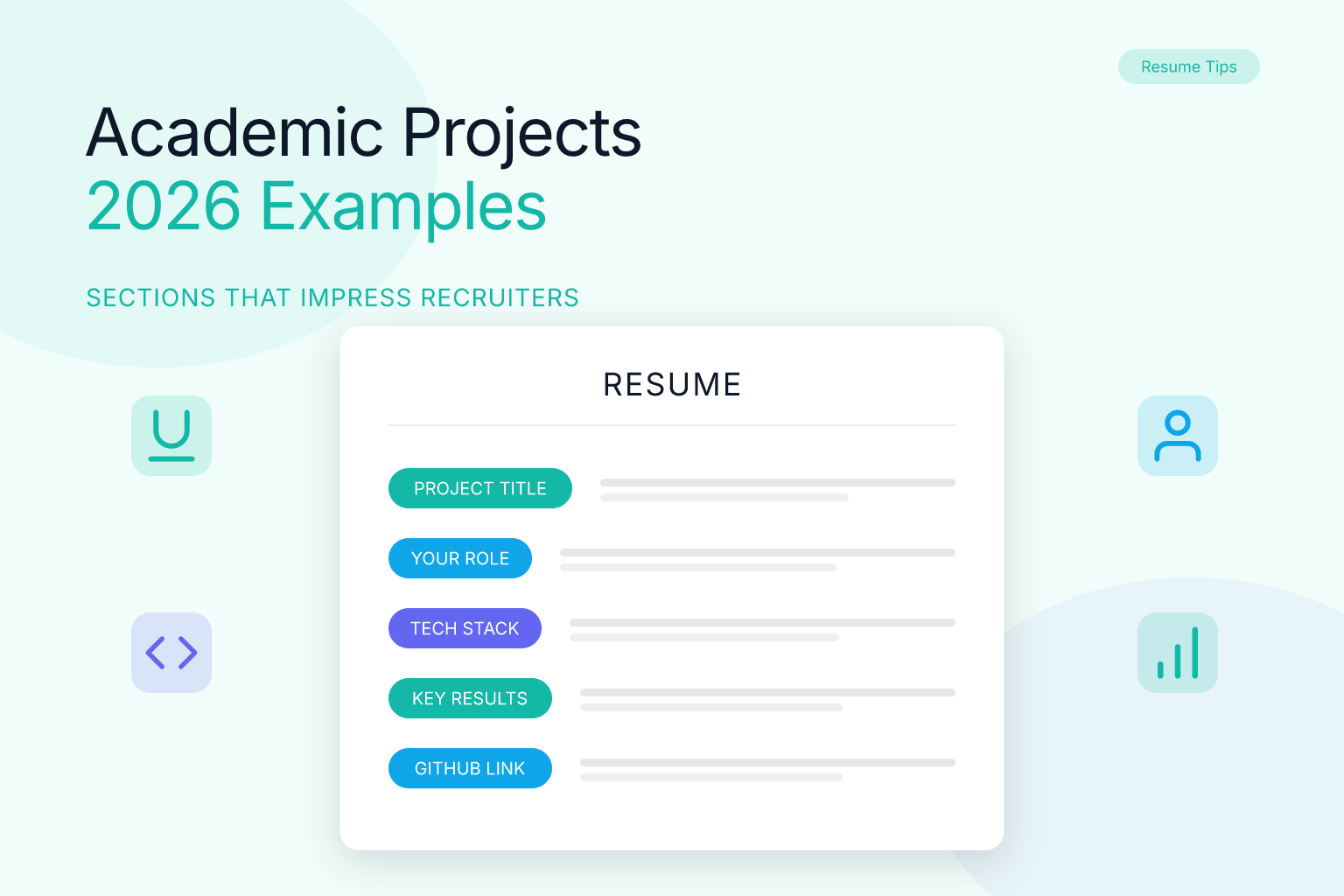
- Projects: Highlight academic, personal, or freelance projects that demonstrate relevant skills or initiative. A well-described project can be more convincing than a generic internship. Include the project name, your role, tools used, and a measurable outcome if possible. For non-technical majors, this could be a research paper, a case study analysis, or a planned event.
- Coursework: List courses related to your target job or industry to show foundational knowledge. Instead of a long list of every class, pick 4–8 that align with the job description. For example, a data analyst role might list “Statistical Modeling, Database Management, Python for Data Science.” Place this directly under your Education section.
- Skills: Include technical skills (software, languages) and soft skills (communication, leadership). Group them into categories like “Technical,” “Tools,” and “Languages” so they’re easy to scan. Avoid rating bars (e.g., “90% Java”) as they are subjective and often ignored by ATS.
- Extracurricular activities: Clubs, volunteer work, or leadership roles that reinforce your qualifications. Being treasurer of a club or organizing a campus event demonstrates responsibility and teamwork — treat these like mini-jobs. This is crucial for searches regarding activities for resume for students, as recruiters look for soft skills here.
- Achievements: Don’t hide your wins. Include Dean’s List, scholarships, hackathon wins, or competition placements. Even “Selected for competitive leadership program (top 5% of applicants)” counts. This directly addresses achievements in resume for students queries by validating your excellence beyond grades.
Examples You Can Copy
Example Objective
Ambitious college student seeking internship in marketing to apply communication and data analysis skills learned through coursework and student organizations.
Example Projects
- Market Research Project: Analyzed consumer trends for a local business, presenting findings that suggested a 10% increase in customer retention strategies.
- Web Development Coursework: Built a responsive website using HTML, CSS, and JavaScript as part of a semester-long project.
- Data Analysis Capstone: Cleaned and visualized a dataset of 5,000+ records using Python (Pandas, Matplotlib) to identify sales trends; presented insights to a panel of faculty and industry mentors.
- Humanities Research Paper: Researched and wrote a 20-page thesis on economic policy impacts, utilizing primary source analysis and peer-reviewed journals.
Example Skills
- Microsoft Excel, Google Analytics
- Public Speaking, Team Collaboration
- Python (basic), HTML/CSS
Example Education Section with Relevant Coursework
Bachelor of Science in Computer Science
University of Example, Expected May 2026
GPA: 3.6
Relevant Coursework: Data Structures, Algorithms, Database Systems, Web Development, Software Engineering
How to Tailor to Postings
Generic resumes get lost. Tailoring yours to each job posting takes 10–15 minutes and dramatically increases your chances of an interview. Here’s a simple process:
- Highlight the keywords in the job description — skills, tools, certifications, and soft skills.
- Match your skills and coursework to those keywords. If the posting asks for “Excel” and “data analysis,” make sure those exact terms appear in your Skills and Projects sections.
- Reorder your projects so the most relevant one appears first. If you’re applying for a marketing role, lead with the social media campaign project, not the Python script.
- Use the posting’s language naturally in your objective and project descriptions. If they say “cross-functional collaboration,” use that phrase instead of “worked with others.”
- Emphasize any software, tools, or certifications mentioned. If the job requires Google Analytics, list it prominently — and if you have a certification, put it in a dedicated “Certifications” line.
For a quick way to see if your tailored resume is hitting the right keywords, try our free resume score checker — it gives you section-by-section feedback in seconds.
ATS Basics for Entry-Level Resumes
Applicant Tracking Systems don’t have to be scary. Most rejections happen because of formatting errors, not content. Follow these rules to keep your resume ATS-friendly:
- Use standard fonts like Arial, Calibri, or Times New Roman. Fancy fonts can turn into gibberish when parsed.
- Avoid tables, graphics, text boxes, and headers/footers. Many ATS can’t read content inside them.
- Save and submit as a PDF unless the posting explicitly asks for a DOCX. Text-based PDFs are parsed accurately by all major ATS platforms. (If you’re still worried, read our breakdown of ATS myths vs. facts in 2026.)
- Include keywords relevant to your field or position. The ATS scans for these to determine if your resume matches the job.
- Use standard section headings. “Work Experience,” “Education,” “Skills,” and “Projects” are universally recognized. Creative headings like “What I’ve Done” can confuse the system.
- Check Contact Info: Ensure your email and phone number are in the body of the document, not just the header, as some ATS strip header information.
Templates & Checklist
Use this checklist before you hit submit. It covers everything a college student resume needs to pass both the ATS and the recruiter’s 7-second scan.
| College Student Resume Checklist |
|---|
| Clear objective or summary |
| Education section with relevant coursework |
| Skills section with technical and soft skills |
| Projects and activities demonstrating qualifications |
| Volunteer work or internships listed if applicable |
| ATS-friendly formatting and targeted keywords |
Fill-in-the-Blank Objective Template:
“Driven college student pursuing [Major] seeking [position] to utilize [skills] and contribute to [company or organization]. Eager to apply academic learning in a practical setting.”
If you’d rather not start from scratch, our free resume builder gives you ATS-optimized templates and pre-written bullet points you can customize in minutes.
Role-Specific Guidance
Different fields expect different things from a college student resume. Here is what to emphasize based on your target role:
Technology / Software Engineering
- List programming languages prominently in a dedicated Skills section (e.g., Python, Java, SQL, React).
- Include GitHub links to personal or academic projects. Even a small script or class assignment shows initiative.
- Highlight hackathons, coding competitions, or open-source contributions.
- Relevant courses: Data Structures, Algorithms, Operating Systems, Database Management.
Marketing / Communications
- Show any content you created — social media posts, blog articles, newsletters, or campaign work for clubs.
- Quantify results wherever possible: “Grew club Instagram from 200 to 950 followers in one semester.”
- List tools: Google Analytics, Canva, Hootsuite, Mailchimp.
- Relevant courses: Consumer Behavior, Digital Marketing, Public Relations, Media Writing.
Finance / Accounting
- Include any Excel or financial modeling projects from coursework.
- Note relevant certifications or exams in progress (e.g., CFA Level I candidate, Bloomberg Market Concepts).
- Relevant courses: Financial Accounting, Corporate Finance, Investments, Econometrics.
Sales / Business Development
- Highlight any fundraising, membership drives, or persuasion-based activities.
- Emphasize communication skills and resilience.
- For specific role expectations, review our Account Executive Roles & Responsibilities Guide to align your resume with industry standards.
- Relevant courses: Sales Management, Business Communication, Negotiation, Psychology.
Healthcare / Pre-Med / Nursing
- Shadow experience, clinic volunteering, and patient-facing roles carry real weight.
- List any CPR or basic life support certifications.
- Relevant courses: Anatomy & Physiology, Microbiology, Statistics, Health Policy.
Design / Creative Fields
- Link to an online portfolio (Behance, Dribbble, or personal website) in your contact header.
- Describe projects with the design challenge, your process, and the final deliverable.
- List tools: Adobe Creative Suite, Figma, Sketch, Procreate.
- Relevant courses: Typography, UX Design, Visual Communication, Digital Imaging.
Step-by-Step Guide: Writing Your Projects Section
The Projects section is the highest-leverage section on a college student resume. Here is how to write it from scratch:
Step 1: Pick 2–4 projects that are most relevant to your target role.
These can be class assignments, personal side projects, freelance work, or club initiatives. Relevance beats impressiveness every time.
Step 2: Write a one-line description of what the project was.
Be specific. “Built a budget tracking web app” is stronger than “Created a project for class.”
Step 3: Describe what YOU did, not what the project was.
Use action verbs: designed, developed, analyzed, led, presented, built, researched.
Step 4: Add a measurable result or outcome if possible.
Examples: “reduced manual data entry time by 40%,” “received highest grade in class,” “presented to 3 local business owners.”
Step 5: List the tools, technologies, or skills used.
This is where your keywords live. Recruiters and ATS both scan for these.
Example (Before → After):
Before: “Class project on consumer behavior.”
After: “Consumer Behavior Research Project — Surveyed 120 students and analyzed purchasing patterns using SPSS. Identified two key drivers of brand loyalty and presented findings to a panel of marketing faculty. (Spring 2024)”
How to Write a Skills Section That Passes ATS
Do not just list generic skills. Structure your Skills section so it is both ATS-readable and useful to a human recruiter.
Recommended format:
- Technical Skills: Python (NumPy, Pandas), Excel (VLOOKUP, Pivot Tables), HTML/CSS, Google Analytics, SQL (basic)
- Software & Tools: Microsoft Office Suite, Figma, Slack, Notion, GitHub
- Languages: Spanish (Conversational), Mandarin (Basic)
- Soft Skills: Team collaboration, public speaking, time management, written communication
Tips:
- Pull exact skill names from the job description and match them in your resume.
- Do not claim “expert” in anything you learned casually. “Proficient” or “familiar with” is safer and more honest.
- Group skills by type instead of listing everything in one long line — it is easier to scan.
Common Mistakes College Students Make
1. Writing an objective that is too vague.
“Looking for an opportunity to grow” tells the recruiter nothing. Replace it with a targeted statement mentioning the role, your field, and one or two concrete skills.
2. Listing responsibilities instead of accomplishments.
“Helped with social media” is weak. “Created 12 Instagram posts per month using Canva, growing page engagement by 34%” is strong.
3. Forgetting to include relevant coursework.
If you have taken courses that directly relate to the job (e.g., Database Management for a data analyst role), list them. Recruiters use coursework as a signal of foundational knowledge.
4. Leaving off extracurricular leadership.
Being treasurer of a club, captain of a sports team, or event organizer for a student organization demonstrates real responsibility and soft skills.
5. Submitting the same resume to every job.
A resume for a software engineering internship should look different from one for a marketing coordinator role. Spend 10–15 minutes customizing the objective, skills, and highlighted projects for each application.
6. Making it longer than one page.
Unless you have substantial internship and research experience (3+ roles), keep it to one page. Recruiters spend an average of 7 seconds on an initial scan — make every line count.
Frequently Asked Questions
Q: How do I add academic projects to my resume?
A: Create a dedicated “Projects” section and list each project with a title, a brief description of what you did, the tools or skills used, and a measurable result if possible. Place this section after your Education or Skills section, depending on what’s most relevant to the job. Use action verbs and quantify outcomes to make the project stand out.
Q: What activities should I include on a college resume?
A: Include clubs, volunteer work, sports teams, or student government where you held a role or made an impact. Focus on leadership positions or specific contributions, such as “organized event for 200 attendees” rather than just listing membership. This shows teamwork and time management skills to recruiters.
Q: What achievements look good on a student resume?
A: Highlight academic honors (Dean’s List, scholarships), competition wins (hackathons, case competitions), and leadership milestones. Even small wins like “raised $500 for charity through a campus event” show initiative. Quantify these achievements whenever possible to demonstrate value.
Q: How do I write a college internship resume with no experience?
A: Focus heavily on your Projects, Coursework, and Skills sections to compensate for lack of work history. Treat class assignments like jobs by describing the problem you solved and the tools you used. Volunteer work and extracurricular leadership can also fill the experience gap effectively.
Q: How do I include relevant coursework on my resume?
A: Add a “Relevant Coursework” line under your Education section. List 4–8 courses that directly relate to the job, separated by commas. Avoid listing every class you’ve taken; focus on those that match the job description’s requirements. For example, a marketing role might list “Consumer Behavior, Digital Marketing, Marketing Analytics.”
Q: How long should a college student resume be?
A: Ideally one page, focused and concise. If you have significant research, multiple internships, or extensive publications, you may stretch to two pages — but only if every line adds value. Recruiters prefer brevity for entry-level candidates.
Q: What skills should I put on a college resume?
A: Mix hard skills (software, languages, tools) with soft skills (communication, problem-solving). Pull keywords directly from the job description to ensure ATS compatibility. Group them logically, such as “Technical Skills” and “Languages,” to make them easy to scan.
Related articles:
Build, Score & Track Your Job Search with ResumeMate
Resume Builder → — Create an ATS-ready resume in minutes. Free to use, exports clean PDFs.
Resume Score Checker → — See how your resume scores against ATS systems instantly. Get section-by-section feedback.
Job Board → — Browse jobs matched to your resume and filter by role or location.
Job Tracker Chrome Extension → — Track every application, deadline, and follow-up in one place — free.