Company Website vs Job Board: 2026 Response Rates, Pros, Cons, and Smart Strategy
When you’re job hunting, the choice between applying directly on a company website vs job board can feel like a coin toss. You find a role on LinkedIn or Indeed, and suddenly you have two paths: click “Apply” right there, or open a new tab, dig through the company’s career page, and submit your resume through their portal. Both methods can land you an interview, but they work differently behind the scenes. This guide breaks down the real pros and cons of each approach, when to use which, and how to combine them so you stop wasting applications and start getting callbacks.
Key Takeaways
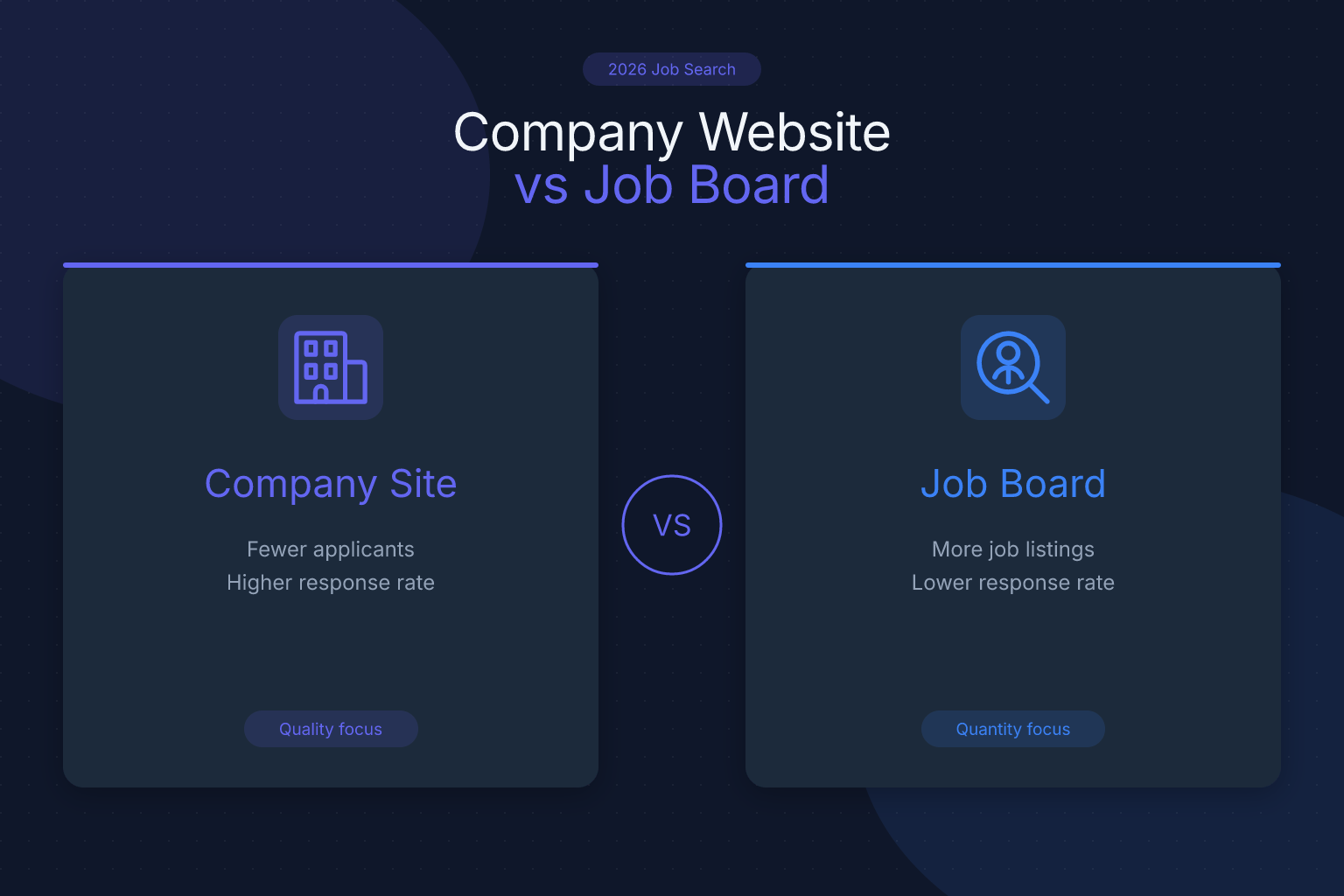
- Applying directly on a company website usually gets your resume into the employer’s applicant tracking system (ATS) faster and with less competition than a job board listing.
- Job boards are better for discovering many openings quickly and filtering by location, salary, and remote options, but your application often competes with hundreds of others from the same listing.
- The most effective strategy is a hybrid: use job boards to find roles, then apply on the company’s career page whenever possible.
- Tracking every application in one place prevents duplicate submissions, missed follow-ups, and the frustration of losing track of where you’ve applied.
- Tailoring your resume for each role matters more than where you apply, so use a free tool to adjust your resume quickly for every submission.
| What to Do | Why It Matters | Time |
|---|---|---|
| Apply on the company website when you find a role you’re excited about | Your application goes directly to the employer’s ATS, often with fewer competing applicants | 5–10 minutes per application |
| Use job boards to search and filter roles by location, salary, and remote options | Saves hours of browsing individual career pages and uncovers companies you didn’t know | 15–30 minutes per search session |
| Keep a spreadsheet or use a job tracker to log every application | Prevents duplicate applications and helps you follow up on time | 2 minutes per application |
| Tailor your resume for each application, regardless of where you apply | Increases your chances of passing ATS screening and impressing recruiters | 10–20 minutes per application |
What Applying Directly on a Company Website vs Job Board Really Means
Before weighing pros and cons, let’s define the two paths clearly.
Applying directly on a company website means you go to the employer’s own career page (often at company.com/careers or jobs.company.com), find the specific role, and submit your resume through their application portal. Sometimes you can also apply directly by emailing a hiring manager or using an employee referral link, but the most common direct route is the company’s own ATS.
Applying via a job board means you use a third-party platform like LinkedIn, Indeed, Glassdoor, or ZipRecruiter. You either click “Apply” on the job board itself (which may redirect you to the company site or let you apply with a stored profile) or you use the board’s “Easy Apply” feature to submit your resume without leaving the platform.
The key difference is where your application lands first. Direct applications go straight into the employer’s system. Job board applications often pass through an aggregator or sit in a separate inbox that recruiters may check less frequently. That single difference drives most of the pros and cons below.
Pros of Applying Directly on a Company Website
Applying directly isn’t just about being thorough—it often gives you a measurable edge.
1. Your application gets seen faster. When you apply on a company’s career page, your resume enters their ATS immediately. Recruiters typically review direct applicants before they sift through job board submissions, because those candidates showed extra initiative. In many cases, a direct application is the first thing a recruiter sees when they log in for the day.
2. Less competition. Job board listings attract hundreds of applicants within days. A direct application on a company site may still face competition, but the pool is usually smaller because many job seekers never bother to leave the job board. If a role is posted on both LinkedIn and the company site, the direct applicants often number in the dozens while the LinkedIn applicants number in the hundreds.
3. You can tailor your application to the company culture. When you’re on the company’s career page, you can read their mission statement, values, and recent news. That context helps you write a more personalized cover letter or tweak your resume summary. Job boards strip away that context, leaving you with just a job description.
4. Some roles are only posted on company websites. Many companies, especially smaller ones or those with niche roles, skip job boards entirely to avoid paying posting fees or dealing with spam. If you only search job boards, you’ll miss these openings. Checking company career pages directly is the only way to find them.
5. It shows genuine interest. Recruiters notice when an applicant took the time to find the role on the company site rather than clicking a one-click apply button. That small signal can tip the scales in your favor when two candidates have similar qualifications.
Cons of Applying Directly on a Company Website
Direct applications aren’t perfect. Here’s where they fall short.
1. It’s time-consuming. You have to visit each company’s career page, search for relevant roles, and fill out a new application form every time. If you’re applying to 20 companies, that’s 20 different portals, 20 different account creations, and 20 different resume uploads. Job boards let you apply to 20 roles in the same time it takes to do 5 direct applications.
2. You might miss roles that aren’t on the career page. Some companies post jobs on job boards first and update their career page later. Others use job boards exclusively for certain roles. If you only check company sites, you could miss a perfect opportunity that’s sitting on Indeed right now.
3. No centralized tracking. When you apply directly, you’re on your own to remember where you applied, when, and what the next step is. Job boards often have built-in application tracking, but direct applications require you to keep your own spreadsheet or use a separate tool.
4. Some companies only accept applications through job boards. A few employers, especially in certain industries or for contract roles, route all applications through a job board or staffing agency. In those cases, applying directly isn’t even an option.
Pros of Using Job Boards
Job boards are the default for a reason—they’re fast and broad.
1. You can search and filter at scale. Instead of visiting 50 company websites, you can search one job board for “remote marketing manager” and see hundreds of results in seconds. Filters for location, salary range, experience level, and job type save hours of manual browsing.
2. Job alerts bring roles to you. Most job boards let you set up email alerts for specific keywords and locations. You’ll get notified the moment a matching role is posted, so you can apply early—often before the company even updates its own career page. For a step-by-step guide on setting up effective alerts, see how to use job alerts effectively.
3. You discover companies you didn’t know existed. Job boards surface employers you’d never think to search for. A startup in a different city, a remote-first company, or a niche firm might only appear in your job board results. That discovery is hard to replicate by manually browsing career pages.
4. Easy Apply saves time. LinkedIn’s Easy Apply, Indeed’s Quick Apply, and similar features let you submit a resume with one click. For high-volume job searching, this speed is unbeatable. You can apply to 10 roles in 15 minutes.
5. Built-in application tracking. Most job boards show you a list of jobs you’ve applied to, along with status updates if the employer uses the platform’s tracking features. That’s convenient, though it only covers applications made through that board.
Cons of Using Job Boards
Job boards have real downsides that can hurt your chances if you rely on them exclusively.
1. Massive competition. A single job board listing can receive 200–500 applications within the first week. Your resume is one of hundreds in a recruiter’s inbox, and many recruiters only review the first 50 or so before moving on. Direct applicants often get reviewed first simply because there are fewer of them.
2. Your application can get lost or ignored. Some companies treat job board applications as a secondary source. They may check their own ATS daily but only log into Indeed or LinkedIn once a week. If a role is urgent, the direct applicants get interviews while job board applicants wait.
3. Higher risk of scams and outdated listings. Job boards are a common hunting ground for scammers who post fake jobs to collect personal information. Even legitimate boards have stale listings that were filled months ago but never removed. Before you apply to anything on a job board, learn how to spot job scams on Indeed and LinkedIn.
4. Less personalization. When you apply through a job board, you’re often limited to uploading a resume and maybe a short note. You can’t easily reference the company’s recent news or tailor your application to their specific culture. That makes it harder to stand out.
5. You might apply to the same job twice. If you apply on a job board and then later find the same role on the company site, you could accidentally submit two applications. That looks sloppy and can get you flagged as a duplicate. Tracking your applications prevents this.
How to Choose: A Simple Decision Framework
You don’t have to pick one method and stick with it forever. Use this framework to decide on a case-by-case basis.
Use a job board when:
- You’re in the early stages of your search and want to see what’s out there.
- You’re applying to many similar roles and need speed.
- The job board listing is the only place the role is posted.
- You’re open to a wide range of companies and locations.
Apply directly on the company website when:
- You’re genuinely excited about the company and want to show it.
- The role is a strong match for your skills and you want to maximize your chances.
- The company is small or mid-sized and likely reviews direct applicants first.
- You found the role on a job board but the company’s career page has a more detailed description or additional openings.
A good rule of thumb: Use job boards for discovery, then apply directly for the roles you care about most. If you’re applying to 20 jobs, maybe 5 get the direct treatment and 15 go through job boards. That balance keeps your search efficient without sacrificing quality on the opportunities that matter.
The Hybrid Strategy That Works Best
The most successful job seekers don’t choose one method—they combine both. Here’s a step-by-step hybrid approach.
- Set up job alerts on 2–3 job boards for your target role, location, and salary range. This ensures you see new postings as soon as they go live.
- When an alert arrives, open the job description and assess fit. If it’s a strong match, note the company name and role title.
- Go to the company’s career page and search for the same role. If it’s there, apply directly. If it’s not, apply through the job board but keep the company name for follow-up.
- Tailor your resume for each application. Even if you’re applying through a job board, adjust your resume summary and skills to match the job description. A free tool like ResumeMate’s AI resume builder can help you make these tweaks in minutes instead of hours.
- Log every application in one place. Whether you applied directly or through a job board, record the company, role, date, and next step. The ResumeMate Job Tracker is a free Chrome extension that does this automatically as you browse job boards and company sites.
- Follow up after 5–7 business days if you haven’t heard back. Direct applicants often get faster responses, but a polite follow-up email can nudge either type of application.
This hybrid approach gives you the speed of job boards and the higher visibility of direct applications. It also prevents the most common mistake: applying to the same job twice because you forgot you already submitted it on a different platform.
Common Mistakes to Avoid
Even with a good strategy, these errors can sabotage your job search.
1. Applying to the same job on both a job board and the company site. This creates duplicate entries in the employer’s ATS and makes you look disorganized. Always check your application tracker before submitting.
2. Using the same generic resume for every application. Job boards make it easy to blast out the same resume to 50 jobs, but that’s a fast way to get ignored. Tailor your resume for each role, even if it’s just tweaking the summary and top skills. For a faster way to tailor resumes using job feeds, see this guide on feed-driven tailored resumes.
3. Ignoring the company’s career page entirely. Some job seekers never visit a company’s website, which means they miss internal postings, employee referral programs, and culture clues that could strengthen their application.
4. Not tracking applications. If you can’t remember where you applied, you can’t follow up effectively, and you risk duplicate submissions. Use a spreadsheet or a free tool like the ResumeMate Job Tracker to log everything.
5. Applying to outdated or fake job board listings. Always verify that the role is still open by checking the company’s career page. If the job isn’t there, it may have been filled or it could be a scam. Run your resume through a free ATS score checker before submitting to catch formatting issues that could get you auto-rejected.
FAQ
Q: Is it better to apply on the company website or a job board?
A: In most cases, applying directly on the company website is better because your application goes straight into the employer’s ATS with less competition. However, job boards are better for discovering many roles quickly. The best approach is to use job boards for search and then apply directly for roles you’re excited about.
Q: Do recruiters prefer direct applications over job board applications?
A: Many recruiters review direct applicants first because they show more initiative and there are usually fewer of them. That doesn’t mean job board applications are ignored, but direct applications often get a slight timing advantage.
Q: Can I apply to the same job on both a job board and the company website?
A: No, you should avoid applying to the same job twice. It creates duplicate entries in the employer’s system and can make you look careless. Track your applications to prevent this.
Q: How do I find jobs that are only posted on company websites?
A: Make a list of 20–30 target companies and check their career pages weekly. You can also set up Google Alerts for phrases like “[company name] careers” or use a job board’s company search feature to find their direct postings.
Q: Do job boards have more job listings than company websites?
A: Job boards aggregate listings from many companies, so they often show more total openings. But some companies only post on their own career page, so you’ll miss those if you rely solely on job boards.
Q: How do I track applications when I apply directly on company websites?
A: Use a spreadsheet with columns for company, role, date applied, source (direct or job board), and next follow-up date. Or use a free tool like the ResumeMate Job Tracker Chrome extension, which automatically logs applications as you browse.
Track Every Application While You Job Hunt
Stop losing track of where you’ve applied. The ResumeMate Job Tracker is a free Chrome extension that tracks every application, deadline, and follow-up in one place — right from your browser.