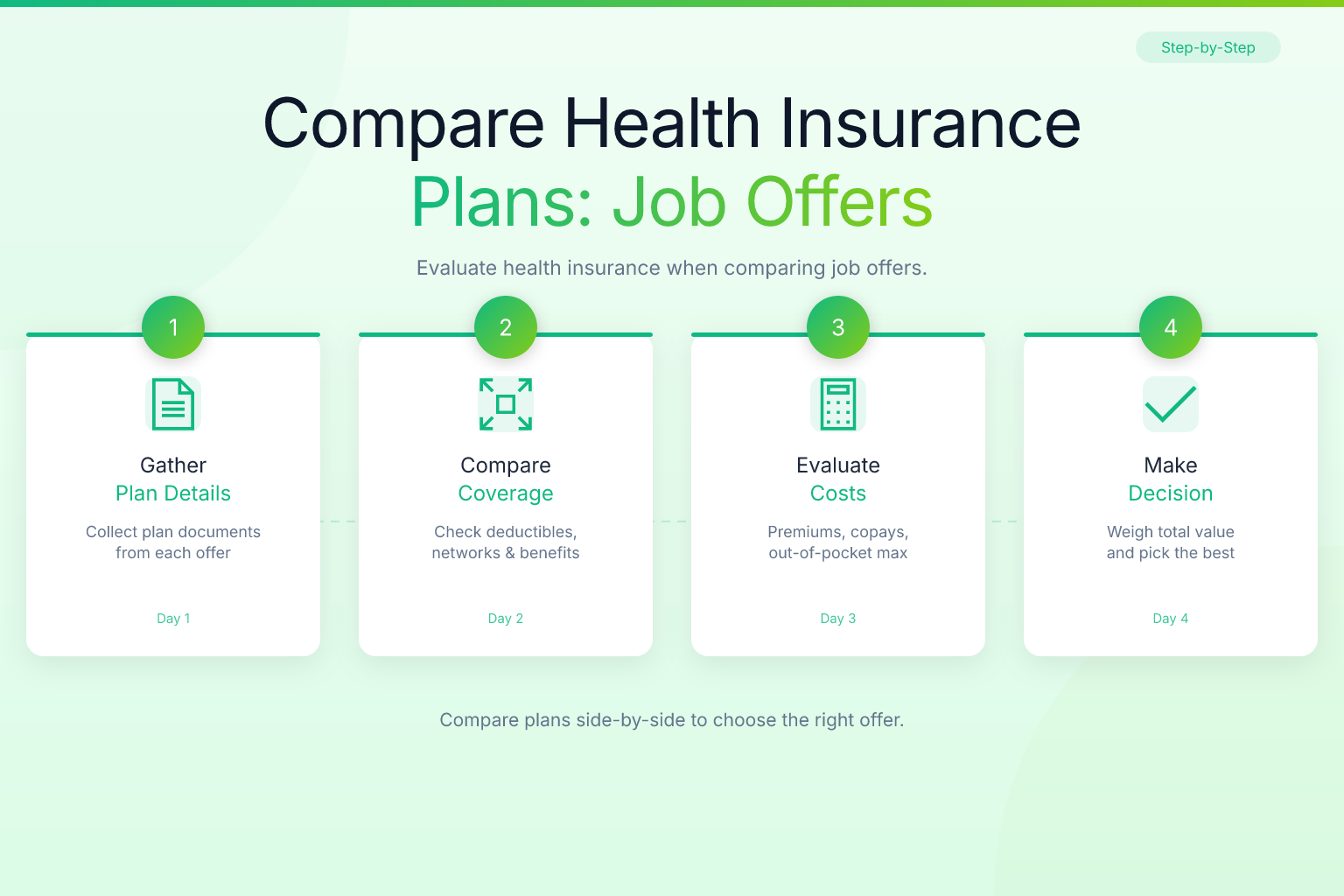
How to Compare Health Insurance Plans Between Job Offers: A Step-by-Step Guide
When you’re weighing multiple job offers, how to compare health insurance plans between job offers can feel like decoding a foreign language. Premiums, deductibles, copays, coinsurance, out-of-pocket maximums, HMOs, PPOs, HDHPs — the terminology alone is enough to make you want to just pick the plan with the lowest monthly cost and move on. But that shortcut can cost you thousands of dollars over the course of a year. Health insurance is often the second-largest component of your total compensation after salary, and according to the Kaiser Family Foundation’s 2024 Employer Health Benefits Survey, the average annual premium for employer-sponsored health insurance was $8,951 for single coverage and $25,572 for family coverage, with workers paying on average $1,368 and $6,296 respectively. That’s real money, and the plan you choose directly affects your take-home pay, your access to care, and your financial risk if you get sick or injured.
This guide walks you through a systematic, side-by-side comparison method so you can evaluate health insurance plans from different employers with confidence. You’ll learn what documents to request, which numbers matter most, how to calculate your true annual cost, and what questions to ask before you sign. By the end, you’ll have a clear framework for making a decision that protects both your health and your wallet.
Key Takeaways
- Request the Summary of Benefits and Coverage (SBC) from each employer — it’s a standardized document that makes side-by-side comparison straightforward.
- Your total annual cost is not just the premium; it’s the premium plus your expected out-of-pocket spending (deductible, copays, coinsurance) up to the out-of-pocket maximum.
- The out-of-pocket maximum is the most important number for financial protection — it caps your total annual spending on covered in-network care.
- Check whether your current doctors, specialists, and medications are covered in-network before choosing a plan, especially if you have ongoing health needs.
- Employer contributions to a Health Savings Account (HSA) are free money that can offset a higher deductible and lower your effective cost.
| What to Do | Why It Matters | Time |
|---|---|---|
| Request the SBC from each employer | Standardized format makes comparison apples-to-apples | 15 min per employer |
| Calculate your total annual cost for each plan | Reveals true cost beyond the monthly premium | 30 min |
| Check network coverage for your providers and medications | Avoid surprise out-of-network bills | 20 min |
| Compare employer HSA or FSA contributions | Free money that lowers your effective cost | 10 min |
| Ask about wellness incentives and dependent coverage | Can add hundreds or thousands in value | 15 min |
Start with the Summary of Benefits and Coverage (SBC)
Before you can compare anything, you need the right documents. Every employer-sponsored health plan is required to provide a Summary of Benefits and Coverage (SBC) — a standardized, plain-language document that outlines what the plan covers and what you’ll pay. It includes a “Coverage Examples” section showing how the plan would handle common scenarios like a diabetes diagnosis or a normal delivery. The SBC is your best friend for comparison because it uses the same format across all plans, so you can line up two SBCs side by side and see the differences immediately.
When you receive a job offer, ask the HR contact or recruiter for the SBC for each health plan option. If they push back or say they’ll send it later, be persistent — you cannot make an informed decision without it. This is a standard request, and any reputable employer will provide it. If you’re still in the interview stage and want to ask about benefits before an offer, check out our guide on how to ask about benefits package before a job offer for scripts and timing tips.
Once you have the SBCs, create a simple spreadsheet or use a piece of paper with columns for each plan. You’ll fill in the numbers as you work through the sections below. If you’re juggling multiple offers with different deadlines, the ResumeMate Job Tracker can help you keep track of each offer’s expiration date and follow-up tasks so nothing slips through the cracks.
Understand the Four Main Health Plan Types
Health plans come in several flavors, and the type of plan affects everything from which doctors you can see to how much you pay out of pocket. Here are the four most common types you’ll encounter in job offers:
- HMO (Health Maintenance Organization): Requires you to choose a primary care physician (PCP) and get referrals to see specialists. Care is only covered in-network except for emergencies. Premiums are usually lower, but flexibility is limited.
- PPO (Preferred Provider Organization): Allows you to see any doctor or specialist without a referral, both in-network and out-of-network (though out-of-network costs more). Premiums are typically higher, but you get more freedom.
- EPO (Exclusive Provider Organization): A hybrid — no referrals needed, but like an HMO, care is only covered in-network except for emergencies. Premiums fall between HMO and PPO.
- HDHP (High-Deductible Health Plan) with HSA: Has a higher deductible (at least $1,650 for an individual or $3,300 for a family in 2026, per IRS guidelines) but lower premiums. You can pair it with a Health Savings Account (HSA) that offers triple tax advantages. Many employers contribute to your HSA.
There’s no universally “best” plan type — it depends on your health needs, budget, and risk tolerance. If you rarely see a doctor and want to save on premiums, an HDHP with an HSA might be ideal. If you have a chronic condition or see specialists regularly, a PPO’s flexibility could be worth the higher premium. We’ll dig into how to match plan type to your situation later.
Compare Premiums: The Monthly Cost You’ll Pay
The premium is the amount deducted from your paycheck each month for health insurance. It’s the most visible cost, but it’s also the easiest to over-index on. A plan with a $50 lower monthly premium might have a $2,000 higher deductible, which could cost you far more if you actually need care.
When comparing premiums, look at:
- Your share vs. employer share: The SBC will show the total premium and what you pay. Some employers cover 100% of employee-only premiums; others pass on a significant portion.
- Coverage tier: Premiums differ for employee-only, employee + spouse, employee + children, and family coverage. Make sure you’re comparing the same tier across offers.
- Pay frequency: Premiums are usually deducted per pay period. If you’re paid biweekly, multiply the per-paycheck amount by 26 to get the annual cost; if semimonthly, multiply by 24.
Write down the annual premium for each plan. For example, if Plan A costs $120 per biweekly paycheck for employee-only coverage, that’s $3,120 per year. Plan B at $90 per biweekly paycheck is $2,340 per year. That’s a $780 difference — but don’t stop there. The premium is just the entry fee; the real comparison comes from what happens when you use the plan.
Compare Deductibles and Out-of-Pocket Maximums
Two numbers on the SBC will tell you most of what you need to know about financial risk: the deductible and the out-of-pocket maximum.
- Deductible: The amount you pay out of pocket for covered services before your insurance starts paying (except for preventive care, which is often covered at 100% before the deductible). Deductibles can range from $0 to several thousand dollars.
- Out-of-pocket maximum (OOPM): The most you’ll pay in a year for covered in-network care, including deductible, copays, and coinsurance. After you hit this number, the plan pays 100% of covered services for the rest of the year. For 2026, the IRS sets the maximum OOPM for HDHPs at $8,300 for an individual and $16,600 for a family, but non-HDHP plans can have different limits.
The OOPM is your worst-case scenario. If you have a major surgery or a serious illness, this is the cap on your annual spending. A plan with a $3,000 deductible and a $6,000 OOPM is very different from one with a $1,500 deductible and a $4,000 OOPM, even if the premiums are similar. When comparing offers, always note both numbers for each plan.
Here’s a quick example:
| Plan | Annual Premium | Deductible | Out-of-Pocket Max |
|---|---|---|---|
| Plan A (PPO) | $3,120 | $1,500 | $4,500 |
| Plan B (HDHP) | $2,340 | $3,000 | $6,000 |
Plan B saves you $780 in premiums, but if you have a bad year, you could pay $1,500 more out of pocket. Whether that trade-off is worth it depends on your expected healthcare usage — which we’ll calculate in a later section.
Compare Copays, Coinsurance, and Prescription Drug Coverage
Once you’ve met your deductible, you still share costs through copays and coinsurance until you hit your out-of-pocket maximum. These details matter, especially for routine care and medications.
- Copay: A fixed dollar amount you pay for a service, like $30 for a primary care visit or $50 for a specialist. Copays often apply before or after the deductible, depending on the plan.
- Coinsurance: A percentage of the cost you pay after meeting your deductible, like 20% of a hospital bill. If a procedure costs $10,000, you’d pay $2,000.
- Prescription drug coverage: Most plans have a formulary (list of covered drugs) with tiers. Generic drugs might have a $10 copay, preferred brand names $40, non-preferred brand names $80, and specialty drugs a percentage coinsurance. If you take regular medications, check the formulary for each plan to see where your drugs fall and what you’d pay.
For example, if you take a brand-name medication that costs $300 per month, a plan with a $40 copay for that tier would cost you $480 per year for that drug alone. A plan with 30% coinsurance would cost you $1,080 per year. That’s a $600 difference that could easily outweigh a premium difference.
Pull up each plan’s drug formulary (usually available on the insurer’s website or from HR) and check your current prescriptions. Also note whether the plan requires step therapy (trying cheaper drugs first) or prior authorization, which can delay access to certain medications.
Evaluate Network Coverage: Are Your Doctors and Hospitals In-Network?
A plan’s network is the list of doctors, hospitals, and other providers that have contracted with the insurer to provide care at negotiated rates. Going out-of-network can be dramatically more expensive — sometimes the plan won’t cover it at all, or you’ll pay a separate, higher out-of-network deductible and coinsurance.
Before choosing a plan, do these three checks:
- List your current providers: Your primary care physician, any specialists you see regularly, and your preferred hospital or urgent care center.
- Check each plan’s provider directory: Most insurers have an online directory where you can search by name or location. Confirm that your providers are listed as in-network for the specific plan you’re considering (networks can vary even within the same insurer).
- Call the providers directly: Directories can be outdated. A quick call to your doctor’s office to confirm they accept the specific plan is worth the time.
If you have a chronic condition or see a specialist you trust, network coverage can be a dealbreaker. A plan with a lower premium but a narrow network that excludes your endocrinologist or therapist could end up costing you more in out-of-network charges — or force you to switch providers, which is disruptive and potentially harmful to your care.
Also consider geographic coverage if you travel frequently or have family members in different locations. Some plans have national networks (like PPOs from major insurers), while others are regional HMOs that only cover care near your home.
Factor in Employer Contributions: HSAs, FSAs, and Wellness Incentives
Health insurance isn’t just about the plan itself — employers often sweeten the deal with contributions to tax-advantaged accounts or wellness programs. These can add hundreds or even thousands of dollars in value.
- Health Savings Account (HSA) contributions: If you choose an HDHP, you can open an HSA. Many employers contribute to your HSA as an incentive — for example, $500 for an individual or $1,000 for a family per year. That’s free money that reduces your effective healthcare cost. HSAs also offer triple tax advantages: contributions are pre-tax, growth is tax-free, and withdrawals for qualified medical expenses are tax-free. You can even invest the funds and use them in retirement.
- Flexible Spending Account (FSA) contributions: Some employers contribute to an FSA, though it’s less common. FSAs are use-it-or-lose-it (with some rollover exceptions), so they’re best for predictable expenses.
- Wellness incentives: Many employers offer cash rewards or premium discounts for completing health assessments, getting annual physicals, or participating in smoking cessation programs. These can range from $100 to $1,000 or more per year.
- Other benefits that affect total compensation: Don’t forget to factor in paid time off, retirement matching, and other perks when comparing offers. Our guide on how to negotiate PTO in a job offer can help you maximize the non-health benefits too.
When comparing plans, add any employer HSA or FSA contributions to your calculation. For example, if Plan B (the HDHP) has a $3,000 deductible but the employer contributes $1,000 to your HSA, your effective deductible is really $2,000. That changes the math significantly.
Calculate Your Total Annual Cost for Each Plan
Now it’s time to put it all together. Your total annual cost for a health plan is:
Total Annual Cost = Annual Premium + Expected Out-of-Pocket Spending (up to the OOPM) – Employer HSA/FSA Contributions
To estimate your expected out-of-pocket spending, think about your healthcare usage over the past year and what you anticipate for the coming year. Consider:
- How many primary care visits, specialist visits, and urgent care visits do you typically have?
- Do you take any regular prescriptions? What are their copays or coinsurance?
- Do you have any planned procedures, like physical therapy, surgery, or maternity care?
- Do you have a chronic condition that requires ongoing management?
For each plan, estimate your annual spending using the plan’s cost-sharing details. Here’s a step-by-step worksheet:
- List your expected services (e.g., 2 PCP visits, 1 specialist visit, 12 months of a generic prescription, 1 urgent care visit).
- For each service, note the copay or coinsurance from the SBC.
- Add up your expected out-of-pocket costs for the year, but cap it at the plan’s out-of-pocket maximum.
- Add your annual premium to that number.
- Subtract any employer HSA or FSA contributions you’ll receive.
- Compare the final totals across plans.
Let’s walk through an example for a single person with moderate healthcare needs:
Expected services: 2 PCP visits, 1 specialist visit, 12 months of a generic drug, 1 urgent care visit.
Plan A (PPO): Premium $3,120/year. Copays: PCP $30, specialist $50, generic drug $10, urgent care $75. Deductible $1,500 (but copays apply before deductible for these services).
- PCP: 2 × $30 = $60
- Specialist: 1 × $50 = $50
- Generic drug: 12 × $10 = $120
- Urgent care: 1 × $75 = $75
- Total out-of-pocket: $305
- Total annual cost: $3,120 + $305 = $3,425
Plan B (HDHP with HSA): Premium $2,340/year. Deductible $3,000. After deductible, 20% coinsurance. Employer contributes $750 to HSA.
- You’ll pay full cost for services until you hit the $3,000 deductible. Let’s estimate the allowed amounts: PCP visit $150, specialist $250, generic drug $30/month, urgent care $200.
- PCP: 2 × $150 = $300
- Specialist: 1 × $250 = $250
- Generic drug: 12 × $30 = $360
- Urgent care: 1 × $200 = $200
- Total before deductible: $1,110 (you haven’t hit the $3,000 deductible, so you pay all of it)
- Total out-of-pocket: $1,110
- Total annual cost: $2,340 + $1,110 – $750 (HSA contribution) = $2,700
In this scenario, Plan B is $725 cheaper per year, even though it has a higher deductible, because the lower premium and employer HSA contribution more than offset the higher out-of-pocket costs. But if this person had a major medical event, Plan A’s lower out-of-pocket maximum ($4,500 vs. $6,000) would provide better protection. That’s why you should also consider your risk tolerance and worst-case scenario.
Run this calculation for each plan using your own expected usage. If you’re unsure, you can also calculate a “best case” (no care needed) and “worst case” (hit the OOPM) to see the range.
Consider Your Health Needs and Family Situation
The right plan for you depends heavily on your personal circumstances. Here’s how to match plan features to your situation:
- You’re young, healthy, and rarely see a doctor: An HDHP with an HSA is often the best value. You’ll pay low premiums, and the HSA lets you save pre-tax money for future healthcare expenses. The high deductible is less of a concern because you’re unlikely to hit it.
- You have a chronic condition or take expensive medications: Look for a plan with low copays for specialists and prescriptions, even if the premium is higher. A PPO or HMO with rich drug coverage may save you more in the long run.
- You’re planning to start a family: Maternity care can be expensive. Check the plan’s coverage for prenatal visits, delivery, and newborn care. Some plans have separate deductibles or coinsurance for maternity. Also consider the out-of-pocket maximum, as a delivery can easily cost $10,000+ before insurance.
- You have a spouse or dependents: Compare family coverage tiers carefully. Sometimes it’s cheaper for each spouse to take their own employer’s individual plan than to be on one family plan. Run the numbers for both scenarios.
- You value flexibility and choice of providers: A PPO gives you the most freedom, but you’ll pay for it in premiums. If you have a trusted specialist or want the option to see out-of-network providers, a PPO might be worth it.
Also think about your financial cushion. If you have a solid emergency fund, you might be comfortable with a higher deductible and lower premium. If you’re living paycheck to paycheck, a plan with a lower out-of-pocket maximum provides more predictable costs, even if the premium is higher.
Finally, remember that health insurance is just one piece of the total compensation puzzle. When you’re deciding between offers, weigh the health plan alongside salary, retirement benefits, PTO, and growth opportunities. Our guide on how to decide between two job offers provides a comprehensive framework for evaluating all factors together.
FAQ
Q: What is the most important factor when comparing health insurance plans?
A: The out-of-pocket maximum is arguably the most important number because it caps your total annual spending on covered in-network care. A plan with a low premium but a high out-of-pocket maximum could leave you with a $8,000+ bill if you get seriously ill. Always compare the OOPM alongside the premium and deductible.
Q: How do I compare HMO vs PPO plans?
A: HMOs have lower premiums but require referrals and only cover in-network care. PPOs have higher premiums but allow you to see any provider without a referral, including out-of-network (at a higher cost). Choose an HMO if you’re healthy and don’t mind a restricted network; choose a PPO if you want flexibility or have specialists you need to see.
Q: What is a high-deductible health plan (HDHP) and is it worth it?
A: An HDHP has a higher deductible (at least $1,650 for an individual in 2026) but lower premiums, and it’s the only plan type that allows you to contribute to a Health Savings Account (HSA). It’s worth it if you’re generally healthy, want to save on premiums, and can take advantage of the HSA’s tax benefits and any employer contributions. If you expect high medical expenses, a traditional plan with a lower deductible may be better.
Q: How do I calculate my total annual healthcare costs?
A: Add your annual premium to your expected out-of-pocket spending (deductible, copays, coinsurance) for the year, then subtract any employer HSA or FSA contributions. Estimate your out-of-pocket spending by listing your expected services and applying the plan’s cost-sharing rules. Cap that number at the out-of-pocket maximum to get your worst-case scenario.
Q: Can I negotiate health insurance benefits in a job offer?
A: You usually can’t negotiate the health plan itself, because employers offer the same plans to all employees. However, you can negotiate other parts of the offer — like salary, signing bonus, or PTO — to offset a less generous health plan. If the health plan is a dealbreaker, you can ask if the employer offers a different plan tier or a stipend for purchasing your own insurance, though this is rare.
Q: What if my doctor is out-of-network?
A: If your current doctor is out-of-network for a plan you’re considering, you have three options: pay higher out-of-network costs (if the plan covers out-of-network care at all), switch to an in-network provider, or choose a different plan that includes your doctor. Before deciding, call your doctor’s office to confirm network status and ask about any exceptions or continuity-of-care provisions.
Q: How do I compare family coverage vs individual coverage?
A: Compare the total cost for covering your entire family under one plan versus each adult taking their own employer’s individual plan. Sometimes two individual plans are cheaper than one family plan, especially if one employer subsidizes employee-only coverage heavily. Also check whether the family plan’s deductible and out-of-pocket maximum are embedded (each person has their own limit) or aggregate (the whole family shares one limit).
Track Every Application While You Job Hunt
Stop losing track of where you’ve applied. The ResumeMate Job Tracker is a free Chrome extension that tracks every application, deadline, and follow-up in one place — right from your browser.