Computer Skills for Resume: How to List Them (With Examples)
Computer skills for resume are one of the most misunderstood sections of a job application. Most candidates either dump a generic list like “Microsoft Office” and call it a day, or they bury specific tools deep in bullet points where recruiters never see them. The result: a resume that looks like everyone else’s and fails to prove you can actually do the job. This guide shows you exactly which computer skills to include, how to format them for both human recruiters and applicant tracking systems (ATS), and where to place them for maximum impact.
Key Takeaways
- List specific software, tools, and platforms you actually use — not vague categories like “computer proficiency” or “tech-savvy.”
- Group computer skills into logical categories (Office Suites, Data Analysis, Design, Programming, etc.) so recruiters can scan them in seconds.
- Tailor your computer skills to each job description by matching the exact keywords the employer uses.
- Basic computer literacy (email, file management, web browsing) is assumed for most office jobs — only list it if the job explicitly requires it or you’re applying to entry-level roles.
- Place computer skills in a dedicated Skills section and also weave them into your work experience bullets to show real-world application.
Summary Table
| What to Do | Why It Matters | Time |
|---|---|---|
| List specific software and tools (e.g., Excel, Salesforce, Photoshop) | Shows you can do the job from day one | 10 min |
| Group skills into categories | Makes your resume scannable and ATS-friendly | 5 min |
| Match skills to job description keywords | Passes ATS filters and recruiter screening | 15 min |
| Include proficiency level (e.g., Advanced Excel) | Sets accurate expectations and avoids overclaiming | 5 min |
| Add computer skills to work experience bullets | Proves you’ve used the skills in real work | 20 min |
What Are Computer Skills for a Resume?
Computer skills are any abilities that let you use software, hardware, or digital tools to complete work tasks. On a resume, they fall into two broad buckets: basic computer literacy (things most office workers know) and job-specific technical skills (tools that directly relate to the role).
Basic computer literacy includes:
- Email (Outlook, Gmail)
- Word processing (Microsoft Word, Google Docs)
- Spreadsheets (Excel, Google Sheets)
- File management (saving, organizing, sharing documents)
- Web browsing and online research
- Video conferencing (Zoom, Microsoft Teams, Google Meet)
Job-specific technical skills are the ones that actually differentiate you. Examples by field:
- Marketing: Google Analytics, HubSpot, Canva, Meta Ads Manager
- Finance: QuickBooks, SAP, Tableau, advanced Excel (pivot tables, VLOOKUP)
- Design: Adobe Photoshop, Illustrator, Figma, InDesign
- Data: SQL, Python, R, Power BI, Excel Power Query
- Project management: Jira, Asana, Trello, Microsoft Project
- Sales: Salesforce, HubSpot CRM, LinkedIn Sales Navigator
If you’re unsure whether a skill counts as “computer skill,” ask: Would a hiring manager need to know I can use this tool to do the job? If yes, list it.
Basic vs. Advanced Computer Skills: What to Include
Not all computer skills deserve space on your resume. The rule of thumb: list skills that are relevant to the job, not every program you’ve ever opened.
When to include basic computer skills:
- The job posting explicitly asks for them (e.g., “proficiency in Microsoft Office”)
- You’re applying to an entry-level or administrative role where basic literacy is a core requirement
- You’re changing industries and need to show you can handle standard office software
When to skip basic computer skills:
- You’re applying to a mid-level or senior role where basic literacy is assumed
- The job requires advanced tools, and listing “Microsoft Word” wastes space
- You have more relevant technical skills to highlight
For example, a retail manager applying for a store leadership role doesn’t need to list “email” or “web browsing.” Instead, they should list point-of-sale systems, inventory management software, and scheduling tools. Check out our guide on retail manager resume examples and skills for more role-specific ideas.
Advanced computer skills are the ones that set you apart. These include:
- Data analysis (SQL, Python, R, Tableau, Power BI)
- Programming languages (Java, JavaScript, C++, HTML/CSS)
- Design and multimedia (Adobe Creative Suite, Figma, Final Cut Pro)
- Enterprise software (SAP, Oracle, Salesforce, Workday)
- Cloud platforms (AWS, Azure, Google Cloud)
- Automation tools (Zapier, Power Automate, UiPath)
If you have advanced skills, lead with them. They signal that you can handle complex tasks and learn new tools quickly.
How to Write Computer Skills on a Resume (Step-by-Step)
Follow this process to list computer skills the right way:
- Read the job description carefully. Highlight every software, tool, or platform mentioned. Those are your must-include keywords.
- Make a master list of your computer skills. Write down every program you’ve used in a work, academic, or volunteer setting. Be honest about your proficiency.
- Match your list to the job. Cross-reference your master list with the job description. Include every skill that appears in both. If the job asks for a tool you don’t know, don’t list it — but consider learning it before applying.
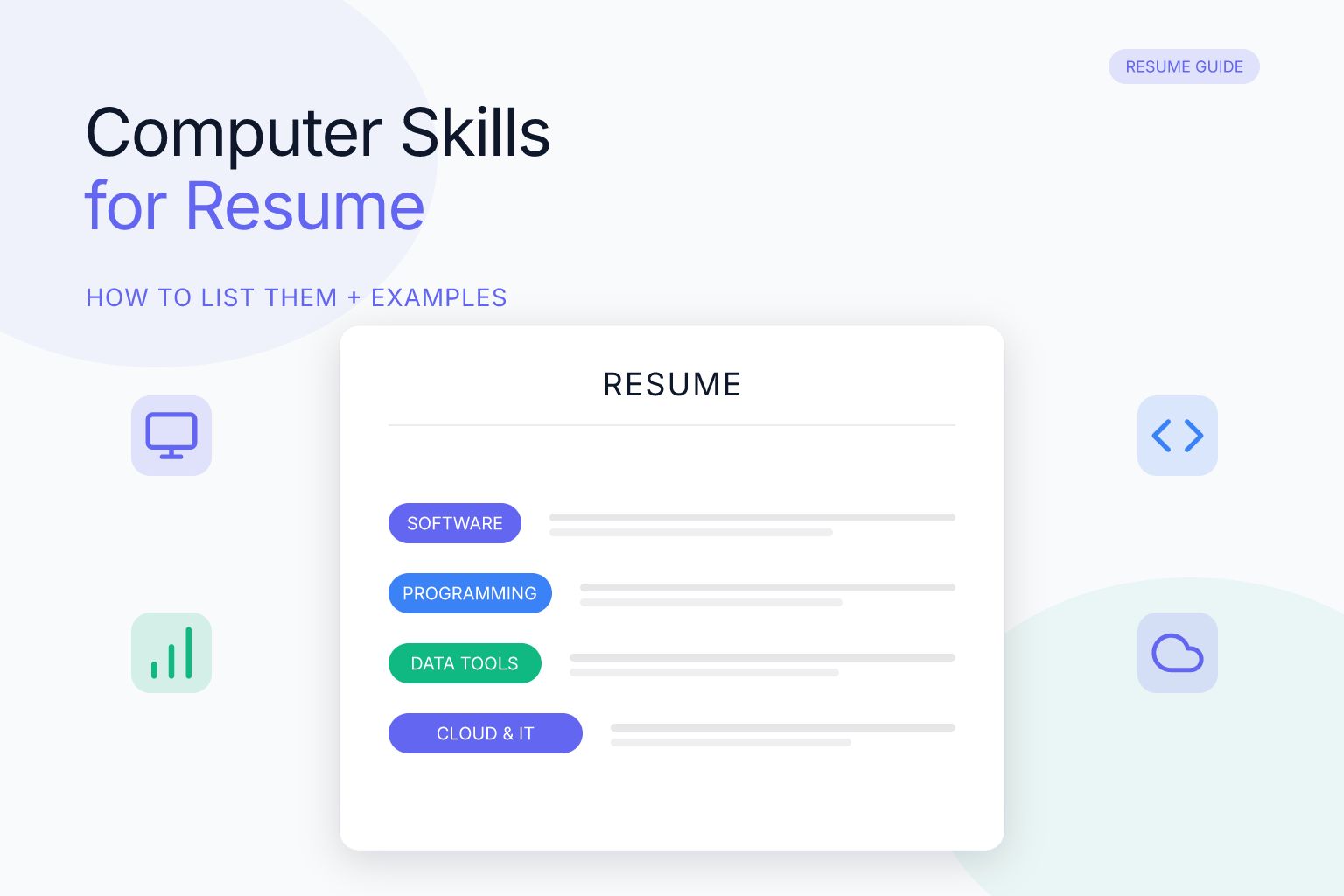
- Group skills into categories. Instead of one long comma-separated list, organize skills under headings like “Software,” “Data Analysis,” “Design Tools,” or “Programming.” This makes your resume scannable.
- Add proficiency levels where relevant. For skills where proficiency matters (e.g., Excel, SQL, Photoshop), add a qualifier: “Advanced Excel (pivot tables, macros),” “Intermediate SQL (joins, subqueries),” “Proficient in Adobe Photoshop.”
- Weave skills into experience bullets. Don’t just list skills in a Skills section. Show how you used them: “Built a sales dashboard in Tableau that reduced reporting time by 30%.”
Here’s an example of a well-formatted Skills section:
Technical Skills
- Data & Analytics: Advanced Excel (pivot tables, VLOOKUP, macros), SQL, Tableau, Google Analytics
- Marketing Tools: HubSpot, Mailchimp, Canva, Meta Ads Manager, SEMrush
- Project Management: Asana, Jira, Trello, Microsoft Project
- Design: Adobe Photoshop, Illustrator, Figma
Compare that to a generic list: “Microsoft Office, Google Suite, social media, email.” The first version tells a recruiter exactly what you can do. The second tells them almost nothing.
Computer Skills Examples by Job Type
Different roles demand different computer skills. Here are examples for common job categories:
Administrative and Office Roles
- Microsoft Office (Word, Excel, PowerPoint, Outlook)
- Google Workspace (Docs, Sheets, Slides, Gmail)
- Scheduling software (Calendly, Microsoft Bookings)
- Video conferencing (Zoom, Teams, Google Meet)
- Document management (SharePoint, Dropbox, Google Drive)
Sales and Customer Service
- CRM software (Salesforce, HubSpot, Zoho CRM)
- Email marketing tools (Mailchimp, Constant Contact)
- Live chat and helpdesk software (Zendesk, Intercom)
- Social media platforms (LinkedIn, Twitter, Instagram)
- Point-of-sale systems (Square, Shopify POS)
Marketing and Communications
- Analytics (Google Analytics, Adobe Analytics, Mixpanel)
- SEO tools (SEMrush, Ahrefs, Moz)
- Content management systems (WordPress, HubSpot CMS)
- Design tools (Canva, Adobe Photoshop, Illustrator)
- Email marketing platforms (Mailchimp, Klaviyo, ActiveCampaign)
Finance and Accounting
- Accounting software (QuickBooks, Xero, Sage)
- Enterprise resource planning (SAP, Oracle, NetSuite)
- Advanced Excel (financial modeling, macros, Power Query)
- Data visualization (Tableau, Power BI)
- Tax preparation software (TurboTax, Drake Tax)
Information Technology
- Programming languages (Python, Java, JavaScript, C++)
- Cloud platforms (AWS, Azure, Google Cloud)
- DevOps tools (Docker, Kubernetes, Jenkins)
- Database management (MySQL, PostgreSQL, MongoDB)
- Cybersecurity tools (Wireshark, Nessus, Splunk)
Creative and Design
- Adobe Creative Suite (Photoshop, Illustrator, InDesign, Premiere Pro)
- UI/UX tools (Figma, Sketch, Adobe XD)
- Video editing (Final Cut Pro, DaVinci Resolve)
- 3D modeling (Blender, AutoCAD, SolidWorks)
- Prototyping (InVision, Marvel)
If you’re applying to a role in a specific industry, look at job postings for that field and mirror the language they use. For example, a real estate agent might list MLS software, CRM tools, and digital signature platforms. See our real estate agent resume examples for more.
Where to Put Computer Skills on Your Resume
Computer skills can appear in three places on your resume:
1. Dedicated Skills section — This is the most common and important location. Place it after your work experience (or after education if you’re a recent graduate). Use bullet points or a two-column layout, but keep it scannable. If you’re using a resume builder, choose a template that has a clear Skills section. ResumeMate’s free resume builder offers ATS-friendly templates with dedicated skills areas.
2. Resume summary — Mention your top 2-3 computer skills in your professional summary if they’re central to the job. Example: “Marketing coordinator with 4 years of experience in HubSpot, Google Analytics, and Canva, driving a 25% increase in email open rates.” This immediately signals your technical competence.
3. Work experience bullets — The most powerful place to show computer skills is in your accomplishments. Instead of just listing “Excel,” write: “Used advanced Excel (pivot tables, VLOOKUP) to analyze sales data and identify a 15% cost-saving opportunity.” This proves you can apply the skill, not just name it.
Avoid putting computer skills in a separate “Computer Skills” section that duplicates your Skills section. One well-organized Skills section is enough.
Common Mistakes to Avoid When Listing Computer Skills
1. Listing outdated or irrelevant software. If you list “Windows XP” or “Internet Explorer,” you look out of touch. Stick to current tools.
2. Overclaiming proficiency. Writing “Expert in Python” when you’ve only completed a beginner tutorial will backfire in an interview. Use honest qualifiers: “Familiar with,” “Proficient in,” “Advanced.”
3. Using vague terms. “Computer savvy,” “tech-friendly,” and “good with computers” mean nothing. Always name the specific tool.
4. Ignoring the job description. If the job asks for Salesforce and you don’t list it (even if you know it), the ATS may filter you out. Always match keywords.
5. Formatting that breaks ATS parsing. Avoid tables, graphics, or text boxes for your skills section. Use simple bullet points and standard fonts. For more on ATS-safe formatting, read our guide on best resume fonts for ATS readability.
6. Listing soft skills as computer skills. “Team player” and “communication” are not computer skills. Keep them separate. If you need help presenting soft skills without buzzwords, see our post on how to highlight soft skills on a resume.
How to Check If Your Computer Skills Are ATS-Friendly
Applicant tracking systems scan your resume for keywords and parse the text into structured fields. If your skills section is formatted oddly, the ATS may miss it entirely. Here’s how to ensure your computer skills pass the test:
- Use a single-column layout. Multi-column layouts can confuse some ATS parsers. Most ResumeMate templates are single-column for this reason.
- Avoid text boxes and tables. Put skills in a simple bulleted list, not a graphic or table.
- Use standard section headings. Label the section “Skills” or “Technical Skills” — not “My Toolbox” or “Digital Arsenal.”
- Spell out acronyms at least once. Write “Customer Relationship Management (CRM)” the first time, then use “CRM” after.
- Run a resume score check. Upload your resume to ResumeMate’s free score checker to see how well your skills section parses and get section-by-section feedback.
A quick ATS check takes five minutes and can prevent your resume from being auto-rejected.
Computer Skills for Remote and Hybrid Jobs
Remote work has made certain computer skills non-negotiable. If you’re applying to a remote or hybrid role, emphasize:
- Video conferencing: Zoom, Microsoft Teams, Google Meet
- Collaboration tools: Slack, Microsoft Teams, Asana, Trello, Notion
- Cloud storage: Google Drive, Dropbox, OneDrive, SharePoint
- Time tracking and productivity: Toggl, RescueTime, Clockify
- Remote access tools: VPN, Remote Desktop, TeamViewer
These tools show you can work independently and communicate effectively without in-person supervision. For a deeper dive, check out our complete guide on remote work skills to put on a resume.
FAQ
Q: How to write computer skills for resume?
A: List specific software and tools you’ve used, grouped into categories like “Data Analysis” or “Design Tools.” Match the skills to the job description, add proficiency levels where relevant, and place them in a dedicated Skills section plus your work experience bullets.
Q: What are computer skills for resume?
A: Computer skills are any abilities to use software, hardware, or digital tools for work. They range from basic literacy (email, word processing) to advanced technical skills (programming, data analysis, design software). On a resume, list only the skills relevant to the job you’re applying for.
Q: What are some computer skills for resume?
A: Common examples include Microsoft Office (Word, Excel, PowerPoint), Google Workspace, CRM software (Salesforce, HubSpot), data analysis tools (SQL, Tableau), design software (Adobe Photoshop, Canva), project management tools (Asana, Jira), and programming languages (Python, JavaScript).
Q: What are basic computer skills for resume?
A: Basic computer skills include email (Outlook, Gmail), word processing (Word, Google Docs), spreadsheets (Excel, Google Sheets), file management, web browsing, and video conferencing (Zoom, Teams). List these only if the job explicitly requires them or you’re applying to an entry-level role.
Q: What are good computer skills for resume?
A: Good computer skills are those that match the job description and demonstrate you can perform the role’s core tasks. For most office jobs, advanced Excel, CRM software, data analysis tools, and collaboration platforms are strong choices. Always prioritize job-specific tools over generic ones.
Q: Is computer skills good for resume?
A: Yes, computer skills are essential on a resume for nearly every job. They show you can use the tools required for the role and reduce training time for the employer. However, they’re only effective if you list specific, relevant skills — not vague terms like “computer literate.”
Q: Is computer literacy a skill for resume?
A: Computer literacy is a skill, but it’s often assumed for office jobs. List it only if the job posting explicitly asks for it or you’re applying to a role where basic computer use is a core requirement (e.g., administrative assistant, data entry). Otherwise, focus on more advanced, job-specific tools.
Q: Can I put “tech savvy” on a resume?
A: Avoid the phrase “tech savvy” on a resume. It’s a vague, subjective term that doesn’t tell a recruiter what you can actually do. Instead, name the specific tools and platforms you’re proficient in — for example, “Proficient in Salesforce, Google Analytics, and Asana” — so your technical abilities are concrete and verifiable.
Q: What are computer proficiencies?
A: Computer proficiencies are the specific software programs, platforms, and digital tools you can use effectively. Unlike general “computer literacy,” which implies basic familiarity, proficiency suggests a working knowledge that lets you complete tasks without supervision. On a resume, list proficiencies by name (e.g., “Advanced Excel,” “Salesforce,” “Adobe Photoshop”) rather than using the umbrella term “computer proficient.”
Q: What computer programs should I list on my resume?
A: List computer programs that appear in the job description and that you genuinely know how to use. Prioritize job-specific tools (e.g., QuickBooks for accounting, Figma for design, Salesforce for sales) over generic ones. If you’re unsure, review 5–10 job postings in your target role and note which programs appear most frequently.
Q: What is a good computer skills description for a resume?
A: A good computer skills description is specific, categorized, and tailored to the job. Instead of writing “good with computers,” write something like: “Advanced Excel (pivot tables, VLOOKUP, macros), Salesforce CRM, Google Analytics, and Asana for project management.” This tells a recruiter exactly which tools you can use and at what level.
Track Every Application While You Job Hunt
Stop losing track of where you’ve applied. The ResumeMate Job Tracker is a free Chrome extension that tracks every application, deadline, and follow-up in one place — right from your browser.