What to Include in a Portfolio for Content Writers (A Complete Guide)
If you’re a content writer, knowing what to include in a portfolio for content writers can make the difference between landing your next client or job and getting passed over. A portfolio is your proof of skill — it shows hiring managers and clients exactly what you can do, not just what you claim on a resume. But many writers either include too much, too little, or the wrong things entirely. This guide breaks down the essential elements of a strong content writing portfolio, with concrete examples and step-by-step advice you can use today.
Key Takeaways
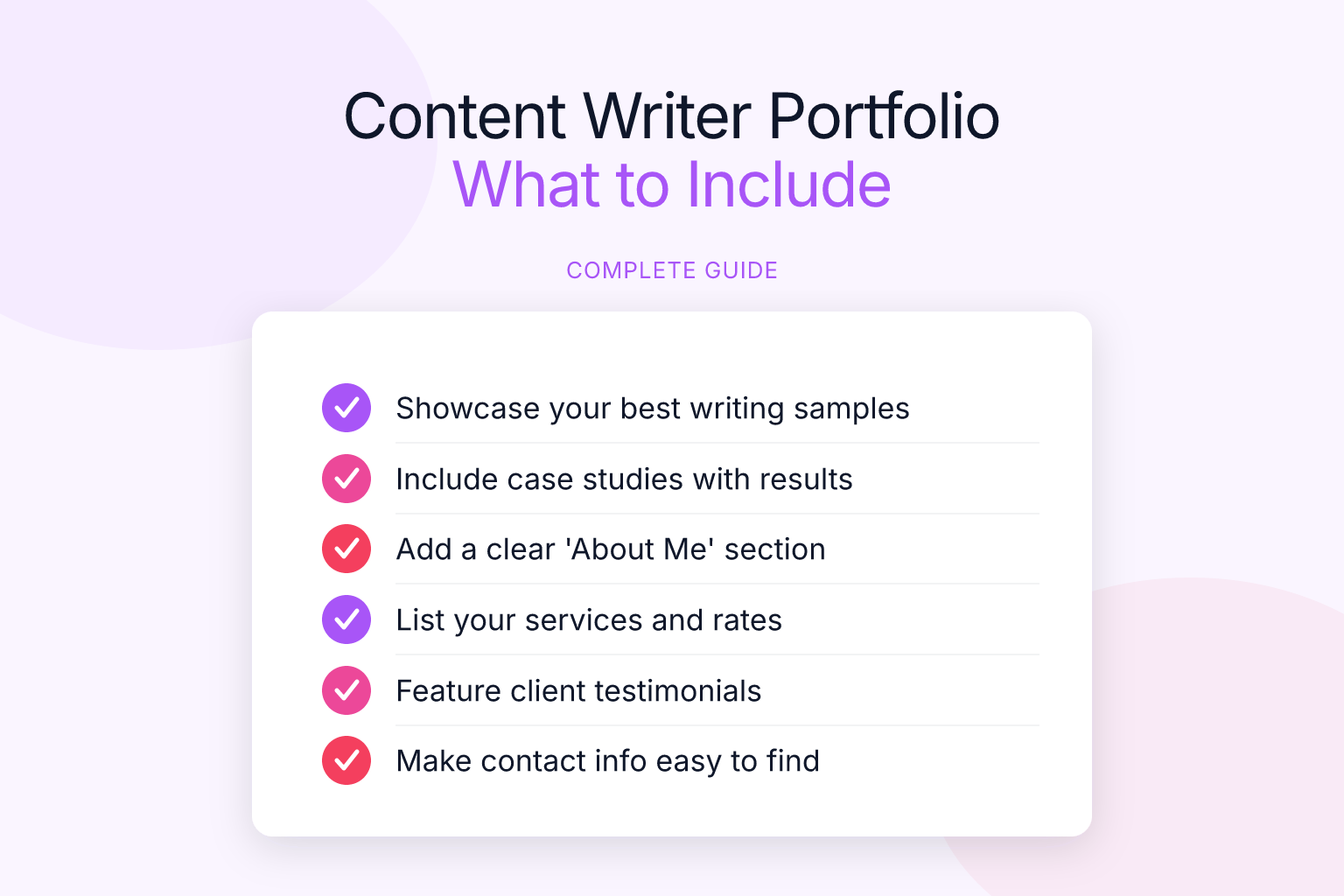
- A content writing portfolio should include 6–10 of your strongest, most relevant writing samples, not everything you’ve ever written.
- Organize samples by niche or format (blog posts, case studies, email copy) so hiring managers can quickly find what they need.
- Each sample needs a short description explaining the goal, your role, and the result — metrics like traffic or conversions make it stronger.
- Include a professional bio, contact information, and links to your LinkedIn or other profiles.
- If you lack paid work, create spec pieces or volunteer content to demonstrate your skills.
| What to Do | Why It Matters | Time |
|---|---|---|
| Curate 6–10 best samples | Shows quality over quantity and relevance to the role | 1–2 hours |
| Write project descriptions with context and results | Helps hiring managers understand your impact | 30–60 min per sample |
| Organize by niche or format | Makes navigation easy and shows range | 1 hour |
| Add bio and contact info | Makes it easy to reach you | 15–30 min |
What to Include in a Portfolio for Content Writers: The Core Elements
A content writing portfolio isn’t just a folder of links. It’s a curated presentation of your work that answers three questions for a potential employer or client: What can you write? How well do you write it? And what results did it produce? The core elements every portfolio needs are:
- Writing samples — the actual pieces you’ve written, whether published or unpublished.
- Project descriptions — a few sentences of context for each sample explaining the goal, your role, and the outcome.
- A professional bio — a short introduction that positions you as a specialist.
- Contact information — an email address, LinkedIn profile, or contact form so people can reach you.
- Optional but valuable: testimonials from clients or editors, links to your resume, and a list of niches or industries you cover.
Think of your portfolio as a sales page for your writing services. Every element should work together to convince the reader that you’re the right person for the job. If you’re also updating your resume, make sure the two documents tell the same story — your portfolio shows the work, and your resume shows the career trajectory. For guidance on presenting published pieces on a resume, see how to list publications on a resume for non-academic jobs.
Choose Your Best Work: Quality Over Quantity
The most common mistake content writers make is including too many samples. Hiring managers and clients rarely have time to read more than a handful of pieces. A portfolio with 20 mediocre articles looks worse than one with 8 excellent ones. Aim for 6–10 samples that represent your best work and align with the type of writing you want to do more of.
Here’s how to select your samples:
- Start with your target audience. If you’re applying for a SaaS content role, prioritize blog posts, case studies, and white papers about software. If you’re pitching freelance clients in the health niche, lead with health-related articles.
- Remove anything weak or outdated. If a piece is more than two years old and no longer reflects your current skill level, cut it. If you wouldn’t proudly share it with a potential client, it doesn’t belong in your portfolio.
- Show range without diluting focus. Include different formats — a blog post, an email sequence, a landing page — but keep them within your chosen niche or two. A portfolio that jumps from finance to fashion to tech can confuse readers about your specialty.
- Prioritize published work over spec pieces. Published articles on reputable sites carry more weight than self-published samples. If you have both, lead with the published ones.
If you’re just starting out and don’t have 6–10 strong samples, don’t panic. Create spec pieces — articles written specifically for your portfolio, modeled after the type of content your target clients publish. You can also volunteer to write for a nonprofit, a friend’s business, or a local publication. The key is to have enough quality work to demonstrate your ability.
Organize Your Portfolio by Niche or Format
A disorganized portfolio forces the reader to hunt for what they need. Instead, group your samples into clear categories. The two most effective ways to organize are by niche (industry or topic) and by format (content type).
By niche:
- SaaS and B2B tech
- Health and wellness
- Personal finance
- E-commerce and retail
By format:
- Blog posts and articles
- Case studies and white papers
- Email sequences and newsletters
- Landing pages and web copy
- Social media content
Choose the organization method that best matches how you want to be hired. If you’re a generalist who writes for multiple industries, organize by format so a client looking for email copy can find it instantly. If you’re a specialist in one niche, organize by format within that niche to show depth.
Each category should have a clear label and a short description. For example, under “Email Sequences,” you might write: “Welcome sequences, abandoned cart flows, and nurture campaigns for e-commerce brands.” This helps the reader understand your expertise at a glance.
Write Compelling Project Descriptions
A writing sample without context is just a link. Hiring managers want to know why you wrote it, what you were trying to achieve, and whether it worked. For every sample in your portfolio, include a short project description — 2–4 sentences — that covers:
- The client or context: Who was this for? A SaaS startup, a healthcare blog, a freelance client?
- The goal: What was the piece supposed to accomplish? Drive traffic, generate leads, educate readers, sell a product?
- Your role: Did you research, write, edit, or all three? Were you part of a team?
- The result: What happened after publication? Did it rank on Google, get shared widely, or convert readers into customers?
Here’s a template you can adapt:
Client: B2B SaaS company in the project management space
Goal: Rank for “best project management tools for remote teams” and drive organic traffic
My role: Researched keywords, interviewed two product managers, wrote a 2,000-word comparison article
Result: Page reached position 3 on Google within four months and generated 1,200+ organic visits per month
If you don’t have exact metrics, describe the outcome qualitatively: “The article was shared by three industry influencers and became the client’s most-read blog post of the quarter.” The point is to show that you understand the purpose behind your writing, not just that you can string sentences together.
Include Metrics and Results Where Possible
Numbers make your portfolio persuasive. A hiring manager scanning 50 portfolios will remember the writer who says “increased email open rates by 22%” over the one who just lists “email copy.” But you don’t need to fabricate data — and you shouldn’t. Only include metrics you can verify or reasonably estimate from client feedback.
Common metrics for content writers include:
- Traffic: page views, unique visitors, organic search rankings
- Engagement: time on page, social shares, comments, backlinks
- Conversions: email signups, demo requests, purchases, click-through rates
- Client outcomes: revenue generated, leads captured, brand mentions
If you’re a newer writer without access to analytics, ask clients or editors for feedback. A simple “the client reported a 15% increase in newsletter subscribers after we launched the new welcome sequence” is enough. If you truly have no numbers, focus on the qualitative impact: “The article positioned the founder as a thought leader and led to two podcast interview invitations.”
Be honest. Inflating metrics can backfire if a potential client asks for proof. A portfolio built on real results, even modest ones, builds trust.
Add a Personal Bio and Contact Information
Your portfolio should make it easy for someone to hire you. That means including a clear, professional bio and multiple ways to get in touch.
Your bio should be 2–4 sentences that answer: Who are you? What do you specialize in? Why should someone work with you? For example:
I’m a B2B SaaS content writer with five years of experience creating blog posts, case studies, and email campaigns for companies like [Client A] and [Client B]. I specialize in turning complex technical topics into clear, engaging content that drives organic traffic and conversions.
If you have notable clients, mention them. If you have a niche, state it. Avoid generic phrases like “passionate about writing” — everyone says that. Instead, show what makes you different.
Contact information should include at minimum an email address. A LinkedIn profile is also valuable, as many hiring managers will check it before reaching out. If you have a contact form on your portfolio site, that works too. Make sure the email address is professional (firstname.lastname@gmail.com, not partylover2000@yahoo.com). For more on what contact details to include across your job search materials, see what contact information to include on a resume.
Consider linking to your resume as well. A portfolio shows your work; a resume shows your experience and skills. If you don’t have a resume yet, you can build one for free with ResumeMate’s AI resume builder and link to the PDF from your portfolio.
Optimize Your Portfolio for Different Audiences
Not all content writing opportunities are the same. An in-house marketing team, a freelance client, and a content agency all look for different things. Tailor your portfolio to the audience you’re targeting.
For in-house roles: Hiring managers want to see that you can match a brand voice and produce consistent, on-strategy content. Include samples that show range within a single niche, and highlight any experience working with style guides or editorial calendars. Mention if you’ve collaborated with designers, SEO specialists, or subject matter experts.
For freelance clients: Clients care about results and reliability. Lead with samples that demonstrate measurable outcomes — traffic, conversions, engagement. Include testimonials if you have them. Make it clear what types of projects you take on and your typical turnaround time.
For content agencies: Agencies need writers who can adapt to different clients and voices. Show variety across industries and formats, and emphasize your ability to follow briefs and meet deadlines. If you’ve written for multiple brands, highlight that.
If you’re transitioning into content writing from another field, your portfolio is even more important. You may not have a long list of published clips, but you can create spec pieces that show your ability. For advice on repositioning your experience, see how to write a resume for a new industry.
Common Portfolio Mistakes to Avoid
Even experienced writers make portfolio mistakes that cost them opportunities. Here are the most frequent ones and how to fix them:
- Too many samples. More than 10 pieces overwhelms the reader. Curate ruthlessly.
- No context. A list of links with no descriptions leaves the reader guessing. Add a short blurb for each sample.
- Broken links. Check every link before sending your portfolio. A dead link makes you look careless.
- Outdated work. If your best sample is from 2019, it may not reflect your current skills. Update or replace it.
- No contact information. If a hiring manager can’t figure out how to reach you, they’ll move on.
- Ignoring mobile. Many people will view your portfolio on a phone. Make sure it’s responsive and easy to navigate.
- Using a generic template. A portfolio that looks like everyone else’s won’t stand out. Add your own voice and personality.
- Forgetting to update. Your portfolio is a living document. Add new work regularly and remove pieces that no longer serve you.
FAQ
Q: How many writing samples should I include in my portfolio?
A: Aim for 6–10 samples. This gives enough variety to show your range without overwhelming the reader. If you’re a specialist, you can include fewer; if you’re a generalist, lean toward the higher end but keep each sample relevant to the type of work you want.
Q: Should I include unpublished work in my portfolio?
A: Yes, if it’s high quality and relevant. Spec pieces, personal blog posts, or volunteer work can demonstrate your skills when you lack published clips. Just label them clearly as unpublished or self-published so the reader knows the context.
Q: Do I need a website for my content writing portfolio, or can I use a PDF?
A: A website is strongly preferred because it’s easy to share, update, and navigate. However, a well-designed PDF portfolio can work for specific applications, especially if you’re emailing a client directly. If you use a PDF, keep it under 10 pages and include clickable links.
Q: How do I show SEO writing skills in my portfolio?
A: Include samples that demonstrate keyword optimization, meta descriptions, and internal linking. In your project descriptions, mention if the piece ranked for a target keyword or drove organic traffic. You can also include a short note about your SEO process, such as keyword research or on-page optimization.
Q: What if I have no professional writing experience?
A: Create spec pieces — articles written specifically for your portfolio, modeled after the type of content your target clients publish. You can also volunteer to write for a nonprofit, a local business, or a friend’s website. Focus on quality over quantity, and treat these samples as seriously as paid work.
Q: How often should I update my content writing portfolio?
A: Update it at least every 3–6 months, or whenever you complete a significant new project. Remove outdated or weak samples, add new work, and refresh your bio and contact information. A stale portfolio suggests you’re not actively writing.
Track Every Application While You Job Hunt
Stop losing track of where you’ve applied. The ResumeMate Job Tracker is a free Chrome extension that tracks every application, deadline, and follow-up in one place — right from your browser.