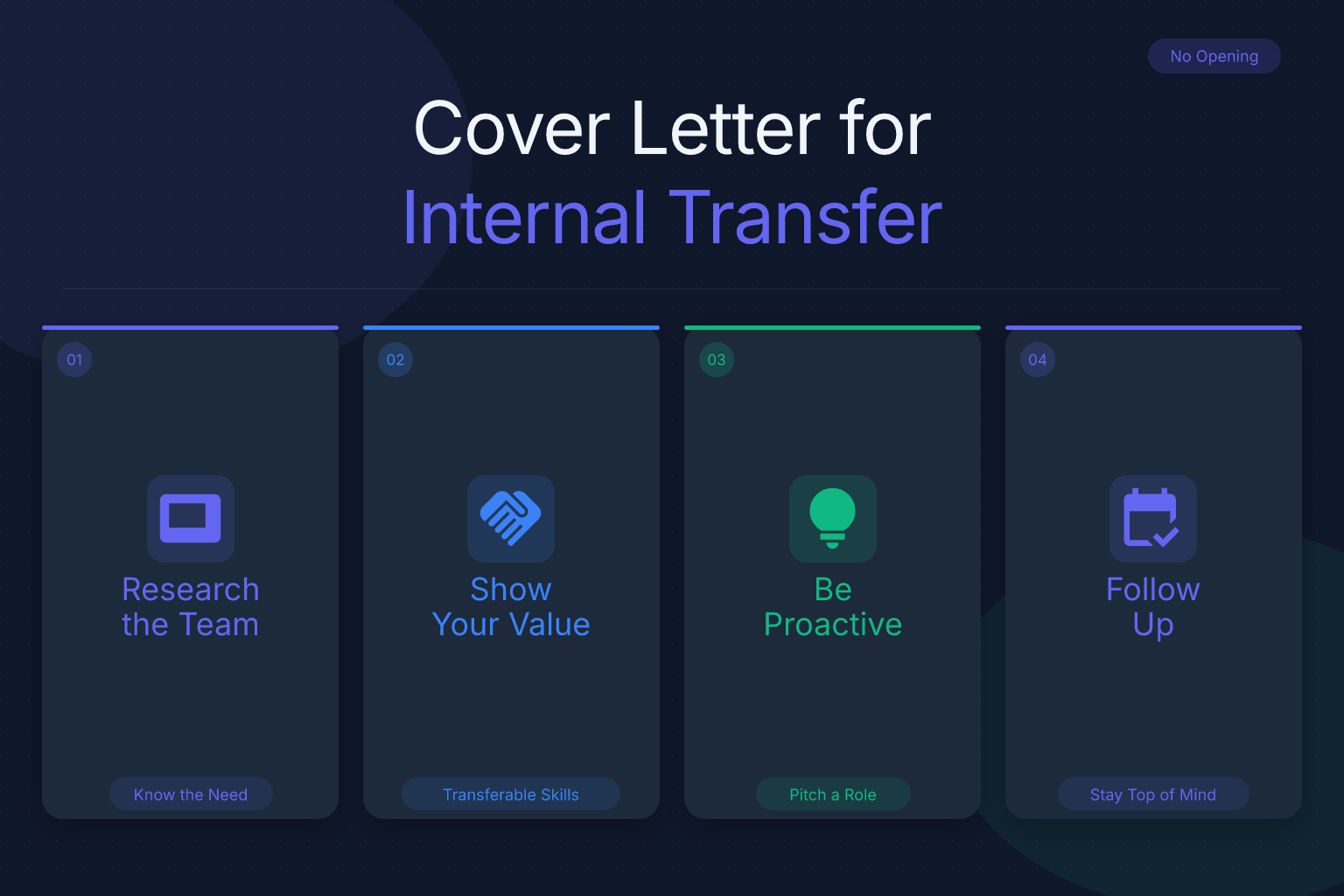
Writing a cover letter for an internal transfer with no opening can feel like throwing a message in a bottle. You’re not responding to a job posting — you’re creating an opportunity. But done right, this proactive letter is one of the most effective ways to move into a new role, team, or department without waiting for a vacancy to appear. Managers often know about upcoming needs, backfills, or restructuring plans long before HR posts a job. Your letter puts you on their radar first.
Key Takeaways
- Send a proactive cover letter to the manager of the team you want to join even when no job is posted, because managers often know about upcoming needs before HR posts a vacancy.
- Before writing, research the specific team’s current projects, pain points, and the right manager to contact so your letter can reference concrete insider insights.
- Keep the letter under one page (250–350 words) and structure it with a clear opening stating your interest, 2–3 specific results tied to the team’s needs, a reason for targeting that team, and a request for a 15-minute conversation.
- Avoid sounding entitled, being vague about your value, ignoring internal politics (like informing your current manager if required), writing too much, or forgetting to update your resume.
- Follow up once after 5–7 business days with a brief polite email, and if you get no response after a second follow-up, stop and continue building relationships or wait for a posted opening.
Here’s a quick summary of the main points covered in this guide:
| Key Point | Summary |
|---|---|
| Proactive pitch | Send a letter even without a posted opening to get on the manager’s radar early. |
| Research first | Identify the right manager and understand the team’s current projects and pain points. |
| Focus on value | Highlight 2–3 specific results and connect them to the team’s needs. |
| Keep it short | Under one page, 250–350 words, with a clear ask for a 15-minute conversation. |
| Follow up politely | Wait 5–7 business days, send one brief follow-up, then stop. |
What Is a Cover Letter for an Internal Transfer with No Opening?
A cover letter for an internal transfer with no opening is a short, targeted message you send to a hiring manager, department head, or team lead inside your own company to express interest in joining their team — even though no job has been posted. Unlike a traditional cover letter that responds to a specific job description, this letter is a pitch. You’re asking the reader to consider you for a role that may not exist yet, or to keep you in mind when one opens up.
This type of letter works best when you’ve identified a team or department where your skills would clearly add value. Maybe you’ve collaborated with them on a project, noticed a gap in their workflow, or heard through the grapevine that they’re planning to expand. Your letter connects those dots for the manager.
It’s different from an internal promotion cover letter, where you’re applying for a posted role at a higher level. And it’s different from a cover letter for a new job at another company, because you already have insider knowledge, relationships, and a track record within the organization. For a deeper comparison, see our guide on internal transfer vs. new job cover letters.
How to Research the Right Person and Department Before You Write
Before you write a single word, you need to know two things: who to send the letter to, and what they care about right now. Sending a generic “I’d love to work on your team” note to the wrong person wastes your shot.
Find the right contact. In most companies, the best person is the manager or director of the team you want to join — not HR. If you don’t know who that is, check your company’s org chart, ask a colleague who works near that team, or look at past project emails. If the department is large, you might send the letter to a senior manager and copy a team lead you’ve worked with before.
Learn what the team is working on. Internal transfers succeed when you can speak to the team’s current reality. Look for:
- Recent project announcements, quarterly reports, or town hall slides
- Slack or Teams channels where the team shares updates
- Conversations with colleagues who work with that team
- Any pain points you’ve observed firsthand — slow processes, missing skills, or recurring bottlenecks
For example, if you’re in customer support and want to move to the product team, you might notice that the product team struggles to get direct user feedback. Your letter can say: “I’ve spent two years talking to customers daily and have a backlog of feature requests and pain points that could inform your roadmap.” That’s a concrete, insider insight an external candidate can’t offer.
What to Include and How to Structure Your Letter
Your letter should be shorter than a traditional cover letter — around 250–350 words. The reader already knows your company, your role, and probably your name. You don’t need to introduce yourself from scratch. Instead, focus on four things:
- Why you’re writing. State clearly that you’re interested in joining their team, even though no position is posted. Be direct: “I’m writing to express my interest in contributing to the [Team Name] as it grows.”
- What you bring. Highlight 2–3 specific skills, experiences, or results that are directly relevant to the team’s work. Use numbers where possible: “I reduced customer churn by 15% last quarter by implementing a new onboarding flow.”
- Why this team, specifically. Reference something concrete about the team’s work — a project, a goal, a challenge — and explain why it excites you or where you see a fit. This shows you’ve done your homework.
- A clear next step. Ask for a short conversation, not a job. “Would you be open to a 15-minute chat in the next couple of weeks? I’d love to learn more about your team’s priorities and share a few ideas.”
If you’re unsure what to include when there’s no job description to mirror, our guide on what to put in a cover letter when there is no job posting walks through the same challenge for external applications.
Once you know what to include, follow this simple structure:
1. Subject line (if sending by email). Make it clear and specific: “Interest in joining the Product Team — [Your Name]” or “Exploring a move to [Department] — [Your Name].” Avoid vague subjects like “Quick question” or “Hello.”
2. Opening paragraph. State your current role, how long you’ve been with the company, and your interest in the target team. Example: “I’m a Senior Customer Support Specialist with three years at [Company], and I’ve been following the Product Team’s recent work on the mobile app. I’d love to explore how my customer insights could support your roadmap.”
3. Body paragraph(s). Connect your experience to the team’s needs. Use one or two short paragraphs. Focus on results, not responsibilities. If you’ve collaborated with the team before, mention it: “During the Q3 beta launch, I worked with [Name] on user testing and compiled a 20-page feedback report that shaped two feature updates.”
4. Why now. Briefly explain why you’re reaching out at this moment. Maybe you’ve completed a major project, gained a new skill, or noticed a gap the team is facing. This gives your letter urgency without sounding desperate.
5. Closing and call to action. Thank them for their time, restate your interest, and ask for a conversation. “I know you’re busy, but if you have 15 minutes in the next few weeks, I’d appreciate the chance to learn more about your team’s goals and share a few ideas. I’m happy to work around your schedule.”
6. Signature. Your name, current title, and contact info (email, internal chat handle).
Sample Cover Letter for Internal Transfer with No Opening (Template)
Here’s a template you can adapt. Replace the bracketed text with your own details.
Subject: Interest in joining the [Target Team] — [Your Name]
Hi [Manager’s Name],
I’m [Your Name], a [Current Role] on the [Current Team] with [X years] at [Company]. I’ve been following the [Target Team]’s work on [specific project or initiative], and I’m writing to express my interest in contributing to your team as it grows — even though no position is currently posted.
In my current role, I’ve [key achievement #1 with metric]. I’ve also [key achievement #2 or relevant skill]. I believe these experiences would translate directly to [specific need or goal of the target team]. For example, [one sentence connecting your work to their challenge].
I’ve enjoyed collaborating with your team in the past — [mention a specific project or person if applicable]. I’m particularly excited about [something specific the team is doing], and I’d love to explore how I could support that work.
I know you’re busy, but if you have 15 minutes in the next couple of weeks, I’d appreciate the chance to learn more about your team’s priorities and share a few ideas. I’m happy to work around your schedule.
Thanks for considering this, and I hope to hear from you.
Best, [Your Name] [Current Title] [Email / internal chat handle]
Common Mistakes to Avoid When Pitching an Internal Move
Even a well-intentioned internal transfer letter can backfire if you make these mistakes.
1. Sounding entitled or demanding. Never say “I deserve a role on your team” or “I’ve been here long enough.” Frame your letter around what you can offer, not what you’re owed.
2. Being vague about your value. “I’m a hard worker and a quick learner” means nothing. Use specific results, projects, and skills. If you can’t quantify, describe the impact qualitatively: “I led the migration of our ticketing system, which cut resolution time by a third.”
3. Ignoring internal politics. If your current manager doesn’t know you’re looking to move, be careful. In many companies, it’s expected that you inform your manager before reaching out to another team. Check your company’s internal mobility policy first. If you’re unsure, ask HR or a trusted mentor.
4. Writing too much. A three-page letter will get skimmed or ignored. Keep it under one page. The manager already knows your company context; you don’t need to explain your entire history.
5. Forgetting to update your resume. Even if no job is posted, the manager may ask for your resume or pass it along to HR. Make sure it’s current and tailored to the target team. You can use a free AI resume builder to quickly refresh your resume for an internal move.
How to Follow Up After Sending Your Letter
You sent the letter. Now what? Most managers are busy, and your email may get buried. A polite follow-up keeps you on their radar without being annoying.
Wait 5–7 business days. If you haven’t heard back, send a short follow-up email. Keep it to 2–3 sentences:
Hi [Manager’s Name],
I wanted to follow up on my note from last week about joining the [Target Team]. I know you’re busy, so no rush — I just wanted to make sure it didn’t get lost. If you have 15 minutes in the next few weeks, I’d still love to chat. Thanks again for considering it.
Don’t follow up more than twice. If you still don’t hear back after a second follow-up, let it go. You’ve made your interest known. Continue building relationships with people on that team, and keep an eye out for posted openings.
If you get a “no” or “not right now.” Thank them for their time and ask if you can check back in a few months. This keeps the door open without pressure.
When to Use This Letter vs. Waiting for a Posted Opening
A proactive internal transfer letter isn’t always the right move. Here’s when to send it — and when to wait.
Send the letter when:
- You’ve identified a specific team or department where your skills clearly fit
- You have a strong relationship with someone on that team or the manager
- You’ve noticed a gap or upcoming need that you could fill
- Your company has a culture of internal mobility and open communication
- You’re willing to wait weeks or months for a role to materialize
Wait for a posted opening when:
- The company has a strict policy that internal moves only happen through formal job postings
- You don’t know the team well and have no insider context to reference
- Your current manager would react negatively to a proactive pitch
- You’re not sure what you want to do next — a posted role gives you a clearer target
If you’re aiming for a promotion rather than a lateral move, the approach is slightly different. Check out our internal promotion cover letter examples for guidance on applying to a posted higher-level role.
FAQ
Q: Is it okay to send a cover letter for an internal transfer when there’s no job opening?
A: Yes, in most companies it’s perfectly acceptable — and often encouraged. Managers appreciate proactive employees who show interest in their team. Just make sure you follow your company’s internal mobility policy and, if required, inform your current manager first.
Q: How long should a cover letter for an internal transfer with no opening be?
A: Keep it under one page, around 250–350 words. The reader already knows your company and role, so you can skip the lengthy introduction and focus on your value and fit for the specific team.
Q: Who should I send the letter to — HR or the team manager?
A: Send it to the team manager or department head, not HR. HR typically handles posted openings, but a proactive pitch is best directed at the person who would actually hire you. If you’re unsure, ask a colleague or check the org chart.
Q: What if my current manager finds out I’m trying to transfer?
A: In many companies, it’s expected that you inform your manager before reaching out to another team. Check your company’s policy. If you’re worried about a negative reaction, have a conversation with your manager first — frame it as a career development interest, not a complaint about your current role.
Q: Should I attach my resume to the internal transfer letter?
A: It’s a good idea to have an updated resume ready, but you don’t need to attach it unless the manager asks. Your letter should stand on its own. If you do attach it, make sure it’s tailored to the target team’s needs.
Q: How long should I wait before following up?
A: Wait 5–7 business days, then send a brief, friendly follow-up. If you don’t hear back after a second follow-up, stop. You’ve made your interest known; continue building relationships and watch for posted openings.
Track Every Application While You Job Hunt
Stop losing track of where you’ve applied. The ResumeMate Job Tracker is a free Chrome extension that tracks every application, deadline, and follow-up in one place — right from your browser.