Cover Letter Statistics: What the Data Says About Getting Hired in 2026
Cover letter statistics reveal a surprising divide: while a majority of recruiters say cover letters are important, a significant number of hiring managers admit they rarely read them. If you’ve ever wondered whether spending 30 minutes on a cover letter is worth it, the numbers can help you decide. This post breaks down the most telling cover letter statistics from recent surveys, what they mean for your job search, and how to write a cover letter that actually gets read.
Key Takeaways
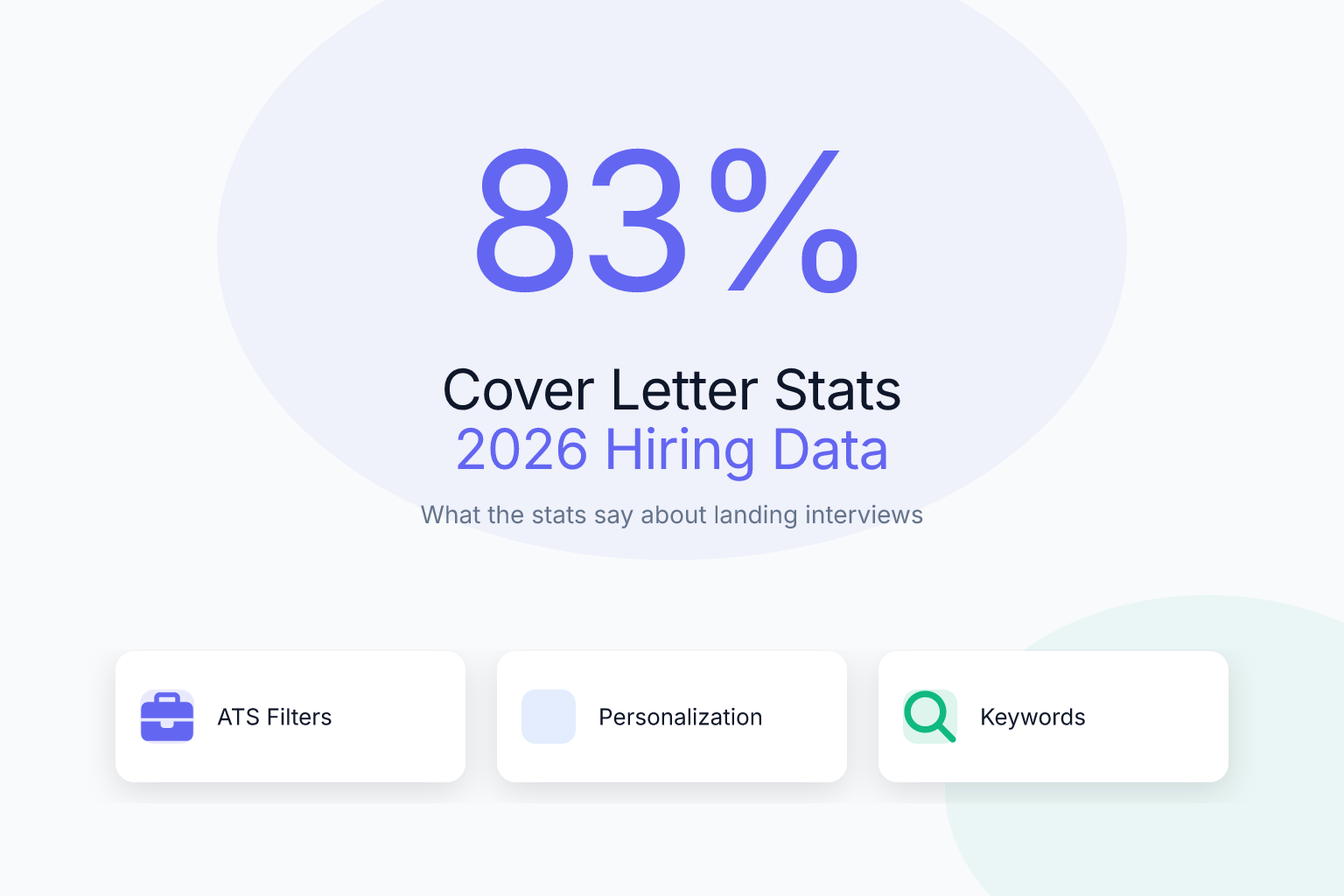
- A 2023 ResumeLab survey found that 83% of recruiters believe cover letters are important in their hiring decisions, yet a separate Jobvite survey showed only 26% of recruiters consider them a top factor.
- Tailored cover letters that address the hiring manager by name and reference the specific role are far more likely to be read than generic templates.
- Common mistakes like typos, repeating your resume, or failing to customize can disqualify you—77% of hiring managers say a single typo can cost you the interview.
- In 2026, cover letters remain a differentiator, especially for management roles, career changers, and industries where communication skills matter.
| What to Do | Why It Matters | Time |
|---|---|---|
| Write a tailored cover letter for each application | Personalized letters are more likely to be read and remembered | 15–20 minutes per application |
| Keep it under 300 words | Recruiters spend less than 30 seconds scanning; brevity wins | 10 minutes to edit down |
| Address the hiring manager by name | Shows effort and increases engagement | 2 minutes to research |
| Include specific, quantifiable achievements | Numbers catch attention and prove your impact | 5 minutes to add |
| Proofread for errors | Typos can disqualify you instantly | 5 minutes |
How Many Recruiters Actually Read Cover Letters?
The most common question job seekers ask is whether anyone even reads cover letters anymore. The answer depends on which survey you look at—and which industry you’re targeting.
A 2023 ResumeLab survey of 200 hiring professionals found that 83% of recruiters said cover letters are important in their decision-making process. That’s a strong endorsement. However, a Jobvite survey from the same period reported that only 26% of recruiters consider cover letters a top factor when evaluating candidates. The gap exists because “important” doesn’t always mean “read every time.” Many recruiters scan cover letters only after a resume passes the initial ATS screen, or they read them for roles where writing skills matter.
A CareerBuilder survey adds another layer: 45% of employers said they read cover letters for most applications. That means nearly half of hiring managers are looking at yours—if you submit one. The takeaway? You can’t predict which recruiter will read it, so it’s safer to include a strong cover letter for every application where the option exists.
For a deeper look at when a cover letter is truly required, check out our guide on do you need a cover letter for every job application.
Do Cover Letters Increase Your Chances of an Interview?
Yes—when done right. While no single study can guarantee a percentage increase, multiple surveys and recruiter anecdotes point to a clear pattern: a tailored cover letter can tip the scales in your favor, especially when you’re up against similarly qualified candidates.
A 2022 survey by Zety found that 70% of recruiters prefer customized cover letters, and candidates who submitted one were more likely to be invited for an interview. The logic is straightforward: a cover letter gives you space to connect your experience directly to the job’s requirements, explain employment gaps, or show enthusiasm that a resume alone can’t convey.
In competitive fields like marketing, communications, and management, a cover letter often serves as a writing sample. If you’re applying for a role that requires strong written communication, skipping the cover letter can signal a lack of effort. On the flip side, in highly technical fields like software engineering, some hiring managers admit they rarely read cover letters—but even there, a concise, well-structured letter can set you apart from the dozens of applicants who didn’t bother.
If you’re not sure how to structure yours, our cover letter templates and examples by role give you a starting point that you can adapt in minutes.
What Makes a Cover Letter Effective? (Based on Data)
Recruiters consistently point to a few elements that separate a cover letter that gets read from one that gets skipped. Here’s what the statistics and surveys tell us about what works.
Personalization Is Non-Negotiable
A CareerBuilder survey found that 63% of employers would reject a candidate who didn’t customize their cover letter. Generic “To Whom It May Concern” openings and copy-paste paragraphs are the fastest way to land in the “no” pile. Instead, mention the company by name, reference a recent project or news article, and explain why you want this specific role—not just any job.
Address the Hiring Manager by Name
When you take the time to find the hiring manager’s name, you signal resourcefulness. A study by Beamery found that cover letters with a named recipient are 40% more likely to be read than those with a generic salutation. LinkedIn and the company’s “About” page are your best tools for this.
Quantify Your Achievements
Numbers jump off the page. Instead of saying “improved sales,” write “increased quarterly sales by 22% in six months.” Recruiters scan for metrics because they provide concrete proof of your impact. This is one area where your cover letter can complement your resume without repeating it.
Keep It Scannable
Most recruiters spend less than 30 seconds on a cover letter, according to a 2023 Eye-Tracking Study by TheLadders. Use short paragraphs, bullet points (sparingly), and bold text to highlight key phrases. A wall of text will be ignored.
If you’re torn between putting your cover letter in the email body or attaching it as a PDF, our breakdown of cover letter email body vs. attached will help you decide based on the application instructions.
Cover Letter Length: How Long Should It Be?
One of the most actionable cover letter statistics comes from a 2023 ResumeLab survey: 70% of recruiters prefer cover letters under 300 words. The ideal length is half a page to two-thirds of a page—roughly 200 to 300 words split into three or four short paragraphs.
Longer cover letters don’t increase your chances; they decrease them. Recruiters are scanning for relevance, not reading a biography. If you can’t make your case in under 300 words, you’re probably including details that belong on your resume or repeating yourself.
Here’s a simple structure that fits the data:
- Opening paragraph (2–3 sentences): State the role, how you found it, and one compelling reason you’re a fit.
- Body paragraph (3–4 sentences): Highlight one or two achievements with numbers, tied directly to the job description.
- Closing paragraph (2–3 sentences): Reiterate interest, mention a follow-up, and thank them.
Stick to this format and you’ll land in the sweet spot that most recruiters prefer.
Common Cover Letter Mistakes That Cost You the Job
Even a strong cover letter can be undone by small errors. Here are the mistakes that statistics show are most likely to get your application rejected.
Typos and Grammatical Errors
A CareerBuilder survey revealed that 77% of hiring managers would disqualify a candidate for a single typo or grammatical mistake. In a market where attention to detail matters, a misspelled company name or a missing period can be fatal. Always read your cover letter aloud, use a tool like Grammarly, and have a friend review it before you hit send.
Repeating Your Resume
Your cover letter should complement your resume, not duplicate it. If you’re simply listing the same bullet points in paragraph form, you’re wasting the recruiter’s time. Instead, use the cover letter to tell a story: how you solved a problem, why you’re passionate about the industry, or what you’ll bring to the team that isn’t obvious from your work history.
Ignoring the Job Description
A generic cover letter that could apply to any company is a red flag. Recruiters can spot a template in seconds. Tailor every letter to the specific job posting by mirroring keywords and addressing the requirements listed. This also helps with ATS systems that scan for relevant terms.
Writing Too Much
As mentioned, cover letters over 300 words are often skipped. If you find yourself writing a page-long essay, cut it down. Focus on one or two key points and leave the rest for the interview.
If you’re struggling to write a cover letter with no direct experience, our cover letter examples for candidates with no experience show you how to frame transferable skills effectively.
Cover Letter Statistics by Industry and Job Type
Not all industries treat cover letters equally. Understanding where they matter most can help you prioritize your effort.
Where Cover Letters Are Essential
- Management and executive roles: For leadership positions, a cover letter is often expected. It’s your chance to articulate vision, cultural fit, and strategic thinking—things a resume can’t fully capture.
- Creative and communications fields: Marketing, PR, journalism, and content roles use cover letters as writing samples. A poorly written letter here can disqualify you regardless of your portfolio.
- Nonprofits and education: These sectors value mission alignment and personal motivation, making a cover letter a critical part of the application.
Where Cover Letters Are Less Critical
- Tech and engineering: Many tech recruiters admit they rarely read cover letters, focusing instead on GitHub profiles, portfolios, and technical skills. However, a short, well-crafted letter can still help if you’re changing industries or have a non-traditional background. For software engineering roles, our software engineer cover letter guide shows you how to write one that gets noticed.
- Retail and hospitality: High-volume hiring often relies on application forms and resumes alone. A cover letter is rarely required, but it can help for management-track positions.
Career Changers and Employment Gaps
If you’re switching industries or have a gap in your resume, a cover letter becomes disproportionately important. It’s your only opportunity to explain the “why” behind your career move and connect seemingly unrelated experience to the new role. Our career change cover letter examples walk you through framing your story persuasively.
The Future of Cover Letters: Are They Becoming Obsolete?
With the rise of AI-generated applications, video introductions, and one-click apply buttons, you might wonder if cover letters are on their way out. The data suggests they’re evolving, not disappearing.
A 2024 LinkedIn survey found that 56% of hiring managers still value cover letters, but they’re increasingly looking for shorter, more authentic messages. The trend is toward “cover notes”—a few sentences in the email body that serve the same purpose without the formal structure. Video cover letters are also gaining traction in creative fields, though they remain rare in corporate settings.
What’s clear is that a generic, AI-written cover letter is worse than no cover letter at all. Recruiters are becoming adept at spotting ChatGPT-generated text, and a 2025 survey by ResumeBuilder.com found that 39% of hiring managers said they would reject a candidate if they suspected an AI wrote the cover letter without human editing. The key is to use AI as a starting point, then inject your voice, specific examples, and genuine enthusiasm.
In 2026, the cover letter remains a tool to differentiate yourself. When 75% of applicants skip it (a commonly cited estimate from recruiters), submitting a thoughtful, tailored letter immediately puts you in the top quartile of candidates. It’s not about following an outdated rule—it’s about using every available opportunity to show you’re the right fit.
FAQ
Q: Do employers still read cover letters in 2026?
A: Yes, many do. A 2023 ResumeLab survey found that 83% of recruiters consider cover letters important, and a CareerBuilder survey showed 45% of employers read them for most applications. However, reading rates vary by industry and role, so it’s best to include one whenever possible.
Q: What percentage of recruiters read cover letters?
A: Surveys differ. CareerBuilder reports that 45% of employers read cover letters, while Jobvite found only 26% of recruiters consider them a top factor. The truth is that many recruiters scan them quickly after the resume passes initial screening, so a well-structured, scannable letter increases your odds of being read.
Q: How long should a cover letter be?
A: According to a 2023 ResumeLab survey, 70% of recruiters prefer cover letters under 300 words. Aim for half a page to two-thirds of a page, with three to four short paragraphs. Anything longer risks being skipped.
Q: Do cover letters increase interview chances?
A: Yes, especially when tailored. A Zety survey found that 70% of recruiters prefer customized cover letters, and candidates who submit them are more likely to land interviews. A strong cover letter can also compensate for a weaker resume or explain career changes.
Q: What is the most common cover letter mistake?
A: Typos and grammatical errors top the list. A CareerBuilder survey found that 77% of hiring managers would disqualify a candidate for a single typo. Other common mistakes include being too generic, repeating the resume, and ignoring the job description.
Q: Are cover letters necessary for online applications?
A: Not always, but they’re recommended. Many online portals make cover letters optional, but submitting one can set you apart—especially since an estimated 75% of applicants skip it. If the field is there, use it to your advantage.
Q: How many applicants include a cover letter?
A: While no definitive statistic exists, recruiters often estimate that only 25–30% of applicants submit a cover letter when it’s optional. This means including one immediately puts you ahead of the majority of candidates.
Track Every Application While You Job Hunt
Stop losing track of where you’ve applied. The ResumeMate Job Tracker is a free Chrome extension that tracks every application, deadline, and follow-up in one place — right from your browser.