Data Analyst Cover Letter: How to Write (With Examples)
A cover letter for a data analyst job is your chance to show you don’t just crunch numbers — you turn data into decisions. While your resume lists the tools and techniques, the cover letter connects the dots: it explains how you used SQL, Python, or Tableau to solve a real business problem, and why that makes you the right fit for this specific role. In this guide, you’ll learn exactly how to write a data analyst cover letter that hiring managers actually want to read, with a full example you can adapt.
Key Takeaways
- A data analyst cover letter must connect technical skills to business outcomes — don’t just list tools, show how you used them to drive revenue, cut costs, or improve efficiency.
- Always tailor the letter to the specific job description by mirroring the company’s language and referencing their data stack or industry.
- Lead with a strong opening that names the company and a relevant achievement, not a generic “I’m applying for the position.”
- Use the STAR method (Situation, Task, Action, Result) to structure your examples and quantify results whenever possible.
- Keep the letter to one page, proofread for errors, and include a clear call to action requesting an interview.
What Hiring Managers Look for in a Data Analyst Cover Letter
Hiring managers for data analyst roles see dozens of applications that list the same technical skills: SQL, Python, Excel, Tableau, Power BI. What they rarely see is a cover letter that explains how those skills created value. Your cover letter should answer three questions:
- Can you translate business questions into data queries?
- Can you communicate findings to non-technical stakeholders?
- Do you understand the company’s industry and data challenges?
A strong cover letter doesn’t repeat your resume. It tells a story. For example, instead of writing “I am proficient in SQL,” you might say: “At my previous role, I wrote a SQL query that identified $200K in duplicate vendor payments, which I presented to the finance team and helped recover within one quarter.” That’s the difference between a skill and a result.
If you’re transitioning into data analysis from another field, check out our guide on how to write a career change cover letter for additional framing strategies.
How to Structure Your Data Analyst Cover Letter
A data analyst cover letter follows a standard business letter format, but the content is what sets it apart. Here’s the structure:
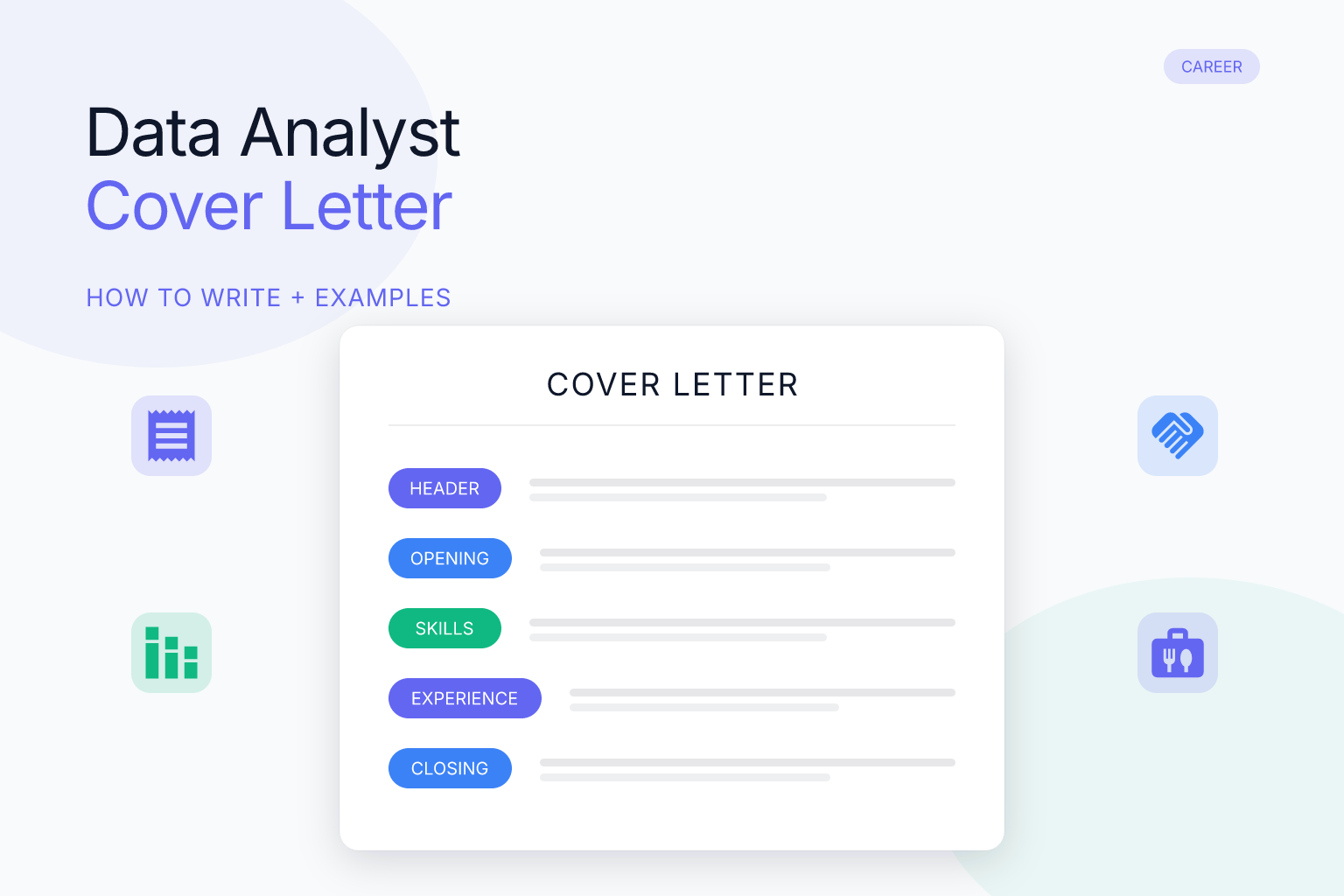
- Header: Your name, phone, email, LinkedIn, and city/state. Match the header style to your resume.
- Date and company details: Include the date and the hiring manager’s name and title if you can find it.
- Salutation: “Dear [Hiring Manager Name]” — avoid “To Whom It May Concern.”
- Opening paragraph: Hook them with a specific achievement and state the role you’re applying for.
- Body paragraph 1: Describe a project where you used data to solve a problem, using the STAR method.
- Body paragraph 2: Connect your skills to the company’s needs, referencing their tools or industry.
- Closing paragraph: Reiterate your interest, include a call to action, and thank them.
- Sign-off: “Sincerely,” followed by your name.
Keep the entire letter to one page — around 250–350 words. Hiring managers spend an average of 7 seconds scanning a resume; a cover letter gets only slightly more time if it’s compelling.
Crafting a Strong Opening Paragraph
The opening paragraph is the most important part of your cover letter. If it’s generic, the hiring manager may not read further. Start with a concrete result that relates to the job, then name the position and company.
Weak opening: “I am writing to apply for the Data Analyst position at ABC Corp. I have three years of experience in data analysis and am proficient in Excel and SQL.”
Strong opening: “When I built a customer churn prediction model that reduced voluntary cancellations by 18% in six months, I knew I wanted to bring that same analytical rigor to a consumer-focused company like ABC Corp. I’m excited to apply for the Data Analyst role and help your team uncover insights that drive retention.”
Notice the difference: the strong version shows impact, names the company, and hints at understanding their business. If you don’t have a dramatic metric, use a smaller one — even “improved report generation time by 30%” works. The key is specificity.
Showcasing Your Technical Skills and Business Impact
Data analyst job descriptions often list required tools: SQL, Python, R, Excel, Tableau, Power BI, Looker, etc. Your cover letter should mention these tools, but only in the context of a project. Never write a sentence like “I have skills in SQL, Python, and Tableau.” Instead, embed them naturally:
- “I used SQL to extract and clean 2 million rows of transaction data, then built a Tableau dashboard that the sales team now uses daily to track pipeline health.”
- “In Python, I automated a weekly reporting process that previously took four hours of manual Excel work, freeing up the marketing team to focus on campaign optimization.”
If the job description emphasizes a specific tool you’re less familiar with, be honest but show adaptability: “While my primary visualization tool has been Tableau, I’ve recently started learning Power BI and completed a project analyzing retail inventory data — I’m confident I can ramp up quickly.”
Quantifying Results with the STAR Method
Data analysts are hired to drive decisions, not just produce reports. Every example in your cover letter should answer: “So what?” Quantify the business impact whenever possible. Use the STAR method:
- Situation: What was the problem or opportunity?
- Task: What was your responsibility?
- Action: What did you do, specifically?
- Result: What measurable outcome did you achieve?
Example:
Situation: The customer support team was overwhelmed with ticket volume and couldn’t identify root causes. Task: I was asked to analyze ticket data to find patterns. Action: I pulled data from Zendesk using SQL, categorized tickets by issue type and product area, and built a weekly trend report in Tableau. Result: The support manager used my analysis to restaff shifts and create targeted help articles, reducing ticket volume by 22% over three months.
Even if you don’t have revenue or cost savings numbers, use time saved, accuracy improved, or user adoption rates. “Adopted by 50+ team members” or “reduced reporting errors to near zero” are still quantifiable.
Tailoring Your Cover Letter to the Job Description
Generic cover letters are easy to spot — and easy to discard. Tailoring means more than swapping the company name. You need to mirror the language of the job description and show you understand the company’s data environment.
Step 1: Read the job description and highlight every tool, skill, and soft skill mentioned. Look for phrases like “experience with A/B testing,” “strong communication skills,” or “familiarity with healthcare claims data.”
Step 2: In your cover letter, use those exact phrases where they fit naturally. If the job asks for “A/B testing,” mention a time you designed and analyzed an A/B test. If they mention “healthcare claims data,” reference any experience with HIPAA, medical coding, or similar datasets.
Step 3: Research the company’s tech stack. Check their engineering blog, job postings for other roles, or LinkedIn profiles of current data analysts. If you see they use dbt, Snowflake, and Looker, mention your experience with those tools — or your eagerness to learn them.
Tailoring your cover letter is similar to tailoring your resume for ATS. For a deeper dive, read how to tailor a resume to a job description.
Data Analyst Cover Letter Example (Full Template)
Below is a complete cover letter you can adapt. Replace the bracketed details with your own.
[Your Name]
[Phone Number] | [Email] | [LinkedIn URL] | [City, State]

[Date]

[Hiring Manager Name]
[Title]
[Company Name]
[Company Address]

Dear [Hiring Manager Name],

When I built a customer segmentation model that increased email campaign revenue by 27% in one quarter, I realized how powerful data can be when it’s tied directly to business strategy. I’m excited to bring that same results-driven approach to the Data Analyst role at [Company Name].

In my current position at [Current/Previous Company], I was tasked with reducing customer churn for a subscription product. I used SQL to analyze 18 months of user behavior data, identified the top three predictors of cancellation, and built a predictive model in Python that flagged at-risk accounts. I then created a Tableau dashboard for the customer success team, which they used to prioritize outreach. Over six months, churn dropped by 14%, saving an estimated $350K in annual recurring revenue.

I understand that [Company Name] is expanding its [specific product or market], and I’m eager to apply my skills in A/B testing and cohort analysis to help optimize user acquisition and retention. I’ve also worked extensively with [mention a tool they use, e.g., Snowflake, dbt, Looker] and am comfortable presenting findings to both technical and non-technical stakeholders.

I would welcome the opportunity to discuss how my background in turning raw data into actionable insights can support [Company Name]’s goals. Thank you for your time and consideration.

Sincerely,
[Your Name]
FAQ
Q: How long should a data analyst cover letter be?
A: Aim for 250–350 words on a single page. Hiring managers prefer concise letters that get straight to the point. Use short paragraphs and bullet points sparingly to improve readability.
Q: Should I include a cover letter if the job application says it’s optional?
A: Yes, in most cases. A tailored cover letter can set you apart from candidates who skip it. It’s especially valuable if you’re changing industries, have an employment gap, or want to explain how your skills transfer to data analysis. For more on when a cover letter is needed, see do I need a cover letter?.
Q: What technical skills should I highlight in a data analyst cover letter?
A: Focus on the tools and techniques mentioned in the job description — typically SQL, Excel, Python or R, and a visualization tool like Tableau or Power BI. But always show how you used them to achieve a result, not just that you know them.
Q: How do I write a cover letter for a data analyst job with no experience?
A: Emphasize transferable skills from other roles, academic projects, or self-directed learning. For example, if you analyzed survey data for a marketing role or built a personal project using public datasets, describe the process and what you learned. Highlight your analytical mindset and eagerness to grow.
Q: Can I use the same cover letter for multiple data analyst applications?
A: You can use a template, but you must customize each letter for the specific company and role. At minimum, change the company name, reference their industry or data stack, and align your examples with the job description’s requirements.
Q: Should I mention salary requirements in my data analyst cover letter?
A: No, unless the job posting explicitly asks for it. Salary discussions are better left for later stages of the interview process. Keep the cover letter focused on your qualifications and fit.
Q: What are common mistakes to avoid in a data analyst cover letter?
A: Avoid repeating your resume, being too generic, ignoring the company’s industry, overloading with jargon, and making typos. Frame achievements in terms of what you can do for the company, not just what you’ve done in the past. A single typo can signal carelessness, so proofread carefully.
Track Every Application While You Job Hunt
Stop losing track of where you’ve applied. The ResumeMate Job Tracker is a free Chrome extension that tracks every application, deadline, and follow-up in one place — right from your browser.