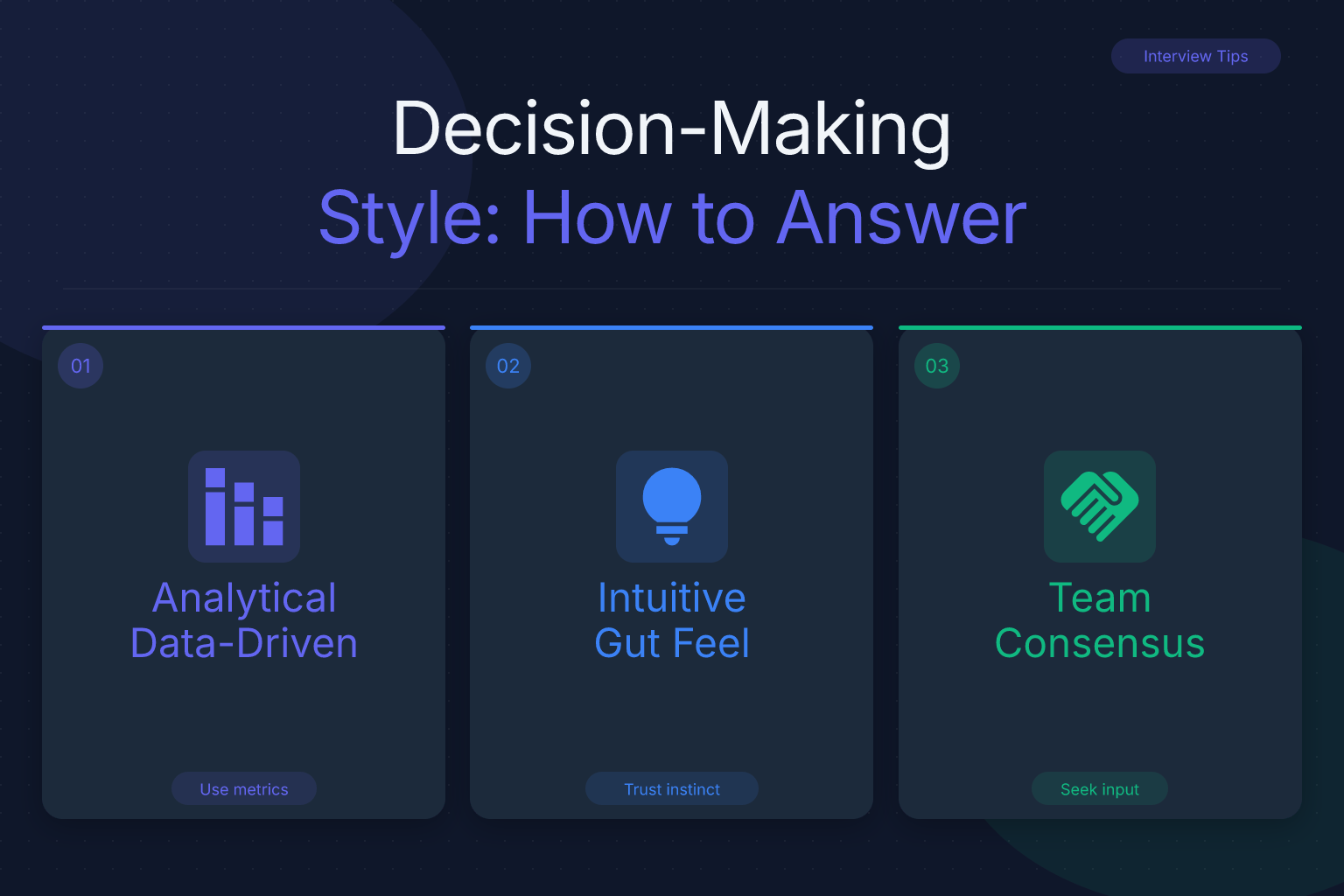
Your decision-making style is how you process information, weigh options, and commit to action. Interviewers ask about it to see if you’ll thrive in their environment. A strong answer names your style, explains your process, and proves it with a specific example. This guide covers the four main styles, a repeatable formula, and sample answers you can adapt.
Key Takeaways
- Identify your dominant decision-making style among analytical, directive, collaborative, or behavioral, and state it directly in your interview answer.
- Use a three-part answer structure: name your style, explain your process in 2–3 sentences, and prove it with a specific example that includes a measurable outcome.
- Tailor your answer to the company’s pace and culture—emphasize speed and autonomy for startups, rigor and compliance for large enterprises, and people focus for management roles.
- Acknowledge the weakness of your decision-making style and how you manage it to demonstrate self-awareness.
- Prepare by reflecting on your last three significant decisions, writing one strong example with a concrete result, and practicing your answer out loud.
What Interviewers Really Want
They’re evaluating three things: self-awareness, fit, and adaptability. The question also often serves as a proxy for “What is your management style?” If you’ve thought through how to answer “What is your problem-solving style?”, you’ll notice overlap—but decision-making is about choosing between options once the problem is understood.
The Four Decision-Making Styles
Most people lead with one style and flex into others depending on context. Here’s how to identify yours.
1. Analytical
How it works: You gather data, compare options systematically, and decide based on evidence. Strengths: Thorough, accurate, minimizes risk. Watch out for: Analysis paralysis. You might be analytical if: You make pro/con lists and ask “what does the data say?” before forming an opinion.
2. Directive
How it works: You decide quickly, rely on your own experience, and act with incomplete information. Strengths: Fast, decisive, keeps projects moving. Watch out for: Missing input from others with relevant expertise. You might be directive if: You get frustrated in meetings that rehash decisions and trust your instincts after years of experience.
3. Collaborative
How it works: You seek input from stakeholders, build consensus, and value buy-in as much as the decision itself. Strengths: High engagement, diverse perspectives, strong commitment. Watch out for: Slower decisions and diluted accountability. You might be collaborative if: You instinctively schedule a meeting before a team-wide change and ask “who else should weigh in?”
4. Behavioral
How it works: You prioritize how the decision affects people—team morale, customer experience, relationships. Strengths: High emotional intelligence, strong loyalty, decisions people want to implement. Watch out for: Avoiding necessary conflict or pleasing everyone but solving nothing. You might be behavioral if: Your first question is “how will this affect the team?” rather than “what does the data say?”
A Simple Formula for Answering
Use this three-part structure to keep your answer focused and memorable.
Step 1: Name your style (one sentence). Say it directly: “I’d describe my decision-making style as primarily analytical, with a collaborative layer when the decision affects multiple teams.”
Step 2: Explain your process (2–3 sentences). Walk through how you actually decide. For example: “I start by defining what a good outcome looks like, then I gather relevant data and input from people closer to the problem. I give myself a deadline so I don’t fall into analysis paralysis, and once I’ve made the call, I communicate the reasoning clearly.”
Step 3: Prove it with an example (2–3 sentences). Use a specific situation with a concrete outcome. Example: “Last quarter, we had to choose between two vendors. I gathered pricing and performance data, ran a quick pilot with each, and made the call based on actual workflow performance. We saved about 15% and the team adopted it without friction.”
Sample Answers for Different Styles
Here are complete answers you can adapt. Replace the examples with your own experiences.
Analytical: “I’d describe my style as analytical. I define criteria upfront, gather data, and compare options against those criteria. For example, when deciding whether to expand into a new market, I built a scoring model with factors like demand, competition, and cost. The model showed one market clearly outperforming, and we launched there—it became profitable within two quarters. I do set time limits so thoroughness doesn’t become delay.”
Directive: “My style is fairly directive—I trust my experience and move quickly once I have enough information. I’d rather decide with 80% of the information and adjust than wait for 100% certainty. When a client project was stalling, I reallocated two team members within 24 hours. The project shipped on time and the client renewed. I’ve learned to slow down for irreversible decisions or when someone has expertise I don’t.”
Collaborative: “I’d call my style collaborative. For decisions affecting the team, I gather input early, make tradeoffs clear, and aim for a decision the group can support. Recently we needed to restructure our sprint process. I ran a survey, held a working session with team leads, and we landed on a hybrid approach. Adoption was immediate because people felt ownership. For small, low-stakes decisions, I just make the call myself.”
Behavioral: “My style is people-focused. I start by asking how the decision will affect the team, customers, and relationships. I still look at data, but I weigh human impact heavily. When considering a schedule change that would improve efficiency but disrupt routines, I talked to affected people first, understood their concerns, and we found a middle ground that captured most of the gain without the disruption. I’ve also learned that sometimes the kindest decision is the hard one.”
How to Tailor Your Answer to the Role
The same style can sound like a strength or a liability depending on context. Research the company’s pace, size, and industry, then adjust your emphasis.
- Fast-moving startup: Emphasize speed, autonomy, and comfort with incomplete information. Say: “I lean directive in early-stage situations where speed matters more than perfection, but I’ll pull in experts when stakes are high.”
- Large enterprise or regulated industry: Emphasize rigor, compliance, and stakeholder alignment. Say: “I’m analytical by default—I document my reasoning, check against regulations, and consult the right stakeholders before committing.”
- People-management role: Emphasize the collaborative or behavioral layer. Frame your answer around how you help others make decisions.
- Individual contributor role: Emphasize ownership and follow-through. Show you can decide independently and escalate appropriately.
Common Mistakes to Avoid
- Saying you have no style. “I just make decisions when they need to be made” signals a lack of self-awareness.
- Claiming you’re perfect at every style. Lead with one dominant style and mention one or two secondary tendencies.
- Giving an example with no outcome. Always include what happened because of your decision—a metric, timeline, or team outcome.
- Trash-talking other styles. It reads as judgmental and inflexible.
- Ignoring the weakness of your style. Acknowledge it and show how you manage it—the same principle as answering “What are your weaknesses?” effectively.
How to Prepare Before the Interview
- Identify your style. Reflect on your last three significant decisions: Did you gather data or trust your gut? Involve others or decide solo? Prioritize speed, accuracy, buy-in, or people’s feelings?
- Write down one strong example. Choose a decision with a measurable outcome and keep it to 60–90 seconds when spoken.
- Research the company’s decision-making culture. Look for words like “autonomy,” “fast-paced,” “cross-functional,” or “consensus” in the job description.
- Practice out loud. Say your answer at least twice; record yourself if possible.
- Make sure your resume tells the same story. If you claim to be analytical, your resume should show metrics and data-driven achievements. For more on articulating your working style, see our guide on how to answer “What is your communication style?”.
FAQ
Q: What is your decision-making style? A: It’s the consistent pattern in how you gather information, weigh options, and commit to action. The four main styles are analytical, directive, collaborative, and behavioral. Most people lead with one and flex into others.
Q: How do I answer “What is your decision-making style?” in an interview? A: Use a three-part formula: name your dominant style, explain your process in 2–3 sentences, and prove it with a specific example that includes a measurable outcome. Tailor your emphasis to the company’s pace and culture.
Q: How to answer “What is your management style?” A: Frame it as your decision-making style applied to leading others. If analytical, describe setting clear metrics and expecting evidence-based proposals. If collaborative, describe involving the team in decisions that affect them. Always include a concrete example.
Q: Should I mention the weaknesses of my decision-making style? A: Yes, briefly. Acknowledging your style’s downside—and how you manage it—demonstrates self-awareness, which is exactly what interviewers are evaluating.
Stop losing track of where you’ve applied. The ResumeMate Job Tracker is a free Chrome extension that tracks every application, deadline, and follow-up in one place. Install ResumeMate Free on Chrome →