The describe your work style interview question is one of the most common behavioral prompts you’ll face, yet many candidates stumble because they haven’t thought about their own working habits in a structured way. Interviewers ask this to assess whether your day-to-day approach fits the team’s culture, pace, and expectations. In this guide, you’ll learn exactly how to answer with confidence, see sample answers for different roles, and avoid the mistakes that make hiring managers move on to the next candidate.
Key Takeaways
- A strong answer to ‘describe your work style’ names 2-3 specific traits (e.g., structured, collaborative, autonomous) and backs each with a brief real example from your experience.
- Tailor your answer to the job description by mirroring the employer’s language for pace, collaboration, and problem-solving, and avoid vague phrases like ‘hard worker’ or ‘perfectionist.’
- Keep your answer under 90 seconds and practice out loud to sound natural, not rehearsed.
- For remote or hybrid roles, emphasize self-motivation, clear written communication, and comfort with asynchronous collaboration.
- Avoid common mistakes like being too vague, overusing buzzwords, contradicting the job description, rambling, or focusing only on solo or team work.
Key Takeaways and Summary
- The “describe your work style” question is a fit assessment, not a trick — interviewers want to know how you operate day-to-day and whether that matches the team’s needs.
- A strong answer names 2-3 specific work style traits (e.g., structured, collaborative, autonomous) and backs each with a brief example from your experience.
- Tailor your answer to the job description by mirroring the language the employer uses for pace, collaboration, and problem-solving.
- Avoid vague answers like “I’m a hard worker” or “I’m a perfectionist” — instead, describe observable behaviors and outcomes.
- Practice your answer out loud so it sounds natural, not rehearsed, and keep it under 90 seconds.
| What to Do | Why It Matters | Time |
|---|---|---|
| Identify 2-3 core work style traits | Shows self-awareness and gives the interviewer concrete hooks | 15 min |
| Match traits to job description keywords | Demonstrates you read the posting and understand the role | 10 min |
| Prepare a brief example for each trait | Provides evidence, not just claims | 20 min |
| Practice out loud and time yourself | Reduces rambling and nerves; keeps answer concise | 10 min |
What Interviewers Really Mean & How to Structure Your Answer
When a hiring manager asks, “How would you describe your work style?” or “What is your work style?”, they aren’t looking for a personality quiz result. They want to know three things: how you organize your time, how you interact with colleagues, and how you handle pressure and deadlines. This question is a culture-fit check disguised as small talk.
Think of it as the interviewer trying to picture you in the role. If the team works in fast sprints with constant collaboration, a candidate who says “I prefer to work alone and take my time to perfect every detail” might raise a red flag — even if that candidate is highly skilled. Conversely, if the role requires deep focus and minimal supervision, saying “I thrive in busy, chatty environments” could signal a mismatch.
Your answer should paint a clear, honest picture of how you actually work. That means avoiding generic phrases and instead describing specific behaviors. For example, instead of “I’m organized,” say “I block my calendar every Monday morning to plan the week’s priorities and set reminders for follow-ups.” The more concrete you are, the easier it is for the interviewer to see you in the job.
A winning answer follows a simple three-part formula: name your traits, give a quick example, and connect it to the role. You don’t need a full STAR story for each trait — one or two sentences per trait is enough. Aim for a total answer length of 60-90 seconds.
Here’s a step-by-step structure:
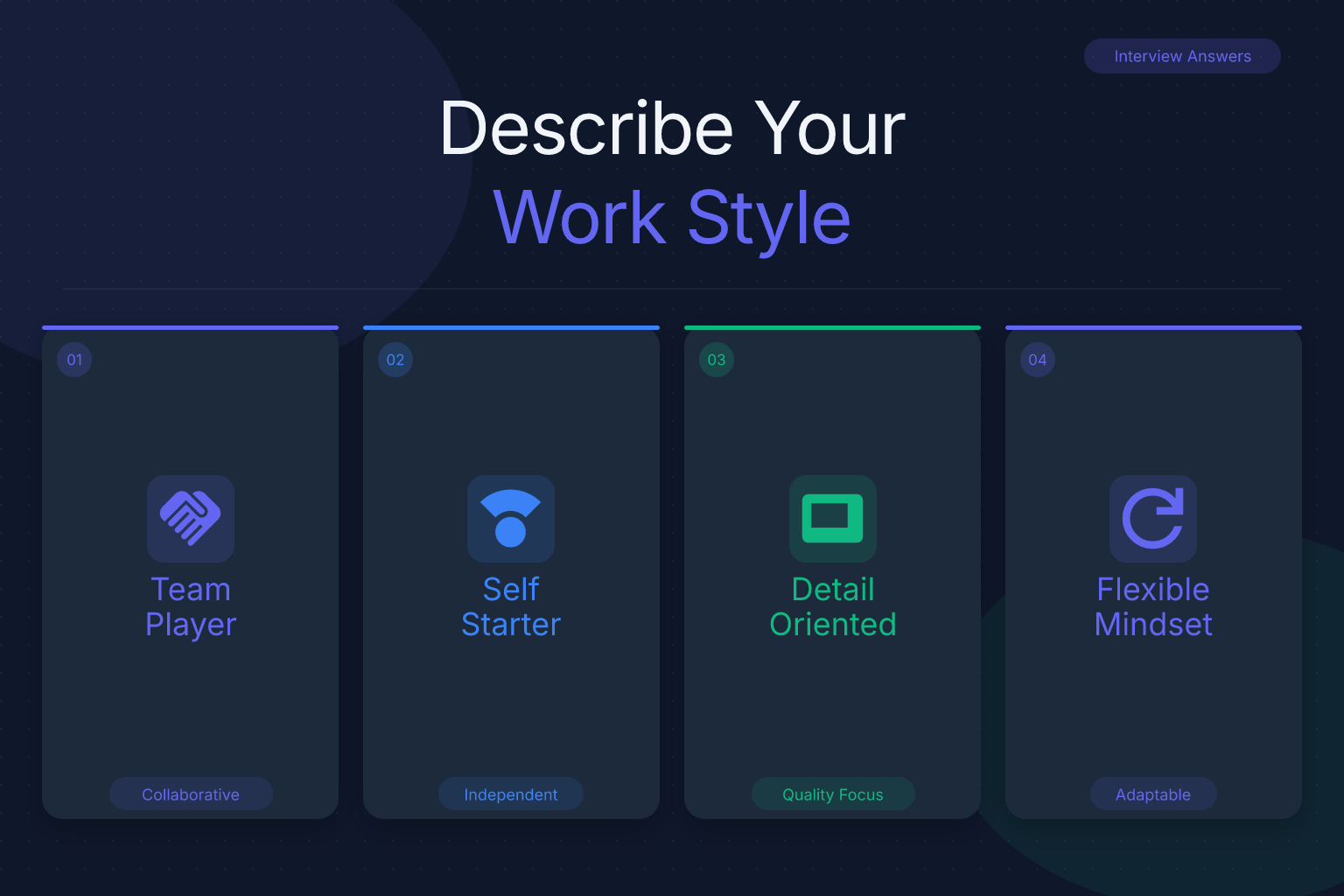
- Open with 2-3 core traits. Choose traits that are true to you and relevant to the job. Examples: structured planner, collaborative problem-solver, autonomous self-starter, detail-oriented executor, adaptable multitasker.
- Back each trait with a micro-example. Use a specific situation from a past job, internship, or project. Keep it brief: “In my last role, I used a shared Trello board to track a product launch, which helped us ship two weeks early.”
- Tie it to the employer’s needs. End with a sentence that shows you understand the role: “That structured approach would help me manage the multiple campaigns your team runs each quarter.”
For example, a complete answer might sound like:
“I’d describe my work style as structured and collaborative. I like to break large projects into weekly milestones and use project management tools to keep everyone aligned. In my last job, I led a website redesign by creating a detailed timeline and holding short daily check-ins, which kept us on schedule despite a tight deadline. I also enjoy brainstorming with teammates early in a project to make sure we’re solving the right problem before diving into execution. That balance of planning and collaboration fits well with how your team handles client work.”
Notice how each trait is paired with a concrete action and a result. That’s what makes the answer memorable.
Work Style Answer Examples for Different Roles
Different roles call for different work style emphases. Here are four sample answers tailored to common job types. Use them as templates, but always swap in your own real examples.
Project Manager “My work style is highly organized and communication-driven. I start every project by mapping dependencies and assigning clear owners, then I set up a weekly status cadence so stakeholders always know where things stand. For a recent software rollout, I created a risk register that flagged a potential vendor delay early, and we adjusted the timeline before it became a crisis. I think that proactive, transparent approach is essential for keeping cross-functional teams on track.”
Software Developer “I’d say I’m an autonomous worker who values deep focus, but I also know when to ask for help. I block off mornings for coding without meetings, which lets me make real progress on complex features. At the same time, I’m active in code reviews and pair programming sessions because I believe collaboration catches bugs early. In my last role, that mix helped me ship a major API refactor with zero production incidents.”
Customer Service Representative “My work style is patient and process-oriented. I follow established scripts and guidelines to ensure consistency, but I also adapt my tone to each customer’s emotional state. For example, when a customer was frustrated about a billing error, I first acknowledged their frustration, then walked through the refund steps one by one, and followed up with a summary email. That approach reduced repeat calls on my team by about 20% over six months.”
Marketing Coordinator “I thrive in fast-paced, creative environments where I can juggle multiple campaigns. I use a content calendar to plan ahead, but I’m comfortable pivoting when a trend or client request changes priorities. Last quarter, I managed three product launches simultaneously by batching similar tasks and setting clear internal deadlines. I also love collaborating with designers and copywriters to brainstorm fresh angles, which keeps our work from feeling stale.”
Each answer names specific traits, gives a real example, and ends with a nod to the role’s demands. That’s the formula for a response that sticks.
Common Mistakes to Avoid & How to Tailor Your Answer
Even well-prepared candidates fall into traps with this question. Here are the most frequent mistakes and how to fix them.
Mistake 1: Being too vague. Saying “I’m a hard worker” or “I’m a team player” tells the interviewer nothing. Instead, describe what hard work looks like for you: “I consistently meet deadlines by breaking tasks into daily checklists and reviewing my progress every afternoon.”
Mistake 2: Overusing buzzwords. Words like “synergy,” “go-getter,” and “results-driven” sound impressive but mean little without context. Replace them with observable behaviors: “I proactively reach out to stakeholders when I see a bottleneck, rather than waiting for it to become a problem.”
Mistake 3: Contradicting the job description. If the posting emphasizes “fast-paced environment” and you say “I prefer a slow, methodical pace,” you’ve just talked yourself out of the job. Read the job description carefully and align your answer with the language the employer uses.
Mistake 4: Rambling. A work style answer should be under 90 seconds. If you find yourself telling a five-minute story about a single project, you’ve lost the interviewer. Practice with a timer and cut anything that doesn’t directly support a trait.
Mistake 5: Focusing only on solo work (or only on teamwork). Most roles require a mix. Even if you’re an independent contributor, mention how you communicate with others. And if you’re a collaborator, show you can also work autonomously. Balance is key.
The best work style answers are customized for each application. Here’s a three-step process to do that quickly.
- Highlight keywords in the posting. Look for phrases like “fast-paced,” “detail-oriented,” “self-starter,” “collaborative,” “remote-friendly,” or “deadline-driven.” These are the traits the employer values most.
- Match your traits to those keywords. If the posting says “self-starter,” emphasize your autonomy and initiative. If it says “collaborative,” lead with your teamwork examples. You don’t need to change who you are — just choose which of your real traits to feature.
- Use the employer’s language. If they say “fast-paced,” say “I thrive in fast-paced environments” rather than “I like busy jobs.” Mirroring their vocabulary shows you’ve paid attention.
For example, if a job description says “must be comfortable with ambiguity and changing priorities,” your answer might start with: “My work style is adaptable. I’m comfortable shifting gears when new information comes in, and I keep a running priority list so nothing falls through the cracks.” Then give a quick example of a time you pivoted successfully.
Work Style vs Leadership Style & Remote/Hybrid Work Style
Candidates sometimes confuse “work style” with “leadership style,” but they’re distinct questions. Your work style describes how you personally approach tasks, manage your time, and interact with colleagues on a day-to-day basis. Your leadership style describes how you guide, motivate, and manage other people.
If you’re applying for an individual contributor role, you’ll likely only be asked about work style. But if the role involves managing a team — or if you’re interviewing for a senior position — you may get both questions. For example, an interviewer might ask, “Describe your work style” and then follow up with, “How would you describe your leadership style?”
Here’s a concrete example of a work style answer versus a leadership style answer:
Work style answer: “I’m a structured planner who breaks projects into weekly milestones and uses a shared task board to keep everyone aligned. In my last role, I led a website redesign by creating a detailed timeline and holding short daily check-ins, which kept us on schedule despite a tight deadline.”
Leadership style answer: “I lead by setting clear expectations and giving regular, constructive feedback. I hold weekly one-on-ones with each team member to discuss progress and remove blockers, and I make sure everyone understands how their work contributes to the team’s goals. For example, when a junior developer was struggling with a complex feature, I paired them with a senior mentor and checked in daily until they felt confident.”
If you need more help with the leadership question, check out our detailed guide on describe your leadership style interview answer examples.
Remote and hybrid roles put a premium on specific work style traits: self-motivation, clear written communication, time management, and comfort with asynchronous collaboration. If you’re interviewing for a remote position, your answer should highlight these.
Here’s a sample answer for a remote role:
“My work style is self-directed and communication-focused. I set my own daily priorities using a task manager and block time for deep work, which helps me stay productive without a manager looking over my shoulder. Because I work remotely, I over-communicate in writing — I send brief daily updates to my team and document decisions in shared docs so everyone stays aligned across time zones. In my last remote role, that approach helped our distributed team ship a major feature without a single missed deadline.”
Notice how the answer addresses the unique challenges of remote work: autonomy, written communication, and async collaboration. If you’re preparing for a virtual interview, our guide on remote job interview tips has more advice on presenting yourself well on camera.
Practice and Preparation Tips
You can’t wing this question and expect a polished answer. Here’s how to prepare in under an hour, with a concrete example to guide you.
- Write down your answer. Draft a 60-90 second response using the three-part formula. Don’t memorize it word-for-word — just capture the key points. For example, a draft might look like: “My work style is detail-oriented and deadline-driven. I use a daily checklist to prioritize tasks and set reminders for follow-ups. In my last role, I managed three client projects simultaneously by batching similar tasks and reviewing my progress every afternoon, which helped me meet every deadline for six months straight. That structured approach would help me handle the multiple campaigns your team runs each quarter.”
- Record yourself. Use your phone to record your answer, then listen for filler words (“um,” “like”), rambling, or a monotone delivery. Adjust until it sounds conversational.
- Time it. If you’re over 90 seconds, cut the least relevant example or tighten your phrasing.
- Get feedback. Ask a friend or mentor to listen and tell you if the answer sounds authentic and specific. If they can’t repeat your main traits afterward, you need more clarity.
- Prepare for follow-ups. Interviewers often ask, “Can you give me an example of that?” or “How would you handle a conflict with a coworker?” Have one extra example ready for each trait.
Before your interview, also make sure your resume is ready to back up your claims. Run it through the free ResumeMate score checker to catch any ATS issues or weak sections. A strong resume plus a strong work style answer gives you the best shot at landing the job.
FAQ
Q: What is your work style interview question answer?
A: A good answer names 2-3 specific work style traits (like structured, collaborative, or autonomous), gives a brief real example for each, and connects those traits to the job you’re applying for. Keep it under 90 seconds and avoid vague phrases like “I’m a hard worker.”
Q: How would you describe your work style answer?
A: Start by identifying your core traits, then pair each with a concrete example from your experience. For instance: “I’m a structured planner who breaks projects into weekly milestones. In my last role, I used a Kanban board to track a product launch, which helped us ship two weeks early.” End by tying it to the employer’s needs.
Q: What is your work style best answer?
A: The best answer is honest, specific, and tailored to the job description. It highlights traits the employer values (like adaptability for a fast-paced role or autonomy for a remote role) and uses real examples to prove those traits. Avoid generic buzzwords and focus on observable behaviors.
Q: How would you describe your own working style?
A: Reflect on how you actually work day-to-day: Do you plan ahead or improvise? Do you prefer solo deep work or constant collaboration? How do you handle deadlines and feedback? Choose 2-3 traits that are true for you and relevant to the role, then prepare a short example for each.
Q: What are good work style examples?
A: Common work style traits include structured planner, collaborative problem-solver, autonomous self-starter, detail-oriented executor, adaptable multitasker, and proactive communicator. The best examples pair a trait with a specific situation, like “I use a daily checklist to manage multiple client projects and rarely miss a deadline.”
Q: How do you answer “describe your work style” with no experience?
A: If you’re entry-level, draw examples from school projects, internships, volunteer work, or even personal projects. Focus on transferable traits like organization, communication, and willingness to learn. For example: “In my senior capstone project, I coordinated schedules for a five-person team using a shared spreadsheet, which kept us on track for our final presentation.”
Track Every Application While You Job Hunt
Stop losing track of where you’ve applied. The ResumeMate Job Tracker is a free Chrome extension that tracks every application, deadline, and follow-up in one place — right from your browser.