Do I Need a Cover Letter? A 2026 Guide for Job Seekers
If you’ve ever stared at a job application and wondered, “do I need a cover letter,” you’re not alone. The answer isn’t a simple yes or no — it depends on the role, the company, and what you have to say. This guide breaks down exactly when a cover letter helps your chances, when you can skip it, and how to write one that actually gets read.
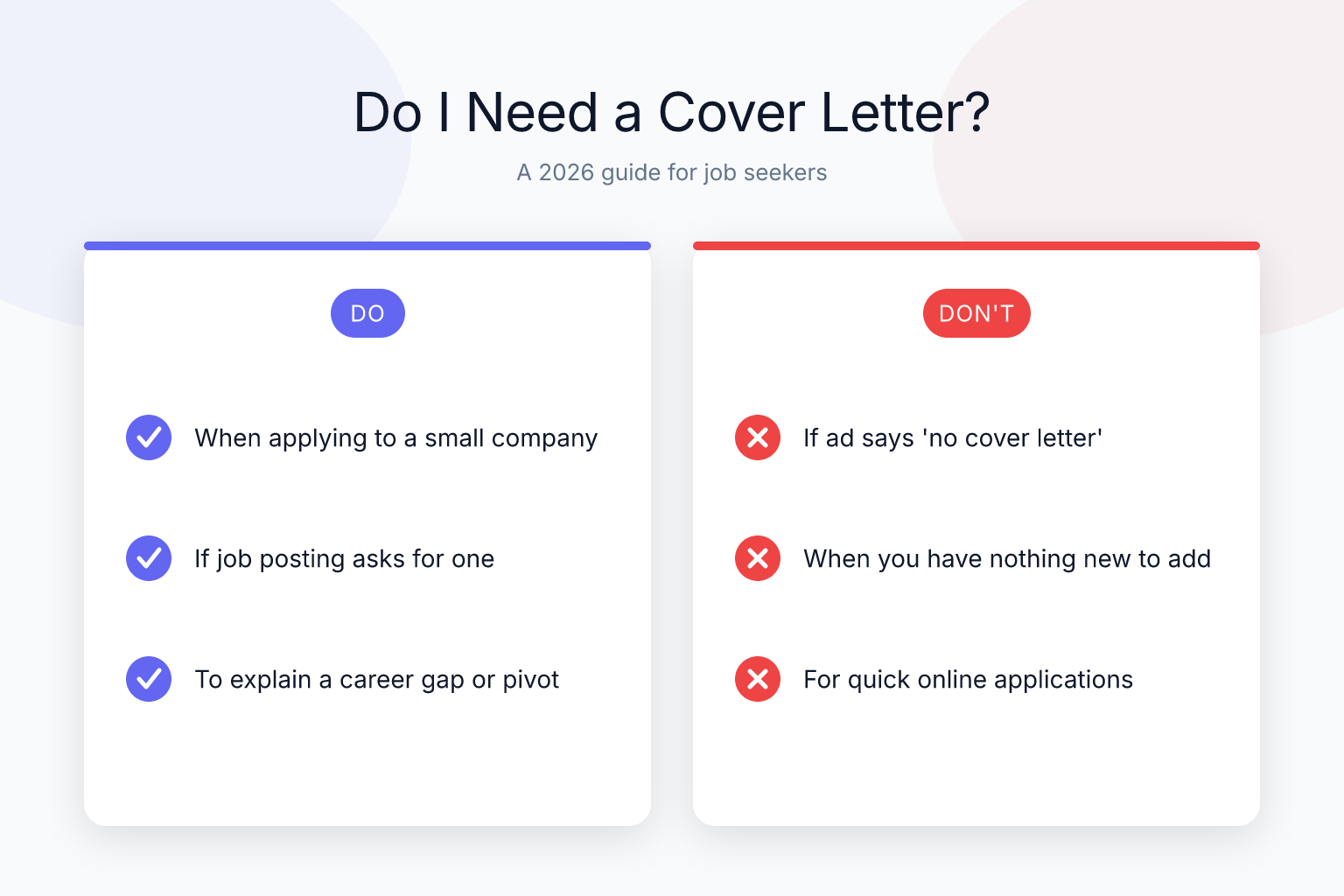
| What to Do | Why It Matters | Time |
|---|---|---|
| Check the job posting for cover letter requirements | Some employers explicitly require it; skipping can disqualify you | 1 minute |
| Write a tailored cover letter when you have a strong story | Shows you understand the role and can fill gaps in your resume | 30–60 minutes |
| Skip the cover letter if the application says “optional” and you have nothing new to add | A generic cover letter can hurt more than help | 0 minutes |
| Use a cover letter to explain career changes or employment gaps | Prevents recruiters from making wrong assumptions | 20–30 minutes |
When You Definitely Need a Cover Letter
So, do you need a cover letter? In several common situations, the answer is a clear yes. Skipping it here can cost you the interview.
1. The job posting explicitly asks for one
If the application says “cover letter required” or includes a dedicated upload field, treat it as mandatory. Many applicant tracking systems (ATS) flag incomplete submissions, and a recruiter may never see your resume if you ignore the instruction. Even when the field is labeled “optional,” a well-written letter can set you apart — but a required field means you must submit something.
2. You’re changing industries or roles
When your resume doesn’t tell an obvious story of fit, a cover letter connects the dots. For example, a teacher moving into corporate training can use the letter to highlight transferable skills like curriculum design and public speaking. Without that bridge, a recruiter scanning a resume full of classroom experience might assume you’re not qualified. If you’re making a bigger pivot, a career change resume format that blends functional and chronological elements can work hand-in-hand with a strong cover letter.
3. You have an employment gap or non-traditional path
A gap of six months or more, freelance stints, or a career break for caregiving can raise questions. A cover letter lets you address the gap proactively — not with a defensive explanation, but by framing what you learned or how you stayed current. One paragraph can turn a potential red flag into a sign of resilience.
4. You’re applying to a small company or a mission-driven organization
Startups, nonprofits, and small businesses often read cover letters closely. They’re hiring for culture fit as much as skills, and a letter that shows you understand their mission can carry more weight than a resume alone. In these settings, a generic application is easy to spot and easy to reject.
5. You have a referral but need to make the case
A referral gets your foot in the door, but the hiring manager still needs to see why you’re right for the role. Mention the referral in the opening line, then use the rest of the letter to connect your experience to the job requirements. This turns a warm introduction into a compelling application.
When You Can Skip the Cover Letter
Not every application needs a cover letter. In fact, sending a boilerplate letter when it’s not required can work against you — it signals low effort. Here’s when it’s safe to skip.
The application says “optional” and you have nothing specific to add
If your resume already speaks clearly to the role and you’d just be repeating bullet points, a cover letter adds noise. Recruiters spend an average of six to eight seconds on an initial resume scan, according to a widely cited eye-tracking study by TheLadders. A cover letter that rehashes the same information doesn’t earn extra points; it just creates more to skim.
You’re applying through a high-volume portal that doesn’t accept one
Some large employers (especially in retail, hospitality, or entry-level roles) use streamlined application forms with no cover letter field. Don’t force one into an “additional documents” upload unless the instructions invite it. In these cases, your resume and the application questions do all the work.
You’re a perfect match on paper and the role is straightforward
For roles where qualifications are binary — like a licensed electrician or a certified public accountant — a cover letter rarely changes the outcome. The hiring decision hinges on credentials and experience, not narrative. Save your time for interview prep instead.
You’re short on time and the deadline is tight
A rushed, error-filled cover letter is worse than none at all. If you can’t write something specific and polished before the deadline, focus on tailoring your resume. A strong, targeted resume beats a weak resume plus a sloppy letter every time. For help building a resume that fits the job, use a free AI resume builder that adapts your content to the role.
Companies that rarely require cover letters
Many job seekers specifically search for companies hiring with no cover letter required. While there’s no universal list, certain industries and employer types have moved away from mandatory cover letters:
- Large tech companies (Google, Amazon, Meta) often use their own application portals and may not even provide a cover letter field.
- Retail, hospitality, and food service chains typically rely on short application forms and don’t ask for cover letters.
- Staffing agencies and high-volume recruiters focus on skills and availability, not narrative.
- Some startups that value speed and practical tests over formal documents may skip the cover letter entirely.
Even when a company doesn’t require one, a well-written cover letter can still differentiate you — but only if it adds genuine value. If the application doesn’t ask for it, you’re never penalized for leaving it out.
What to Include in a Cover Letter (If You Write One)
When you decide to write a cover letter, every paragraph needs to earn its place. Here’s a structure that works for most applications.
1. Header with your contact information
Match the header style to your resume. Include your name, phone number, email, and LinkedIn profile link. If you know the hiring manager’s name, add it here; if not, “Hiring Manager” is fine. Adding the date is a professional touch — it shows the letter is current and helps recruiters track when you applied.
2. Opening that names the role and shows you did your homework
Start with the exact job title and where you found it. Then, in one sentence, show you understand the company’s challenge. For example: “I’m writing to apply for the Customer Success Manager role at Acme Corp. Your recent expansion into enterprise accounts caught my attention, and I see an opportunity to bring the onboarding playbook I built at my current company to your team.”
3. One or two body paragraphs that connect your experience to their needs
Don’t summarize your resume. Instead, pick two or three requirements from the job description and give a brief example of how you’ve done that work before. Use numbers where you can: “I reduced churn by 22% in my first quarter by implementing a proactive check-in cadence.”
4. A paragraph that addresses any obvious concerns
If you’re relocating, changing industries, or have a gap, address it here — briefly and positively. “After taking a planned career break to care for a family member, I’ve spent the last three months completing a certification in project management and am eager to return full-time.”
5. A closing that invites the next step
End with a clear call to action: “I’d welcome the chance to discuss how my experience with enterprise onboarding can support Acme’s growth. I’m available for a call at your convenience.” Then a professional sign-off and your name.
For role-specific examples you can adapt, check out our cover letter templates and examples by role.
How to Write a Cover Letter Fast Without Starting from Scratch
You don’t need to write a cover letter from a blank page every time. A reusable framework saves hours and keeps quality high.
Step 1: Build a master cover letter skeleton
Create a document with your header, a strong opening sentence template, a few bullet points of your top achievements, and a closing paragraph. Leave placeholders for the company name, role, and specific examples you’ll swap in.
Step 2: Research the company in 10 minutes
Read the job description, the company’s “About” page, and their most recent blog post or press release. Find one specific detail — a new product launch, a stated value, a recent award — and mention it in your opening. This shows you’re not mass-applying.
Step 3: Tailor the body paragraphs to the job’s top three requirements
Pull the three most emphasized qualifications from the job posting. For each, write one sentence that names the skill and one sentence that gives a concrete result. If the job asks for “data analysis skills,” don’t just say you have them — write: “At XYZ Corp, I used SQL and Tableau to identify a $50K monthly billing error, which I corrected in my first week.”
Step 4: Run a quick quality check
Read the letter aloud to catch awkward phrasing. Check that the company name and role are correct — a wrong name is an instant rejection. Keep the whole letter under one page; 250–400 words is the sweet spot.
While you’re polishing your application, make sure your resume is just as strong. ResumeMate’s free AI resume builder creates a clean, ATS-friendly PDF resume in minutes, so you can focus on the cover letter without worrying about formatting.
Cover Letter vs. Resume: Why Both Matter
A common question: why do I need a cover letter and resume? They serve different purposes, and together they give a recruiter a complete picture.
- The resume is the evidence. It lists where you worked, what you did, and what you achieved — structured for quick scanning and ATS parsing.
- The cover letter is the argument. It explains why that evidence matters for this specific role and fills in context the resume can’t provide.
Think of the resume as a spec sheet and the cover letter as the sales pitch. A hiring manager might read your resume and see “managed a team of five.” The cover letter can add: “I took over a team that had missed its quarterly targets for a year; within six months, we exceeded them by 15%.” That story doesn’t fit in a bullet point, but it can win the interview.
If your resume isn’t yet telling a clear story on its own, start with our complete guide on how to write a resume. A strong resume makes your cover letter easier to write because you’re not over-explaining basics.
Do ATS Systems Scan Cover Letters?
Many job seekers worry that a cover letter won’t even be seen if an ATS filters them out. The reality is more nuanced.
Most modern ATS platforms (Workday, Greenhouse, Lever, iCIMS) do parse cover letters when they’re submitted as a text-based PDF or through a text field. The system may extract keywords and attach the letter to your candidate profile. However, recruiters don’t always read them — especially in high-volume roles where they screen hundreds of applications.
According to a 2023 survey by ResumeLab, 83% of HR professionals said cover letters are important for their hiring decisions. That doesn’t mean every recruiter reads every letter, but it does mean that when a letter is present and well-written, it can influence the outcome. In many cases, the cover letter is read after the resume passes the initial screen — so it’s your chance to seal the deal, not to get past the gatekeeper. A 2022 Jobvite study found that 26% of recruiters still consider cover letters important, reinforcing that while not universal, they remain a meaningful part of many hiring processes.
To make sure your entire application — resume and cover letter — is ATS-friendly, run your resume through a free resume score checker that shows exactly how an ATS would parse your content. If your resume formatting trips up the system, your cover letter may never get a look. For a deeper dive into what ATS actually do and don’t do, read our breakdown of ATS myths vs. facts in 2026.
Common Cover Letter Mistakes to Avoid
Even a well-intentioned cover letter can backfire if it falls into these traps.
- Repeating your resume verbatim. If your cover letter just lists the same bullet points, it adds zero value. Use the letter to provide context, not duplication.
- Using a generic template without customization. “I am writing to apply for the [Job Title] position at [Company Name]” screams copy-paste. Recruiters see it instantly.
- Focusing on what you want, not what they need. Avoid sentences like “This role would be a great next step for my career.” Instead, lead with the value you bring.
- Making it too long. A dense, two-page cover letter rarely gets read. Stick to three or four short paragraphs.
- Typos and wrong company names. This is the fastest way to get rejected. Always proofread, and if possible, have someone else read it too.
- Addressing it “To Whom It May Concern.” If you can’t find a name, “Dear Hiring Manager” is the modern, acceptable alternative.
- Forgetting to attach it. If the application requires a cover letter and you leave the field empty, your application may be marked incomplete. Double-check before submitting.
FAQ
Q: Do I need a cover letter?
A: It depends on the job. If the posting requires one, you must include it. If it’s optional, write one only when you have a compelling story that your resume doesn’t tell — like a career change, employment gap, or specific connection to the company’s mission. In many cases, a tailored cover letter can give you an edge, but a generic one can hurt.
Q: Do I need a cover letter for my resume?
A: A cover letter is not a mandatory attachment to every resume, but it complements your resume by providing context and personality. If the application allows it and you can add value beyond your resume bullet points, include one. Otherwise, a strong resume alone is sufficient.
Q: Is a cover letter necessary?
A: Not universally. In 2026, many companies — especially in tech, retail, and high-volume hiring — have made cover letters optional or removed the field entirely. However, for roles where communication skills matter or when you need to explain something unusual on your resume, a cover letter is still a powerful tool.
Q: Do you have to write a cover letter for every job?
A: No. You only need to write a cover letter when the employer explicitly requires it, or when you have something meaningful to add that your resume can’t convey. Mass-applying with the same generic letter for every job is a waste of time and can backfire.
Q: Does a cover letter need a date?
A: Including the date is not strictly required, but it’s a professional best practice. It shows the letter is current and helps recruiters understand the timeline of your application. Place it below your contact information and above the employer’s address.
Q: Which companies don’t require a cover letter?
A: Many large tech firms (Google, Amazon, Meta), retail and hospitality chains, staffing agencies, and some startups have moved away from requiring cover letters. Always check the job posting — if there’s no mention of a cover letter and no upload field, you can safely skip it.
Q: Why do I need a cover letter and resume?
A: The resume provides the factual record of your work history and skills; the cover letter makes the case for why that record matters for this particular job. Together, they give a recruiter both the evidence and the argument to move you forward.
Q: What do I need to include in a cover letter?
A: Include your contact information, a specific opening that names the role and company, one or two paragraphs connecting your experience to the job requirements, a brief address of any concerns (like a gap), and a closing that invites an interview. Keep it under one page.
Q: What do I need to write a cover letter?
A: You need the job description, a few minutes of research on the company, and a clear understanding of your top two or three relevant achievements. A reusable template with placeholders can speed up the process — just customize the details for each application.
Q: Why should I have a cover letter?
A: A tailored cover letter can set you apart from candidates who submit only a resume. It shows effort, communication skills, and genuine interest in the role. In a 2023 ResumeLab survey, 83% of HR professionals said cover letters are important in their hiring decisions.
Q: Do I need a cover letter if the application says it’s optional?
A: Only if you have something meaningful to add that your resume doesn’t already convey. If you’d just be repeating bullet points, it’s better to skip it. A generic optional letter can signal low effort, while a strong one can give you an edge.
Q: Can a cover letter hurt my chances?
A: Yes, if it’s full of typos, addresses the wrong company, or rehashes your resume without adding insight. A bad cover letter draws attention to mistakes; a good one draws attention to your fit. When in doubt, have someone review it before you submit.
Related articles:
- Cover Letter for Internal Transfer No Opening: 2026 Guide
- Australian CV & Cover Letter PDF: Free Download & Guide
- LinkedIn Headline Examples for Unemployed Job Seekers
- Account Executive Roles & Responsibilities Guide
Track Every Application While You Job Hunt
Stop losing track of where you’ve applied. The ResumeMate Job Tracker is a free Chrome extension that tracks every application, deadline, and follow-up in one place — right from your browser.