How to Answer a Career Gap in an Interview: Sample Answers for 2026
You’re sitting across from the hiring manager, the conversation is flowing, and then it comes: “I see you have a gap in your employment history. Can you tell me about that?” If you’ve ever wondered how to explain an employment gap in an interview without freezing up or sounding defensive, you’re not alone. Career breaks are more common than most people think — and when you frame yours the right way, it can actually strengthen your candidacy rather than weaken it.
Key Takeaways
- A concise, forward-looking explanation that highlights what you learned or accomplished during the gap is far more effective than a long, apologetic one.
- Interviewers ask about gaps to assess reliability, skill currency, and how you handle challenges — not to judge you personally.
- You can preempt the question by addressing the gap briefly on your resume, using a functional summary or a “Career Break” entry.
- Practice your answer out loud until it feels natural; a calm, confident delivery signals that the gap is a non-issue.
- Never lie about a gap — background checks and reference calls will uncover the truth, and dishonesty is an instant disqualifier.
| What to Do | Why It Matters | Time |
|---|---|---|
| Prepare a 2-3 sentence gap explanation | Keeps the answer brief and prevents rambling | 15 minutes to draft |
| Frame the gap around skills gained | Shifts focus from absence to value | 10 minutes to brainstorm |
| Practice with a friend or record yourself | Builds muscle memory so you sound natural | 20 minutes |
| Update your resume to minimize the gap visually | Reduces the chance the question feels like a “gotcha” | 30 minutes |
| Research the company’s culture around career breaks | Helps you tailor your answer to their values | 15 minutes |
How to Explain an Employment Gap in an Interview: The Core Strategy
When an interviewer asks about a gap, they’re rarely looking for a minute-by-minute account of your time off. They want to know three things: whether you left your last job on good terms, whether your skills are still sharp, and whether you’re genuinely ready to return to work. Your answer should address all three in under 60 seconds.
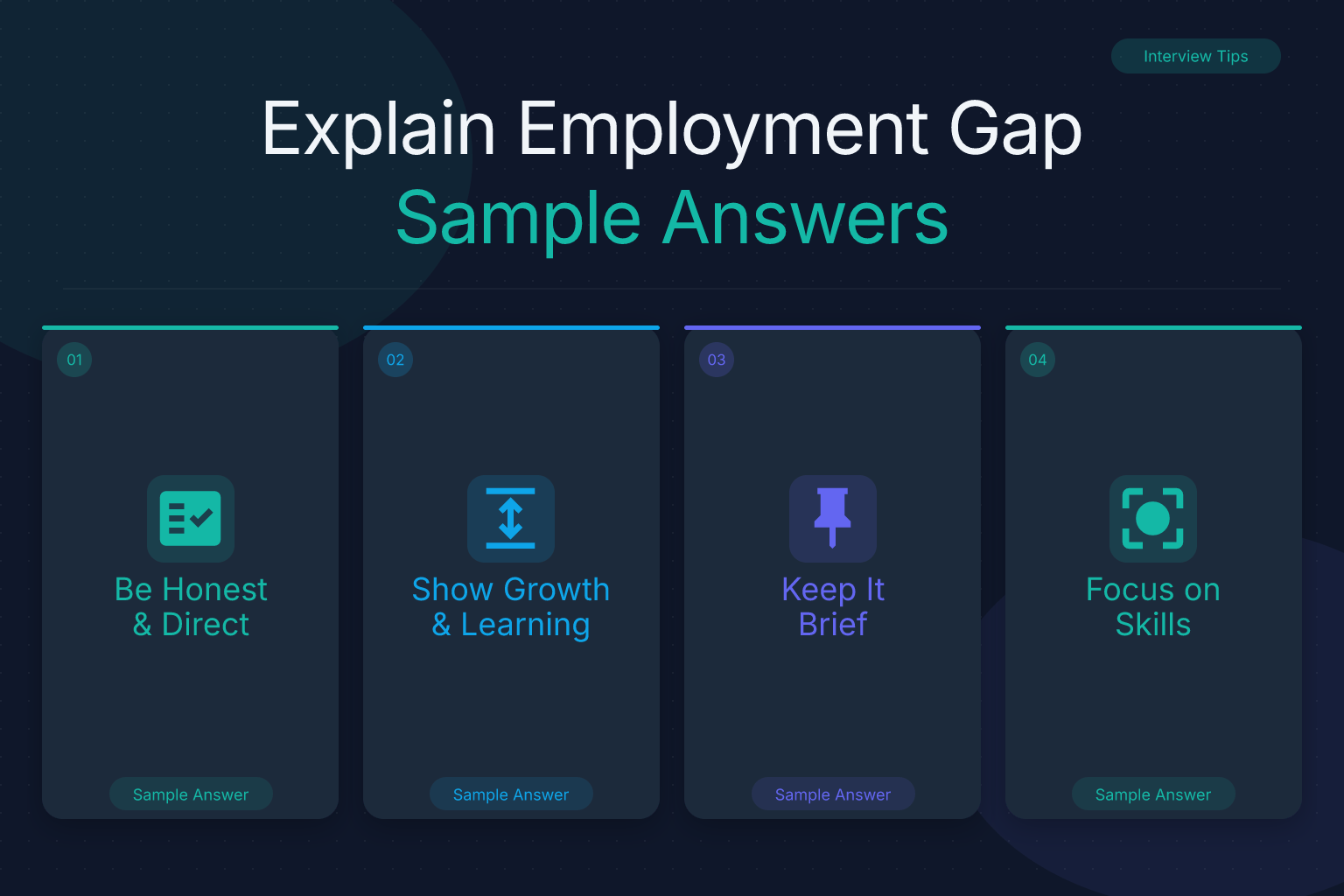
Start by acknowledging the gap without over-explaining. Then pivot immediately to what you did during that time — even if it wasn’t paid work. Finally, connect that experience to the role you’re interviewing for. This structure works for gaps of any length, from a few months to several years.
For example, if you took 18 months off to care for a family member, you might say: “I took a planned career break to manage a family health situation. During that time, I stayed current by completing two online certifications in project management and volunteering as a coordinator for a local nonprofit. That experience sharpened my organizational skills, and I’m eager to bring that discipline back to a full-time role.”
Notice what this answer does: it’s honest, it shows initiative, and it ends on a forward-looking note. There’s no apology, no defensiveness — just facts and a clear bridge to the job at hand.
Common Reasons for Employment Gaps (and How to Frame Them)
Not all gaps are created equal, but every gap can be framed constructively. Here are the most common scenarios and the key message you want to convey for each.
- Layoff or company restructuring: Emphasize that the departure was not performance-related and highlight any upskilling you did afterward. “After my role was eliminated in a company-wide reduction, I used the time to earn my AWS certification and consult on two small projects. I’m now looking for a permanent position where I can apply those cloud skills.”
- Health or family caregiving: Keep the personal details minimal. Focus on the fact that the situation is resolved and you’re fully ready to commit. “I stepped away to support a family member through a medical recovery. That chapter is now behind me, and I’ve spent the last three months refreshing my skills and networking in the industry.”
- Personal development or travel: Frame it as intentional growth. “I took a sabbatical to travel and volunteer abroad. The experience taught me adaptability and cross-cultural communication — skills I’ll use every day in a client-facing role like this one.”
- Education or upskilling: This is the easiest gap to explain. Simply state what you studied and why. “I left my previous role to pursue a full-time data science bootcamp. I graduated last month and am now looking for a junior data analyst position where I can apply my new skills.”
- Job search that took longer than expected: Be honest but brief. “I’ve been selective in my job search to find the right culture fit. In the meantime, I’ve been freelancing and taking courses to stay sharp.”
If you’re a recent graduate with a gap between school and your first job, the same principles apply. Frame the time as a period of exploration, skill-building, or personal responsibility. For more on handling that specific scenario, see the FAQ section below.
Step-by-Step: Crafting Your Gap Explanation
Building your answer doesn’t have to be complicated. Follow these four steps to create a response that feels authentic and professional.
- Acknowledge the gap in one sentence. State the timeframe and the reason without unnecessary detail. “I took a 14-month career break to relocate and support my spouse’s job transfer.”
- Describe what you did during the gap that’s relevant to work. Even if you weren’t employed, you likely did something that kept your mind engaged. List courses, volunteer work, freelance projects, caregiving logistics, or self-study. “During that time, I completed a Google UX Design certificate and redesigned a website for a local business.”
- Connect that activity to the job you’re applying for. Show the interviewer that the gap actually made you a stronger candidate. “That hands-on project gave me experience with user research and prototyping, which directly applies to this product design role.”
- Reaffirm your readiness and enthusiasm. End with a confident statement that closes the topic. “I’m fully recharged and excited to bring that creative energy to your team.”
Write your answer down, then edit it until it’s under 100 words. The goal is to be thorough enough to satisfy curiosity but short enough that the interviewer moves on to the next question.
Sample Answers for Different Gap Scenarios
Sometimes the best way to prepare is to see how others have phrased it. Here are sample answers you can adapt to your own situation.
Gap due to layoff (6 months)
“My position was eliminated during a restructuring last fall. I took a few weeks to reset, then enrolled in a digital marketing certification program and started consulting for a small e-commerce brand. That project reignited my passion for data-driven campaigns, and I’m now looking for a full-time role where I can lead strategy from day one.”
Gap due to caregiving (2 years)
“I took a planned break to care for my aging parent. While managing their care, I also volunteered as a treasurer for a community organization, which kept my financial and organizational skills sharp. That chapter is now complete, and I’m fully ready to return to a demanding accounting role.”
Gap due to travel or sabbatical (1 year)
“I took a sabbatical to travel through Southeast Asia and volunteer with a literacy program. The experience taught me how to communicate across language barriers and adapt quickly to new environments — skills I think are essential for a customer success role like this one.”
Gap for a recent graduate (8 months after graduation)
“After graduating, I took some time to help my family relocate and then completed a Python for Data Analysis course online. I also built a portfolio of personal projects, which you can see on my GitHub. I’m now eager to apply those skills in a professional setting.”
Each of these answers follows the same pattern: brief reason, productive activity, connection to the job, and a confident close. Practice your version until it feels like second nature.
What Not to Say When Explaining a Gap
Just as important as what you say is what you avoid. A poorly handled answer can turn a minor gap into a major red flag.
- Don’t lie or exaggerate. If you say you were freelancing when you weren’t, a background check or reference call can expose the fabrication. Honesty is always the safer path.
- Don’t overshare personal details. You don’t need to describe the specifics of a health condition, a messy divorce, or a family conflict. “I took time off for personal reasons that are now resolved” is sufficient.
- Don’t sound bitter about a previous employer. Even if you were treated unfairly, complaining about a past boss makes you look difficult. Keep the focus on what you did next.
- Don’t say “I just needed a break” without context. That can sound like you lack drive. If you took time off to recharge, frame it as intentional: “I took a planned sabbatical to travel and volunteer, and I returned with fresh perspective and new skills.”
- Don’t apologize excessively. One brief acknowledgment is fine, but repeated apologies signal that you think the gap is a problem. It’s not — it’s a part of your story.
How to Address Gaps on Your Resume Before the Interview
The best way to handle a gap in the interview is to make sure it doesn’t look like a mystery on your resume. A few formatting tweaks can reduce the number of questions you get in the first place.
- Use years instead of months for employment dates. If you worked from January 2020 to October 2022, listing “2020–2022” can make a few months of gap less noticeable. Be consistent across all entries.
- Add a “Career Break” or “Professional Development” entry. Treat the gap like a job: list the dates, give it a title like “Full-Time Caregiver” or “Independent Study,” and include 2-3 bullet points describing what you accomplished. This shows you weren’t idle.
- Lead with a strong summary statement. A well-written summary at the top of your resume can frame your entire career narrative, including the gap, before the reader even gets to the timeline. For example: “Project manager with 8 years of experience, returning to the workforce after a planned sabbatical focused on agile certification and nonprofit board service.”
- Use a functional or hybrid resume format. If your gap is significant, a format that groups skills and accomplishments above the chronological work history can shift attention to what you can do, not when you did it. Most modern ATS systems parse these formats well, especially when built with a clean, single-column layout. For more on formatting your resume to minimize gaps, see our guide on resume gap strategies.
If you’re updating your resume to minimize a gap, make sure the final document is ATS-friendly. A free ATS resume score check can flag formatting issues that might cause your resume to be rejected before a human even sees it. And if you’re starting from scratch, the ResumeMate AI resume builder creates clean, single-column PDFs that keep the focus on your skills — not your timeline.
Practice Your Delivery: Mock Interview Tips
Even the best-written answer falls flat if you deliver it nervously. Practice is what turns a rehearsed script into a natural conversation.
- Record yourself on your phone. Play it back and listen for filler words (“um,” “like”), pacing, and tone. Aim for a calm, conversational speed.
- Practice with a friend who will ask follow-up questions. The interviewer might probe deeper, so be ready to expand on your gap activities without getting flustered.
- Use the “Tell me about yourself” question as a launchpad. Many interviewers will ask about your background before they zero in on the gap. If you weave a brief mention of the gap into your overall story, it feels less like an interrogation. For a full guide on crafting that opening answer, see our post on how to answer “Tell me about yourself” in an interview.
- Prepare a transition phrase. If the gap question catches you off guard, a simple “That’s a fair question — I’m glad you asked” buys you a second to collect your thoughts and signals confidence.
Turning Your Gap Into a Strength
The most memorable candidates don’t just explain their gap — they use it to differentiate themselves. A career break can be a source of unique perspective, resilience, and clarity about what you want next.
Think about what your gap taught you that a continuously employed candidate might not have. Did caregiving sharpen your patience and crisis management? Did a layoff push you to learn a new technical skill? Did travel give you cultural fluency that’s rare in your industry? These are not soft-pedaled excuses; they’re competitive advantages.
When you frame your gap as a deliberate chapter in your career — one that added value — you change the dynamic. The interviewer stops seeing a risk and starts seeing a candidate who knows themselves, adapts to change, and brings more to the table than a standard résumé.
If you left your last job under difficult circumstances, you may also want to prepare for questions about why you left. Our guide on how to answer “reasons for leaving a job” walks you through framing that conversation just as positively.
FAQ
Q: How to explain career gap in interview sample answer?
A: A strong sample answer follows a simple formula: state the reason briefly, describe what you did during the gap that kept your skills relevant, and connect it to the job. For example: “I took a 10-month break to care for a family member. During that time, I completed a digital marketing certification and managed social media for a local nonprofit. That hands-on experience directly applies to this marketing coordinator role, and I’m excited to bring that momentum to your team.”
Q: How to explain career gap in interview for freshers?
A: For recent graduates, frame the gap as a period of skill-building or personal responsibility. You might say: “After graduation, I spent six months helping my family relocate and then completed an online data analytics course. I also built a portfolio of projects that showcase my skills, which I’d love to walk you through.” The key is to show you were proactive, not idle.
Q: Can you explain your employment gap?
A: Yes — and you should. A concise, honest explanation that highlights what you learned or accomplished during the gap reassures the interviewer that you’re ready to return to work. Avoid long, emotional stories; stick to the facts and pivot to the future.
Q: What does employment gap explanation mean?
A: An employment gap explanation is your verbal or written response to a question about a period when you were not formally employed. It typically includes the reason for the gap, what you did during that time, and how it relates to your career goals. The purpose is to address any concerns about your reliability or skill currency.
Q: How do you explain your gap in employment answer?
A: Structure your answer in four parts: (1) acknowledge the gap in one sentence, (2) describe productive activities you engaged in, (3) connect those activities to the job you’re applying for, and (4) express enthusiasm about returning to work. Practice until you can deliver it in under 60 seconds without sounding rehearsed.
Q: What if my employment gap was due to a layoff?
A: Layoffs are common and rarely reflect individual performance. Be upfront: “My role was eliminated in a company-wide reduction.” Then immediately shift to what you did next — courses, consulting, volunteering — and why you’re excited about this new opportunity. Never badmouth the previous employer.
Q: Should I address an employment gap on my resume before the interview?
A: Yes. Adding a “Career Break” entry with bullet points or using years instead of months can reduce the number of questions you get. A clean, ATS-friendly resume format also helps ensure the gap doesn’t cause your application to be screened out automatically.
Related articles:
- Types of Drugs Tested in Pre-Employment Screening 2026
- Stress Interview Question: Sample Answers & Tips
- Availability Start Date: Sample Answers
Track Every Application While You Job Hunt
Stop losing track of where you’ve applied. The ResumeMate Job Tracker is a free Chrome extension that tracks every application, deadline, and follow-up in one place — right from your browser.