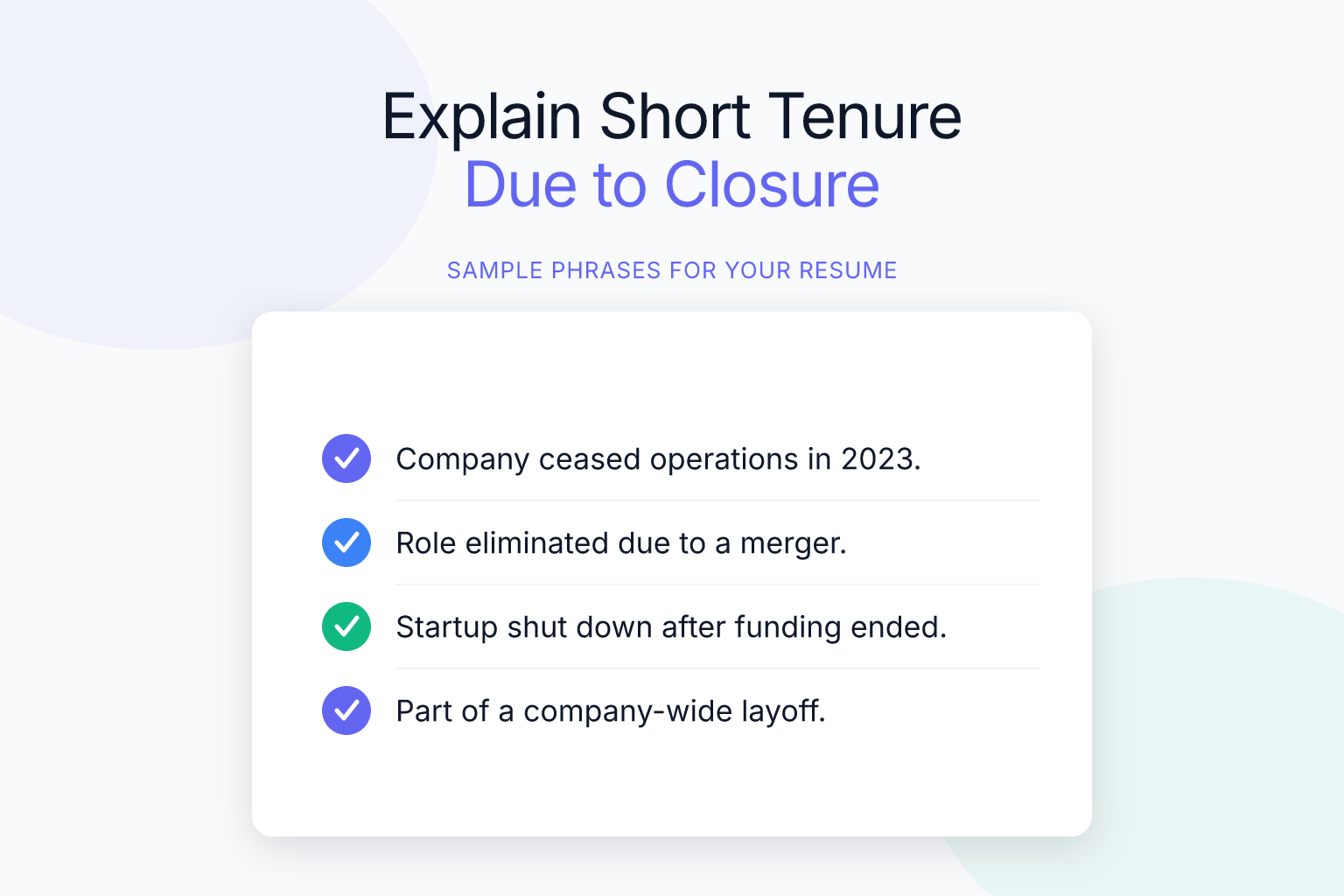
How to Explain Short Tenure Due to Company Closure (with Sample Answers)
If you’re trying to figure out how to explain short tenure due to company closure, you’re in a far better position than you might think. A company shutting down is a no-fault event — it says nothing about your performance, reliability, or skills. But if you don’t frame it clearly, a recruiter scanning your resume might see a six-month stint and assume you were fired or quit impulsively. This guide gives you the exact words, resume tweaks, and interview strategies to make sure that doesn’t happen.
Key Takeaways
- A short tenure caused by a company closure is a neutral, verifiable reason for leaving — it won’t hurt you if you address it proactively.
- Adding a brief closure note to your resume (e.g., “Company ceased operations”) prevents recruiters from guessing why you left.
- In interviews, lead with what you accomplished during that short time, then mention the closure as context — never as an apology.
- You can turn the experience into a strength by highlighting adaptability, resilience, and the ability to deliver results under uncertainty.
- If the closure was messy, stick to factual, forward-looking statements and never badmouth former employers.
| What to Do | Why It Matters | Time |
|---|---|---|
| Add a one-line closure note on your resume | Stops recruiters from assuming you were fired or quit | 5 minutes |
| Prepare a 30-second explanation for interviews | Lets you control the narrative with confidence | 15 minutes |
| Lead every answer with an achievement from that role | Proves your value outweighs the short duration | Ongoing |
| Use your cover letter to set context before they see dates | Frames the short stint as a non-issue from the start | 10 minutes |
| Frame the closure as a learning experience | Turns a potential red flag into a sign of resilience | 5 minutes |
Why Explaining Short Tenure Due to Company Closure Is Different
When you need to explain short tenure due to company closure, the first thing to understand is that this reason sits in a completely different category from being fired, laid off for performance, or quitting after a few months. A business shutting down is an external event — it’s not about you. Recruiters and hiring managers know that startups fail, retail locations close, and even established companies sometimes fold. According to data from the U.S. Bureau of Labor Statistics, thousands of business establishments close each year across every industry. That means you’re far from alone.
The real risk isn’t the closure itself; it’s leaving the reason unstated. When a resume shows a job that lasted only 8 or 10 months with no explanation, a recruiter’s first assumption is often the worst: you couldn’t hack it, you clashed with a manager, or you job-hopped. By clearly and calmly stating that the company closed, you remove that doubt immediately. The rest of your job search materials can then focus on what you achieved, not why you left.
How to Address the Closure on Your Resume
Your resume is the first place a recruiter will notice the short tenure, so it’s also the first place you should address it. You don’t need a separate “Reason for Leaving” section — that can look defensive. Instead, weave the closure into the job entry itself in one of three ways:
- Add a brief note in parentheses after the company name or job title. For example: “Marketing Coordinator, GreenLeaf Retail (Store closed March 2026).”
- Include it as the final bullet point under that role. Something like: “Role ended when the company ceased operations due to loss of primary investor.”
- Mention it in your resume summary if the short stint is your most recent role. “Results-driven sales professional whose most recent position ended due to a company-wide closure.”
Whichever method you choose, keep it factual and unemotional. The goal is to answer the question before it’s asked, not to over-explain. If you’re listing a startup that shut down, you can find more detailed formatting advice in our guide on how to list startup experience on a resume after closure.
Before you send that resume out, make sure the formatting won’t cause problems. Modern applicant tracking systems parse clean, text-based PDFs without issue, but a cluttered layout can still trip them up. Run your resume through ResumeMate’s free resume score checker to confirm it’s ATS-friendly and that your closure note reads clearly.
Sample Resume Entries for a Closed Company
Sometimes seeing a concrete example makes all the difference. Here are two before-and-after resume entries that show how to handle a short tenure from a company closure.
Before (vague, invites questions):
Digital Marketing Specialist
TechVantage Solutions | June 2025 – February 2026
- Managed social media campaigns across Instagram and LinkedIn
- Increased website traffic by 25% through SEO optimization
- Collaborated with sales team on lead generation content
After (closure addressed, achievements highlighted):
Digital Marketing Specialist
TechVantage Solutions (Company closed February 2026) | June 2025 – February 2026
- Grew organic website traffic 25% in six months by overhauling the blog’s SEO strategy and publishing 3x weekly
- Built a social media calendar that boosted LinkedIn engagement by 40% and generated 120 qualified leads
- Role ended when the company ceased operations after its Series A funding fell through
Notice how the closure is mentioned twice — once in the header and once as a final bullet — but the bulk of the entry sells your impact. That’s the balance you want.
For a retail or service job:
Assistant Store Manager
Bella’s Boutique (Location closed March 2026) | October 2025 – March 2026
- Trained and supervised a team of 8 associates, improving upsell rates by 18%
- Redesigned floor layout, leading to a 12% increase in average transaction value
- Position ended when the parent company closed all underperforming locations in the region
Writing a Cover Letter That Handles the Closure
Your cover letter gives you a chance to address the short tenure before a recruiter even looks at your resume dates. You don’t need to dwell on it — one sentence is usually enough. The key is to mention it, then immediately pivot to what you learned and why you’re excited about the new role.
Here’s a paragraph you can adapt:
“I was drawn to this opportunity because of your company’s focus on sustainable supply chains. In my most recent role as a Logistics Coordinator at GreenPath Distributors, I reduced delivery times by 15% in just seven months before the company unfortunately closed due to industry consolidation. That experience taught me how to drive efficiency with limited resources — a skill I’m eager to bring to your team.”
If the closure left a gap on your resume, you can combine this with strategies for explaining employment gaps. Our post on how to write a cover letter for an employment gap walks you through that in more detail.
Interview Answers for “Why Did You Leave Your Last Job?”
This is the question where your preparation really pays off. When an interviewer asks why you left, they’re often checking for red flags: Were you fired? Did you quit without a plan? A company closure is the easiest answer to give — as long as you deliver it with confidence and immediately redirect to your contributions.
The formula: State the closure factually → Share one concrete achievement → Connect it to the role you’re interviewing for.
Sample answer 1 (startup closure):
“The startup I was working for lost its primary investor and had to shut down in February. It was disappointing, but I’m proud of what we accomplished in that time. I built their entire content marketing engine from scratch, and within six months we were ranking on page one for 12 target keywords. That experience taught me how to move fast and prioritize ruthlessly — exactly the mindset I’d bring to this content strategist role.”
Sample answer 2 (retail or branch closure):
“The company made the decision to close several underperforming locations, including ours. I completely understand — it was a business decision, not a reflection of our team’s work. While I was there, I led a customer retention initiative that brought our repeat purchase rate up by 22%. I’m looking for a role where I can apply that same customer-first thinking on a larger scale.”
Sample answer 3 (company bankruptcy):
“The company filed for Chapter 11 and ultimately ceased operations. It was a tough situation, but I got to wear a lot of hats as a result. I stepped in to manage vendor relationships when our procurement lead left, and I negotiated contracts that saved us $30,000 in my last quarter. I’m ready to bring that kind of ownership to a stable, growing team like yours.”
If you’ve been through multiple involuntary departures, the framing is similar but requires a bit more nuance. You might find our guide on how to explain being laid off twice in an interview helpful for handling that conversation.
Handling Concerns About Short Tenure and Job Hopping
Even when the reason is a company closure, some hiring managers still worry about a pattern of short stints. If this is your only short tenure, it’s unlikely to be an issue. But if you have two or three roles under a year — even for valid reasons — you’ll want to proactively show stability.
Here’s how:
- Group contract or freelance work under a single umbrella. If you did short projects between full-time roles, list them as “Independent Consultant” with a date range that spans the entire period. This visually lengthens your tenure.
- Emphasize commitment in your interview answers. Say something like: “I’m looking for a long-term home where I can grow. The closure was out of my control, and I’m being intentional about finding the right fit this time.”
- Use your resume summary to tell a cohesive story. Instead of a list of short jobs, frame your career as a series of experiences that built a specific skill set. For example: “Operations professional with experience scaling processes at three early-stage companies, most recently at a startup that closed after its acquisition fell through.”
- Provide references who can vouch for your performance. A strong reference from a manager at the closed company can override any concern about the short duration.
What If the Closure Was Messy or Involved Legal Issues?
Not every company closure is a clean, orderly wind-down. Maybe the owner disappeared, the business filed for bankruptcy amid lawsuits, or you’re still owed back pay. In these cases, it’s tempting to vent or over-explain — but that almost always backfires.
Stick to these rules:
- Never badmouth the company or its leadership. Even if they deserve it, complaining makes you look unprofessional. Say “the company faced financial difficulties and had to close” rather than “the CEO ran it into the ground.”
- Keep the explanation brief and forward-looking. If pressed, you can say: “It was a challenging situation, but I learned a lot about navigating uncertainty. I’m ready to apply those lessons in a more stable environment.”
- If there’s a public record (like a bankruptcy filing), you can reference it neutrally. “The company filed for Chapter 7 in January, which ended my role there.” This adds credibility without editorializing.
- Focus on what you controlled. Talk about the work you did, the team you supported, and the results you delivered. That’s what interviewers care about.
Turning a Short Stint into a Career Strength
A company closure can actually become one of the most compelling parts of your story — if you frame it right. Short tenures at failed startups or shuttered businesses often mean you had to learn fast, take on responsibilities beyond your job description, and deliver results with limited resources. Those are exactly the traits employers want.
Here’s how to position the experience as a strength:
- Highlight versatility. “Because the team was lean, I ended up managing both social media and email marketing. I can step into multiple roles and get up to speed quickly.”
- Show resilience. “Having a company close under you teaches you to stay focused and productive even when things are uncertain. I don’t get rattled easily.”
- Demonstrate loyalty. “I stayed until the very end and helped wrap up projects for clients. I’m not someone who jumps ship at the first sign of trouble.”
- Connect it to the new role. “That experience gave me a deep appreciation for financial stability and smart growth — which is why I’m so drawn to your company’s steady, 10-year track record.”
When you tell your story this way, the short tenure stops being a liability and starts being proof that you can thrive in tough situations.
FAQ
Q: Should I mention the company closure on my resume?
A: Yes, briefly. A short note like “Company closed March 2026” next to the job title or as a final bullet removes ambiguity and prevents recruiters from assuming you were fired or quit. It takes one line and saves you from being screened out unfairly.
Q: How do I explain a short tenure due to company closure in an interview?
A: State the closure factually in one sentence, then immediately share a concrete achievement from that role. For example: “The company shut down after losing its main client, but during my time there I reduced customer churn by 15%. I’m proud of that work and ready to bring that focus to your team.” Keep it brief and forward-looking.
Q: Will a short tenure hurt my job search?
A: Not if you address it proactively. A single short stint caused by a company closure is rarely a dealbreaker. Recruiters are far more concerned about unexplained gaps or a pattern of job-hopping. By clearly stating the reason and emphasizing your accomplishments, you neutralize the concern.
Q: What if the company closed after I left?
A: If you left before the closure, you don’t need to mention it on your resume at all — your departure was unrelated. In an interview, you can simply explain why you left (e.g., “I accepted another opportunity”). If the closure happened shortly after and you’re asked about it, you can say: “I had already moved on, but I heard they closed a few months later. It confirmed that I made the right decision to leave when I did.”
Q: How do I list a closed company on LinkedIn?
A: List it the same way you would any other position, but add “(Closed)” or “(Company ceased operations)” after the company name. In the description, you can include a line like “Role ended when the company closed.” This keeps your profile transparent and prevents awkward questions from recruiters who might see a short tenure and wonder.
Q: Can I leave the short job off my resume entirely?
A: You can, but it’s usually not the best move. If the role gave you relevant skills or fills what would otherwise be a gap, include it with the closure note. Omitting it creates an employment gap you’ll have to explain anyway. The only time to leave it off is if the job was completely unrelated to your target role and lasted less than three months — and even then, be prepared to explain the gap if asked.
Track Every Application While You Job Hunt
Stop losing track of where you’ve applied. The ResumeMate Job Tracker is a free Chrome extension that tracks every application, deadline, and follow-up in one place — right from your browser.