Fired for Attendance? How to Explain It in Interviews and Get Unemployment
Getting fired is never easy, and when the reason is attendance issues, it can feel especially hard to explain to a future employer. You might worry that any mention of lateness or absences will immediately disqualify you. But here’s the truth: hiring managers are human. They understand that life happens — illness, family crises, transportation problems, or even burnout. What they really want to know is that the problem is behind you and that you’ll be a reliable employee going forward.
This guide will walk you through exactly how to address a termination for attendance in interviews, on your resume, and in cover letters. You’ll learn how to frame your story honestly without sabotaging your chances, and how to demonstrate that you’ve grown from the experience.
Key Takeaways
- Frame your attendance-related firing as a past challenge you’ve fully resolved, not an ongoing weakness.
- Never lie or blame others; take ownership and explain the concrete steps you’ve taken to ensure reliability.
- Prepare a concise, forward-looking explanation that pivots quickly to your qualifications and enthusiasm for the new role.
- Address the termination only when asked — don’t volunteer it on your resume or in a cover letter unless the application specifically requires disclosure.
- Use your cover letter and interview to highlight recent, consistent attendance and performance in any subsequent roles or activities.
| What to Do | Why It Matters | When to Address It |
|---|---|---|
| Prepare a brief, honest explanation that focuses on what you learned | Shows self-awareness and maturity without dwelling on the negative | During the interview, when asked about the reason for leaving |
| Emphasize the steps you’ve taken to fix the root cause (e.g., reliable transportation, health management) | Proves the issue is resolved and you’re now a dependable employee | In the interview and, if relevant, in a cover letter |
| Keep the explanation short and pivot to your strengths | Prevents the interviewer from fixating on the firing | Every time the topic comes up |
| Avoid badmouthing your former employer or making excuses | Demonstrates professionalism and accountability | Always |
| If the attendance issue was due to a medical or family situation, frame it as a resolved personal matter | Protects your privacy while addressing the gap | Only if directly asked about the reason for termination |
How to Explain Being Fired for Attendance Issues: The Honest Approach
When an interviewer asks, “Why did you leave your last job?” and the real answer is that you were fired for attendance, your instinct might be to dodge the question. But honesty — delivered strategically — is your best tool. The key is to acknowledge the situation briefly, take responsibility, and immediately shift the focus to what you’ve done to fix it and why you’re a stronger candidate now.
Start by understanding the root cause of your attendance problem. Were you dealing with a chronic health condition? Unreliable childcare? A long commute with unpredictable traffic? Burnout that led to calling in sick too often? Knowing the “why” helps you craft a truthful explanation that doesn’t sound like an excuse.
Then, frame it as a learning experience. For example:
“I was let go from my previous position because I struggled with consistent attendance. At the time, I was dealing with some personal health challenges that I didn’t manage well. Since then, I’ve gotten the treatment I needed and have put systems in place to ensure I’m always on time and present. I’ve also taken on a part-time role where I’ve had perfect attendance for the past six months.”
This approach works because it:
- Admits the mistake without over-explaining.
- Shows you’ve taken concrete action.
- Provides recent evidence of reliability.
If your attendance issue was due to something like a difficult commute or unreliable transportation, you can say:
“I was terminated because of repeated lateness. I underestimated how much my commute would affect my punctuality. I’ve since moved closer to public transit and now plan my mornings with a 30-minute buffer. In my current volunteer work, I’ve been early every day.”
Notice how each example ends with a positive, present-tense proof point. That’s what turns a red flag into a story of growth.
Preparing Your Explanation Before the Interview
Walking into an interview without a rehearsed answer is a recipe for rambling or panic. Spend time crafting and practicing your response so it feels natural, not scripted.
Step 1: Write Down the Facts
Jot down the actual reason for your attendance issues. Be honest with yourself. Was it a one-time crisis or a pattern? Understanding the facts helps you avoid contradictions later.
Step 2: Identify the Lesson and the Fix
For every problem, there’s a solution you’ve implemented. Write down:
- What you learned (e.g., “I realized I need a consistent morning routine.”)
- What you changed (e.g., “I now use a scheduling app and set multiple alarms.”)
- What the result has been (e.g., “I haven’t been late to any commitment in over a year.”)
Step 3: Practice Out Loud
Say your explanation to a friend, a career coach, or even your mirror. Time it — aim for 30–60 seconds. The goal is to sound calm, confident, and brief.
Step 4: Prepare for Follow-Up Questions
Interviewers may ask, “What specifically did you do to improve?” or “How do we know this won’t happen again?” Have a second, slightly more detailed version ready, but still keep it positive and forward-looking.
What to Say in the Interview: A Step-by-Step Script
Here’s a simple, four-part framework you can adapt to your situation:
Acknowledge the termination directly.
- “I was let go from my last role due to attendance issues.”
Give a brief, honest reason (without over-sharing).
- “At the time, I was dealing with a family health crisis that required my attention during work hours.”
Explain what you’ve done to resolve it.
- “That situation has since stabilized, and I’ve put a support system in place so I can fully commit to my work schedule.”
Pivot to your current reliability and enthusiasm.
- “Since then, I’ve completed a certification program with perfect attendance and am eager to bring that same dedication to this role.”
You can use this exact structure for any attendance-related firing. The key is to keep the explanation short — no more than three or four sentences — and then immediately redirect to your qualifications.
Sample Scripts for Common Scenarios
Health-related absences:
“I was terminated because I missed too many days due to an ongoing medical issue. I’ve since completed treatment and my health is now stable. I’ve also learned to communicate proactively with my manager if I ever need flexibility, and I’ve maintained a spotless attendance record in my subsequent freelance work.”
Transportation or commute problems:
“My previous job required a long commute that often made me late. I was let go after several warnings. I’ve since relocated to be closer to reliable public transit and now build extra time into my morning routine. In my current part-time role, I’ve been early every shift.”
Childcare or family obligations:
“I was fired because I had inconsistent childcare and had to leave early or miss days unexpectedly. I’ve now secured full-time, reliable childcare and have a backup plan in place. I’ve also been volunteering at my child’s school, where I’ve never missed a scheduled commitment.”
Burnout or mental health:
“I was let go because I was calling in sick too often. I didn’t realize at the time that I was experiencing burnout. I’ve since worked with a therapist to set better boundaries and manage stress, and I’ve taken on a contract role where I’ve had zero unplanned absences.”
Addressing Attendance on Your Resume and Cover Letter
Your resume is a marketing document, not a confession. You are not required to list the reason you left a job. Simply list the employment dates and your accomplishments. If there’s a gap after the termination, you can address it in your cover letter or interview, but never volunteer the firing on the resume itself.
If you’re worried about the gap, consider using a functional or hybrid resume format that emphasizes skills over chronology. For more on handling employment gaps, see our guide on how to write a cover letter for an employment gap.
In your cover letter, you have the option to briefly address the termination if you think it will come up in a background check. But only do this if the application specifically asks for an explanation of employment gaps or terminations. If you choose to mention it, use the same four-part framework: acknowledge, explain briefly, show resolution, pivot to strengths. Keep it to one or two sentences, and place it near the end of the letter after you’ve already sold your qualifications.
Example cover letter snippet:
“You may notice a gap in my employment after my role at XYZ Corp. I was let go due to attendance issues stemming from a now-resolved personal matter. Since then, I’ve completed a project management certification and have been consulting part-time with perfect reliability. I’m excited to bring my skills to your team.”
How to Show You’ve Overcome the Issue
Telling an interviewer you’ve changed is one thing; proving it is another. The strongest evidence is recent, verifiable reliability. Here’s how to build that proof even before you land the interview:
- Take on temporary, contract, or volunteer work. Any role where you can demonstrate punctuality and attendance gives you a recent reference. Even a short-term gig can provide a manager who will vouch for your dependability.
- Complete a certification or course. Many online programs track attendance or require live sessions. Mentioning that you “attended all 12 live workshops” or “completed the program on schedule” is concrete evidence.
- Gather performance reviews or attendance records from any post-termination work. If you’ve done freelance projects, ask clients for brief testimonials that mention your reliability.
- Use a reference who can speak to your character and work ethic. A former colleague, mentor, or client who knows you well can offset concerns about the firing.
If you don’t have any post-termination work yet, focus on what you’ve done to address the root cause. For example, if transportation was the issue, you can say, “I’ve mapped out the commute to your office and it’s a 20-minute bus ride with three backup routes. I’m confident I can be here by 8:45 every day.” That level of specificity shows you’re serious.
What Not to Say About Your Firing
Just as important as what you say is what you avoid. Certain phrases can raise red flags or make you seem unaccountable.
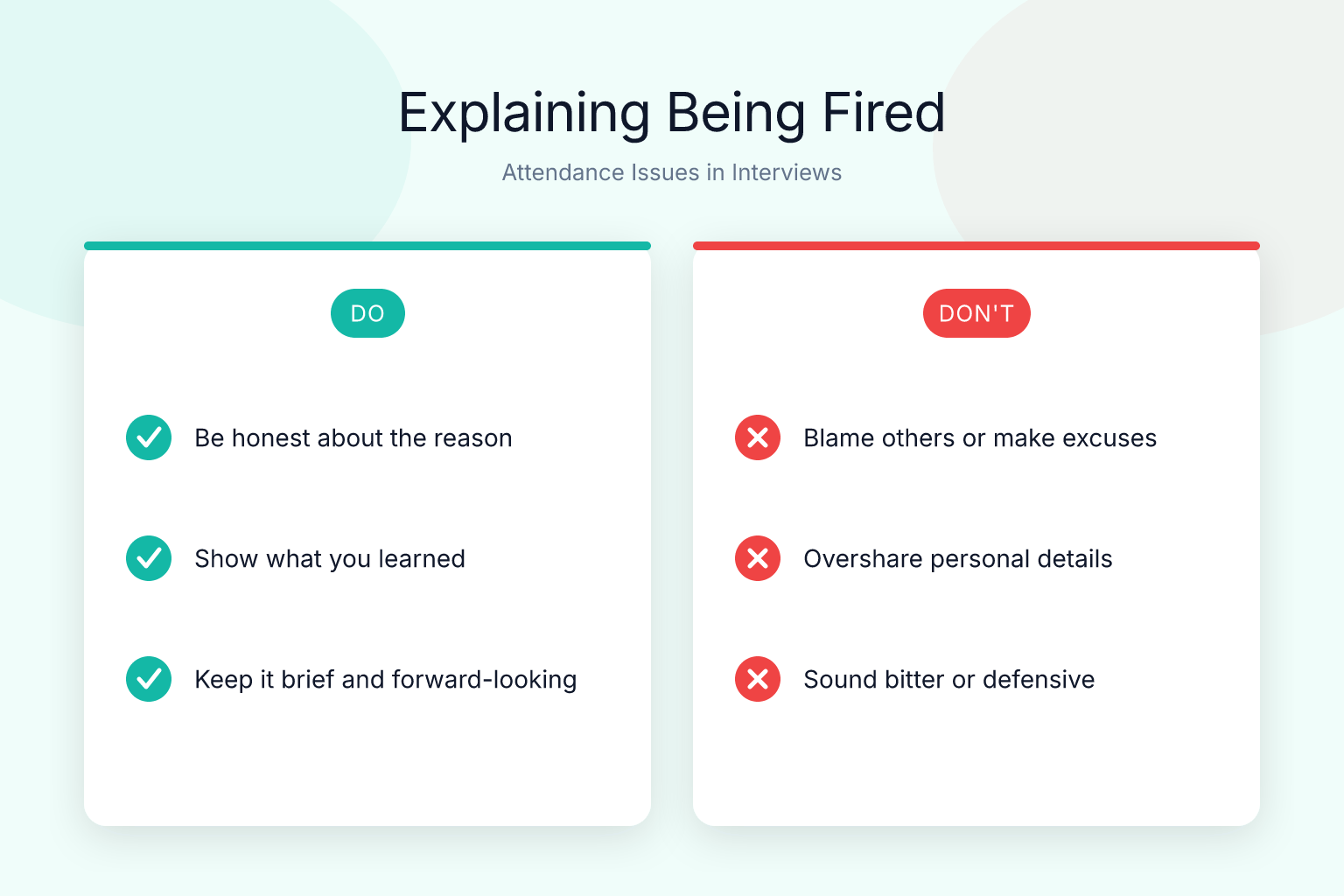
- Don’t blame your former employer. Saying “They were unfair” or “My manager had it out for me” makes you look like a problem employee. Even if you feel wronged, keep the focus on your own actions.
- Don’t lie. If you were fired for attendance, don’t say you were laid off. Background checks can reveal the truth, and getting caught in a lie is far worse than the original offense.
- Don’t overshare. You don’t need to give every detail of your medical history, family drama, or personal struggles. A simple, “I was dealing with a personal health issue that has since been resolved” is enough.
- Don’t sound like you’re still struggling. Avoid phrases like “I’m still working on it” or “It’s a challenge.” The interviewer needs to hear that the problem is in the past.
- Don’t badmouth yourself. Don’t say “I was a terrible employee” or “I really messed up.” Take responsibility, but frame it as a learning experience, not a character flaw.
Sample Answers for Common Interview Questions
Here are a few more ways to handle the topic when it comes up in different forms.
Q: Why did you leave your last job? A: “I was let go because of attendance issues. I had some personal challenges at the time that affected my reliability. I’ve since resolved those challenges and have built a strong track record of punctuality in my current freelance work. I’m ready to bring that same consistency to a full-time role.”
Q: What is your greatest weakness? A: “In the past, I struggled with time management and punctuality. It actually led to me being let go from a job, which was a wake-up call. I’ve since become almost obsessive about planning my day — I use a digital calendar with reminders, I lay out my clothes the night before, and I always aim to arrive 15 minutes early. It’s now a strength.”
Q: Can you explain this gap in your resume? A: “After leaving my last role, I took some time to address a personal health matter and to upskill. I completed a certification in digital marketing and have been freelancing since then. The time off allowed me to reset and come back as a much more focused professional.”
Q: Have you ever been fired? A: “Yes, I was terminated from a position about two years ago due to attendance. It was a difficult period, but I learned a lot about the importance of communication and planning. Since then, I’ve held a part-time job for over a year with perfect attendance and glowing reviews.”
Rebuilding Your Professional Reputation
Getting fired for attendance can feel like a permanent stain, but it doesn’t have to define your career. Many successful professionals have been fired at some point. What matters is how you bounce back.
Start by updating your resume to focus on achievements, not chronology. Use a free resume score checker to see how your resume stacks up against applicant tracking systems and get feedback on how to strengthen it. A clean, ATS-friendly resume helps you get past the initial screening so you can tell your story in person.
Next, lean on your network. A personal referral can bypass some of the scrutiny around a termination. If a former colleague or manager is willing to recommend you, their endorsement carries weight. For tips on asking for referrals, read our guide on how to ask for a LinkedIn referral.
Finally, be patient with yourself. Job searching after a firing is stressful, but every interview is practice. The more you refine your explanation and gather evidence of your reliability, the more confident you’ll become.
FAQ
Q: Should I mention being fired for attendance on my resume?
A: No. Your resume is a summary of your skills and accomplishments, not a confession. You don’t need to list the reason for leaving any job. If there’s a gap, you can address it in your cover letter or interview, but only if asked.
Q: Can a background check reveal that I was fired for attendance?
A: It depends. Most background checks verify dates of employment and job titles, not the reason for leaving. However, some employers may disclose whether you are eligible for rehire, which can hint at a termination. It’s best to be honest if asked directly, but you don’t need to volunteer the information.
Q: What if my attendance issues were due to a disability or medical condition?
A: You may have legal protections under the Americans with Disabilities Act (ADA) if your employer failed to provide reasonable accommodations. However, in an interview, you are not required to disclose a disability. You can simply say, “I had a medical issue that affected my attendance, but it’s now resolved and I’m fully able to meet the demands of this role.” If you believe you were wrongfully terminated, consult an employment attorney.
Q: How do I explain being fired for attendance if I don’t have any recent work to prove I’ve changed?
A: Focus on the concrete steps you’ve taken to address the root cause. For example, if transportation was the issue, explain that you’ve moved or bought a reliable car. If it was health-related, mention that you’ve completed treatment. You can also reference any volunteer work, courses, or personal projects where you demonstrated reliability, even if they weren’t paid.
Q: Is it better to say I was laid off instead of fired for attendance?
A: No. Lying about the reason for leaving is risky. If a background check or reference call reveals the truth, you’ll lose the job offer and damage your professional reputation. Honesty, framed strategically, is always the better approach.
Q: How long should I wait before applying to jobs after being fired for attendance?
A: There’s no required waiting period. You can start applying as soon as you feel ready and have addressed the underlying issue. However, having at least a few weeks or months of demonstrated reliability (through temporary work, volunteering, or a course) can make your explanation much stronger.
Track Every Application While You Job Hunt
Stop losing track of where you’ve applied. The ResumeMate Job Tracker is a free Chrome extension that tracks every application, deadline, and follow-up in one place — right from your browser.