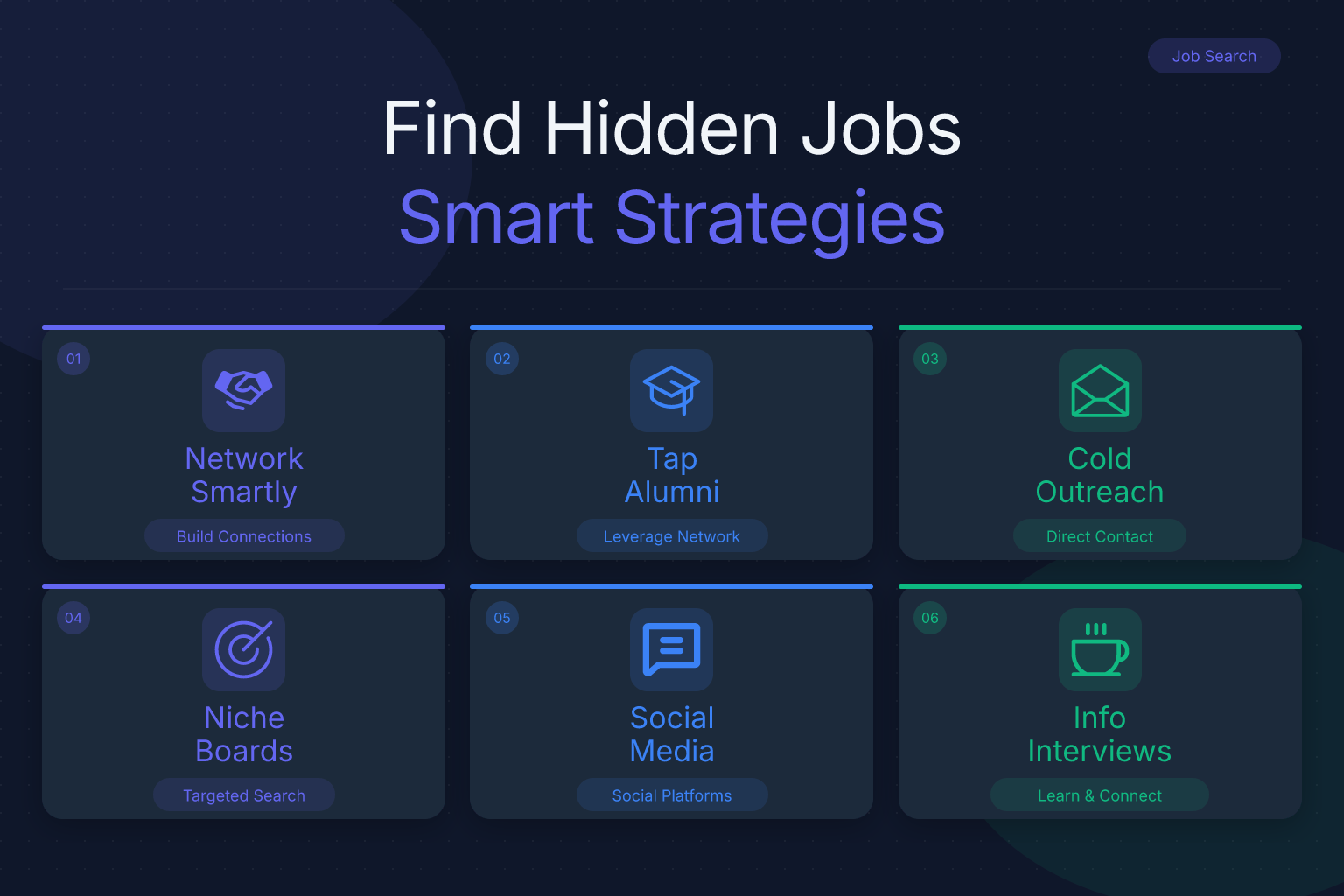
How to Find Hidden Jobs: 7 Strategies to Unlock the Unadvertised Market
If you’re only applying to jobs you see on LinkedIn or Indeed, you’re missing most of the opportunities out there. How to find hidden jobs isn’t about secret handshakes — it’s about understanding that the majority of roles are filled before a job description ever goes live. According to LinkedIn, up to 85% of jobs are filled through networking, meaning many positions never appear on a public job board. The hidden job market is real, and tapping into it gives you a massive advantage over candidates who wait for postings.
Key Takeaways
- The hidden job market consists of roles filled through referrals, internal moves, and direct outreach — often before a public listing exists.
- Strategic networking, not mass applications, is the most reliable way to uncover unadvertised opportunities.
- You can find hidden jobs by building relationships with hiring managers, joining professional communities, and using LinkedIn beyond the job board.
- Informational interviews and speculative applications turn cold outreach into warm leads that frequently lead to interviews.
- Niche platforms, alumni networks, and freelance gigs are overlooked goldmines for roles that never hit mainstream job sites.
| What to Do | Why It Matters | Time |
|---|---|---|
| Build a referral network | Referred candidates are 4x more likely to be hired and often hear about roles first | Ongoing |
| Reach out to companies directly | Many teams create roles for strong candidates before HR posts them | 1–2 hours per week |
| Use LinkedIn’s hidden features | Saved searches, employee alerts, and content engagement surface unlisted openings | 15 minutes daily |
| Attend industry events and join associations | Decision-makers share upcoming needs in casual conversations | 2–4 hours per month |
| Conduct informational interviews | You learn about unposted roles while building advocates inside target companies | 30 minutes per interview |
1. How to Find Hidden Jobs by Building a Referral Network
Most hidden jobs are filled through someone who knows someone. The fastest way to get on the inside track is to become the person a hiring manager thinks of before HR drafts a job description.
Start with your existing network — former colleagues, classmates, managers, and vendors. Don’t just ask if they know of openings. Instead, be specific: “I’m looking for a product marketing role in health tech. If you hear of any teams growing, I’d love an introduction.” This gives them a clear mental hook.
Then, expand your network intentionally:
- Reconnect with dormant contacts. Send a short message on LinkedIn or by email. Mention something you admired about their work and share what you’re looking for.
- Join Slack and Discord communities in your industry. Many have dedicated #jobs or #hiring channels where members post roles before they go public.
- Attend local meetups and virtual events. The person you chat with after a panel might be building a team next quarter.
- Offer help first. Share an article, make an introduction, or give feedback. People remember generosity and are far more likely to return the favor when a role opens up.
When you do get a referral, tailor your resume to the company’s context — even if there’s no formal job description yet. Use what you learned from your contact to highlight the skills and projects that matter most. If you need a quick way to customize your resume for each opportunity, a free resume builder can help you swap bullet points and keywords in minutes without starting from scratch.
2. Reach Out to Companies Before They Post Openings
Many hiring managers have a need but haven’t gotten approval to post a job — or they’re too busy to write the description. A well-timed, thoughtful message can turn that need into an offer.
Identify 10–15 companies you’d genuinely love to work for. Don’t blast the same email to all of them. Research each one:
- Read their blog, press releases, and leadership interviews to spot growth areas.
- Look at recent hires on LinkedIn. If a company just brought on a VP of Engineering, they’ll likely need more engineers soon.
- Check funding announcements. Startups that raised a Series A or B are almost always hiring, even if their careers page is thin.
Then, find the right person to contact. For smaller companies, that might be the founder or department head. For larger ones, target a director or senior manager in your function. Send a concise, value-first message:
“Hi [Name], I’ve been following [Company]’s work on [specific project] and I’m impressed by [detail]. I noticed your team is growing in [area]. I specialize in [skill] and recently [quick accomplishment]. If you’re open to a brief chat, I’d love to learn more about what’s ahead for your team.”
This isn’t asking for a job — it’s starting a conversation. If they’re not hiring now, they’ll remember you when they are. If they are, you’ve just skipped the applicant tracking system entirely.
3. Uncover Hidden Jobs on LinkedIn (Beyond the Job Board)
LinkedIn’s job board shows only a fraction of available roles. The real hidden jobs surface through activity, not search filters.
Turn on “Open to Work” strategically. Recruiters use LinkedIn Recruiter to find candidates who have signaled they’re open — but you can control who sees it. Set it to “Recruiters only” so your current employer doesn’t get notified. Recruiters often fill roles that never get posted publicly.
Follow target companies and engage with their content. When you comment thoughtfully on a post, employees notice. A marketing director who sees your insightful comment might check your profile and reach out if they’re hiring.
Set up job alerts with a twist. Instead of just saving a search for “product manager,” save searches for phrases like “growing team,” “we’re expanding,” or “new role.” These often appear in posts, not job listings. You can also set alerts for when employees at your target companies change jobs — a departure often creates an unposted opening.
Use LinkedIn’s “People” search to find hiring managers. Search for “hiring [your role]” or “head of [department]” and filter by company. Connect with a note that references their work. Don’t pitch yourself immediately; build a relationship over a few interactions.
Check the “Jobs” tab on company pages for internal-only listings. Some companies post roles visible only to employees, but LinkedIn sometimes surfaces them to followers. If you see a role that says “Posted 3 days ago” with zero applicants, it might be an internal transfer opportunity that you can still inquire about.
4. Find Hidden Jobs Through Professional Associations and Events
Industry associations, conferences, and local chapters are where decision-makers talk about upcoming projects before they become official headcount. A casual conversation at a virtual roundtable can lead to a job that won’t be advertised for months.
- Join the main association for your field (e.g., American Marketing Association, Society for Human Resource Management, Project Management Institute). Many have member-only job boards with roles that never hit Indeed.
- Attend chapter meetings and special interest groups. These smaller gatherings are less about passive listening and more about discussion. Introduce yourself in the chat, ask a question, and follow up on LinkedIn afterward.
- Volunteer for a committee. When you help plan an event or manage a newsletter, you work alongside senior professionals who see your skills firsthand. They’ll think of you when a position opens.
- Speak at events or write for the association’s blog. Even a 10-minute lightning talk positions you as an expert. Hiring managers in the audience will approach you afterward.
Don’t just collect business cards. After an event, send a personalized connection request referencing something you discussed. A week later, share an article or resource that relates to their work. These small touches keep you top of mind when a hidden role appears.
5. Use Informational Interviews to Discover Unlisted Roles
An informational interview is a 20-minute conversation where you ask someone about their career path, company culture, and industry trends — not a job. Yet these chats routinely lead to job offers because you’re building a relationship without the pressure of an application.
How to request one:
- Find people in roles or companies you admire. Second-degree LinkedIn connections are ideal.
- Send a short, no-pressure message: “Hi [Name], I’m exploring a move into [field] and your career path really resonates with me. Would you have 20 minutes for a virtual coffee? I’d love to hear how you got into [specific aspect].”
- Prepare 5–7 thoughtful questions. Ask about their biggest challenges, what skills they’re hiring for, and what they wish they’d known earlier.
- Never ask for a job. If they mention an opening, you can express interest. Otherwise, end with: “This was incredibly helpful. If you think of anyone else I should talk to, I’d be grateful for an introduction.”
After the call, send a thank-you note within 24 hours. Reference something specific they said. A month later, update them on your progress. Many hidden jobs come from the second or third follow-up, not the first conversation.
6. Search for Hidden Jobs on Niche Platforms and Communities
Mainstream job boards are crowded. Niche platforms and communities often have roles posted by founders, team leads, and early employees — not HR — and many of those roles never make it to LinkedIn.
- Industry-specific job boards: If you’re in tech, check Wellfound (formerly AngelList) for startup roles. For remote work, We Work Remotely and Remote OK list jobs that often skip big boards. For creatives, Working Not Working and Dribbble’s job board are goldmines.
- Reddit communities: Subreddits like r/forhire, r/jobbit, and industry-specific subs (r/cscareerquestions, r/marketing) frequently have “hiring” threads. Search for “hiring” or “looking for” within those communities. Many Reddit hires happen through direct messages, not formal applications.
- Slack and Discord groups: Communities like RevGenius (sales), Designer Hangout (UX), and Indie Hackers (bootstrapped startups) have active job channels. Engage in conversations first; then, when you see a role, you’re not a stranger.
- Alumni networks: Your university’s alumni directory and LinkedIn group are underused. Alumni often post jobs or ask for referrals before going public. Reach out with a shared connection: “I see we both studied at [University] — I’d love to learn about your experience at [Company].”
When you find a role on a niche platform, you’re often competing against far fewer applicants. But you still need a resume that matches what the poster is looking for. Use the ResumeMate score checker to make sure your resume highlights the right keywords and passes ATS filters — even for informal postings, many companies still run resumes through screening software.
7. Turn Internships, Freelance Gigs, and Temp Work Into Permanent Hidden Jobs
Many full-time roles are created for people who are already doing the work. Companies would rather convert a known performer than gamble on an external hire. This is one of the most overlooked ways to find hidden jobs — because the job didn’t exist until you proved it was needed.
- Freelance and contract work: Platforms like Upwork, Toptal, and Contra can lead to long-term relationships. Once you’ve delivered a few projects, ask if they’d consider bringing you on full-time. Even if they say no now, they’ll think of you when budget opens up.
- Temp-to-hire positions: Staffing agencies like Robert Half and Aquent specialize in placing candidates in roles that start as temporary but often convert. Treat every temp assignment as an extended interview. Learn the company’s tools, build relationships, and document your impact.
- Internships (even if you’re not a student): Some companies offer “returnships” or mid-career internships for people re-entering the workforce. These are designed to convert to full-time offers. Search for “return to work program” or “career reentry internship.”
- Internal projects and stretch assignments: If you’re already employed, volunteer for cross-functional projects. When you solve a problem outside your job description, you make a case for a new role. Document your results and present a proposal to your manager. This is how many internal hidden jobs are born — and you can use our guide on writing a resume for an internal promotion to position yourself when the time comes.
FAQ
Q: How to find hidden jobs?
A: Hidden jobs are found through proactive networking, direct company outreach, informational interviews, and niche communities — not by waiting for postings. Build relationships with people in your target industry, engage on LinkedIn beyond the job board, and check platforms like Reddit, Slack groups, and alumni networks where roles are shared informally.
Q: How to find hidden jobs on Reddit?
A: Search subreddits like r/forhire, r/jobbit, and industry-specific communities (e.g., r/cscareerquestions) for “hiring” or “looking for” threads. Sort by new and engage with posters via direct message. Many Reddit hires happen through casual conversations, so introduce yourself and share relevant work samples without a formal application.
Q: How to find hidden jobs online?
A: Go beyond job boards. Use LinkedIn to follow companies and engage with employees’ posts, join Slack and Discord communities with job channels, and set Google Alerts for phrases like “we’re hiring” plus your target role. Niche job boards like Wellfound and We Work Remotely also list roles that never appear on Indeed or LinkedIn.
Q: How to find the hidden job market?
A: The hidden job market consists of roles filled through referrals, internal moves, and direct outreach before they’re advertised. To access it, build a referral network, reach out to hiring managers at companies you admire, attend industry events, and conduct informational interviews. The key is to be visible and helpful before a job exists.
Q: How to get hidden jobs?
A: Getting a hidden job requires shifting from an applicant mindset to a relationship-building mindset. Identify target companies, connect with decision-makers, offer value (share insights, make introductions), and stay in touch. When a need arises, you’ll be the first person they call — often before HR writes a job description.
Q: How to see hidden jobs on Handshake?
A: Handshake’s default job feed shows postings visible to all students at your school. To see hidden or early-access roles, filter by “Employers recruiting at your school” and check the “Events” tab for info sessions where recruiters share unposted openings. Also, follow employers and enable notifications — some post roles only to followers before making them public.
Q: How to find secret jobs?
A: “Secret jobs” are usually roles that haven’t been formally approved or posted. Find them by talking to people inside companies. Ask during informational interviews: “What projects is your team taking on that might need extra hands?” or “Are there any skills gaps you’re trying to fill?” These conversations reveal needs that haven’t yet become job requisitions.
Q: How to find hidden job market opportunities as a recent graduate?
A: Leverage your alumni network, attend campus career events even after graduating, and reach out to recent grads working at companies you’re targeting. Many entry-level roles are filled through employee referrals before they hit job boards. Also, consider internships or contract work that can convert to full-time — these are hidden jobs in plain sight.
Track Every Application While You Job Hunt
Stop losing track of where you’ve applied. The ResumeMate Job Tracker is a free Chrome extension that tracks every application, deadline, and follow-up in one place — right from your browser.