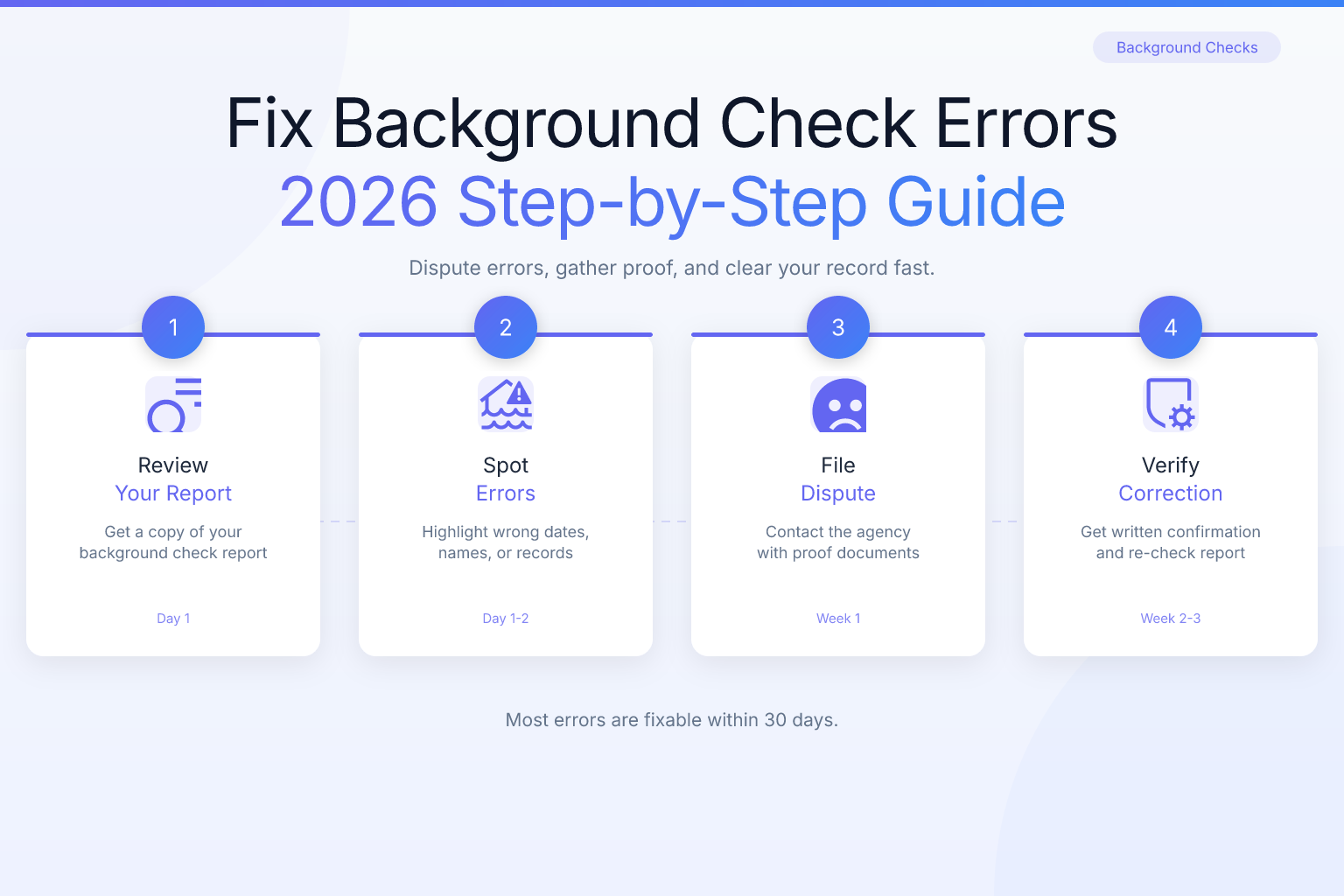
How to Fix Background Check Errors: Step-by-Step Guide (2026)
You’ve aced the interviews, negotiated the salary, and the offer letter is signed — then you discover background check errors that threaten your job. The employer says something turned up that doesn’t match what you reported: maybe a criminal record that isn’t yours, a degree you never claimed, or a previous employer showing you were fired when you resigned. These mistakes are more common than most job seekers realize, and they can cost you a job you’ve already earned. The good news: you have rights, and you can fix the mistake. This guide walks you through exactly what to do when a background check contains wrong information, from the first notification to getting the record corrected.
Key Takeaways
- You have the legal right under the Fair Credit Reporting Act (FCRA) to see your background check report and dispute any inaccurate information.
- Contact the background screening company immediately to file a formal dispute — they must investigate and correct errors within 30 days.
- Notify the employer in writing that you are disputing the error, and provide any evidence you have to support your case.
- If the error came from a court or government database, you may need to contact that source directly to fix the underlying record.
- Keep detailed records of every communication, and follow up persistently until the error is resolved and the employer has the corrected report.
Summary Table
| What to Do | Why It Matters | Time |
|---|---|---|
| Request a copy of your background check report | You can’t dispute what you haven’t seen; the FCRA gives you the right to review it | Within 60 days of the employer’s adverse action notice |
| Identify the specific error and gather evidence | Pinpointing the mistake and having proof (court documents, diplomas, etc.) speeds up the correction | 1–2 days |
| File a dispute with the background check company | The screening firm is legally required to investigate and correct errors | Company has 30 days to complete investigation |
| Contact the original source of the error (e.g., court, university) | Fixing the root record prevents the same error from reappearing in future checks | Varies; can take weeks to months |
| Follow up with the employer and provide corrected report | Protects your job offer and shows you are proactive and honest | As soon as the dispute is resolved |
Common Types of Background Check Errors
Before you dive into the dispute process, it helps to understand the kinds of mistakes that show up most often. Knowing what you’re dealing with makes it easier to gather the right evidence and explain the problem to the employer.
Mixed Files (Mistaken Identity)
This is one of the most frequent errors. A background check pulls up a record for someone with a similar name, date of birth, or Social Security number. For example, a report might show a criminal conviction for “John A. Smith” when you are “John B. Smith.” Screening companies are supposed to match on multiple identifiers, but when they cut corners, innocent people get flagged. Mixed files can include criminal records, credit histories, and even employment data that belong to a stranger.
How to spot it: Look for addresses you’ve never lived at, employers you’ve never worked for, or court cases in counties where you’ve never resided. These are red flags that someone else’s information got mixed into your file.
Criminal Record Errors
Criminal background check errors can be especially damaging. Common problems include:
- Records that were expunged or sealed but still appear in commercial databases.
- Misdemeanors reported as felonies.
- Arrests that never led to a conviction showing up as if they did.
- Cases that were dismissed or resulted in acquittal but are listed as guilty.
- Outdated information that hasn’t been updated after a pardon or appeal.
If you see a criminal record that isn’t yours or is inaccurate, act immediately. The consequences for employment are severe, and the fix often requires going to the court that originated the record.
Real-world impact: A 2023 study by the National Association of Professional Background Screeners found that approximately 8% of background reports contain at least one error that could affect employment decisions. Criminal record errors account for nearly half of these mistakes.
Employment History Errors
Background checks verify your work history, and mistakes here can make it look like you lied on your resume. Typical errors:
- Wrong dates of employment (e.g., showing you worked somewhere for six months when it was two years).
- Incorrect job titles.
- A termination listed when you resigned voluntarily.
- Gaps that don’t exist because a short-term job wasn’t reported.
These often stem from third-party employment verification services like The Work Number, which may have outdated or incorrect data from your former employer.
Prevention tip: Keep your own records of employment dates, titles, and separation reasons. Save offer letters, pay stubs, and W-2s in a dedicated folder. This documentation becomes invaluable when disputing errors. Before you apply, ensure your resume accurately reflects your history — tools like the ResumeMate score checker can help you catch inconsistencies before an employer does.
Education and Credential Errors
A background check might claim you never earned a degree you have, or that you attended a school you didn’t. This can happen when:
- The school’s records are incomplete or misfiled.
- A diploma mill with a similar name is confused with your legitimate institution.
- The screening company checks the wrong campus or program.
What to do: Contact your school’s registrar office immediately. Most universities can provide official transcripts or verification letters within 3-5 business days. If the school has closed, check the Department of Education’s database of closed schools to find where records were transferred.
Credit Report Errors (When Applicable)
For jobs that involve financial responsibility, employers may check your credit. Errors can include accounts that aren’t yours, incorrect payment histories, or bankruptcies that were discharged years ago. While credit checks for employment are less common, they still happen, and the same FCRA dispute rights apply.
Understanding these categories helps you zero in on the problem and collect the right proof. Now, let’s walk through exactly what to do when you discover a mistake.
What to Do If Your Background Check Has Errors: First Steps
When an employer tells you something came back on your background check that you didn’t expect, your first reaction might be panic. Take a breath. You have rights under the federal Fair Credit Reporting Act (FCRA), and the process for fixing mistakes is clearly defined. The most important thing is to act quickly and stay organized.
1. Get a Copy of the Report
Under the FCRA, if an employer takes an “adverse action” — such as rescinding a job offer, denying a promotion, or firing you — based on a background check, they must give you a copy of the report and a document called “A Summary of Your Rights Under the Fair Credit Reporting Act.” Even if the employer hasn’t made a final decision yet, you can ask for a copy. Many employers will provide it voluntarily. If they don’t, you can request it directly from the background screening company. You have 60 days from the date of the adverse action notice to get a free copy.
Pro tip: Don’t wait for the adverse action notice. If you sense hesitation from the employer after interviews, proactively ask: “Can you share what’s showing up on my background check so I can address any concerns?” This shows responsibility and may speed up resolution.
Once you have the report, go through it line by line. Look for:
- Names that aren’t yours (common with mixed files)
- Criminal records in jurisdictions you’ve never lived in
- Employment dates that don’t match your resume
- Education credentials you never claimed
- Credit accounts that aren’t yours
2. Identify the Error and Gather Proof
Pinpoint exactly what’s wrong. Is it a case of mistaken identity? A court record that was expunged but still shows up? A previous employer reporting you as terminated when you resigned? The type of error determines how you’ll fix it.
Collect any documents that prove the correct information. This might include:
- A copy of your driver’s license or passport to prove your identity
- Court disposition records showing a case was dismissed or expunged
- Pay stubs or W-2s to verify employment dates
- Your diploma or transcripts
- Letters from previous employers confirming your separation reason
If the error is a criminal record that belongs to someone else, you’ll need to show that the name, date of birth, or other identifiers don’t match yours. A common scenario: a background check pulls up a record for “John A. Smith” when you are “John B. Smith.” The screening company should have matched on more than just name, but mistakes happen.
Document organization: Create a digital folder with subfolders for each error type. Name files clearly (e.g., “Court_Disposition_Case12345.pdf”, “Employment_Verification_ABC_Corp.pdf”). This makes it easy to attach the right documents to each dispute.
How to Dispute Errors with the Background Check Company
Every background screening firm is required by the FCRA to have a dispute process. You’ll usually find a dispute form on their website or a phone number on the report itself. File your dispute in writing — email is fine, but certified mail creates a paper trail.
What to Include in Your Dispute
- Your full name, date of birth, and the reference number from the report
- A clear description of the error and why it’s wrong
- Copies (never originals) of any supporting documents
- A request that the company correct or delete the inaccurate information
- Your contact information and preferred method for receiving the results
Sample Dispute Letter Template
[Your Name]
[Your Address]
[City, State, ZIP]
[Date]

[Background Check Company Name]
[Dispute Department Address]
[City, State, ZIP]

Re: Dispute of Inaccurate Information - Report Reference # [Number]

Dear Dispute Department,

I am writing to dispute the following information in my background check report dated [Date]:

Item in Question: [Describe the specific error, e.g., "Criminal conviction listed for Case #12345 in Harris County, TX"]

Why This Is Inaccurate: [Explain clearly, e.g., "This record belongs to a different individual. I have never lived in Texas and my date of birth does not match the record."]

Supporting Documentation: I have attached the following documents to support my dispute:
- Copy of my driver's license showing my correct date of birth and address
- Court disposition showing this case was dismissed
- [Add other relevant documents]

I request that you investigate this matter and correct or delete this inaccurate information within the 30-day timeframe required by the Fair Credit Reporting Act. Please send me the updated report once the investigation is complete.

Sincerely,
[Your Signature]
[Your Printed Name]
[Your Phone Number]
[Your Email]
Once the screening company receives your dispute, they must investigate — usually within 30 days. They’ll contact the source of the information (the court, university, previous employer, etc.) to verify it. If the source confirms the information is wrong, the screening company must correct it and send you the updated report. If the source says the information is accurate but you still disagree, you can add a brief statement to your file explaining your side.
What If the Company Doesn’t Respond?
If 30 days pass with no resolution, follow up. Call and ask for the status. If they’re unresponsive, you can file a complaint with the Consumer Financial Protection Bureau (CFPB) or your state attorney general’s office. You may also have the right to sue under the FCRA for actual damages, though most disputes get resolved long before that point.
Tracking your dispute: Create a simple spreadsheet with columns for: Date Submitted, Company Name, Error Type, Expected Resolution Date, Status, and Follow-Up Dates. This keeps you organized if you’re disputing multiple errors or dealing with multiple screening companies.
Fixing the Source: Courts, Universities, and Employers
Sometimes the error isn’t just in the background check report — it’s in the underlying database. If a court record is wrong, disputing with the screening company will only fix that one report. The next time someone runs a check, the same error could pop up again. To prevent that, you need to correct the record at the source.
Court Records
If a criminal or civil case is showing up incorrectly, contact the clerk’s office in the county where the case was filed. Ask how to get a certified copy of the correct disposition. If the record is truly not yours, you may need to provide fingerprints to prove it. Some courts have a process for correcting identity theft-related errors. This can take weeks or months, so start as soon as you discover the problem.
Step-by-step for court records:
- Call the court clerk and ask for the records department
- Request a certified copy of the case disposition
- If the record is wrong, ask about their correction process
- Submit any required forms with supporting documentation
- Follow up every 2 weeks until resolved
- Once corrected, request a new certified copy for your records
University or Education Records
If a degree or enrollment date is wrong, contact the registrar’s office. They can provide an official transcript or verification letter. If the school closed or merged, the records may be held by a state agency or another institution — the Department of Education’s database of closed schools can point you in the right direction.
Quick fix: Many universities now offer digital verification through services like the National Student Clearinghouse. You can often download an official verification letter within 24 hours, which you can share directly with employers or screening companies.
Previous Employers
If a past employer is reporting incorrect dates or a termination when you resigned, reach out to their HR department. Many large companies use third-party services like The Work Number to verify employment. You can request your own data report from The Work Number and dispute errors directly with them. A letter from your former manager or a copy of your resignation letter can help.
Important: Even if you left on good terms, get employment verification in writing before you need it. Request a letter confirming your dates, title, and separation reason while you’re still employed or shortly after leaving.
Communicating with the Employer During the Dispute
While you’re working to fix the error, keep the employer in the loop. Most hiring managers understand that background checks aren’t perfect. How you handle the situation can actually demonstrate your professionalism.
What to Say to the Employer
As soon as you learn about the error, contact the hiring manager or HR representative. Be direct and calm:
“I received a copy of my background check and noticed an error. The report shows [describe the error], but that’s not accurate. I’ve already filed a dispute with the screening company and have documentation to support the correct information. I’ll keep you updated on the progress and can provide the corrected report as soon as it’s available.”
Offer to share your evidence right away. If the error is a criminal record that isn’t yours, showing your ID and the court disposition can often clear things up on the spot. Employers are allowed to make their own judgment about whether to move forward while the dispute is pending, but many will wait for the corrected report if you’re transparent.
Email Template for Employer Communication
Subject: Background Check Dispute - [Your Name] - [Position]

Dear [Hiring Manager/HR Name],

Thank you for moving forward with my application for the [Position] role. I wanted to proactively reach out regarding the background check.

I've reviewed the report and identified an error: [briefly describe the error]. This information is inaccurate, and I have documentation to support the correct information.

I've already filed a formal dispute with [Screening Company Name] and expect resolution within 30 days per FCRA requirements. I'm happy to share my supporting documents now and will provide the corrected report as soon as it's available.

I remain very interested in this opportunity and appreciate your understanding. Please let me know if you need any additional information from me.

Best regards,
[Your Name]
[Phone Number]
[Email]
If the Offer Is Rescinded
If the employer pulls the offer before you can fix the error, you still have options. Ask for the adverse action notice in writing — they’re required to provide it. Then continue the dispute process. Once the report is corrected, you can re-approach the employer. There’s no guarantee they’ll reconsider, but a clean report and a professional follow-up can sometimes reopen the door. For more on handling communication gaps after an interview, read our guide on what to do when you get no response after an interview.
Re-engagement strategy: Wait until you have the corrected report in hand, then send a concise follow-up email attaching the updated report and reiterating your interest. Keep it professional, not emotional. Example: “The background check error has been resolved. Attached is the corrected report. I remain interested in the [Position] role and would welcome the opportunity to discuss next steps.”
Your Legal Rights Under the FCRA
The Fair Credit Reporting Act (FCRA) is a federal law that protects you when it comes to background checks and credit reports. It applies to employment screening, tenant screening, and more. Understanding your rights is the first step to fixing errors and holding companies accountable.
- Right to know: An employer must get your written permission before running a background check. If they decide to take adverse action (like rescinding a job offer) based on the report, they must provide you with a pre-adverse action notice, a copy of the report, and a document called “A Summary of Your Rights Under the Fair Credit Reporting Act.” You have 60 days from the adverse action notice to request a free copy of your report.
- Right to dispute: If you find inaccurate or incomplete information, you can file a dispute with the background screening company. They are required to investigate your claim, usually within 30 days, and correct or delete any information that cannot be verified. If the investigation doesn’t resolve the issue, you have the right to add a brief statement to your file explaining your side of the story.
- Right to accuracy: Screening companies must follow reasonable procedures to ensure the information they report is as accurate as possible. This means they can’t mix up files, report outdated information, or include records that don’t belong to you. If they fail to do so, they’ve violated the law.
- Right to sue: You can take legal action against screening companies, employers, or data furnishers that violate the FCRA. You may be entitled to actual damages (such as lost wages or emotional distress), statutory damages of up to $1,000 per violation, and attorney’s fees. In cases of willful noncompliance, punitive damages may also be awarded.
Some states offer even stronger protections. For example, California’s Investigative Consumer Reporting Agencies Act imposes stricter rules on how background checks are conducted and how errors must be handled. If you’re dealing with a stubborn error, check your state’s laws — you may have additional rights that can help you get the mistake corrected faster.
State-specific resources: Many state attorney general offices have consumer protection divisions that handle FCRA complaints. Search “[Your State] attorney general background check complaint” to find the right office. Some states also have dedicated consumer protection hotlines.
How to Prevent Background Check Errors Before They Happen
You can’t control every database, but you can reduce the chances of a surprise. Before you start job hunting, run a background check on yourself. Several services let you do this for a small fee, or you can request your own report from the major screening companies. Review it for accuracy and dispute anything that’s wrong before an employer sees it.
Also, be proactive during the hiring process. When you fill out the background check authorization form, provide your full legal name, any previous names, and your date of birth. If you have a common name, consider including your middle name or suffix to help the screener distinguish you from others. If you know there’s something in your past that might come up — even if it’s accurate — address it with the employer upfront. Honesty often defuses the situation before the report lands.
Beyond the background check itself, make sure your resume and application materials are error-free. Discrepancies between your resume and what a background check finds can raise red flags even when the check is wrong. Use a tool like the free ResumeMate resume builder to create a clean, ATS-friendly resume that accurately reflects your work history. Before you submit applications, run your resume through the ResumeMate score checker to catch any formatting or content issues that could cause confusion later.
Pre-employment checklist:
- Request your own background check 2-3 months before job hunting
- Review all sections for accuracy
- Dispute any errors immediately
- Gather supporting documents for your employment history
- Ensure your resume matches your actual dates and titles
- Keep all verification documents in an organized folder
For a complete walkthrough of what to expect and how to get ready, see our guide on how to prepare for an employment background check.
What to Do If the Error Keeps Coming Back
You dispute the error, the screening company corrects it, and then six months later a different employer runs a check and the same mistake appears. This happens when the source record was never fixed. If you only disputed with the screening company, they corrected that one report but the underlying database still has the bad data.
To stop the cycle, you must go to the source. For court records, that means getting the case file corrected or sealed. For employment data, that means disputing with The Work Number or the employer directly. For education, it means updating the National Student Clearinghouse if your school reports there. It’s tedious, but it’s the only permanent fix.
Keep a folder with all your dispute documentation — letters, emails, certified mail receipts, and the corrected reports. If the error surfaces again, you can quickly show the new employer that it’s a known mistake and provide the proof.
Long-term monitoring: Consider signing up for a credit monitoring service that includes background check alerts. Some services notify you when new information is added to your file, giving you a chance to dispute errors before they affect employment.
When to Get Legal Help
Most background check errors can be resolved without a lawyer, but there are situations where legal assistance is the best course of action. If the screening company ignores your dispute, fails to investigate within the required 30 days, or refuses to correct an obvious error, an attorney can step in. Similarly, if an employer rescinds a job offer based on an inaccurate report and refuses to reconsider even after you provide proof, you may have a claim for damages.
The FCRA allows you to sue for actual damages, which can include lost wages, emotional distress, and harm to your reputation. You may also recover statutory damages of up to $1,000 per violation, plus punitive damages if the violation was willful. Many consumer protection attorneys work on a contingency fee basis, meaning you don’t pay unless you win your case. They often offer free initial consultations to evaluate your situation.
It’s important to act quickly because the FCRA has a statute of limitations. Generally, you must file a lawsuit within two years of discovering the violation, or five years if the violation was willful. Even if you’re not ready to sue, a letter from a lawyer can often motivate a screening company to fix an error they’ve been ignoring. Sometimes the threat of legal action is enough to get results that dozens of phone calls couldn’t.
If you’re unsure whether your situation warrants legal help, gather all your documentation — dispute letters, email correspondence, the erroneous report, and any evidence of harm — and schedule a consultation. An experienced FCRA attorney can tell you whether you have a strong case and what your next steps should be.
Finding an attorney: Search for “FCRA attorney” or “consumer protection lawyer” in your area. The National Association of Consumer Advocates (NACA) has a directory of attorneys who specialize in these cases. Many offer free consultations and work on contingency.
FAQ
Q: How do I fix a background check error?
A: Start by requesting a copy of your background check report from the employer or screening company. Identify the specific error, gather supporting documents (court records, pay stubs, diplomas), and file a written dispute with the background check company. They must investigate within 30 days under the FCRA. If the error comes from a court or employer, contact that source directly to fix the underlying record.
Q: How long does a background check company have to correct an error?
A: Under the FCRA, the screening company must complete its investigation within 30 days of receiving your dispute. If they can’t verify the information, they must delete it. They can extend the investigation by 15 days if you provide additional information during the 30-day window. You should receive the results in writing once the investigation is complete.
Q: How do I correct wrong information on a background check?
A: Submit a formal written dispute to the background screening company that includes your report reference number, a clear description of the error, and copies of supporting documents. Send it via certified mail for a paper trail. Simultaneously, contact the original source (court, university, employer) to correct the root record so the error doesn’t reappear in future checks.
Q: Can I still get the job if my background check has an error?
A: Yes, many employers will wait for the corrected report if you communicate promptly and provide evidence. Be transparent with the hiring manager, share your dispute confirmation, and offer to provide documentation immediately. Some employers may proceed with a conditional offer pending the corrected report. Your professionalism during the dispute process can actually strengthen their confidence in you.
Q: Do I need a lawyer to dispute a background check error?
A: Not always. Most errors can be resolved by filing a dispute yourself using the screening company’s process. However, consider legal help if the company ignores your dispute, misses the 30-day deadline, or the error costs you a job and the employer won’t reconsider. Many FCRA attorneys work on contingency and offer free consultations.
Q: What if the error is a criminal record that belongs to someone else?
A: This is a mixed-file error and requires immediate action. Dispute it with the screening company and provide government-issued ID proving your identity. Contact the court that reported the record to get a certified disposition showing the case doesn’t belong to you. You may need to submit fingerprints to clear your name. Keep the employer informed throughout the process.
Q: How do I dispute incorrect background check information if the employer won’t give me the report?
A: If the employer took adverse action (rescinded an offer, fired you, etc.), they are legally required to provide a copy of the report and a summary of your rights under the FCRA. If they refuse, you can file a complaint with the Consumer Financial Protection Bureau (CFPB) or your state attorney general’s office. You can also request the report directly from the background screening company named in the adverse action notice.
Track Every Application While You Job Hunt
Background check issues are just one hurdle in the job search. Stay organized and never miss a follow-up with the ResumeMate Job Tracker — a free Chrome extension that tracks every application, deadline, and follow-up in one place right from your browser.
Install ResumeMate Job Tracker Free →
Also Helpful:
- Build an error-free resume: Use the free AI Resume Builder to create a clean, ATS-safe PDF resume that accurately reflects your history.
- Check your resume before applying: Run your resume through the Resume Score Checker to catch formatting or content issues that could cause confusion during background verification.
- Find your next opportunity: Browse thousands of openings on the ResumeMate Job Board with filters for role, location, and remote options.