Flight Attendant Resume: Examples & How to Write One
A flight attendant resume needs to do more than list your work history — it must prove you can keep passengers safe, handle emergencies, and deliver exceptional service at 35,000 feet. Airlines sift through thousands of applications for every open cabin crew position, so your resume has to immediately show you meet the non-negotiable requirements and stand out as a calm, reliable professional. This guide walks you through exactly what to include, how to structure your resume, and how to tailor it for specific airlines — with examples you can adapt.
Key Takeaways
- To pass airline applicant tracking systems, include safety-related keywords like ‘safety procedures,’ ‘CPR certified,’ and ’emergency evacuation’ throughout your resume.
- Tailor your resume for each airline by mirroring the job description’s language, such as emphasizing ‘safety culture’ or ‘premium service’ based on the carrier’s priorities.
- Use a clean, single-column resume layout without photos or graphics to ensure ATS compatibility and avoid unconscious bias in the hiring process.
- Quantify your work achievements using the formula Action + Context + Result, and lead with safety-related accomplishments to demonstrate your readiness for cabin crew responsibilities.
- Write a professional summary that names the target airline and concisely states your safety mindset, service experience, and what sets you apart.
Quick Start Checklist
| What to Do | Why It Matters | Time |
|---|---|---|
| List FAA or airline-specific certifications | Airlines filter for required credentials first | 5 min |
| Use a clean, single-column layout | Ensures ATS parses your resume correctly | 10 min |
| Write a safety-and-service-focused summary | Grabs attention in the first 6 seconds | 15 min |
| Quantify achievements in past roles | Shows measurable impact, not just duties | 20 min |
| Tailor resume to each airline’s job posting | Matches your skills to their specific needs | 15 min per application |
What Airlines Look for in a Flight Attendant Resume
Airlines aren’t just hiring someone to serve drinks. They’re hiring safety professionals who can de-escalate conflicts, evacuate an aircraft in 90 seconds, and represent the brand with warmth. Your flight attendant resume must reflect that dual identity.
Most carriers screen resumes with an ATS before a human ever sees them. The system scans for keywords tied to the job description. If your resume doesn’t contain terms like “safety procedures,” “CPR certified,” “emergency evacuation,” or “customer service,” it may never reach a recruiter.
The keywords that matter most. Based on real airline job postings, the following terms appear again and again. Weave them naturally into your summary, skills, and experience sections:
- Safety procedures, emergency evacuation, ditching, decompression
- CPR, AED, first aid, first responder
- Security protocols, threat response, crowd management
- Customer service, passenger satisfaction, premium service
- Teamwork, crew coordination, communication
- Language skills (specify languages and proficiency)
- FAA Certificate of Demonstrated Proficiency (or your country’s equivalent)
- Inflight service, cabin preparation, pre-flight briefing
- Conflict resolution, de-escalation
- Flexibility, irregular hours, physical stamina
If you’re applying internationally, note that “cabin crew” is often used interchangeably with “flight attendant.” Including both terms can help your resume get picked up by ATS that search for either phrase.
Beyond keywords, airlines look for:
- Safety certifications: FAA Certificate of Demonstrated Proficiency (U.S. carriers), CPR/AED, first aid, or equivalent credentials from your country’s aviation authority.
- Customer service experience: Any role where you handled complaints, served diverse populations, or worked in high-pressure environments counts.
- Language skills: Fluency in a second language is often a deciding factor, especially for international routes.
- Physical stamina and flexibility: Mentioning your ability to work irregular hours, stand for long periods, and lift luggage into overhead bins signals you understand the job’s demands.
- Teamwork and communication: Flight attendants operate as a tight crew. Examples of collaboration and clear communication carry weight.
If you’re new to aviation, don’t panic. Many successful flight attendants come from hospitality, healthcare, or retail. The key is framing that experience through a safety-and-service lens.
How to Structure and Tailor Your Flight Attendant Resume
Airlines value clarity and professionalism. Your resume’s structure should reflect that. Stick to a reverse-chronological format — it’s the most familiar to recruiters and ATS-friendly.
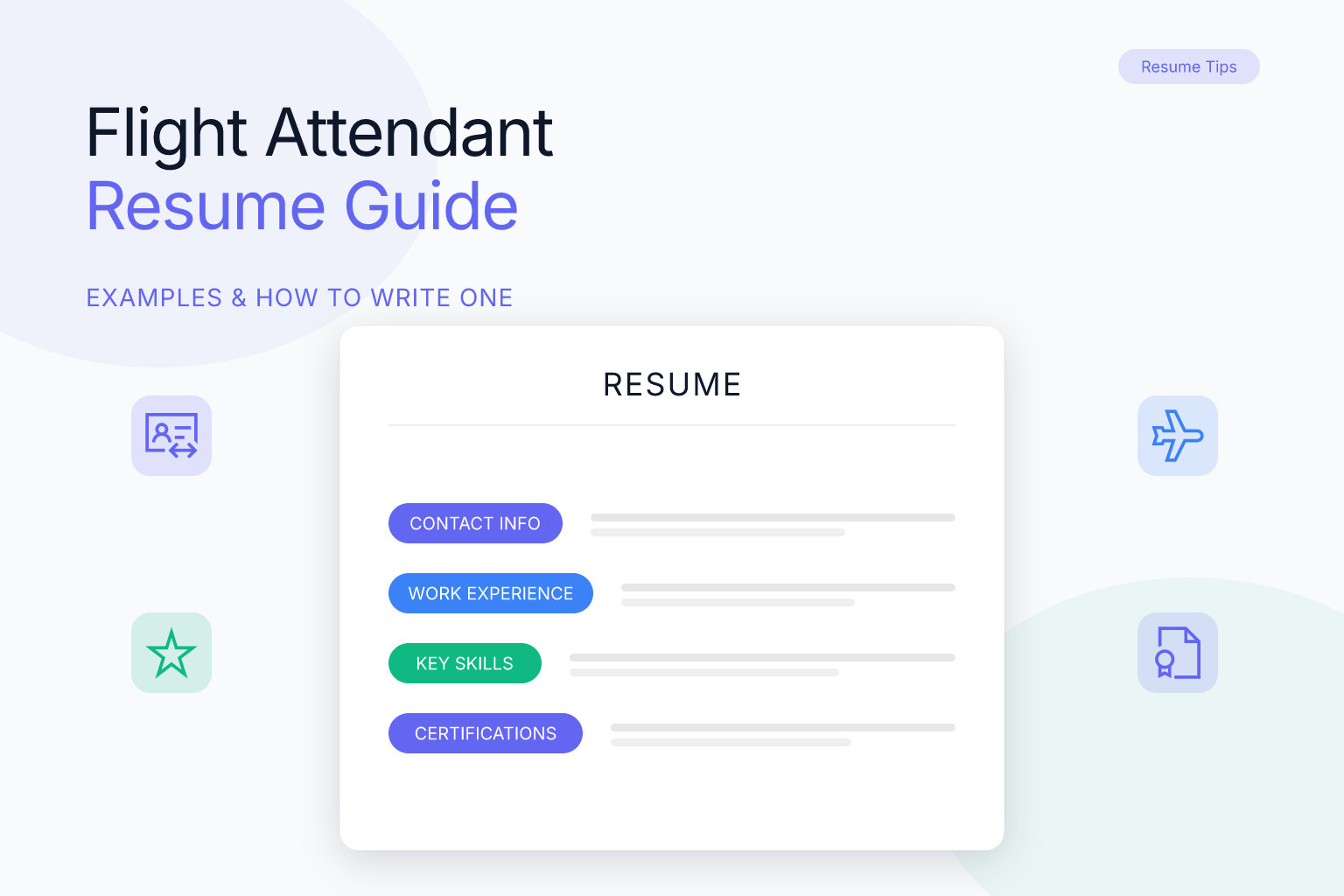
Essential sections:
- Contact information: Full name, city/state, phone number, professional email address. Skip the photo unless the airline specifically requests one (most U.S. carriers discourage it to avoid bias).
- Professional summary: 2–3 lines that combine your safety mindset, service experience, and key qualifications.
- Work experience: Bullet points that emphasize safety, service, and reliability. Start with your most recent role.
- Education: High school diploma minimum; list any college coursework or degrees.
- Certifications: FAA certificate, CPR, first aid, language proficiency scores.
- Skills: A short list of hard and soft skills relevant to the role.
- Languages: Separate section if you speak more than one language — include proficiency levels.
Layout matters. A single-column design is the safest choice for ATS parsing. Multi-column layouts can confuse older systems, though modern ATS often handle them fine. If you use a template, make sure it exports a clean, text-based PDF — not a scanned image. ResumeMate’s free resume builder offers both single- and multi-column templates and exports ATS-safe PDFs, so you can pick the style that fits your experience while staying machine-readable. For more on formatting, see our guide to ATS-friendly resume templates.
Avoid graphics, tables, and text boxes. They can scramble the parsing order and bury your keywords. When in doubt, test your resume with a free ATS score checker to see exactly how a system reads it.
Tailoring for each airline. A generic resume won’t cut it. Each airline has a distinct brand, culture, and set of priorities. A regional carrier might emphasize flexibility and community, while a major international airline may prioritize language skills and premium service experience.
Before you apply, study the job description and the airline’s website. Pull out repeated phrases and requirements, then weave them into your resume. For a step-by-step method, read our guide on how to tailor a resume to a job description.
Tailoring examples:
- If the posting mentions “safety culture” three times, make sure your summary and first bullet point under each job highlight safety achievements.
- If the airline serves international routes, move your language skills higher and add a bullet about cross-cultural communication.
- If they emphasize “premium service,” swap generic customer service examples for ones that show attention to detail and anticipating needs.
ResumeMate’s free resume builder lets you save multiple versions, so you can create a base resume and quickly tweak it for each application without starting from scratch. Once your resume is tailored, browse flight attendant openings on our job board to find airlines hiring now.
Flight Attendant Resume Skills: Hard and Soft Skills to Include
A dedicated skills section helps both the ATS and the recruiter quickly see you’re qualified. Split your skills into hard (teachable, measurable) and soft (interpersonal) categories — or list them together in a scannable bullet group.
Hard skills for flight attendants:
- Safety and emergency procedures (evacuation, ditching, decompression)
- First aid, CPR, and AED operation
- Aircraft equipment operation (doors, slides, oxygen systems)
- Security protocols and threat response
- Food and beverage service
- Multilingual communication
- Inventory management (catering, duty-free)
Soft skills for flight attendants:
- Conflict resolution and de-escalation
- Cross-cultural communication
- Teamwork and crew coordination
- Adaptability and quick decision-making
- Patience and empathy
- Attention to detail
- Public speaking and announcement delivery
Don’t just list these words — prove them in your experience section. For example, instead of simply writing “conflict resolution,” a bullet point like “Mediated seating disputes between passengers, achieving a 95% satisfaction rating on post-flight surveys” shows the skill in action. Similarly, “attention to detail” becomes concrete when you write “Identified and reported a faulty emergency exit slide during pre-flight checks, preventing a potential safety delay.” If you claim “multilingual communication,” back it up with a bullet such as “Delivered safety briefings in English and Spanish, ensuring comprehension for 30+ non-native speakers per flight.” This approach turns a static list into a compelling narrative of your capabilities.
How to Write a Flight Attendant Resume Summary
Your professional summary sits at the top of the page and often determines whether a recruiter keeps reading. Skip the outdated “seeking a position where I can utilize my skills” line. Instead, write a tight, specific statement that answers three questions: What makes you a safe pair of hands? What service experience do you bring? What sets you apart?
For more role-specific summary examples, check out our resume summary examples for 20+ roles.
Example summaries:
Entry-level (no aviation experience):
Customer-focused professional with 3+ years in high-volume hospitality and a current CPR/AED certification. Calm under pressure, fluent in Spanish, and trained in conflict resolution. Eager to apply safety-first mindset and service skills to a cabin crew role with Delta Air Lines.
Experienced flight attendant:
FAA-certified flight attendant with 5 years of experience on domestic and international routes. Consistently recognized for de-escalating in-flight conflicts and maintaining 100% safety audit scores. Fluent in English and Mandarin. Seeking to bring premium service and crew leadership to United Airlines.
Career changer (healthcare to cabin crew):
Registered nurse with 6 years of emergency department experience, BLS and ACLS certified. Skilled in rapid patient assessment, crisis communication, and team coordination. Transitioning to aviation to apply clinical calm and care to passenger safety and service.
Each summary names the target airline — a small touch that shows you’ve done your homework.
Flight Attendant Resume Work Experience: Show Safety, Service, and Reliability
Your work experience section is where you prove you can do the job. Every bullet point should connect a past responsibility to a flight attendant’s core duties: safety, service, and teamwork.
Use this formula: Action + Context + Result (quantified when possible).
Before (weak):
- Responsible for passenger safety.
- Served food and drinks.
After (strong):
- Conducted pre-flight safety equipment checks and delivered briefings to 150+ passengers per flight, maintaining a 100% compliance record over 2 years.
- Resolved 20+ passenger conflicts monthly through active listening and de-escalation, reducing formal complaints by 30%.
- Coordinated with a 4-person crew to complete emergency evacuation drills in under 90 seconds, exceeding airline benchmarks.
If you don’t have aviation experience, pull from other roles:
- Retail: “Managed crowd flow during peak holiday rushes, ensuring safety and reducing wait times by 15%.”
- Hospitality: “Served 50+ guests per shift in a fine-dining setting, handling dietary restrictions and special requests with zero errors.”
- Healthcare: “Monitored vital signs for 10+ patients per shift, identifying and escalating critical changes within seconds.”
Always lead with safety-related accomplishments when possible. Even if your past job wasn’t safety-focused, you can highlight times you followed protocols, reported hazards, or kept people calm under stress.
Resume Example
JANE DOE Chicago, IL | jane.doe@email.com | (312) 555-0123
PROFESSIONAL SUMMARY FAA-certified flight attendant with 4 years of experience on domestic and transatlantic routes. Known for resolving in-flight conflicts calmly, maintaining 100% safety compliance, and delivering premium service. Fluent in English and French.
CERTIFICATIONS
- FAA Certificate of Demonstrated Proficiency
- CPR, AED & First Aid – American Red Cross (current)
- TOEIC Score: 950/990 (French)
PROFESSIONAL EXPERIENCE
Flight Attendant | Skyline Airlines | Chicago, IL | May 2022 – Present
- Ensure safety of 180+ passengers per flight by conducting pre-flight briefings, equipment checks, and emergency procedure demonstrations.
- De-escalated 15+ passenger disputes, maintaining a calm cabin environment and earning a 98% satisfaction rating on post-flight surveys.
- Collaborated with a 5-person crew to complete emergency evacuation drills in under 80 seconds, exceeding FAA standards.
- Managed in-flight service for business-class cabin, handling special meal requests and VIP preferences with zero complaints.
Customer Service Associate | Grand Hotel | Chicago, IL | June 2020 – April 2022
- Resolved 30+ guest concerns weekly, using active listening and problem-solving to turn negative experiences into positive reviews.
- Trained 10 new hires on safety protocols and emergency response procedures for a 500-room property.
- Coordinated with housekeeping and maintenance teams to address safety hazards, reducing incident reports by 25%.
EDUCATION Associate of Arts in Hospitality Management | City College of Chicago | 2020
SKILLS Safety & Emergency Procedures | Conflict Resolution | CPR/First Aid | Multilingual (English, French) | Public Announcements | Crew Resource Management | Customer Service | Adaptability
Education and Certifications for Flight Attendants
Most airlines require a high school diploma or equivalent. Some prefer or require some college coursework, especially in hospitality, tourism, communications, or a foreign language. List your highest level of education, including the institution name and graduation year (optional if you’re concerned about age bias).
Certifications that strengthen your application:
- FAA Certificate of Demonstrated Proficiency (required for U.S. flight attendants — you earn this after completing airline-specific training, but if you already hold it, list it prominently).
- CPR, AED, and First Aid (American Red Cross, American Heart Association, or equivalent).
- Language proficiency certifications (e.g., TOEIC, DELF, DELE) with scores.
- Crowd management and safety training (some maritime or security certifications transfer well).
When listing certifications, include the issuing organization and expiration date if applicable. For example:
- CPR, AED & First Aid – American Red Cross, expires June 2026
- TOEIC Listening & Reading – Score: 945/990, 2024
If you’re currently enrolled in a certification course, you can note it as “In Progress” — airlines appreciate initiative. For instance, “FAA Certificate of Demonstrated Proficiency (expected completion August 2025)” shows you’re on track. Even if you haven’t finished, listing relevant training like “Crowd Management and Passenger Safety Training – Online Course, 2024” demonstrates your commitment to the role. This section should be easy to scan, so use a simple bulleted list and place it near the top of your resume if you hold multiple credentials.
Common Mistakes to Avoid on a Flight Attendant Resume
Even strong candidates get rejected because of avoidable errors. Here are the most frequent ones — and how to fix them:
- Using a generic objective statement. “Seeking a challenging position with a growing airline” tells the recruiter nothing. Replace it with a tailored summary that names the airline and highlights your safety and service strengths. A specific summary immediately signals you’ve researched the carrier and understand the role.
- Neglecting safety keywords. If your resume doesn’t mention safety, emergency procedures, or certifications, the ATS may rank you below candidates who do. Scan the job description and mirror its safety language — words like “evacuation,” “security protocols,” and “first responder” can make the difference.
- Including a photo (unless requested). In the U.S. and many other countries, photos can introduce unconscious bias and may cause your application to be discarded to comply with hiring regulations. Unless the airline explicitly asks for one, leave it off.
- Listing duties instead of achievements. “Responsible for passenger service” is vague. “Improved post-flight satisfaction scores by 15% through personalized service” is specific and memorable. Always quantify results when you can.
- Forgetting language skills. Even basic proficiency in a second language can set you apart. Always include a languages section if you speak more than one, and note your level (e.g., “Conversational French” or “Fluent Spanish”).
- Using a cluttered or graphic-heavy template. Stick to a clean, single-column layout that exports as a text-based PDF. Test it with an ATS checker before submitting. Fancy designs often scramble the parsing order and hide your keywords.
- Sending the same resume to every airline. Tailoring takes extra time but dramatically increases your interview chances. A regional carrier and a global airline look for different things — adjust your summary, skills, and bullet points accordingly.
FAQ
Q: How should a flight attendant resume look?
A: A flight attendant resume should look clean, professional, and easy to scan. Use a single-column layout with clear section headings, a professional summary at the top, and bullet points that emphasize safety and customer service. Avoid photos, graphics, and dense paragraphs.
Q: How to make a flight attendant resume with no experience?
A: Focus on transferable skills from hospitality, retail, healthcare, or customer service roles. Highlight safety-related responsibilities (even if informal), certifications like CPR, and language abilities. Use a strong summary that connects your background to the demands of cabin crew work.
Q: What should I include in a cabin crew resume with no experience?
A: A cabin crew resume with no experience should emphasize any customer-facing role where you demonstrated reliability, communication, and calmness under pressure. Include a professional summary that mentions your safety mindset, list relevant certifications (CPR, first aid), and add a languages section if applicable. Even volunteer work that involved teamwork or public interaction can be valuable.
Q: What are the best flight attendant resume keywords?
A: Top keywords include: safety procedures, emergency evacuation, CPR certified, first aid, customer service, conflict resolution, teamwork, communication, language skills, FAA certificate, inflight service, and security protocols. Always mirror the exact phrases from the job description to pass ATS screening.
Q: What are the duties of a flight attendant to put on a resume?
A: Key duties to highlight are: conducting pre-flight safety briefings and equipment checks, demonstrating emergency procedures, ensuring passenger compliance with safety regulations, providing inflight service, de-escalating conflicts, coordinating with the crew during emergencies, and maintaining a calm, professional demeanor at all times. Quantify these where possible (e.g., “briefed 150+ passengers per flight”).
Q: How to write a CV for a flight attendant?
A: In the U.S., a resume is standard, but if you’re applying to airlines in Europe or the Middle East, a CV (curriculum vitae) may be expected. The content is largely the same: contact info, professional summary, work experience, education, certifications, skills, and languages. A CV may include more detail on training and personal attributes. Keep it ATS-friendly and tailor it to the airline.
Q: Can I use a flight attendant resume template?
A: Yes, a template can save time, but choose one that is single-column, text-based, and free of graphics or tables. Many free resume builders, like ResumeMate’s, offer ATS-optimized templates that you can customize for each airline. Always test the final PDF with an ATS score checker before submitting.
Q: What is a good flight attendant resume sample?
A: A strong sample includes a targeted professional summary, quantifiable achievements in work experience, a dedicated certifications section, and a clean layout. The example in this guide (Jane Doe) is a solid reference — it balances safety, service, and language skills while remaining scannable and ATS-friendly.
Q: How to write a flight attendant resume that passes airline screening?
A: Start by mirroring keywords from the job description — especially safety terms, certifications, and service-related phrases. Use a reverse-chronological format, quantify achievements, and keep the design ATS-friendly. Tailor the resume for each airline you apply to.
Q: What should a flight attendant resume look like in terms of length?
A: One page is ideal for most applicants. If you have 10+ years of relevant experience or extensive language/certification credentials, a second page is acceptable — but keep it concise.
Q: What to put on a resume for a flight attendant position?
A: Include contact information, a professional summary, work experience (with safety and service bullet points), education, certifications (FAA, CPR, first aid), skills, and languages. If you have volunteer work or extracurriculars that demonstrate teamwork or leadership, add those as well.
Q: What does a flight attendant resume look like compared to other industries?
A: It places more emphasis on safety certifications, language skills, and customer service metrics than a typical corporate resume. The layout is similar, but the content prioritizes calmness under pressure, teamwork, and regulatory compliance.
Related articles:
Track Every Application While You Job Hunt
Stop losing track of where you’ve applied. The ResumeMate Job Tracker is a free Chrome extension that tracks every application, deadline, and follow-up in one place — right from your browser.