How to Follow Up After Submitting an Application with No Job Posting
You sent a speculative application to a company you admire — no job posting, just a well-crafted cover letter and resume. Now you’re wondering how to follow up after submitting an application with no job posting without coming across as pushy or desperate. The silence can be frustrating, but a strategic follow-up can turn a cold submission into a conversation.
Key Takeaways
- Wait 5–7 business days after sending your application before following up; any sooner risks seeming impatient, any later and your application may be forgotten.
- Research the right contact person — ideally the hiring manager or department head — rather than emailing a generic HR inbox.
- Keep your follow-up email concise, reference your original application, and add one new piece of value (a relevant insight, project, or connection) to reignite interest.
- If you don’t hear back after two follow-ups, pause and redirect your energy to other opportunities; persistence is good, but pestering can backfire.
- Track every speculative application and follow-up in one place so you never lose context or miss a window.
| What to Do | Why It Matters | Time |
|---|---|---|
| Send a follow-up email 5–7 days after applying | Shows initiative without being pushy | 5–7 days after application |
| Research the right contact person | Increases the chance your email is read | Before sending follow-up |
| Craft a concise, value-driven message | Grabs attention and demonstrates fit | When drafting email |
| Track all applications and follow-ups | Prevents missed opportunities and double-follow-ups | Ongoing |
Why Following Up on a No-Job-Posting Application Matters
When you apply without a job posting, you’re not competing against a stack of resumes — you’re competing against the company’s attention. Hiring managers are busy, and your unsolicited application can easily get buried. A thoughtful follow-up signals that you’re genuinely interested, not just mass-emailing companies.
Many recruiters say they appreciate a polite follow-up because it shows initiative — a trait they want in any hire. It also gives you a second chance to make an impression. Your initial application might have been skimmed; a follow-up can bring it back to the top of the inbox and give you an opportunity to add context or a new reason to consider you.
However, the approach is different from following up on a posted job. There’s no deadline, no formal process, and no guarantee anyone is even looking. That means your follow-up needs to be more personalized and less transactional. You’re not asking for an update on your application status — you’re starting a conversation.
When to Send Your First Follow-Up
Timing is everything. Send your follow-up too soon and you look impatient; wait too long and the recipient may have forgotten your application entirely.
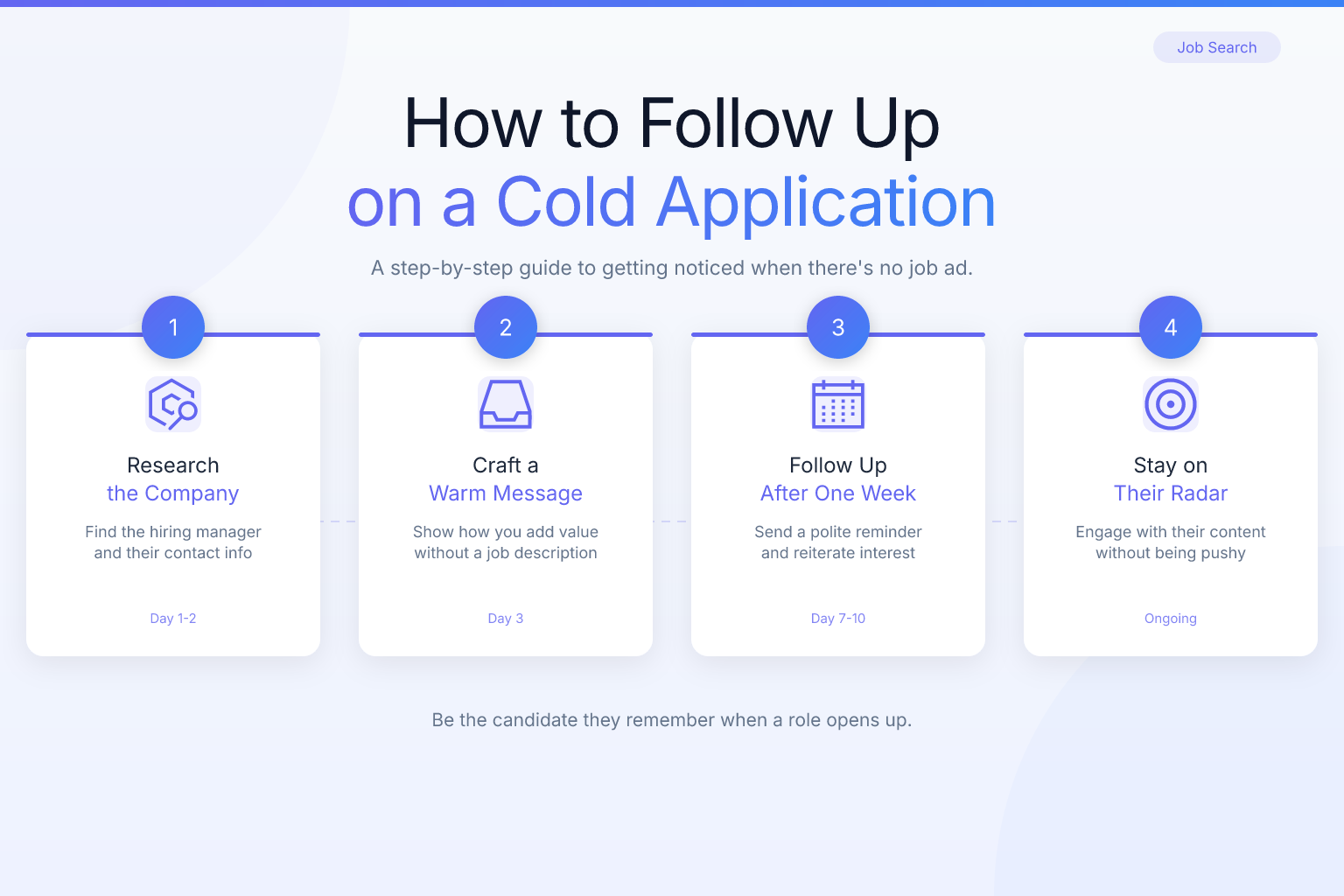
The sweet spot: 5–7 business days after you submitted your application. This gives the recipient enough time to have seen your email (even if they haven’t acted on it) without letting the thread go cold. If you applied on a Friday, count from the following Monday.
Avoid Mondays and Friday afternoons. Tuesday through Thursday mornings tend to have the highest open rates for cold emails. If you’re using a tool like the ResumeMate Job Tracker, you can set a reminder to follow up exactly when you planned.
If the company is small and you have a direct contact, you might shorten the window to 3–4 days. For larger organizations, stick to a full week.
How to Find the Right Contact Person
Sending a follow-up to a generic “careers@company.com” address is a shot in the dark. Your goal is to reach the person who would actually manage the role you’re targeting — or at least someone in that department.
Start with LinkedIn. Search for the company and filter by job title (e.g., “Marketing Director” if you’re applying for a marketing role). Look for people who have been at the company for a while and are likely to influence hiring. If you can’t find the exact hiring manager, a senior team member or department head is a good alternative.
If LinkedIn doesn’t yield a name, try the company’s website. Many organizations list leadership or team members on an “About Us” or “Team” page. You can also use tools like Hunter.io or Apollo.io to find email patterns, but always verify the address before sending.
When you do find a name, personalize your follow-up. Mention something specific about their background or a recent company achievement. This shows you’ve done your homework and aren’t just blasting the same message to everyone.
Crafting a Follow-Up Email That Gets a Response
Your follow-up email should be short, polite, and add value. Don’t just say “Did you get my application?” — that puts the burden on them and offers nothing new.
Here’s a template you can adapt:
Subject: Following up on my application — [Your Name]
Hi [First Name],
I sent over my resume and a note last week about how I could contribute to [Company Name]’s [specific area, e.g., content team]. I wanted to follow up in case it got buried.
Since then, I came across [relevant article/industry trend/project] and thought of [something specific to their work]. I’d love to chat briefly about how my background in [your skill] could support what you’re building.
No pressure if the timing isn’t right — I’d just appreciate a few minutes of your time.
Best, [Your Name]
Notice what this does: it references the original application, adds a new piece of value (the article or insight), and makes a low-pressure ask. It also respects their time.
If you’re struggling with what to include in that initial cover letter, our guide on what to put in a cover letter when there is no job posting can help you craft a strong foundation.
What to Do If You Don’t Hear Back After the First Follow-Up
Silence after one follow-up is common. Don’t take it personally — the person may be on vacation, swamped, or simply not hiring right now.
Send a second follow-up 7–10 days after the first. This one should be even shorter and offer an easy out. For example:
Subject: Quick check-in — [Your Name]
Hi [First Name],
I wanted to circle back one last time on my application. If now isn’t a good time, no worries at all — I’d be grateful if you could keep me in mind for future opportunities.
Thanks again for your time.
Best, [Your Name]
This message is gracious and leaves the door open. If you still don’t hear back, stop. Two follow-ups are enough. Continuing to email after that can damage your reputation.
If you’re following up after an interview rather than a cold application, the rules are different. Check out our post on no response after an interview follow-up for tailored advice.
Phone Follow-Up: When and How to Call
Email is usually the safest channel, but a phone call can work if you have a direct number and a reason to believe the person is open to it. This is more common in smaller companies or industries where phone communication is the norm.
Before you call, ask yourself: Do I have a specific, time-sensitive reason to call? If you’re just checking in, email is better. If you have a referral or a concrete opportunity to discuss, a call might be appropriate.
When you call, be prepared with a 30-second script:
- Introduce yourself and mention you applied recently.
- State the reason for your call in one sentence.
- Ask if they have a moment to talk or if you should schedule a time.
If you get voicemail, leave a brief message with your name, the fact that you applied, and a request to call back or email. Then follow up with an email referencing the voicemail.
Never call multiple times without a response. One call, one voicemail, then move on.
Leveraging LinkedIn for a Soft Follow-Up
LinkedIn can be a less intrusive way to stay on someone’s radar. If you’ve already sent an email follow-up and haven’t heard back, consider sending a connection request with a short note.
Your note might say:
Hi [First Name], I applied to [Company Name] recently and wanted to connect. I admire the work your team is doing in [area]. Would be great to stay in touch.
This isn’t a direct follow-up — it’s a relationship-building move. If they accept, you can engage with their content, share relevant articles, and keep the door open for future conversations. Avoid immediately pitching yourself again in a LinkedIn message; let the connection breathe.
For more on crafting cold outreach that gets noticed, read our guide on speculative application cold emails.
Common Mistakes to Avoid When Following Up on Speculative Applications
Even well-intentioned follow-ups can backfire if you make these errors:
- Following up too soon. Anything less than 3 business days can feel aggressive.
- Sending a generic “just checking in” email. Always add value or a reason for reaching out again.
- Emailing multiple people at the same company simultaneously. This looks disorganized and can annoy the team.
- Being overly casual or overly formal. Match the company’s tone — if their website is friendly and conversational, your email can be too.
- Forgetting to proofread. A typo in a follow-up undermines the professionalism of your original application.
- Not tracking your follow-ups. You risk emailing the same person twice or forgetting to follow up at all.
Tracking Your Follow-Ups and Staying Organized
When you’re sending speculative applications to multiple companies, it’s easy to lose track of who you contacted, when, and what you said. A spreadsheet can work, but it’s manual and easy to neglect.
A better approach is to use a dedicated job tracking tool. The ResumeMate Job Tracker is a free Chrome extension that automatically logs every application you submit, including speculative ones. You can add notes, set follow-up reminders, and see your entire pipeline at a glance — no more guessing when you last emailed someone.
If you’re also polishing your resume for these applications, the ResumeMate AI Resume Builder can help you create a clean, ATS-friendly PDF in minutes, so your speculative applications always look professional.
Frequently Asked Questions
Q: How long should I wait before following up on a speculative application?
A: Wait 5–7 business days after submitting your application. This gives the recipient time to see your email without letting the conversation go cold. For smaller companies, 3–4 days may be appropriate.
Q: What should I say in a follow-up email when there was no job posting?
A: Reference your original application, add one new piece of value (like a relevant article or insight), and make a low-pressure ask for a brief conversation. Keep it under 150 words and personalize it to the recipient.
Q: Is it okay to call after submitting a speculative application?
A: Only if you have a direct number and a specific reason to call. Email is usually preferred. If you do call, leave one voicemail and follow up with an email referencing it. Don’t call repeatedly.
Q: How many times should I follow up if I don’t get a response?
A: Send a maximum of two follow-up emails. The first after 5–7 days, the second 7–10 days after that. If you still hear nothing, stop and focus on other opportunities.
Q: What if I can’t find a contact person to follow up with?
A: Use LinkedIn to search for department heads or senior team members. If you still can’t find a name, you can email a generic address, but your chances of a response are lower. In that case, make your subject line and opening sentence as specific as possible to the department you’re targeting.
Q: Should I follow up on LinkedIn instead of email?
A: LinkedIn can be a good soft follow-up after an email, but it shouldn’t replace your primary follow-up. Send a connection request with a short note, but don’t pitch yourself again immediately. Use it to build a relationship over time.
Q: Can following up too much hurt my chances?
A: Yes. More than two follow-ups can come across as pestering and may leave a negative impression. Respect the recipient’s silence and move on after two attempts.
Track Every Application While You Job Hunt
Stop losing track of where you’ve applied. The ResumeMate Job Tracker is a free Chrome extension that tracks every application, deadline, and follow-up in one place — right from your browser.