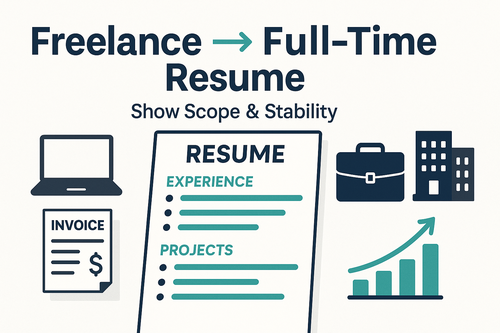
Freelance-to-Full-Time Resume (Show Scope & Stability)
Transitioning from freelancing to a full-time role can be challenging, but a well-crafted freelance-to-full-time resume that highlights your project scope, skills, and demonstrated stability can set you apart. In 2025, using a combination format and ATS-optimized language ensures recruiters see your freelance experience as a strong foundation for full-time employment.
| Key Resume Focus Areas |
|---|
| Demonstrating length and consistency of freelance work |
| Highlighting transferable skills and project outcomes |
| Framing freelance roles as stable and professional |
| Including certifications, volunteering, and side projects |
The Challenge (Recruiter Perspective)
Recruiters may have concerns when reviewing freelance-to-full-time candidates regarding:
- Gaps or inconsistencies in employment history
- Doubts about long-term commitment and stability
- Difficulty assessing direct business impact or teamwork
- Challenges with ATS parsing unconventional formats
A resume that clearly outlines stable freelance engagements and relevant skills mitigates these concerns.
The key insight here is that recruiters are not actually opposed to freelance experience — they are opposed to ambiguity. When a hiring manager cannot tell if you worked one month or three years with a client, or whether you delivered anything measurable, uncertainty creeps in. The solution is to describe your freelance work with the same structure and specificity you would apply to a salaried role.
Choose the Right Format to De-Emphasize Gaps
- Opt for the combination resume that opens with skills and qualifications, followed by a detailed freelance section.
- List freelance work in a way that groups similar projects or clients to demonstrate ongoing work.
- Minimize focus on fragmented job dates; emphasize accomplishments and skills.
How to structure your freelance section in a combination resume:
Rather than listing each client as a separate entry (which creates a timeline that looks fragmented), consolidate your freelance work under a single professional identity:
Independent [Your Specialty] | Self-Employed | [Start Year]–Present Provided [service type] to clients across [industries], delivering [type of outcomes]. Key projects included [brief highlights].
This approach reads like continuous employment rather than a scattered list of gigs. It also allows you to highlight your three or four strongest projects as bullet points underneath, giving recruiters the specificity they need without overwhelming them.
Reframe Experience (Skills, Projects, Volunteering)
- Describe freelance projects like full-time jobs with responsibilities, deadlines, and measurable results.
- Highlight client management, collaboration, and project scope.
- Include any volunteer work or certifications to demonstrate continuous professional growth.
When describing freelance projects, use the same formula that works for any strong resume bullet: Action verb + task + measurable result.
Weak: “Did design work for various clients” Strong: “Redesigned e-commerce checkout flow for a retail client, reducing cart abandonment rate by 22% and increasing mobile conversions by 18%”
Every project you list should answer the question: “So what?” What changed because of your work? Even rough estimates (“approximately 30% faster,” “reduced costs by an estimated $10K annually”) are better than no numbers at all. Freelancers often underestimate how much of their work can be quantified — think delivery timelines, client retention, traffic increases, cost savings, or volume of work produced.
Language Examples You Can Adapt
- “Managed end-to-end website redesign projects for multiple clients, improving user engagement by 35%.”
- “Collaborated remotely with cross-functional teams to deliver consistent results under tight deadlines.”
- “Demonstrated strong time management and client communication skills resulting in repeat business.”
Step-by-Step Guide: Building Your Freelance-to-Full-Time Resume
Follow this process to build a resume that accurately represents your freelance career while positioning you for full-time employment:
Step 1: List every client engagement from the past five to seven years. Include the industry, approximate duration, type of work, and one or two key outcomes for each. This is your raw material.
Step 2: Identify patterns. Group similar work together. If you did three website builds, two SEO projects, and four social media campaigns, you can categorize yourself as a “Digital Marketing and Web Specialist.”
Step 3: Select your top four to six projects. Choose the ones that are most relevant to your target role and have the clearest, most impressive outcomes. These become your resume bullets.
Step 4: Write a strong professional summary. This is your pitch. State your specialty, your years of experience, and the type of role you are seeking. Example: “Versatile UX/UI designer with six years of freelance experience delivering end-to-end digital products for clients in tech, healthcare, and retail. Seeking a full-time design role to apply collaborative skills and deep product thinking within a team environment.”
Step 5: Add a skills section above your experience. List tools, platforms, methodologies, and soft skills that match the job descriptions you are targeting.
Step 6: Include your prior full-time experience (if any) below your freelance section. Even if it is from several years ago, it signals to recruiters that you have operated in a structured employment environment before.
Step 7: Add certifications, courses, and professional development. These show you have stayed current and are serious about your craft.
How to Explain Gaps in Applications
- Address gaps briefly in cover letters or interviews emphasizing growth activities like training or certifications.
- Avoid defensive explanations on your resume.
- Show commitment by highlighting recent continuous projects or engagements.
ATS Considerations
- Use standard section titles like “Experience” and “Skills.”
- Avoid dates cluttered with multiple short gigs by grouping freelance periods or projects.
- Incorporate keywords relevant to your targeted full-time roles.
- Use simple formatting, bullet points, and avoid graphics or tables.
Templates & Checklist
| Freelance-to-Full-Time Resume Checklist |
|---|
| Skills and qualifications section upfront |
| Freelance experience described with clear, stable engagement |
| Projects listed demonstrating impact and collaboration |
| Certifications and volunteering included |
| ATS-friendly formatting and keyword-rich content |
Copy-Ready Example (Combination Format)
Skills & Qualifications
- Project Management
- Client Communication & Relationship Building
- UX/UI Design & Development
- Time Management & Remote Collaboration
Freelance Experience
Independent UX/UI Designer | 2019–Present
- Delivered 15+ full lifecycle design projects for clients in tech and healthcare sectors.
- Improved client satisfaction scores by 40% through iterative design processes and effective communication.
- Coordinated with developers and marketing teams to ensure alignment and timely delivery.
Professional Experience
Marketing Assistant | ABC Corp | 2015–2018
- Supported marketing campaigns increasing leads by 20%.
- Managed content creation and social media engagement.
FAQ
Q: Should I list freelance work as a job?
A: Yes, present it as professional experience with clear roles and outcomes.
Q: How do I show stability when freelancing?
A: Group projects and emphasize continuous client engagements and repeat work.
Q: Can I include volunteer projects?
A: Yes, particularly if relevant to your target role and demonstrating ongoing skills.
Q: How long should a freelance-to-full-time resume be?
A: One to two pages, focusing on relevance and clarity.
Q: What if most of my freelance clients were under NDA and I cannot name them?
A: Describe the industry and project type without identifying the client. For example: “Redesigned internal HR portal for a Fortune 500 financial services firm (NDA)” or simply “large enterprise client in financial services.” You can still quantify outcomes and describe scope.
Q: How do I handle the salary expectations question when I have been setting my own rates?
A: Research market rates for the full-time role you are applying for. Being a freelancer means you may have charged more per hour but without benefits. Factor in health insurance, PTO, and other benefits when evaluating offers, and be transparent that your rate history was project-based.
Q: Should I mention that I am still freelancing while applying for full-time roles?
A: Yes, list your freelance work as ongoing with the current date. If asked in an interview whether you will stop freelancing, be prepared to confirm that full-time employment would be your priority and you would wind down active clients over a reasonable transition period.
Build, Score & Track Your Job Search with ResumeMate
Resume Builder → — Create an ATS-ready resume in minutes.
Resume Score Checker → — See how your resume scores against ATS systems instantly.
Job Board → — Browse jobs matched to your resume.
Job Tracker Chrome Extension → — Track every application, deadline, and follow-up in one place — free.