Lebenslauf Template & 5 Essential German CV Rules (2026)
A Germany CV (Lebenslauf) follows specific cultural and formatting norms distinct from other international resume styles. In 2026, understanding length, mandatory sections, photo etiquette, and inclusion of certificates ensures your Lebenslauf complies with German expectations and stands out in applications. Whether you call it a Lebenslauf, CV, or curriculum vitae, the German format is unique — and getting it right can make or break your Bewerbung (application).
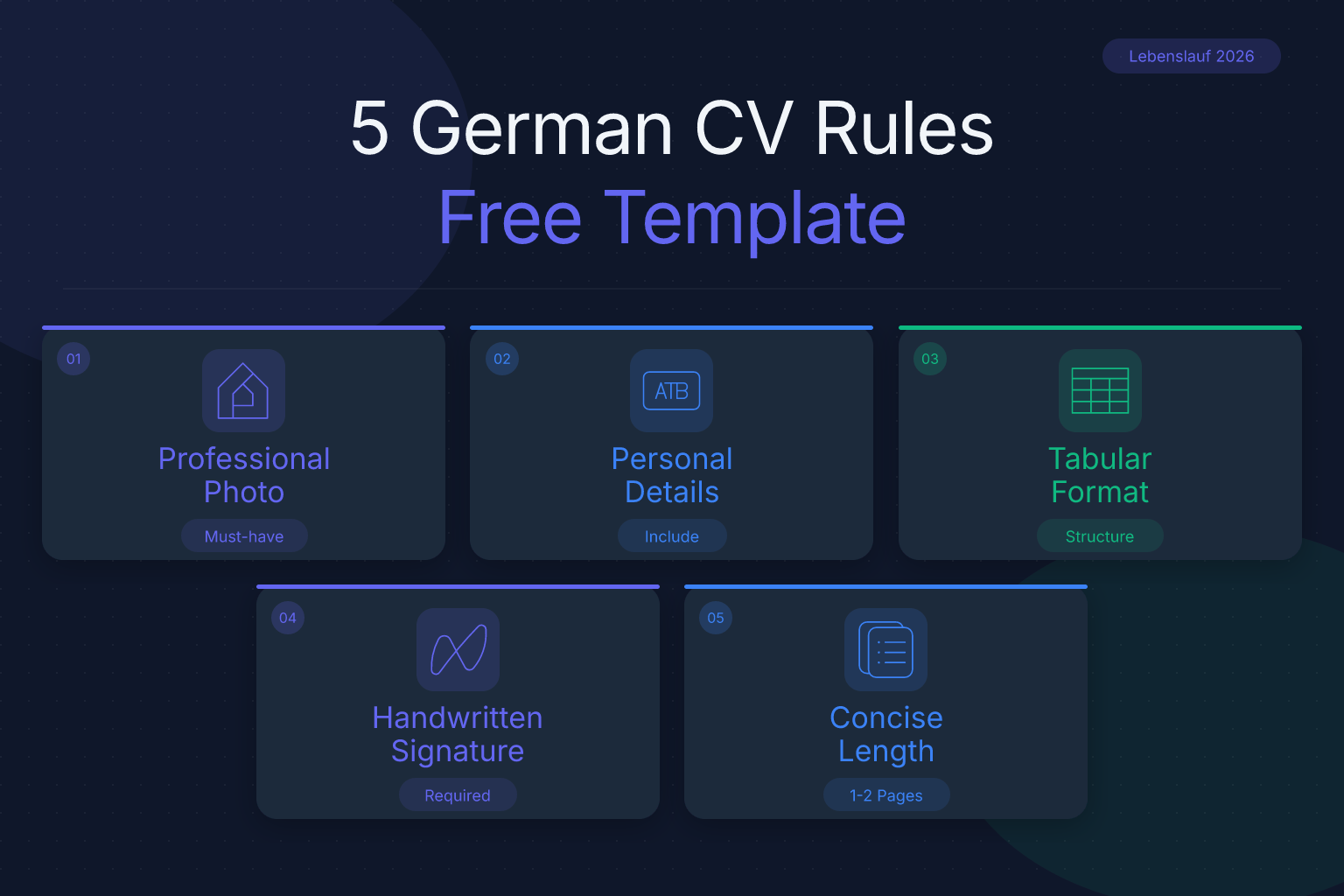
| Germany CV/Lebenslauf Norms at a Glance |
|---|
| Length: 1–2 pages, concise and factual |
| Photo: Professional and mandatory in most cases |
| Sections: Personal, Education, Work Experience, Skills, Certificates |
| Paper Size: A4 |
| Date Format: DD.MM.YYYY |
What’s Different vs. US Resumes
| Feature | Germany CV/Lebenslauf | US Resume |
|---|---|---|
| Photo | Usually included at top right | Generally excluded |
| Personal Details | Full address, date of birth, marital status (optional) | Minimal, usually city/state only |
| Length | Typically 1–2 pages | Often 1 page |
| Date Format | DD.MM.YYYY | MM/DD/YYYY |
| Certificates | Multiple work and education certificates often included | Certifications often summarized |
Germany emphasizes formality and completeness, with clear chronological order. The German Lebenslauf is not just a summary of your career — it’s a detailed, factual document that leaves little to the imagination. While US resumes often prioritize brevity and impact statements, German employers expect a full picture: every job, every degree, and every relevant certificate. This cultural difference stems from a hiring culture that values thoroughness and verifiable information over storytelling. If you’re used to a one-page US resume, you’ll need to adjust your mindset: a two-page Lebenslauf is perfectly acceptable, even for early-career professionals, as long as every line adds value.
Formatting & File Setup (A4, Date Formats)
- Paper Size: Use A4 format (21 x 29.7 cm). This is the standard in Germany and most of Europe. If you’re applying from abroad, set your document to A4 — not US Letter — to avoid awkward scaling when printed or viewed by German recruiters.
- Fonts: Use classic, legible fonts—Arial, Times New Roman size 11-12pt. Calibri or Lato are also acceptable modern alternatives. Avoid decorative fonts.
- Margins: Standard 2.5 cm margins recommended. This gives your CV a clean, professional frame.
- Date Formats: Use German convention DD.MM.YYYY (e.g., 23.08.2025). Consistency is key — every date in your Lebenslauf must follow this format.
- File Format: PDF is strongly preferred for preservation of layout. A clean, text-based PDF (not a scanned image) is the best CV format for Germany because it ensures your formatting stays intact and is readable by both humans and ATS. DOCX is accepted only if the job posting explicitly requests it.
- ATS Compatibility: Use simple layouts avoiding tables, graphics, or excessive formatting. Modern German companies often use applicant tracking systems (ATS) like Workday or SAP SuccessFactors. A single-column, tabular-style layout — where dates sit in a narrow left column and descriptions in a wider right column — is the classic “CV in tabular form” that parses well. Avoid actual HTML or Word tables; instead, use clear section headings and consistent spacing. For a guaranteed ATS-friendly Lebenslauf, you can use a free resume builder that exports clean, single-column PDFs.
Essential Sections of a Germany CV/Lebenslauf
1. Personal Information (Persönliche Daten)
- Full name (first and last, no middle initials)
- Current address with postal code (street, house number, ZIP, city)
- Phone number (with country code if applying from abroad)
- Email address (professional, ideally based on your name)
- Date of birth and place of birth (e.g., 23.08.1990, Berlin)
- Marital status (optional; “ledig” or “verheiratet” — increasingly omitted by younger applicants)
- Include a professional passport-style photo usually top right. The photo should be 4.5 x 6.5 cm, with a neutral background, and you should look directly at the camera with a slight smile. This is the “CV mit Foto” expectation.
2. Professional Summary (Optional, Profil)
A brief statement of career goals and core competencies tailored to the position. In German, this is often called a Kurzprofil or Profil. Keep it to 2–4 lines. Example: “Erfahrener Projektmanager mit 8 Jahren Erfahrung in der Automobilindustrie. Spezialisiert auf agile Methoden und internationale Teamführung.”
3. Work Experience (Berufserfahrung)
- List jobs in reverse-chronological order (most recent first).
- Include job title, employer, location, and employment dates (month/year format, e.g., 06/2020–07/2025).
- Describe key responsibilities and achievements concisely. Use bullet points with action verbs in the first person (e.g., “Leitete ein Team von 5 Entwicklern”). Quantify results where possible — German employers value measurable outcomes.
- If you have gaps, explain them briefly (e.g., “Elternzeit” for parental leave, “Weiterbildung” for further education).
4. Education (Ausbildung)
- Include school, degree, and dates (month/year).
- Mention completed certificates and training programs. In Germany, vocational training (Berufsausbildung) is highly respected and should be listed alongside academic degrees.
- For university degrees, include your final grade (e.g., “Abschlussnote: 1,7”) if it’s good. German employers often expect this.
5. Skills (Fähigkeiten)
- Foreign languages with proficiency level using the Common European Framework (e.g., Englisch: C1, Französisch: B2).
- Computer skills and technical competencies. Be specific: list software, programming languages, and tools.
- Soft skills are less emphasized than in US resumes; focus on hard, verifiable skills.
6. Certificates & Additional Qualifications (Bescheinigungen/Zusatzqualifikationen)
- Include relevant professional certificates, licenses, or awards. In Germany, this section carries more weight than in many other countries. List the full certificate name, issuing body, and date.
- If you have an Arbeitszeugnis (work reference), mention that it is attached, but do not paste the full text here.
7. Interests and Hobbies (Interessen) (Optional)
- Include if relevant to company culture or personal branding. For example, “Marathonlaufen” shows discipline; “Ehrenamtliche Tätigkeit” (volunteer work) demonstrates social commitment. Avoid generic entries like “Lesen, Reisen.”
Examples/Templates
Personal Information Example
Max Mustermann
Musterstraße 12, 12345 Berlin
Telefon: +49 30 1234567
E-Mail: max.mustermann@email.de
Geburtsdatum: 23.08.1990, Berlin
Familienstand: Ledig(Professional passport-style photo at top right)
Work Experience Example
Projektmanager
Musterfirma GmbH, Berlin | 01.06.2020 – 31.07.2025
- Leitung von cross-funktionalen Teams zur termingerechten Umsetzung von IT-Projekten.
- Optimierung der Prozesse, was zu Einsparungen von 15% im Jahresbudget führte.
Full Lebenslauf Template (Tabular Form)
Below is a simplified structure of a classic German CV in tabular form. Notice how dates sit on the left and content on the right — this is the “CV in tabular form” that German recruiters expect.
| Persönliche Daten | |
|---|---|
| Name | Max Mustermann |
| Adresse | Musterstraße 12, 12345 Berlin |
| Telefon | +49 30 1234567 |
| max.mustermann@email.de | |
| Geburtsdatum/-ort | 23.08.1990, Berlin |
| Familienstand | Ledig |
| Berufserfahrung | |
|---|---|
| 06/2020 – 07/2025 | Projektmanager, Musterfirma GmbH, Berlin |
| • Leitung cross-funktionaler Teams | |
| • Budgetverantwortung über 2 Mio. € | |
| 01/2018 – 05/2020 | Junior Projektmanager, StartUp AG, München |
| • Unterstützung bei der Einführung agiler Methoden |
| Ausbildung | |
|---|---|
| 10/2014 – 09/2017 | Bachelor of Science (B.Sc.) Wirtschaftsinformatik, Universität Berlin |
| Abschlussnote: 1,7 |
| Kenntnisse | |
|---|---|
| Sprachen | Deutsch (Muttersprache), Englisch (C1), Französisch (B1) |
| IT | MS Office, JIRA, SAP, Python (Grundkenntnisse) |
| Zertifikate | |
|---|---|
| 2023 | PRINCE2 Foundation |
| 2021 | Scrum Master (PSM I) |
| Ort, Datum | Berlin, 23.08.2025 | | Unterschrift | (handwritten signature or typed name) |
You can recreate this layout easily with a free resume builder that offers A4 templates and automatically formats dates in DD.MM.YYYY.
What Is an Arbeitszeugnis and Why It Matters
The Arbeitszeugnis (work reference or employment certificate) is a document German employers are legally required to provide when an employee leaves. It is unlike anything in US or UK hiring culture and plays a significant role in German job applications.
There are two types:
- Einfaches Arbeitszeugnis: A simple certificate confirming employment dates and job title only.
- Qualifiziertes Arbeitszeugnis: A qualified reference that also evaluates the employee’s performance, conduct, and overall contribution.
When applying for jobs in Germany, you are expected to attach copies of your most recent Qualifiziertes Arbeitszeugnisse. Hiring managers actively read these documents. A positive Arbeitszeugnis can significantly strengthen your application, while a mediocre one raises questions.
Important: German Arbeitszeugnisse use a coded language. Phrases that appear polite on the surface may actually signal negative feedback when read by an experienced recruiter. For example, “sie hat die ihr übertragenen Aufgaben stets zu unserer Zufriedenheit erledigt” (she completed tasks to our satisfaction) is actually a below-average rating. The highest praise is “stets zu unserer vollsten Zufriedenheit” (always to our fullest satisfaction). Familiarize yourself with this system before sending references. If you’re unsure, have a German-speaking professional review your Zeugnisse.
Step-by-Step Guide: Building Your Lebenslauf
Follow this checklist to construct a compliant, professional German CV from scratch:
- Choose the right template. Use a clean, single-column Word or PDF template in A4 format. Avoid visual clutter. A tabular layout with dates on the left and content on the right is the most traditional and ATS-friendly. You can find free Lebenslauf templates online or use a resume builder that automatically applies German formatting.
- Add your professional photo. Place a passport-style photo in the top-right corner. Use a neutral background and professional attire. This is expected in most industries. The photo should be recent (within the last year) and high-quality. If you’re applying to a very progressive startup or an international company that explicitly states “no photo,” you may omit it — but for 90% of German employers, a photo is still the norm.
- Fill in personal data. Include full name, complete address, phone number, email, and date of birth. Marital status is optional. If you’re not comfortable sharing your full address, you can list only city and country, but a full address is still standard.
- Write a short professional summary (Profil). Two to four sentences summarizing your experience and value proposition. Tailor this to each application. Use keywords from the job description.
- List work experience in reverse-chronological order. Start with your most recent position. Include exact start and end months and years in MM/YYYY – MM/YYYY format (the German convention is often written as 06/2020–07/2025, but the full DD.MM.YYYY is used for birth date). For each role, add 3–5 bullet points that highlight achievements, not just duties.
- List education. Include your degree name, institution, location, and dates. Also include vocational training (Berufsausbildung) if applicable. If you studied abroad, mention the equivalent German degree if known.
- Add your skills section. Language proficiency should include standard levels (e.g., Englisch: C1, Französisch: B2). List relevant software and technical tools. Group skills logically (languages, IT, certifications).
- List certificates and qualifications. Include professional licenses, industry certifications, or completed training programs. Attach copies of the most important ones to your application.
- End with a place, date, and signature. German CVs traditionally end with the city name, current date, and either a handwritten signature (scanned) or typed name (for digital submissions). This signals completeness and formality.
- Attach supporting documents. Gather your Arbeitszeugnisse, degree certificates, and any relevant training certificates to include as appendices. In a digital application, merge everything into a single PDF with the CV first, followed by the cover letter (Anschreiben), then certificates.
After building your Lebenslauf, run it through a resume score checker to see how it performs against ATS criteria and get section-by-section feedback — free.
Role-Specific Lebenslauf Examples
Engineering / Technical Role
Skills Section:
- Programmiersprachen: Python (fortgeschritten), Java (gut), SQL (grundlegend)
- Software: AutoCAD, MATLAB, SAP
- Sprachen: Deutsch (Muttersprache), Englisch (C1)
Work Experience Entry: Softwareentwickler TechCorp GmbH, München | 01.09.2019 – 30.06.2024
- Entwicklung und Wartung von Backend-Systemen für die Logistikplattform.
- Reduktion der Ladezeiten um 30% durch Datenbankoptimierung.
Healthcare / Clinical Role
For healthcare roles in Germany, you must also include your Approbationsurkunde (license to practice) and any specialist qualifications. These are not optional — they are mandatory for employment. Additionally, list your Facharztausbildung (specialist training) with dates and the medical chamber (Ärztekammer) where you are registered.
Business / Management Role
Profil:
Vertriebsleiter mit über 10 Jahren Erfahrung im B2B-SaaS-Vertrieb. Erfolgreicher Aufbau eines 20-köpfigen Teams und Steigerung des Jahresumsatzes um 40%.
Berufserfahrung: Vertriebsleiter DACH Software AG, Frankfurt am Main | 01.03.2018 – heute
- Verantwortung für den gesamten Vertriebszyklus in der DACH-Region.
- Einführung eines neuen CRM-Systems, das die Lead-Conversion um 25% verbesserte.
Common Mistakes in German CV Applications
- Sending a US-style one-page resume. German employers expect completeness, not brevity at the cost of detail. A two-page Lebenslauf is standard for professionals with 5+ years of experience.
- Omitting a photo. While this is a personal choice, most traditional German employers still expect one. Research the company culture first. If in doubt, include a professional photo — it’s rarely a disadvantage.
- Using MM/DD/YYYY date format. Always use DD.MM.YYYY in Germany. Even in digital applications, this is a quick signal that you understand local norms.
- Forgetting to attach Arbeitszeugnisse. Many applicants skip this, but German hiring managers specifically look for them. If you don’t have a recent one, request it from your previous employer — they are legally obligated to provide it.
- Writing vague responsibilities without achievements. Use metrics where possible — German employers value precision and measurable results. Instead of “responsible for sales,” write “increased sales by 15% in the first year.”
- Using informal language or tone. The Lebenslauf should be written in formal, third-person-friendly language, even in bullet points. Avoid “I” and use implied first person or passive constructions where appropriate.
- Sending the wrong file format. PDF is strongly preferred unless the job posting specifically requests DOCX. A PDF ensures your layout, fonts, and photo appear exactly as intended.
- Including irrelevant personal information. While date of birth and marital status are common, avoid adding religion, number of children, or political affiliation — these can lead to unconscious bias and are not required.
- Not tailoring the CV to the job. A generic Lebenslauf sent to every opening will be noticed. Adjust your Profil and key skills to match the Stellenanzeige (job ad).
Compliance and Anti-Bias Notes
- Germany’s General Data Protection Regulation (GDPR) governs privacy; include only requested personal info. You are not obligated to share your date of birth or marital status, though it remains common practice.
- While photos are common, some employers may prefer color-blind anonymized applications — check company norms. Large international firms and public sector organizations sometimes use anonymized screening to reduce bias.
- Avoid information that can lead to bias (religion, political affiliation) unless voluntarily disclosed. Even your nationality is not required unless it affects work eligibility.
- If you are applying with a non-German name or from abroad, be aware that some employers may expect a “lückenloser Lebenslauf” (gap-free CV). Explain any gaps honestly and briefly.
FAQ
Q: Is including a photo mandatory on German CVs?
A: It is standard and often expected unless the employer states otherwise. The photo should be professional, taken against a neutral background, and similar in style to a passport photo. For most industries, a “CV mit Foto” is still the norm, but always check the job posting for any “anonymisierte Bewerbung” requests.
Q: How many pages should a Germany CV be?
A: Usually 1–2 pages, concise and structured. For candidates with many years of experience, 2 pages is acceptable. Students and recent graduates can often fit everything on one page.
Q: Should certificates be attached or mentioned?
A: Mention certificates in the CV body, then attach scanned copies as appendices at the end of your application package. This is standard practice in Germany. Merge all documents into a single PDF.
Q: What is the proper date format in Germany?
A: Use DD.MM.YYYY format (e.g., 23.08.2025) throughout your document. For employment periods, you can use MM/YYYY – MM/YYYY (e.g., 06/2020–07/2025).
Q: What is a Deckblatt and do I need one?
A: A Deckblatt is a cover page placed at the front of the application package. It typically includes your name, a professional photo, contact details, and the job title you are applying for. It is optional but common for formal applications in Germany.
Q: Do I need to write my Lebenslauf in German?
A: For most German-language workplaces, yes. However, some international companies or tech firms in Germany accept applications in English. Always match the language of the job posting. If the ad is in German, submit a German CV; if it’s in English, an English CV is acceptable — but you may still want to include a German-language version if you are fluent.
Q: What is the best CV format for Germany?
A: The best CV format for Germany is a clean, single-column PDF in A4 size, with a professional photo, clear section headings, and a tabular layout (dates on the left, content on the right). Avoid graphics, columns, and tables created with actual table tools — use simple formatting to ensure ATS compatibility.
Q: What does “CV in tabular form” mean?
A: A “CV in tabular form” (tabellarischer Lebenslauf) is the standard German CV layout where information is organized in a two-column structure: dates or headings on the left, and descriptive text on the right. It looks like a table but is built with indents and tabs, not actual table elements, to remain ATS-friendly.
Q: What is the difference between a Lebenslauf and a CV?
A: In Germany, “Lebenslauf” and “CV” (curriculum vitae) are used interchangeably. However, a German Lebenslauf follows specific local conventions (photo, personal data, tabular form) that differ from a US-style resume or a UK-style CV. When applying in Germany, always follow the Lebenslauf format described here.
Q: Can I use a free Lebenslauf template?
A: Yes, many free templates are available online. For a template that automatically applies German formatting (A4, DD.MM.YYYY dates, tabular layout) and exports an ATS-optimized PDF, you can use a free resume builder.
Q: What is the best German CV template for 2026?
A: The best German CV template for 2026 is one that balances tradition with modern ATS requirements. Look for a single-column, tabular layout in A4 size, with a professional photo placeholder, clear section headings, and no graphics or tables. A template that exports a clean, text-based PDF is ideal. You can find such templates in a free resume builder that automatically applies German formatting.
Q: What is a “curriculum vitae” in German?
A: “Curriculum vitae” is the Latin term for “Lebenslauf,” which is the German word for CV or resume. In Germany, the terms are used interchangeably, but the document itself follows specific German conventions: A4 size, DD.MM.YYYY dates, a professional photo, and a tabular layout with personal data, work experience, education, and skills.
Q: How do I format a Lebenslauf for an Ausbildung (vocational training) application?
A: For an Ausbildung application, emphasize your school education, any relevant internships (Praktika), and your motivation for the specific vocational path. List your expected school-leaving qualification (e.g., Realschulabschluss, Abitur) with the expected date. Include any relevant hobbies or volunteer work that demonstrate practical skills. Keep the CV to one page, and ensure your photo and personal data are complete.
Related articles:
- France CV Format: Photo, Personal Details, and Rules
- Accountant Resume Examples with CPA and GAAP Skills
Build, Score & Track Your Job Search with ResumeMate
Resume Builder → — Create an ATS-ready resume in minutes.
Resume Score Checker → — See how your resume scores against ATS systems instantly.
Job Board → — Browse jobs matched to your resume.
Job Tracker Chrome Extension → — Track every application, deadline, and follow-up in one place — free.