Graduate CV vs Resume: What to Use & When
Graduates often face confusion over whether to use a CV or a resume when applying for jobs. The key difference lies in purpose, length, and content. In 2025, knowing when to use each and how to tailor them for industry roles optimizes your chances of success.
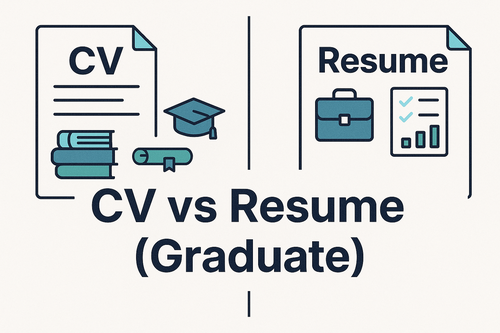
| Quick Comparison Overview |
|---|
| CV (Curriculum Vitae) |
| Length: Multiple pages |
| Focus: Complete academic history |
| Used for: Academic, research, medical roles |
| Resume |
| Length: 1-2 pages |
| Focus: Relevant skills & experience |
| Used for: Industry, corporate, most job applications |
What Hiring Managers Look For at This Stage
- Clear, concise presentation of relevant skills and accomplishments
- Tailoring to job requirements using keywords
- Evidence of achievements and potential contributions
- Easy-to-read format compatible with ATS systems
For graduates, the bar is not “did you manage a team of twenty?” — it is “can you show me evidence that you are capable of learning and contributing quickly?” Hiring managers reviewing entry-level applications know you do not have ten years of experience. They are looking for evidence of intellectual curiosity, initiative, and the ability to apply what you have learned in real contexts. Both CVs and resumes should be crafted with this mindset.
Choose a Simple Format
- CV: Chronological format highlighting education, publications, projects, and awards.
- Resume: Tailored summary plus focused skill and experience sections, often reverse-chronological.
Both should be clean, ATS-friendly, and easy to scan.
A key formatting difference: a CV places Education at the top and keeps it there throughout your career. A resume typically moves Education lower as you gain professional experience. For a recent graduate with a resume, it is perfectly appropriate to keep Education near the top if you have limited work history, then shift it down as your professional experience grows.
Font and layout guidance: Both documents should use a 10–12pt professional font (Calibri, Arial, Georgia, or Times New Roman), 0.5–1 inch margins, and consistent heading styles. Do not use columns, text boxes, or graphic elements — these confuse ATS systems and often break the parsing entirely.
What to Include (Projects, Coursework, Skills)
- CV: Full academic background, research, teaching experience, publications, presentations, and relevant certifications.
- Resume: Selective projects, relevant coursework, internships, skills, and professional experience.
What to include on a graduate resume when you have limited work experience:
Many graduates feel their resumes are too thin because they have not held traditional jobs. Here is what you can legitimately include to fill the document with relevant, honest content:
- Capstone or thesis projects: Describe the problem, your method, and the outcome. Quantify where possible (“Analyzed dataset of 5,000 records to identify purchasing trends, resulting in a recommendation adopted by the sponsoring company”).
- Relevant coursework: List course names that directly relate to the role (e.g., “Data Structures and Algorithms,” “Financial Modeling,” “Consumer Psychology”) rather than general core requirements.
- Part-time or seasonal work: Even retail or food service jobs demonstrate reliability, customer communication, and time management — which are relevant for most roles.
- Extracurricular leadership: Club officer roles, sports team captaincy, or event organization all demonstrate initiative and real-world responsibility.
- Hackathons or competitions: Results from academic competitions, case challenges, or coding events signal drive and applied ability.
Examples You Can Copy
Graduate CV Example (Academic Focus)
- Education: Degrees with thesis titles and honors
- Research Experience: Detailed descriptions with outcomes
- Publications and Presentations: Formatted citations
- Skills: Languages, laboratory techniques, software
Sample CV research entry:
Research Assistant | Department of Neuroscience, State University | Sept–May Designed and conducted behavioral experiments on 40+ mouse subjects to investigate the role of dopamine pathways in reward learning. Analyzed results using MATLAB and contributed to a manuscript currently under peer review.
Graduate Resume Example (Industry Focus)
- Summary: Tailored to job and key skills
- Experience: Internships or relevant projects with quantified accomplishments
- Skills: Technical and soft skills relevant to role
- Education: Degrees and relevant coursework
Sample resume summary for a marketing graduate:
“Recent Marketing graduate with hands-on internship experience in digital advertising, email campaign management, and Google Analytics. Passionate about data-driven content strategy and eager to contribute to a growth-focused marketing team.”
Sample resume project entry:
E-Commerce Analytics Project | Senior Capstone Built a sales dashboard in Tableau for a local retail client, identifying top-performing product categories and seasonal trends. Recommendations led to a 12% increase in Q4 promotional spend effectiveness.
Common Mistakes Graduate Applicants Make
Knowing what to avoid is as important as knowing what to include.
- Submitting a CV for an industry role: Hiring managers at corporate companies often see a five-page CV from a recent graduate and immediately move on. They do not have time to sift through it. Send a targeted one-page resume instead.
- Using academic writing style on a resume: Avoid passive voice and dense paragraph descriptions. Resumes use punchy, active bullet points. Instead of “Responsibilities included assisting with data collection,” write “Collected and cleaned data from 200+ survey responses for academic research project.”
- Listing skills without evidence: Writing “strong communication skills” proves nothing. Replace it with a bullet that demonstrates it: “Presented research findings to a panel of faculty and industry professionals at the annual department symposium.”
- Omitting GPA when it is strong: If your GPA is 3.5 or above, include it. Many entry-level employers use it as a screening signal when work experience is limited.
- Sending the same document everywhere: Even a small amount of tailoring — swapping in keywords from the job description, reordering bullet points to lead with the most relevant accomplishments — significantly improves your callback rate.
How to Tailor to Postings
- Read job descriptions carefully to identify required skills and qualifications.
- Use keywords directly in your resume or CV where applicable.
- Emphasize transferable skills for industry roles on resumes.
- Highlight research and academic achievements on CVs when applying to similar fields.
ATS Basics for Entry-Level Documents
- Avoid complex formatting, images, or tables.
- Use standard fonts such as Arial or Times New Roman.
- Save as DOCX or ATS-friendly PDF (if allowed).
- Organize information under clear headings for ATS parsing.
Templates & Checklist
| Graduate CV vs Resume Checklist |
|---|
| CV includes comprehensive academic info |
| Resume emphasizes relevant skills and professional experience |
| Content is tailored to the specific application |
| Formatting is clean and ATS-optimized |
| Keywords match job description |
| Length is appropriate (CV: multiple pages, Resume: 1-2 pages) |
Fill-in-the-Blank CV Objective:
“Dedicated graduate with a background in [field] seeking to leverage academic research and analytical skills in a [industry/role] position.”
Fill-in-the-Blank Resume Objective:
“Motivated recent graduate aiming to use [skills] to contribute to [company]’s [specific goals].”
FAQ
Q: When should I use a CV instead of a resume?
A: Use a CV for academic, research, or medical roles that require detailed educational and publication history.
Q: Can I submit a CV for industry jobs?
A: Generally, a concise resume is preferred in industry; use a CV only if requested.
Q: How long should each be?
A: CVs can be multiple pages; resumes should not exceed 2 pages.
Q: Should I tailor my CV/resume for each application?
A: Yes, personalized content improves ATS performance and recruiter response.
Q: What if I have no internship experience at all?
A: Focus on academic projects, lab work, freelance or volunteer work, and extracurricular leadership. Quantify outcomes wherever possible and frame each entry the same way you would a professional role.
Q: Should I include a photo on my CV or resume?
A: Not in most English-speaking countries (US, UK, Canada, Australia). Photos can introduce unconscious bias and are not expected. The exception is some European and Asian countries where including a professional headshot on a CV is standard practice — research the norms for your target country.
Q: Is a one-page resume always better for graduates?
A: One page is ideal for most entry-level applications. However, if you have substantial internship experience, research, or project work that genuinely fills a second page with relevant content, two pages is acceptable. Never pad a resume to fill space — and never cut important content to force it onto one page at the expense of readability.
Q: How do I handle a double major or minor on my resume?
A: List both, especially if one is directly relevant to the job. Format it as: “B.S. Computer Science, Minor in Statistics” or “B.A. Economics and Political Science.” Relevant coursework from either program can be listed if it supports the role you are applying for.
Related articles:
Build, Score & Track Your Job Search with ResumeMate
Resume Builder → — Create an ATS-ready resume in minutes.
Resume Score Checker → — See how your resume scores against ATS systems instantly.
Job Board → — Browse jobs matched to your resume.
Job Tracker Chrome Extension → — Track every application, deadline, and follow-up in one place — free.