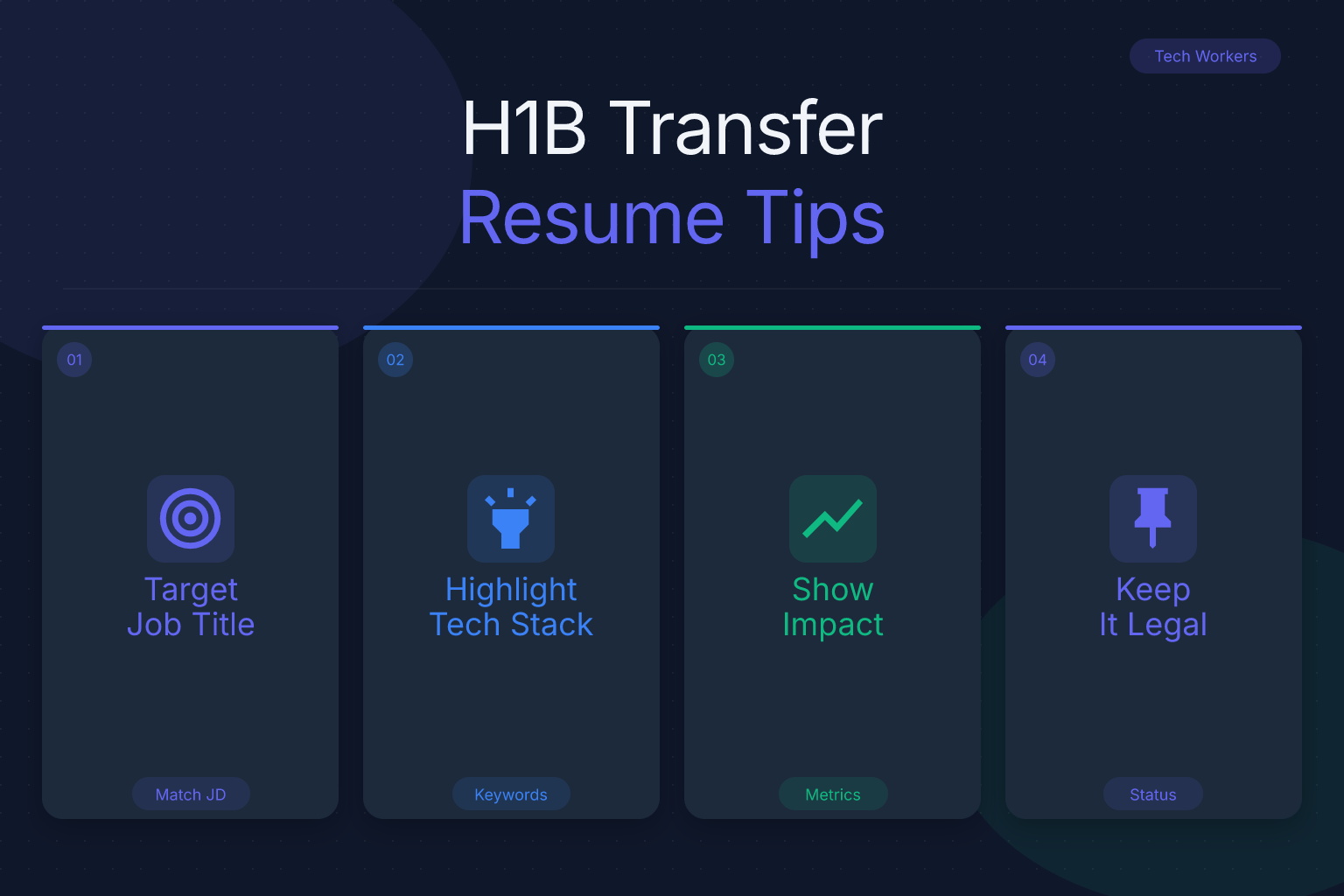
H1B Transfer Resume Tips for Tech Workers
If you’re a tech worker on an H-1B visa, h1b transfer resume tips for tech workers are not just about landing an interview — they’re about convincing a new employer that hiring you is worth the paperwork, the waiting period, and the legal fees. Unlike a typical job search, your resume has to do double duty: it must sell your technical skills and simultaneously signal that you’re a low-risk, transfer-ready candidate. This guide walks through exactly how to structure, word, and format your resume so it clears both the recruiter’s screen and the immigration attorney’s review.
Key Takeaways
- You do not need to list your visa status on your resume, but you should mention H-1B transfer eligibility in your cover letter or first recruiter call to avoid wasting time.
- Emphasize continuous, verifiable employment with exact dates and employer names — gaps or vague timelines raise red flags for both HR and USCIS.
- Tailor your resume summary to show you’re an immediate contributor, not someone who needs months of onboarding or training.
- Use a clean, single-column PDF format that parses correctly in applicant tracking systems, since H-1B transfer candidates often face extra document scrutiny.
- Keep your resume focused on skills and achievements that match the new job description, because the H-1B petition must prove you qualify for the specific role.
| What to Do | Why It Matters | Time |
|---|---|---|
| List every employer with exact start/end dates (month and year) | Proves continuous H-1B status and no unauthorized gaps | 15 minutes |
| Rewrite your summary to target the new role’s tech stack | Shows immediate value and reduces perceived onboarding risk | 30 minutes |
| Remove any mention of visa expiration or “needs sponsorship” from the resume itself | Keeps the resume focused on qualifications; visa details belong in the cover letter or conversation | 10 minutes |
| Run your resume through an ATS score checker | Ensures the format doesn’t get mangled when the employer’s system parses it | 5 minutes |
| Prepare a separate document listing your H-1B history (employer, dates, job title) | Speeds up the attorney’s review and shows you’re organized | 20 minutes |
Understand What H-1B Transfer Employers Look For
When a tech company considers hiring an H-1B worker from another employer, they’re evaluating two things at once: your technical ability and your transfer feasibility. The resume is the first piece of evidence for both. Recruiters and hiring managers want to see that you have the exact skills the job requires, because the H-1B petition must demonstrate that you meet the minimum qualifications for the specific role — not just that you’re a generally good engineer. At the same time, the company’s immigration counsel will review your employment history to confirm you’ve maintained lawful status. Any unexplained gap, overlapping dates, or vague job titles can trigger a request for evidence (RFE) and delay your start date by weeks or months.
So your resume for an H-1B transfer should be more precise than a typical tech resume. Use exact month and year for every position. Avoid phrases like “2019–2021” if you actually worked from March 2019 to November 2021 — the extra specificity costs nothing and prevents confusion. If you held multiple roles at the same company, list them as separate entries with clear dates. This level of detail signals to the employer that you understand the stakes and have nothing to hide.
One of the most common questions from H-1B tech workers is whether to write “H-1B visa holder” or “authorized to work in the U.S.” on the resume. The short answer: you don’t need to put it on the resume at all. Your resume is a marketing document about your skills, not an immigration form. Adding visa details can invite unconscious bias or cause a recruiter to skip you before they understand your transfer eligibility. Instead, handle visa status in the cover letter or during the first phone screen. A simple line like “Currently on H-1B with a valid I-797; eligible for H-1B transfer under AC21 portability” is enough to move the conversation forward.
If you do choose to mention work authorization on the resume — for example, if you’re applying to a company that explicitly asks for it — keep it to one line at the bottom under a “Work Authorization” heading. Write “H-1B visa (transfer eligible)” rather than “H-1B visa expires June 2027.” Never include your visa expiration date, passport number, or A-number on a resume. Those details belong in the immigration paperwork, not in a document that gets shared with multiple people in the hiring pipeline.
Highlight Transferable Tech Skills and Certifications
For an H-1B transfer, the new employer’s immigration attorney must prove to USCIS that you possess the specialized knowledge required for the offered position. That means your resume should map directly to the job description’s required skills. If the new role asks for Python, AWS, and Kubernetes, those terms need to appear in your skills section and in the bullet points under your relevant work experience. Don’t bury them in a long list of every technology you’ve ever touched. Recruiters and attorneys both scan for keyword matches, and a focused skills section makes their job easier.
Certifications carry extra weight in H-1B transfers because they provide third-party verification of your expertise. If you hold AWS Certified Solutions Architect, Google Cloud Professional, or a similar credential, list it prominently near the top of your resume. For tech workers pivoting to a slightly different stack or role, this is where a resume summary for a tech career pivot can help you frame your transferable experience without looking like a career changer. The key is to show that your existing H-1B specialty occupation aligns with the new role’s requirements — even if the job title is different.
Show Continuous Employment and Avoid Gaps
USCIS expects H-1B workers to maintain continuous authorized employment. A gap of even a few weeks between jobs can raise questions about whether you fell out of status, especially if you didn’t file a change of employer before leaving your previous job. On your resume, every month should be accounted for. If you took a short break between employers — for example, you resigned and then started the transfer process — list the exact end date of the old job and the exact start date of the new one. If the gap was longer than 30 days, be prepared to explain it in an interview or in a separate note to the immigration team. Common acceptable reasons include family leave, medical treatment, or waiting for the new petition to be approved before starting work.
If you have a genuine employment gap that you need to explain on your resume, the same principles apply as when explaining a resume gap for family caregiving: be honest, keep it brief, and focus on what you did during that time to stay current in your field. For tech workers, that might mean freelance projects, open-source contributions, or online courses. List those activities under a “Professional Development” or “Independent Projects” section with dates, so there’s no blank space on your timeline.
Tailor Your Resume Summary for the H-1B Transfer Context
Your resume summary is the first thing a recruiter reads, and for an H-1B transfer candidate, it needs to do three things: state your current role and core expertise, show that you’re an immediate contributor, and subtly signal that you’re not a visa risk. Avoid generic phrases like “seeking a challenging position.” Instead, write something like:
“Senior backend engineer with 7 years of experience building distributed systems in Python and Go. Currently on H-1B with a valid I-797 and eligible for immediate transfer under AC21 portability. Led a team of 5 to reduce API latency by 40% at a Series C fintech startup.”
That summary tells the recruiter exactly what you do, proves you’ve delivered measurable results, and answers the visa question before it’s even asked. If you’re an experienced worker worried about age bias or being seen as overqualified, lead with recent, relevant achievements and trim older roles to a single line each.
Format Your Resume for ATS and Recruiter Scrutiny
H-1B transfer candidates often face an extra layer of document review, which means your resume will be opened, parsed, and re-saved by multiple systems. A resume that looks beautiful in a two-column layout with graphics and tables may turn into gibberish when an applicant tracking system (ATS) extracts the text. For the safest result, use a single-column format with standard section headings (Work Experience, Skills, Education). Avoid headers, footers, text boxes, and images. Export your resume as a clean, text-based PDF — not a scanned document or a Word file with tracked changes. If you’re emailing your resume directly to a recruiter, keep the file size under 1 MB so it doesn’t get blocked.
Before you send your resume anywhere, run it through a free resume score checker to see how well it parses and whether any sections are missing or mislabeled. A score of 80 or above usually means your resume will survive the first automated screen.
Address Potential Red Flags Head-On
Every H-1B transfer resume has at least one thing that could raise an eyebrow: a short tenure at your current employer, multiple job changes in a short period, a job title that doesn’t match your degree, or a gap between your I-797 approval and your actual start date. You can’t hide these things, and trying to will only make the attorney’s job harder. Instead, address them proactively in your resume or cover letter.
For short tenures, add a one-line reason in parentheses after the job title, such as “(company acquired; role eliminated)” or “(contract position, 6-month term).” For multiple job changes, group them under a single heading like “Contract and Consulting Roles (2019–2022)” with a brief note that all positions were H-1B compliant. If your job title doesn’t match your degree — for example, you have a degree in mechanical engineering but work as a data scientist — use your summary to explain the connection: “Mechanical engineer by training, data scientist by practice, with 5 years of applied machine learning experience.” The goal is to preempt the questions that would otherwise slow down your transfer.
Next Steps After the Resume: Interview and Documentation
Once your resume gets you past the initial screen, the H-1B transfer process shifts to interviews and paperwork. Your resume is still the foundation, because the immigration attorney will use it to draft the job description and the Labor Condition Application (LCA). Make sure the resume you submit to the employer matches the one you’ll eventually sign off on for the petition — any discrepancy can cause delays. After you accept an offer, prepare a separate document listing your full H-1B history: employer name, job title, start and end dates, and I-797 receipt numbers. This saves the attorney hours of back-and-forth and shows you’re a serious candidate.
For the interview itself, review the complete guide to interview preparation and practice answering questions about your visa status calmly and confidently. You don’t need to volunteer details, but if asked, state clearly: “I’m on an H-1B visa and eligible for a transfer of employer. My current I-797 is valid, and I can start as soon as the new petition is filed under AC21 portability.” That one sentence reassures the hiring manager that you’re not a legal headache.
Related articles:
FAQ
Q: Should I put my H-1B visa status on my resume?
A: No, you don’t need to. Your resume should focus on skills and experience. Mention H-1B transfer eligibility in your cover letter or during the first recruiter call instead. If you must include it, add one line at the bottom: “H-1B visa (transfer eligible).”
Q: How do I explain a gap between H-1B jobs on my resume?
A: List exact end and start dates for every position, and if the gap is longer than 30 days, add a brief note under a “Professional Development” or “Other Experience” section explaining what you did (freelance work, courses, family leave). Never leave a blank period on your timeline.
Q: Can I transfer my H-1B without a new resume?
A: Technically, the H-1B transfer petition doesn’t require a resume, but the employer and their attorney will almost always ask for one to prove you qualify for the new role. A well-tailored resume speeds up the process and reduces the chance of an RFE.
Q: What if my current employer is sponsoring my H-1B but I want to switch?
A: You can switch employers while on H-1B as long as the new employer files a new petition before your current status expires. Your resume should show continuous employment and highlight skills that match the new job, so the new employer feels confident filing the transfer.
Q: How long does an H-1B transfer take, and does my resume affect the timeline?
A: With premium processing, an H-1B transfer can be approved in 15 calendar days; without it, several months. A clear, detailed resume helps the attorney draft the petition faster and reduces the chance of an RFE, which can add weeks or months to the process.
Q: Do I need to mention my visa expiration date on my resume?
A: No. Never include your visa expiration date, passport number, or A-number on a resume. Those details belong in the immigration forms, not in a document shared with multiple people in the hiring pipeline.
Track Every Application While You Job Hunt
Stop losing track of where you’ve applied. The ResumeMate Job Tracker is a free Chrome extension that tracks every application, deadline, and follow-up in one place — right from your browser.