Hobbies & Interests on a Resume: When They Help (and Hurt)
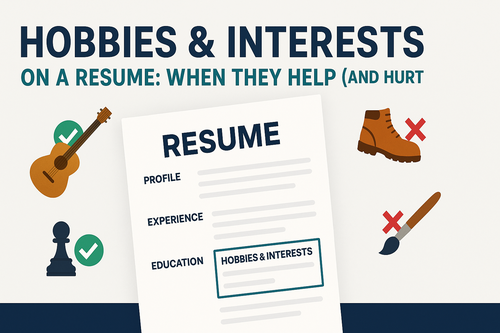
Including hobbies and interests on a resume can be a double-edged sword. When chosen wisely, they showcase personality, culture fit, and soft skills, particularly for creative or people-facing roles. However, irrelevant or controversial hobbies may distract or disqualify you, especially in 2025 ATS and recruiter screens.
Recruiters spend an average of six to seven seconds on an initial resume scan. A well-crafted hobbies section can be the detail that makes a hiring manager pause, remember you, and invite you to interview. A poorly chosen one can do the opposite — raising questions about judgment, professionalism, or fit before you ever get a chance to explain yourself.
The key is intentionality. Every hobby you list should earn its place by communicating something meaningful about who you are as a professional. This guide walks through exactly when hobbies help, when they hurt, and how to write them so they work in your favor.
| What to Do (Short Checklist) |
|---|
| Include hobbies that complement job skills |
| Highlight interests showing teamwork, leadership, or creativity |
| Avoid overly generic or divisive hobbies |
| Tailor hobbies section to company culture |
| Format simply for ATS readability |
Who This Guide Is For
This guide is designed for applicants across all experience levels, especially those applying to creative, customer service, sales, or culture-driven organizations. It’s relevant to beginners and seasoned professionals wanting to add personality while maintaining ATS compliance.
If you are a recent graduate with limited work history, a career changer bridging two fields, or a mid-career professional applying to a company that emphasizes culture fit, the hobbies section can be a strategic asset. If you are a senior executive in a conservative industry, you may find this section adds little — and this guide will help you decide when to leave it out entirely.
Job seekers applying through online portals should also note that many modern ATS platforms parse the hobbies section without issue, but the content still matters. A clean, text-based resume built with an ATS-friendly resume builder ensures your hobbies section — and everything else — is read correctly by both machines and humans.
Hobbies & Interests on a Resume — Definition & Purpose
Hobbies and interests are non-professional activities listed to provide insight into your character, reliability, interpersonal skills, and cultural fit. They complement your qualifications and can make you memorable to hiring managers.
But there is a subtle distinction worth understanding:
- Hobbies are activities you actively do — playing chess, running marathons, painting watercolors, contributing to open-source projects.
- Interests are topics or areas you engage with intellectually — behavioural economics, sustainable architecture, data privacy, contemporary poetry.
Both can be valuable on a resume, but they serve slightly different purposes. Hobbies demonstrate action and discipline — proof that you follow through on commitments outside of work. Interests demonstrate curiosity and intellectual range — signals that you will bring fresh perspectives to the team.
The purpose of this section is not to fill space. It is to answer a question every hiring manager is silently asking: “Would I enjoy working with this person?” Your experience section answers “Can they do the job?” Your hobbies section answers “Will they fit in here?”
Best-Practice Rules (Do / Don’t)
| Do | Don’t |
|---|---|
| List hobbies that demonstrate relevant soft skills | Include polarizing or political activities |
| Connect hobbies to professional traits (leadership, creativity) | Use clichés like “reading” or “traveling” without context |
| Keep the section brief and relevant | Overemphasize hobbies over core qualifications |
| Tailor hobbies to company values and role type | Include hobbies that may appear unprofessional |
| Avoid complex formatting or graphics | Add hobbies just to fill space |
Let’s unpack a few of these rules, because they are where most job seekers go wrong.
“Connect hobbies to professional traits” means you should never list an activity without explaining what it demonstrates. “Marathon running” is fine; “Marathon running — completed four full marathons, demonstrating long-term discipline and goal-setting” is better. The second version tells the recruiter why the hobby matters.
“Tailor hobbies to company values” requires research. Before you submit an application, spend ten minutes on the company’s careers page, LinkedIn, and social media. If they post about team hiking trips, a hiking hobby will resonate. If they emphasize innovation and side projects, your personal coding projects will land well. If you are applying through a job board, use the job description itself as your guide — the language the employer uses tells you what they value.
“Avoid complex formatting or graphics” is about ATS compatibility. Some resume templates include icons next to hobbies (a camera for photography, a book for reading). These can confuse older ATS parsers and cause the entire section to be skipped. Stick to plain text.
Examples by Level & Industry
Creative Roles
- Photography and digital art, with a focus on Adobe Creative Suite
- Freelance blogging on design trends and user experience
- Managing a personal Instagram account focused on editorial photography (2,500+ followers)
- Producing and editing a monthly podcast on independent film
- Participating in local art collectives and gallery exhibitions
People-Facing Roles
- Volunteer team coach for local youth sports league
- Event organizing and public speaking in community groups
- Mentoring new members in a professional association
- Leading a book club of 12 members for three years
- Organizing charity 5K runs with 200+ participants
Technical & Corporate
- Open-source software contributor
- Marathon running demonstrating discipline and perseverance
- Building and maintaining a personal finance blog with 5,000 monthly readers
- Competitive chess player (rated 1,800 ELO)
- Restoring vintage electronics as a side project
Entry-Level & Student Roles
- Treasurer of university debate society (managed a £3,000 annual budget)
- Part-time volunteer at a local food bank (Saturday shifts, two years)
- Captain of intramural football team
- Running a small Etsy shop selling handmade crafts
- Peer tutor for first-year computer science students
What Makes a Hobby “Attractive” to Employers
Not all hobbies are created equal in the eyes of a hiring manager. Some activities consistently stand out because they signal traits that translate directly to workplace performance. If you are searching for attractive hobbies for a resume, here is what makes certain activities more compelling than others.
Hobbies that demonstrate leadership. Anything where you organize, coordinate, or take responsibility for others — coaching a team, running a community group, leading a volunteer initiative — signals that you can step up when needed.
Hobbies that show measurable achievement. “Running” is generic. “Completed the London Marathon in 3:45” is specific and impressive. Numbers, milestones, and concrete outcomes make any hobby more attractive.
Hobbies that require rare skills. Activities like woodworking, coding side projects, or learning a second language demonstrate patience, technical aptitude, and a growth mindset. These are harder to fake and therefore more credible.
Hobbies that align with the role. A data analyst who lists “building dashboards for personal finance tracking” is showing relevant skills in a hobby context. A sales candidate who lists “competitive debating” is demonstrating persuasion and quick thinking.
Hobbies that show social intelligence. Team sports, group volunteering, and community organizing all suggest you can work well with others — a trait every employer values.
The least attractive hobbies are those that are passive, generic, or impossible to verify: “watching Netflix,” “hanging out with friends,” “listening to music.” These communicate nothing and waste valuable resume space.
Creative Hobbies That Stand Out
If you are applying for roles in design, marketing, content, or any field that values original thinking, creative hobbies on a resume can be particularly powerful. They demonstrate that you generate ideas, not just execute tasks.
Strong creative hobbies to consider:
- Writing — blogging, fiction, poetry, newsletters. Writing shows communication skills, which are valuable in nearly every role.
- Photography — especially if you can point to a portfolio, a following, or published work.
- Music — playing an instrument, composing, or performing. Music requires discipline, practice, and often collaboration.
- Visual art — painting, illustration, graphic design. These demonstrate aesthetic judgment and attention to detail.
- Video production — YouTube channels, short films, or editing work. Video skills are increasingly in demand across industries.
- Crafting and making — woodworking, ceramics, knitting, 3D printing. These show patience, precision, and a maker mindset.
- Cooking and baking — especially if you host events, develop recipes, or run a food blog. Cooking demonstrates creativity, planning, and hospitality.
When listing creative hobbies, always include a concrete detail: what you create, how often, and what the output looks like. “I write a weekly newsletter on design trends with 800 subscribers” is far more compelling than “I like writing.”
Hobbies for Biodata: A Quick Note
If you are applying for jobs in South Asia — or to companies with South Asian hiring practices — you may be asked to submit a biodata rather than a traditional resume. A biodata typically includes personal details (age, marital status, nationality) alongside education, experience, and hobbies.
In a biodata context, the hobbies section carries more weight than it does on a Western-style resume. Employers and matchmakers alike use it to assess personality, family background, and social compatibility. Common hobbies listed on biodata include:
- Reading (especially if you can name genres or authors)
- Sports (cricket, badminton, football)
- Music (listening or playing an instrument)
- Cooking
- Travelling
- Social work or volunteering
- Gardening
If you are preparing a biodata, the same principles apply: be specific, avoid controversy, and choose hobbies that reflect positively on your character. “Reading self-improvement and business books” is stronger than “reading.” “Volunteering at a local temple or community center” signals values that many biodata reviewers appreciate.
How to Customize Hobbies to a Job Description
- Research company culture and values.
- Choose hobbies that relate to desired soft skills (teamwork, initiative).
- Avoid hobbies irrelevant or contradictory to job environment.
- Tailor descriptions subtly to reinforce professional brand.
- Do not list hobbies if space is limited or if they add no value.
Let’s go deeper on each step, because customization is where most job seekers fall short.
Step 1: Research company culture. Look at the company’s website, LinkedIn page, Glassdoor reviews, and social media. What do they celebrate? What language do they use? A company that posts about “hackathons and innovation” will respond differently to hobbies than one that posts about “work-life balance and family values.”
Step 2: Map hobbies to soft skills. Take the job description and highlight every soft skill mentioned — teamwork, communication, leadership, creativity, adaptability, attention to detail. Then ask yourself: which of my hobbies demonstrates one of these? If the job asks for “strong communication skills,” your public speaking club membership is relevant. If it asks for “attention to detail,” your miniature painting hobby is relevant.
Step 3: Check for contradictions. If you are applying to a remote-first company that values flexibility, listing “enjoy working in a structured office environment” as an interest would be a red flag. If you are applying to a health-focused organization, listing “competitive eating” would be tone-deaf. Think about what each hobby implies.
Step 4: Write descriptions that reinforce your brand. Your resume should tell one coherent story. If your summary says “data-driven marketing professional,” your hobbies should not be “abstract painting and poetry” — unless you can frame them as “creative problem-solving through abstract art.” Consistency matters.
Step 5: Know when to skip it. If your resume is already packed with relevant experience, achievements, and skills, adding hobbies may dilute the impact. A two-page resume with a hobbies section that pushes key content to page three is worse than a two-page resume without hobbies.
Formatting Tips (ATS + Readability)
- Use a simple heading like “Hobbies & Interests” or “Interests.”
- List hobbies in a comma-separated or bulleted format.
- Keep this section short—3 to 6 items maximum.
- Avoid graphics, icons, or elaborate layouts.
- Ensure ATS scanners can easily parse the text.
Where to place the hobbies section. It should appear at the bottom of your resume, after your professional experience, education, and skills. Placing it higher signals that you are padding your resume with non-professional content.
How to format each entry. You have two options:
Comma-separated list (best for space-constrained resumes):
Hobbies & Interests: Marathon running, open-source contribution, chess (1,800 ELO), community volunteering
Bulleted list with brief descriptions (best when you have room and want to add context):
- Marathon running — completed four full marathons, demonstrating discipline and goal-setting
- Open-source contribution — active contributor to two GitHub projects with 500+ combined stars
- Chess — rated 1,800 ELO, demonstrating strategic thinking and patience
ATS considerations. Modern ATS platforms (Workday, Greenhouse, Lever, iCIMS) parse text-based resumes reliably, including the hobbies section. The problems arise with scanned PDFs, image-based resumes, or templates that use tables and graphics. If you are building your resume with a resume builder, choose a clean, single-column template to ensure every section — including hobbies — is parsed correctly. You can verify your resume’s ATS compatibility with a free resume score checker before submitting.
Checklist & Templates
| Hobbies Section Checklist |
|---|
| Are hobbies relevant and complementary to the job? |
| Is the section concise and easy to scan? |
| Are hobbies described to show positive traits? |
| Is formatting simple and ATS-compatible? |
| Have polarizing or controversial hobbies been omitted? |
| Does each hobby include a specific detail or outcome? |
| Is the section tailored to this specific application? |
Fill-in-the-Blank Template:
“[Hobby or interest] demonstrating [soft skill or characteristic relevant to role].”
Example:
“Community volunteering showcasing leadership and teamwork.”
Alternative Template (with measurable detail):
“[Hobby] — [specific achievement or detail], demonstrating [relevant trait].”
Example:
“Marathon running — completed the Berlin Marathon in 3:52, demonstrating long-term discipline and goal-setting.”
When Hobbies Genuinely Help Your Application
There are specific situations where a well-placed hobbies section meaningfully improves your chances.
When you are a recent graduate or career starter: With limited professional experience, hobbies can fill in the picture of who you are. A student applying for a marketing role who lists “managing a personal blog with 2,000 monthly readers” has demonstrated real marketing skills without a job title to back them up. Similarly, a graduate who captained a university sports team has shown leadership that no internship could replicate.
When the company culture values personal interests: Startups, creative agencies, and mission-driven organizations frequently look for cultural fit. These employers often read the hobbies section carefully. If a company’s careers page emphasizes work-life balance, outdoor culture, or community involvement, matching hobbies can strengthen your application. A startup that posts about team climbing trips will notice a candidate who lists “indoor bouldering, V5 level.”
When a hobby is directly transferable: Some hobbies are functionally equivalent to professional experience. Running a weekend cooking class demonstrates teaching and communication skills. Organizing a charity fundraiser demonstrates project management and stakeholder coordination. These deserve to be described, not just listed. A candidate who “organized a charity 5K with 200 participants and raised £8,000” has demonstrated event management, fundraising, and logistics — all transferable to a wide range of roles.
When you are changing careers: In a career transition, hobbies and side activities can bridge the gap between your old field and your target role. A former accountant applying for a UX design role who lists “UI/UX personal projects and design community participation” is using hobbies to support the career narrative. The hobbies section becomes evidence that the career change is genuine and backed by real interest, not just a whim.
When the role requires specific soft skills: Customer service, sales, teaching, and management roles all depend heavily on interpersonal skills. Hobbies that demonstrate empathy, patience, communication, or leadership can be as persuasive as professional experience. A sales candidate who lists “volunteer crisis hotline counselor” is showing active listening and emotional intelligence — exactly what a sales manager wants to see.
When Hobbies Hurt Your Application
Equally important is knowing when to leave this section out entirely.
When your resume is already two full pages: Hobbies are optional. If including them means cutting actual experience or achievements, cut the hobbies every time. A recruiter will always prefer a detailed description of your last role over a list of your weekend activities.
When the hobby signals risk to the employer: This is context-dependent, but hobbies that suggest physical danger (extreme sports, for example) may concern employers in industries where insurance, liability, or reliability matters. A candidate applying for a role requiring consistent attendance who lists “freestyle motocross” may raise questions about injury risk. This is not about judging the hobby — it is about understanding how an employer might perceive it.
When the hobby is generic and unadorned: Listing “reading” or “watching films” with no context tells a recruiter nothing useful. These are filler entries that occupy space without adding value. Either add context that makes them meaningful (“reading non-fiction on behavioural economics”) or leave them out.
When the hobby conflicts with company values: Research the company before including anything. A hobby related to hunting, for example, might be perfectly fine at one company and create a negative impression at an animal welfare organization. Similarly, listing “competitive poker” might be fine at a fintech startup but questionable at a bank.
When you are applying to highly conservative industries: Certain industries — law, finance, traditional corporate environments — tend to have less appetite for personal sections. In these fields, your professional credentials do all the talking. If you are applying to a traditional law firm or investment bank, a hobbies section may be seen as unprofessional or irrelevant. Check industry norms before including it. For example, an accountant resume typically focuses on certifications and technical skills rather than personal interests.
When the hobby is too time-consuming: Some hobbies imply a level of commitment that might concern an employer. Listing “training for Ironman triathlons” or “running a side business” may raise questions about whether you have time for the job. If your hobby requires 20+ hours per week, consider whether to include it at all.
Before and After: Transforming Weak Hobby Entries
The difference between a hobby that helps and one that hurts is often just how it is framed.
Before (weak):
Hobbies: Reading, travelling, cooking
After (strong):
Interests: Reading non-fiction on behavioural economics and decision-making; travelling independently across Southeast Asia (planned and managed all logistics); cooking and hosting regular dinners for groups of 10–15 people
The second version turns three generic words into a snapshot of curiosity, self-reliance, and social skills — all relevant to a wide range of professional roles.
Before (weak):
Interests: Gaming
After (strong):
Interests: Competitive online gaming — active member of a 20-person team requiring real-time coordination, strategy, and communication
The second version frames the same activity in a way that highlights teamwork and communication skills.
Before (weak):
Hobbies: Gym, movies, music
After (strong):
Hobbies: Strength training (four days per week, two years consistent); independent film analysis (published reviews on Letterboxd with 1,200 followers); learning piano (Grade 5 ABRSM)
The second version shows discipline, analytical thinking, and a commitment to learning — all traits employers value.
Before (weak):
Interests: Social media
After (strong):
Interests: Managing a personal Instagram account focused on sustainable fashion (3,500 followers, 4% average engagement rate)
The second version demonstrates content creation, audience building, and an understanding of social media metrics — directly relevant to marketing and communications roles.
Common Mistakes to Avoid
- Listing too many hobbies: Three to five well-chosen interests outperform a list of ten generic ones. More is not better. A long list suggests you are padding your resume and dilutes the impact of the hobbies that actually matter.
- Using the same hobbies for every application: Tailor this section the same way you tailor your summary and skills. What resonates with a tech startup may be irrelevant to a law firm. A hobby that helps at one company can hurt at another.
- Placing hobbies too high on the resume: This section belongs at the bottom, after all professional content. Moving it higher signals that you are padding.
- Spelling or grammar errors in the hobbies section: Recruiters notice these even in optional sections. Proofread everything. A typo in a hobby description is just as damaging as a typo in your experience section.
- Including hobbies that are too personal: Details about your family, religion, political views, or health should never appear in a hobbies section. These are protected characteristics in many jurisdictions and including them can create bias — or the appearance of bias — in the hiring process.
- Copying hobbies from online templates: Recruiters see the same generic hobbies (“reading, travelling, spending time with family”) on hundreds of resumes. If your hobbies section looks identical to everyone else’s, it adds no value. Make it specific to you.
- Forgetting to update the section: If you listed “captain of university cricket team” five years ago and you are now a mid-career professional, that hobby is stale. Update or remove it.
FAQ
Q: Can you put hobbies on a resume?
A: Yes, you can — but you should only do so when the hobbies add value. A hobbies section is optional and works best for recent graduates, career changers, and applicants to culture-driven companies. If your resume is already full of relevant experience, or if you are applying to a conservative industry, it is often better to leave hobbies off entirely.
Q: How do I add hobbies to a resume?
A: Add a section at the bottom of your resume with the heading “Hobbies & Interests” or “Interests.” List three to five hobbies in either a comma-separated format or as short bullet points with brief descriptions. Keep the section to four to six lines maximum, and make sure each hobby is specific and relevant to the role you are applying for.
Q: What are good interests to put on a resume?
A: Good interests are those that demonstrate transferable skills or positive character traits. Examples include: marathon running (discipline), team sports (collaboration), volunteering (empathy and community focus), blogging (communication), open-source contribution (technical skill), public speaking clubs (confidence), and mentoring (leadership). The best interests are specific, verifiable, and relevant to the job.
Q: What are attractive hobbies for a resume?
A: Attractive hobbies are those that signal desirable workplace traits: leadership (coaching, organizing events), achievement (completing marathons, winning competitions), rare skills (coding, woodworking, language learning), social intelligence (team sports, group volunteering), and alignment with the role (personal projects related to the job). Hobbies with measurable outcomes — numbers, milestones, or published work — are consistently more attractive than generic activities.
Q: What are good creative hobbies to include on a resume?
A: Strong creative hobbies include writing (blogs, newsletters, fiction), photography (especially with a portfolio or following), music (playing an instrument, performing), visual art (painting, illustration, design), video production (YouTube, editing), crafting (woodworking, ceramics, 3D printing), and cooking (especially if you host events or develop recipes). Always include a concrete detail — what you create, how often, and what the output looks like.
Q: What hobbies should I include in a biodata?
A: For a biodata, choose hobbies that reflect positively on your character and social compatibility. Common and effective options include reading (with specific genres or authors), sports (cricket, badminton, football), music (playing an instrument or active listening), cooking, travelling, volunteering or social work, and gardening. Avoid controversial or overly individualistic hobbies, and always add a specific detail to make each entry meaningful.
Q: Should I include hobbies on every resume?
A: Not always. Use discretion based on role, industry, and available space. Hobbies add the most value for recent graduates, career changers, and culture-driven applications. For senior roles in conservative industries, they are often unnecessary.
Q: Can hobbies improve ATS scores?
A: Rarely — hobbies mostly influence recruiter impressions rather than ATS rankings. However, if a hobby description naturally contains industry keywords (such as “open-source software contribution” for a developer role), it can provide a small ATS benefit. You can check how your resume scores with a free resume score checker.
Q: What hobbies are best for creative jobs?
A: Artistic activities, writing, design, social media content creation, photography, and community involvement in creative spaces. The key is being specific — “managing an Instagram account focused on editorial photography” is stronger than “photography.”
Q: Are controversial hobbies risky?
A: Yes. To maintain professionalism, avoid sensitive, political, or divisive interests. The goal of a hobbies section is to humanize you and signal good cultural fit — not to spark debate.
Q: How long should the hobbies section be?
A: Three to five items, written in one to two lines each if described, or as a short comma-separated list if kept brief. The entire section should take up no more than four to six lines on your resume.
Q: What if my hobbies are not impressive?
A: Frame everyday activities in terms of the skills they demonstrate. Even casual hobbies like cooking for friends or following financial news can be written to reflect relevant traits. If nothing fits or adds value, simply leave the section out.
Build, Score & Track Your Job Search with ResumeMate
Resume Builder → — Create an ATS-ready resume in minutes.
Resume Score Checker → — See how your resume scores against ATS systems instantly.
Job Board → — Browse jobs matched to your resume.
Job Tracker Chrome Extension → — Track every application, deadline, and follow-up in one place — free.