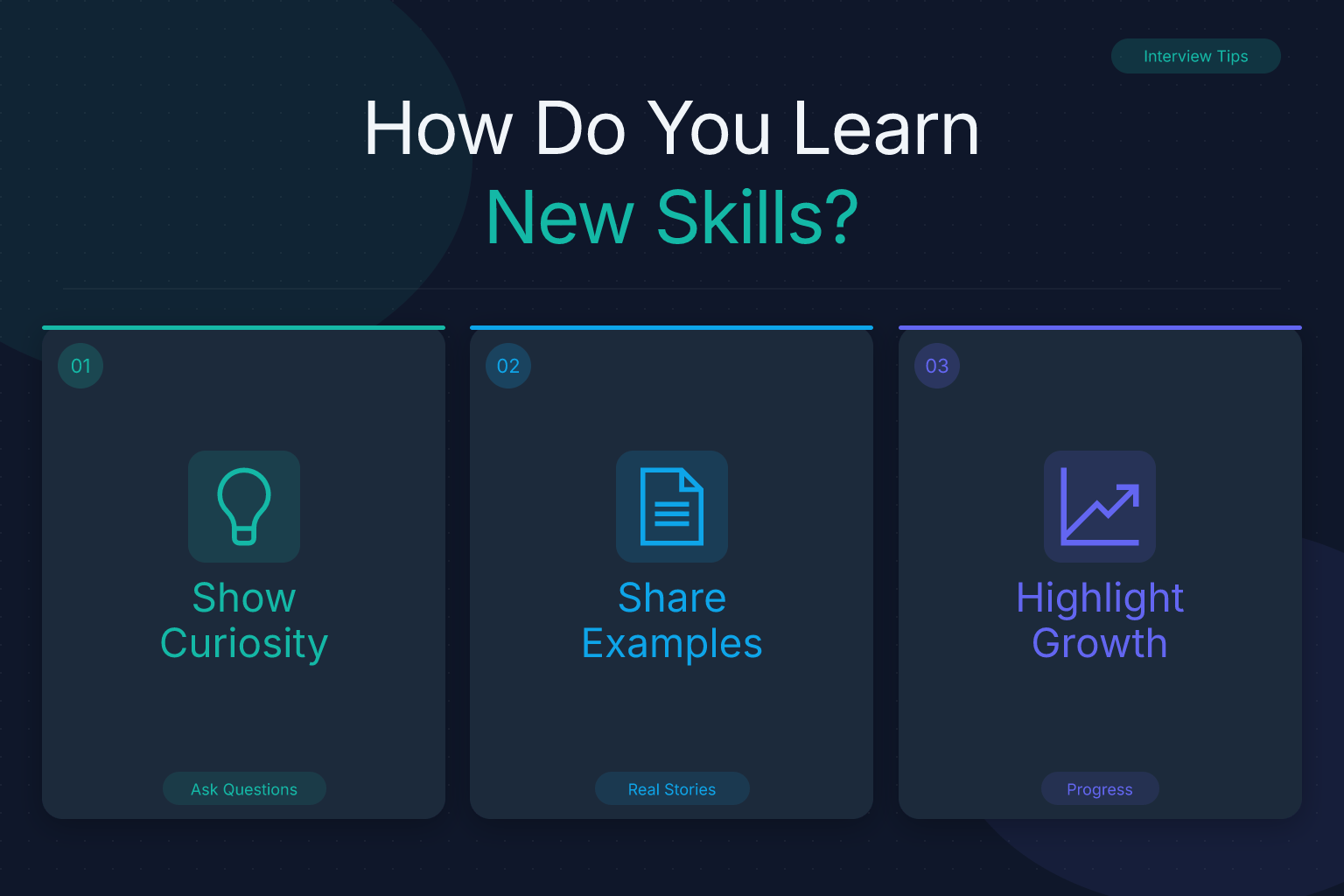
If you’re preparing for an interview, knowing how to answer “how do you learn new skills” can set you apart from candidates who freeze or give a vague, forgettable response. This question shows up in interviews for almost every role — from entry-level positions to senior leadership — because hiring managers want to know whether you can adapt, grow, and keep pace with a changing job. The good news: with a clear structure and a specific example, you can turn this question into a chance to prove you’re a fast, self-aware learner.
Key Takeaways
- Name a specific learning method (e.g., structured courses plus hands-on practice) and support it with a recent example of a skill you learned, including a measurable result.
- Structure your answer using the STAR method (Situation, Task, Action, Result) and quantify the outcome whenever possible.
- Avoid vague statements like “I’m a quick learner”; instead describe your step-by-step learning process and how you handle getting stuck.
- Tailor your answer to the job by referencing specific tools or processes from the job description and explaining how you would learn them.
- Practice your answer to be 45-75 seconds, using a bullet-point outline, and prepare a second example in case of follow-up.
Key points to remember:
- The best answers name a specific learning method (e.g., structured courses, hands-on projects, peer feedback) and tie it to a real skill you acquired, with a measurable result.
- Interviewers ask this to assess your adaptability, self-awareness, and whether your learning style fits the team’s pace, tools, and culture.
- Use a modified STAR method (Situation, Task, Action, Result) to structure your example, and quantify the outcome whenever possible — even a rough number helps.
- Avoid vague answers like “I learn by doing” without specifics; instead, describe your step-by-step process and what you do when you get stuck.
- Mention how you stay current with industry trends (newsletters, courses, communities) to show proactive, continuous learning.
Why Interviewers Ask “How Do You Learn New Skills?”
When an interviewer asks how do you learn new skills, they’re not looking for a textbook definition of learning styles. They’re probing three things:
- Adaptability — Can you pick up new tools, processes, or domain knowledge without hand-holding? In most jobs, the software, market, or customer needs change every few months. A candidate who only learns when forced will struggle.
- Self-awareness — Do you know how you learn best? Someone who says “I just figure it out” may be hiding a lack of reflection. A thoughtful answer shows you’ve analyzed your own process.
- Fit with the team’s pace — If the role requires learning a new CRM in week one, a candidate who prefers slow, structured courses might not be the best fit. Conversely, a fast-moving startup may love someone who learns by jumping into projects.
This question often appears alongside other behavioral prompts like “Tell me about a time you had to learn something quickly” or “What’s your adaptability style?” If you’ve already prepared an answer for how to answer what is your adaptability with examples, you can reuse much of that material here — just shift the focus to the learning process rather than the change itself.
What a Strong Answer Covers
A memorable answer to “How do you learn new skills?” has three layers. Missing any one of them makes your response feel incomplete.
1. Your learning method (the “how”)
Be specific. Instead of “I learn by doing,” say something like:
- “I start with the official documentation or a short course to get the fundamentals, then I build a small project to apply it.”
- “I learn best when I can watch someone do it once, then try it myself with feedback.”
- “I break a new skill into micro-steps and practice each one daily for 15 minutes until it sticks.”
Naming your method shows you’ve thought about this. It also gives the interviewer a concrete picture of how you’d approach their onboarding.
2. A real example (the “proof”)
Don’t just describe your method in theory. Anchor it with a story: a skill you learned recently, why you learned it, and what happened as a result. The example should be recent (within the last 1–2 years) and relevant to the job if possible.
3. Relevance to the role (the “so what”)
End by connecting your learning approach to the job. For example: “Since this role uses Salesforce and I’ve never used it, I’d follow the same process — take the Trailhead modules, then rebuild a sample pipeline in a sandbox before my first week ends.” This shows you’re already thinking about how you’d ramp up.
Step-by-Step: How to Structure Your Answer
Use a modified STAR method to keep your answer tight and results-focused. Here’s the framework:
Situation — What skill did you need to learn, and why? (One sentence.) Task — What was the goal or deadline? (One sentence.) Action — Walk through your learning process in 2–3 steps. This is the core of your answer. Result — What improved, changed, or got accomplished? Quantify if you can.
Example using the framework
Situation: “Last year, my team switched from Excel to Google Sheets for all reporting, and I was the only one who had never used it.” Task: “I needed to rebuild our monthly dashboard within two weeks so leadership could still see the numbers.” Action: “I started with Google’s free certification course to learn the formulas and pivot tables. Then I rebuilt our old dashboard in a test sheet, comparing outputs side by side with the Excel version to catch errors. When I got stuck on array formulas, I asked a teammate for a 20-minute walkthrough instead of guessing.” Result: “I finished the dashboard in 10 days, and it actually loaded faster than the old one. My manager asked me to train the rest of the team on the new setup.”
That answer is specific, shows a process, and ends with a concrete win. It takes about 45 seconds to say out loud — perfect for an interview.
Example Answers for Different Scenarios
Here are three full sample answers tailored to common situations. Adapt the details to your own experience.
Entry-level or recent graduate
“I learn best through a mix of structured courses and hands-on practice. For example, in my final semester I needed to learn Python for a data analysis project, but I had only used Excel before. I took a free online course on Python basics, then immediately applied each concept to a small dataset from my part-time job. Whenever I got an error I couldn’t solve, I searched Stack Overflow and read the documentation rather than asking for help right away. By the end of the semester, I had automated a weekly report that used to take two hours, cutting it down to 15 minutes. I’d use the same approach here — start with your internal training materials, then build a small practice project using your actual data.”
Career changer
“I’m a very structured learner. When I decided to move from retail management into digital marketing, I knew I needed to learn SEO, Google Analytics, and content strategy from scratch. I created a 12-week plan: weeks 1–4 for SEO fundamentals through a certification course, weeks 5–8 for hands-on practice by optimizing my friend’s small business website, and weeks 9–12 for analytics by setting up a test property and tracking real traffic. I also joined two marketing communities and asked for feedback on my work. Within four months, I had three case studies I could show in interviews, and one of them led to a freelance project. I’d bring that same structured plan to this role — especially since you mentioned the team is adopting a new marketing automation tool.”
Technical or fast-paced role
“I learn fastest when I can pair structured learning with immediate application. Last quarter, our team adopted a new project management tool, and I volunteered to be the early adopter. I spent one evening going through the vendor’s video tutorials, then the next morning I set up a test project and migrated one of our real workflows into it. I documented what worked and what didn’t, then ran a 30-minute lunch-and-learn for the team. Within two weeks, everyone was using the new tool, and our project visibility improved enough that we cut our weekly status meeting from 45 minutes to 20. For this role, I’d do the same with your internal systems — learn the basics, test on a real but low-risk task, then share what I learned.”
Common Mistakes to Avoid
Even well-prepared candidates sabotage this question with a few predictable errors. Here’s what to watch out for:
- Being too vague. “I’m a quick learner” or “I just pick things up” tells the interviewer nothing. Always follow up with a specific method and example.
- Rambling about the learning process without a result. The interviewer cares about outcomes. If you spent three paragraphs describing the course you took but never said what you did with the skill, you’ve missed the point.
- Choosing an irrelevant or outdated example. Learning to ride a bike at age 10 doesn’t prove you can learn a new CRM at work. Pick something from the last two years, ideally work-related.
- Saying you don’t need to learn anything new. Even if you’re an expert, the question is about how you learn, not whether you need to. Saying “I already know everything for this role” comes across as arrogant and closed-minded.
- Ignoring the job description. If the role requires learning a specific tool or process, mention it by name. A generic answer that could apply to any job is forgettable.
Tailoring Your Answer & Showing Continuous Learning
The best way to make your answer feel custom is to mine the job posting for learning signals. Look for:
- Tools and software — If the posting lists Salesforce, Figma, SQL, or any tool you haven’t used, mention how you’d learn it.
- Industry or domain knowledge — If the company works in healthcare, fintech, or logistics, show you understand the learning curve for that domain.
- Soft skills — If the posting emphasizes “adaptability,” “curiosity,” or “growth mindset,” weave those words into your answer naturally.
For example, if the job description says “must be comfortable learning new marketing automation platforms,” your answer could end with: “I noticed you use HubSpot, which I haven’t worked with directly. Based on how I learned Marketo last year — through their certification plus a sandbox project — I’d follow the same path and be productive within the first two weeks.”
This level of specificity shows you’ve done your homework and makes your answer impossible to confuse with a generic script.
Your answer to this question shouldn’t exist in a vacuum. Interviewers often cross-check what you say with your resume, portfolio, and LinkedIn. If you claim to be a proactive learner, your materials should back that up. Here’s how to reinforce your answer:
- Update your resume with the skill you learned. If you learned Python, Google Analytics, or a new project management tool, add it to your skills section. Use a free resume builder like ResumeMate to add it cleanly without messing up your formatting.
- List certifications or courses in a dedicated section. Even free courses from Coursera, HubSpot Academy, or Google count. They show you invest time in learning.
- Mention learning in your cover letter or summary. A line like “Self-taught in SQL and Tableau over the past year” signals curiosity before the interview even starts.
- Bring a portfolio or work sample. If you learned a skill and applied it to a project, show the result. A before-and-after screenshot or a link to a GitHub repo speaks louder than any verbal claim.
If you’re changing industries, check out our guide on how to write a resume for a new industry — it covers how to frame self-taught skills when you lack direct experience.
Practice Tips & FAQ
You can have a perfect answer written down and still stumble when you say it out loud. Here’s how to practice so it comes out naturally:
- Write a bullet-point outline, not a script. Scripts sound robotic. Write down your Situation, Task, Action steps, and Result as short phrases, then speak from those.
- Time yourself. Aim for 45–75 seconds. If you’re over 90 seconds, cut details. If under 30, add one more specific action step.
- Record yourself on your phone. Listen for filler words (“um,” “like”), rambling, or a monotone delivery. Fix the biggest issue, then record again.
- Practice with a friend or in front of a mirror. Saying it to another person forces you to make eye contact and adjust your pacing.
- Prepare a follow-up example. Sometimes the interviewer will ask, “Can you give me another example?” Have a second, shorter story ready — maybe a time you learned a soft skill like giving feedback or managing up.
If you’re also preparing for other common interview questions, our guide on how to answer what makes you unique with examples pairs well with this one, since your learning style can be part of what makes you unique.
Frequently Asked Questions
Q: What is the best answer to “How do you learn new skills?” A: The best answer names a specific learning method (e.g., structured courses plus hands-on practice), gives a recent example of a skill you learned using that method, and ends with a measurable result. Avoid vague statements like “I’m a quick learner” without proof.
Q: How do I answer if I don’t have a formal learning process? A: Even if you’ve never thought about it, you do have a process. Think back to the last time you learned something — a new app, a recipe, a workout routine. What did you do first? Did you watch a video, read instructions, or just try it? Describe that sequence honestly, then apply it to a work-related skill.
Q: Should I mention online courses or certifications in my answer? A: Yes, if they’re relevant and recent. Saying “I took a Google Analytics certification course and then applied it to a real project” is stronger than “I read some blog posts.” Just make sure you also describe the application, not just the course.
Q: How long should my answer be? A: Aim for 45–75 seconds. That’s enough time to give a method, a specific example, and a result without rambling. If the interviewer wants more detail, they’ll ask a follow-up.
Q: What if the skill I learned isn’t directly related to the job? A: That’s fine. The interviewer cares about your process, not the specific skill. Learning to edit videos, speak basic Spanish, or use a new budgeting app all demonstrate a learning method. Just connect the process to how you’d learn the job’s tools.
Q: Can I say I learn best by teaching others? A: Absolutely. Teaching is a powerful learning method. If you’ve learned something by preparing a training session or writing documentation for teammates, that’s a great example. It also shows collaboration and communication skills.
Track Every Application While You Job Hunt
Stop losing track of where you’ve applied. The ResumeMate Job Tracker is a free Chrome extension that tracks every application, deadline, and follow-up in one place — right from your browser.
For example, imagine you apply to 15 jobs in a week. Without a tracker, you might forget which companies you’ve contacted, when to follow up, or which version of your resume you sent. With ResumeMate, you can log each application with the date, role, and notes, set reminders for follow-ups, and see your entire pipeline at a glance. One user reported that after installing the extension, they stopped double-applying to the same role and never missed a follow-up deadline again, which helped them land three more interviews in a month.