How do you stay organized? Interview answer + examples
“How do you stay organized?” is one of those interview questions that sounds simple but trips up a lot of candidates. It’s not a trick question — but it is a test. Interviewers ask it to figure out whether you can handle multiple priorities, meet deadlines, and keep your work from spiraling into chaos. A vague answer like “I’m just naturally organized” won’t cut it. You need a specific, credible system you can describe in under two minutes.
Key Takeaways
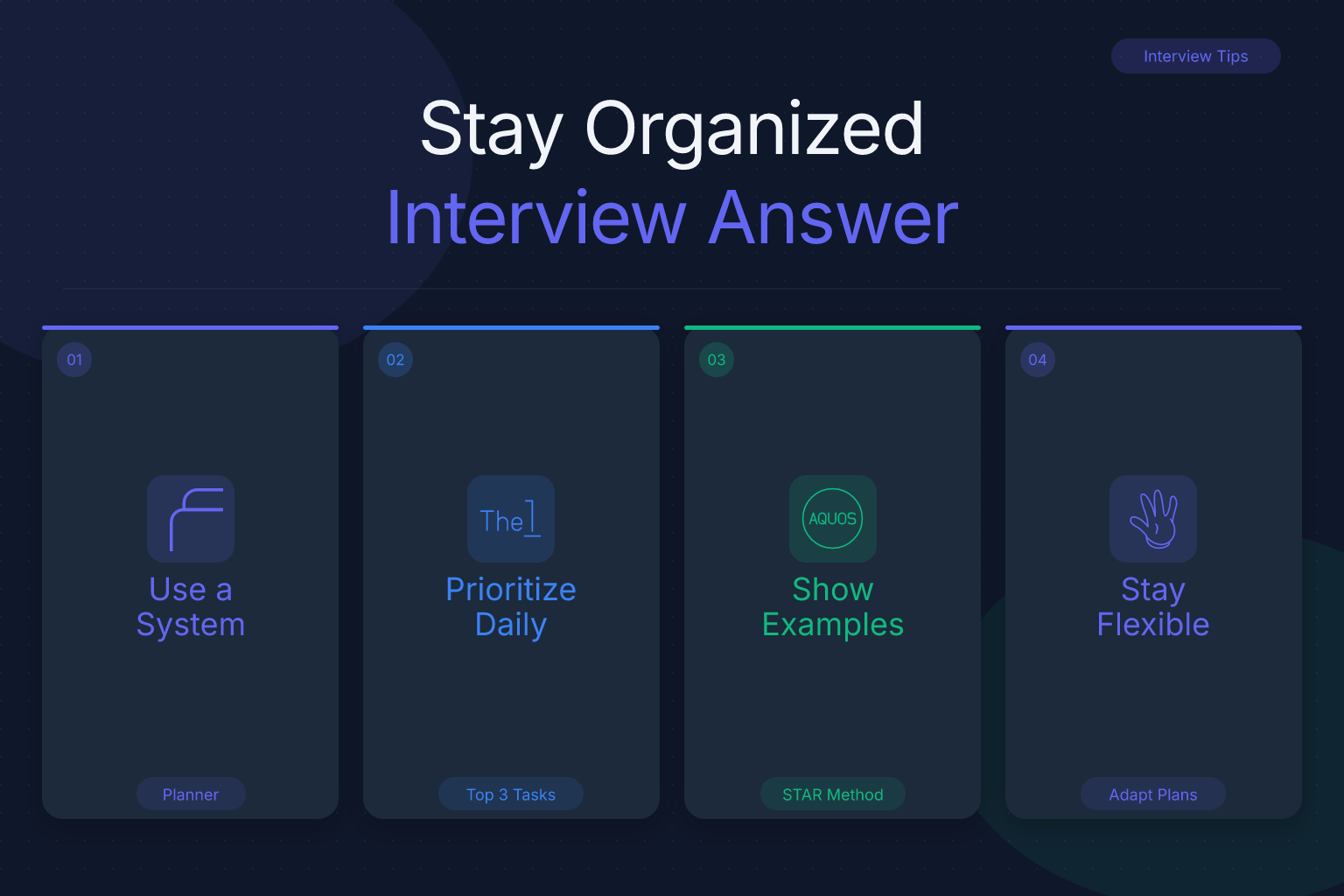
- The best answers name a specific system or tool (like a task manager, calendar blocking, or a prioritization framework) and show it in action with a real example.
- Interviewers ask this question to assess reliability, time management, and how you handle competing priorities — not to hear that you’re a perfectionist.
- Use the STAR method (Situation, Task, Action, Result) to structure your answer around a concrete work scenario.
- Avoid vague claims like “I’m very organized” or “I use my inbox as my to-do list” — these signal a lack of a real system.
- Tailor your answer to the role: a project manager’s answer should sound different from a customer service rep’s or a software engineer’s.
Summary Table
| What to Do | Why It Matters | Time |
|---|---|---|
| Name a specific tool or system you use | Proves your organization is intentional, not accidental | 15 seconds |
| Give a concrete example using STAR | Shows your system works under real pressure | 45-60 seconds |
| Connect your method to the job’s demands | Demonstrates you understand what the role requires | 20 seconds |
| Practice your answer out loud | Prevents rambling and keeps you under two minutes | 10 minutes before the interview |
How to Answer “How Do You Stay Organized?” — The Core Strategy
Interviewers aren’t looking for a personality trait. They’re looking for evidence of a repeatable system. The strongest answers follow a simple three-part structure:
- Name your system. What do you actually use? A task manager like Asana or Trello? Calendar blocking? A physical notebook? A prioritization matrix? Be specific.
- Show it in action. Give one concrete example of a time your system helped you juggle competing deadlines or catch a critical detail.
- Connect it to the role. Explain why your approach will work in this specific job.
Here’s what that sounds like in practice:
“I use a combination of calendar blocking and a Kanban board in Trello. Every Monday morning, I block 30 minutes to review my projects, move tasks into ‘This Week,’ ‘In Progress,’ and ‘Blocked,’ and then time-block my calendar around my top three priorities. For example, when I was coordinating a product launch with a hard deadline, this system helped me spot two weeks early that a vendor deliverable was slipping — I reallocated resources and we still shipped on time. I’d bring the same approach here, especially since this role involves managing multiple client accounts simultaneously.”
That answer names a system, proves it with a result, and ties it to the job. That’s the formula.
Why Interviewers Ask “How Do You Stay Organized?”
Understanding the intent behind the question helps you answer it more effectively. Interviewers ask this because:
- They want to know if you can handle the workload. Every job has more tasks than hours in the day. They need someone who can triage.
- They’re testing self-awareness. Can you articulate how you work? People who can describe their process are usually more deliberate about it.
- They’re probing for reliability. Missed deadlines and dropped balls are expensive. Your answer signals whether you’re a risk.
- They want to see if your style fits the team. A startup that moves fast might value flexibility over rigid systems. A compliance-heavy role might value meticulous documentation.
For example, a hiring manager at a marketing agency once told me she asks this question because a previous coordinator missed a major campaign deadline after relying on memory alone. She now looks for candidates who can name a specific tool or routine — not just claim to be organized.
This question often appears alongside “How do you prioritize your work?” — the two are closely related, and interviewers sometimes ask both in the same conversation. If you’re preparing for a behavioral interview, it’s worth practicing both.
5 Example Answers for Different Roles
1. Project Manager
“I live by a combination of a master project timeline and daily stand-up notes. I use Asana for the big picture — every project has milestones, dependencies, and owners — and I keep a running ‘parking lot’ list for issues that come up mid-sprint. Each morning, I spend 15 minutes reviewing what’s due this week and what’s blocked. When I managed a website migration with 14 stakeholders, this system helped me catch a content freeze conflict three weeks out. We adjusted the timeline, communicated early, and launched without a single missed deadline.”
Why it works: It names specific tools, shows a daily habit, and proves the system with a measurable outcome.
2. Customer Service Representative
“I use a ticketing system to track every customer interaction, and I keep a personal checklist for follow-ups. At the start of each shift, I review open tickets by priority and age, then work through them in order. I also set calendar reminders for any customer I promised to call back. In my last role, I handled 40-60 tickets a day, and my follow-up rate was consistently above 95% because nothing fell through the cracks.”
Why it works: It’s concrete, role-appropriate, and includes a metric that demonstrates reliability.
3. Software Engineer
“I use a combination of sprint boards and a personal ‘focus list.’ Our team works in two-week sprints, so I track my tickets in Jira and keep a separate Notion page for my daily top three. I also block two hours every morning for deep work before meetings start. When I was building a payment integration with a tight deadline, this system helped me flag a dependency issue early — I raised it in stand-up, we reprioritized, and the feature shipped on schedule.”
Why it works: It shows you understand team workflows (sprints, stand-ups) and have a personal system on top of that.
4. Administrative Assistant or Executive Assistant
“I use a shared calendar for my executive’s schedule and a color-coded task list for everything else. Every Friday, I do a ‘week ahead’ review where I confirm all meetings, flag any conflicts, and prep materials for the following week. I also keep a ‘waiting on’ folder for anything I’ve delegated or requested from others. This system helped me catch a double-booked client meeting and a travel conflict in the same week — both were resolved before they became problems.”
Why it works: It demonstrates proactive organization, not just reactive task management.
5. Entry-Level or Recent Graduate
“I use a simple three-list system: a master list of everything, a weekly list of what’s due this week, and a daily list of my top three. I learned this in college while juggling a part-time job, a capstone project, and a student org leadership role. Every Sunday night, I plan my week. Every morning, I pick my top three. It’s low-tech but it works — I never missed a deadline across four semesters of overlapping commitments.”
Why it works: It’s honest, specific, and shows you can manage multiple priorities even without years of work experience. If you’re early in your career, this kind of answer is stronger than pretending you use enterprise project management software.
Common Mistakes to Avoid
1. Being Vague
“I’m just a very organized person” is not an answer. It’s a claim with no evidence. Interviewers hear this constantly, and it tells them nothing about how you actually work.
Fix: Name a tool, a habit, or a framework. Even “I use a paper planner and review it every morning” is better than a vague personality claim.
2. Using Your Inbox as a To-Do List
Saying “I use my email inbox to track everything” is a red flag. It suggests you’re reactive, not proactive. Inboxes are where other people’s priorities live.
Fix: Describe a system that’s separate from email — a task manager, a notebook, a spreadsheet, a Kanban board.
3. Rambling About Every Tool You’ve Ever Tried
“I’ve used Asana, Trello, Notion, Monday.com, a bullet journal, and Google Calendar…” sounds scattered, not organized. Pick one or two tools and go deep.
Fix: Choose the system you actually use now and describe it in detail. Depth beats breadth.
4. Claiming Perfection
“I never miss a deadline” or “I’ve never forgotten anything” sounds either dishonest or like you’ve never had a demanding job. Everyone drops a ball occasionally. What matters is how you recover.
Fix: If relevant, briefly mention how your system helps you catch mistakes early — that’s more credible than claiming you never make them.
5. Ignoring the Role’s Context
A rigid, documentation-heavy system might be perfect for a compliance role but overkill for a fast-moving startup. Your answer should reflect the environment you’re interviewing for.
Fix: Research the company culture before the interview. If they emphasize speed and iteration, emphasize flexibility. If they emphasize accuracy and compliance, emphasize thoroughness.
How to Tailor Your Answer to the Job Description
The best answers don’t just describe your system — they connect it to what the employer actually needs. Here’s how to do that in three steps:
- Read the job description carefully. Look for phrases like “manage multiple priorities,” “fast-paced environment,” “attention to detail,” “meet deadlines,” or “coordinate with multiple stakeholders.”
- Match your system to those demands. If the role mentions “multiple priorities,” emphasize how you triage and reprioritize. If it mentions “attention to detail,” emphasize your review process or checklists.
- Use their language. If the job description says “cross-functional collaboration,” use that phrase when describing how you coordinate with other teams.
For example, if you’re applying for a role that emphasizes “managing competing deadlines,” your answer might sound like:
“I use a priority matrix to sort tasks by urgency and impact. Every morning, I identify my top three tasks that will move the needle, and I protect time on my calendar for those before anything else. When two deadlines collided on a recent project, I communicated early with both stakeholders, negotiated a one-day extension on the lower-priority item, and delivered both on time.”
This answer directly addresses the “competing deadlines” concern from the job description.
How to Practice Your Answer
You don’t want to sound scripted, but you do want to sound prepared. Here’s a simple practice routine:
- Write out your answer using the three-part structure (system, example, connection to role).
- Time yourself. Aim for 60-90 seconds. If you’re over two minutes, cut something.
- Say it out loud three times. The first time will feel awkward. The third time will feel natural.
- Record yourself on your phone and listen back. You’ll catch filler words (“um,” “like,” “you know”) and awkward phrasing.
- Prepare a follow-up. Interviewers often ask, “Can you give me another example?” Have a second scenario ready.
If you’re preparing for a broader behavioral interview, it’s worth reviewing related questions like “What is your problem-solving style?” and “Tell me about a time you were successful.” — these often come up in the same conversation.
What If You’re Not Naturally Organized?
Here’s the honest truth: you don’t need to be a naturally organized person to answer this question well. You need to have a system that compensates for whatever your natural tendencies are.
If you’re someone who tends to forget things, your answer might emphasize external systems — calendar reminders, checklists, a task manager that sends notifications. That’s a perfectly good answer. In fact, it can be more compelling than “I’m naturally organized” because it shows self-awareness and a deliberate solution to a real challenge.
For example:
“I’ll be honest — I’m not someone who can keep everything in my head. So I’ve built a system that doesn’t rely on memory. Every task goes into my task manager the moment it’s assigned, I set reminders for anything with a deadline, and I do a 10-minute review at the end of each day to plan tomorrow. This system has kept me on track through some genuinely chaotic periods, including a quarter where I was covering for two colleagues on leave.”
This answer is honest, specific, and demonstrates self-awareness — all qualities interviewers value.
FAQ
Q: How do you answer “How do you stay organized?” in an interview?
A: Name a specific system or tool you use (like a task manager, calendar blocking, or a prioritization framework), give a concrete example of it working under pressure using the STAR method, and connect it to the demands of the role you’re interviewing for. Keep your answer under two minutes.
Q: What is a good answer to “How do you stay organized?”
A: A good answer names a real system, proves it with a specific example, and ties it to the job. For example: “I use calendar blocking and a Kanban board. Every Monday I plan my week, and every morning I identify my top three priorities. This helped me catch a slipping vendor deadline two weeks early on a recent product launch.”
Q: How do you respond to “How do you stay organized?” if you’re not naturally organized?
A: Be honest and emphasize your external systems. Say something like, “I don’t rely on memory — every task goes into my task manager immediately, I set reminders for deadlines, and I do a daily review. My system compensates for my natural tendencies, and it’s kept me on track through busy periods.”
Q: What should I avoid saying when asked about organization?
A: Avoid vague claims like “I’m just a very organized person,” avoid saying you use your email inbox as your to-do list, and avoid claiming you never miss deadlines. These answers lack evidence and can signal a lack of a real system.
Q: How long should my answer to “How do you stay organized?” be?
A: Aim for 60-90 seconds. That’s enough time to name your system, give one concrete example, and connect it to the role. If you’re over two minutes, you’re probably rambling.
Q: Is “How do you stay organized?” a behavioral interview question?
A: Yes. It’s a behavioral question that asks you to describe how you work. The STAR method (Situation, Task, Action, Result) is an effective way to structure your answer, especially the example portion.
Q: How is this question different from “How do you prioritize your work?”
A: “How do you stay organized?” is broader — it covers your overall system for managing tasks, information, and time. “How do you prioritize your work?” is more specific — it asks how you decide what to do first when everything is urgent. You can read our full guide on answering prioritization questions for more detail.
Related articles:
Track Every Application While You Job Hunt
Stop losing track of where you’ve applied. The ResumeMate Job Tracker is a free Chrome extension that tracks every application, deadline, and follow-up in one place — right from your browser.