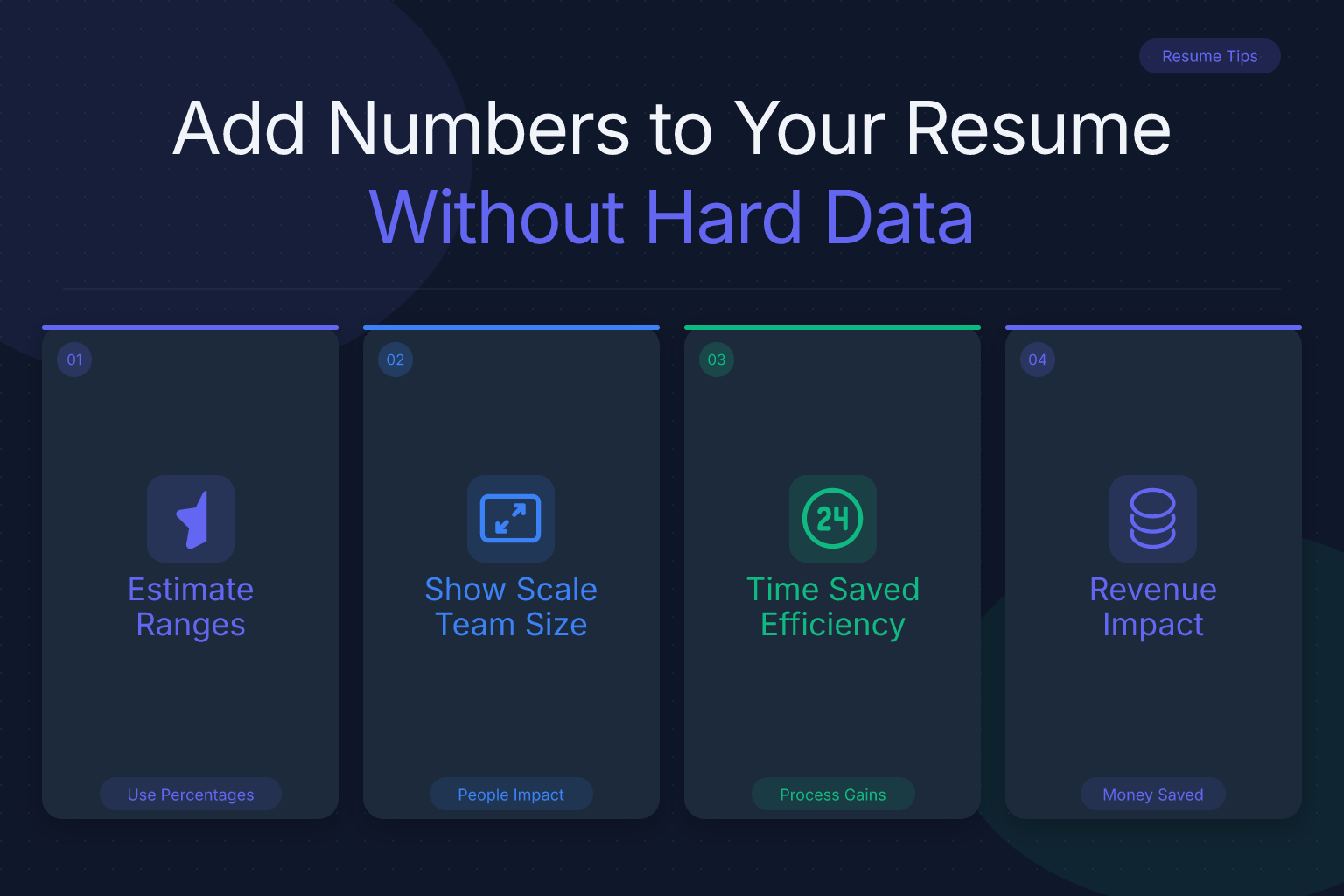
How to Add Numbers to Your Resume When You Don’t Have Data
You know that adding numbers to your resume makes it more compelling, but what if you don’t have hard data? Maybe you worked in a role where metrics weren’t tracked, or you’re early in your career and haven’t managed budgets or led teams. The good news: you can still quantify your impact. Recruiters and hiring managers look for evidence of results, and numbers are the fastest way to deliver that evidence — but they don’t always need to be exact. This guide shows you how to add credible, meaningful numbers to your resume even when you think you have none.
Key Takeaways
- You can estimate numbers using ranges, averages, and proportions when exact figures aren’t available — just be honest and consistent.
- Quantify the scope of your work by including team sizes, budgets, timelines, and volumes that you do know.
- Turn soft achievements into hard numbers by counting frequency, scale, or the number of people impacted.
- Use before-and-after comparisons to show improvement even without precise data.
- When numbers truly aren’t possible, describe the process and qualitative impact in a way that still demonstrates value.
| What to Do | Why It Matters | Time |
|---|---|---|
| Estimate ranges and averages | Gives recruiters a concrete sense of scale | 5-10 min per bullet |
| Use percentages and proportions | Shows relative improvement without exact figures | 5 min per bullet |
| Quantify scope (team, budget, timeline) | Demonstrates responsibility level | 10 min to gather info |
| Turn frequency into numbers | Makes soft skills measurable | 5 min per skill |
| Compare before and after | Highlights your direct impact | 10 min to recall |
Why Numbers Matter on a Resume (Even When You Think You Have None)
Recruiters scan resumes in seconds, and numbers jump off the page. A bullet that says “Improved customer satisfaction” is forgettable. One that says “Improved customer satisfaction scores by 15% within 3 months” tells a story. But many job seekers freeze at this point because they never had access to dashboards, sales reports, or formal performance metrics. You might have worked in a small business, a non-profit, or an entry-level role where data simply wasn’t collected.
Here’s the reality: you don’t need a company’s official numbers to quantify your work. You can build credible estimates from your own experience. The key is to be truthful and avoid fabricating data. When you use phrases like “approximately,” “over,” or “up to,” you signal that the number is an estimate while still giving the reader a concrete picture of your impact. This approach works because hiring managers care more about the magnitude of your contribution than whether you can cite a database report.
Before you start adding numbers, it helps to see how your current resume stacks up. Run it through a free ATS resume checker to identify which sections need more quantitative punch. The feedback will show you exactly where numbers would make the biggest difference.
Start With What You Do Know: Estimate Ranges and Averages
You likely have a rough sense of your daily, weekly, or monthly workload. Turn that into a range. If you handled customer inquiries, ask yourself: how many did you typically field in a day? Even if you never counted, you can estimate based on memory. A safe approach is to use a conservative range.
Example:
- Instead of: “Answered customer calls.”
- Try: “Handled approximately 40–60 customer inquiries daily, resolving issues on the first call 90% of the time.”
If you managed inventory, you might not know the exact number of items, but you can estimate: “Oversaw inventory of over 500 SKUs, reducing stock discrepancies by roughly 20%.”
When estimating, stick to round numbers and avoid precise figures that imply you have data you don’t. Words like “roughly,” “about,” and “nearly” are your friends. They show you’re being honest while still providing scale.
Use Percentages and Proportions to Show Relative Impact
Percentages are powerful because they show change without needing absolute numbers. If you streamlined a process, you can estimate the time saved as a percentage. If you grew a social media following, you can estimate the percentage increase even if you don’t remember the exact follower count.
Example:
- Instead of: “Made the scheduling system more efficient.”
- Try: “Reduced scheduling time by an estimated 30% by introducing a shared calendar system.”
To arrive at a percentage, think in relative terms. Did the task take half as long? That’s a 50% reduction. Did you handle about a third more clients? That’s a 33% increase. You don’t need the raw numbers to calculate the proportion — just your honest assessment of the change.
Be careful not to overstate. If you’re unsure, use a range: “Increased efficiency by 20–30%.” This shows confidence in the improvement without claiming a precise figure you can’t back up.
Quantify the Scope of Your Work: Team Size, Budget, Timeline
Even if you can’t measure your direct output, you can quantify the context in which you worked. Numbers that describe the scale of your responsibilities are just as valuable as outcome metrics. They tell a recruiter the level of complexity you handled.
What to quantify:
- Team size: “Collaborated with a cross-functional team of 8 to launch a new product feature.”
- Budget: “Managed a departmental budget of $15,000 for office supplies and vendor contracts.”
- Timeline: “Completed a 3-month website redesign project 2 weeks ahead of schedule.”
- Volume: “Processed an average of 200 invoices per week with 99% accuracy.”
- Audience or reach: “Created training materials used by over 150 employees across 4 locations.”
These numbers are usually easy to recall because they were part of your daily environment. If you’re unsure about a budget figure, ask a former colleague or check old emails. Even a ballpark figure is better than leaving the scope invisible.
Turn Soft Achievements Into Hard Numbers Using Frequency and Scale
Soft skills like training, mentoring, and problem-solving can feel impossible to quantify. But you can count how often you did something or how many people were affected.
Examples:
- Training: “Onboarded and trained 7 new team members on company CRM software over 6 months.”
- Mentoring: “Mentored 3 junior developers, all of whom were promoted within a year.”
- Problem-solving: “Resolved an average of 15 technical support tickets per day, maintaining a 95% satisfaction rating.”
- Customer service: “Assisted 50+ customers per shift during peak holiday season.”
If you don’t know the exact number, estimate conservatively. For instance, if you trained new hires occasionally, you might say “trained approximately 5 new employees per quarter.” The point is to move from a vague statement to one that shows repetition and scale.
Leverage Comparisons and Before/After Scenarios
A before-and-after comparison is one of the most convincing ways to show impact, and it doesn’t require a spreadsheet full of data. You simply describe the state of things before you took action and the improved state after.
Example:
- Before: “Responsible for social media.”
- After: “Grew company LinkedIn following from roughly 500 to over 1,200 in 8 months by posting industry insights 3 times per week.”
You can also compare your performance to a team average or an industry benchmark if you have a general sense. For instance: “Consistently exceeded the team’s average sales target by 10–15% each quarter.” Even if you don’t know the exact team average, you know you were a top performer, and that’s worth stating.
When using comparisons, be ready to explain your reasoning in an interview. You might say, “I didn’t have access to the official numbers, but based on the volume of work I saw, I estimated a 20% increase.” That honesty builds trust.
Use Action Words That Imply Scale Without Exact Figures
Sometimes you truly can’t pin down a number, but you can still convey magnitude through word choice. Words like “dozens,” “hundreds,” “thousands,” “multiple,” and “several” give a sense of scale without committing to a specific figure.
Examples:
- “Coordinated logistics for dozens of corporate events annually.”
- “Reviewed hundreds of applications during seasonal hiring drives.”
- “Managed multiple vendor relationships across several states.”
This technique works best when the exact number isn’t critical but the scale is impressive. However, use it sparingly. If you can estimate a number, that’s always stronger than a vague quantifier. Reserve this approach for situations where even a rough estimate would be misleading.
When You Truly Have No Numbers: Focus on Process and Impact
There will be cases where no amount of estimation feels honest. Maybe you worked on a project that was purely qualitative, like improving team morale or redesigning a filing system. In these situations, describe the process you followed and the qualitative impact it had, then look for any small way to add a number — even if it’s just the number of people affected or the time saved.
Example:
- Instead of: “Improved office organization.”
- Try: “Reorganized the physical and digital filing system, making it possible for 12 team members to locate documents in under a minute — a task that previously took up to 10 minutes.”
Here, you’ve quantified the team size and the time improvement without needing official data. You simply observed the change.
If you’re struggling to find any numbers at all, step back and look at your resume through a recruiter’s eyes. Use a resume score checker to see which sections are weakest. The tool will highlight areas where adding even a small number could boost your score. Then, revisit the strategies above with fresh eyes.
Common Mistakes to Avoid When Adding Numbers to Your Resume
Even with good intentions, it’s easy to slip up. Here are the most common pitfalls and how to steer clear of them.
- Fabricating data: Never invent a number you can’t justify. If asked in an interview, you need to explain your reasoning. Stick to estimates you genuinely believe.
- Using numbers that don’t add value: “Answered 10 emails a day” isn’t impressive unless those emails were high-stakes. Make sure the number highlights something meaningful.
- Over-quantifying every bullet: Not every line needs a number. If a task was routine and the number doesn’t show impact, leave it out. A mix of quantified and qualitative bullets reads more naturally.
- Being inconsistent: If you use “approximately” in one bullet and a precise figure in another for the same type of estimate, it looks sloppy. Choose a style and stick with it.
- Forgetting to tailor the numbers to the job: A number that matters for a sales role might be irrelevant for an operations role. When you tailor your resume to a job description, choose the numbers that align with what the employer cares about most.
How to Test If Your Numbers Are Working
Once you’ve added numbers to your resume, test them. Ask a friend or mentor to read your bullets and tell you what they think you achieved. If they can’t quickly grasp the impact, your numbers might need tweaking. You can also run your resume through an ATS simulator to see if the quantified bullets parse correctly. Many modern ATS systems handle numbers well, but formatting matters. Use a free ATS resume checker to confirm your resume is both human-friendly and machine-readable.
Another test: cover the numbers with your thumb and read the bullet without them. Does it still sound strong? If the bullet falls flat without the number, you’ve found a spot where quantification is doing its job.
FAQ
Q: Is it okay to estimate numbers on my resume?
A: Yes, as long as you’re honest and can explain your reasoning. Use words like “approximately,” “roughly,” or “over” to signal that the figure is an estimate. Never fabricate a number you can’t back up in conversation.
Q: What if I have absolutely no numbers — not even estimates?
A: Focus on the scope of your work (team size, budget, timeline) and the qualitative impact. Describe the process and the result in concrete terms. Even saying “Reduced the time needed for monthly reporting from 3 days to 1 day” is a number you can observe without official data.
Q: How many bullets on my resume should include numbers?
A: Aim for roughly half to two-thirds of your experience bullets to include some form of quantification. Not every task needs a number, but the most important achievements should have one. Quality over quantity.
Q: Can I use numbers from a team project if I wasn’t solely responsible?
A: Yes, but clarify your role. Instead of “Increased sales by 20%,” say “Contributed to a 20% sales increase as part of a 4-person team by revamping the email outreach strategy.” This shows collaboration while still claiming your piece of the result.
Q: What if my numbers don’t sound impressive?
A: Context matters. A small number can be powerful if it represents a big improvement. “Reduced customer wait time from 15 minutes to 5 minutes” is a 67% reduction — that’s impressive even though the absolute numbers are small. Frame the number in a way that highlights the change.
Q: Should I use numbers in my resume summary or objective?
A: Yes, if you have a standout metric that sums up your career. For example: “Customer service professional with 5+ years of experience, consistently achieving 95%+ satisfaction ratings.” Learn more about resume summaries vs. objectives to decide where to place your strongest numbers.
Track Every Application While You Job Hunt
Stop losing track of where you’ve applied. The ResumeMate Job Tracker is a free Chrome extension that tracks every application, deadline, and follow-up in one place — right from your browser.