How to Address a Cover Letter Without a Name: Expert Tips & Examples
Knowing how to address a cover letter when you don’t know the name can feel like a small detail, but it sets the tone for your entire application. A generic or outdated salutation can make you seem lazy, while a thoughtful one shows you’ve put in effort even when the hiring manager’s identity is hidden. This guide walks you through exactly what to write — and what to avoid — so your cover letter starts strong every time.
Key Takeaways
- The safest, most professional salutation when you don’t have a name is “Dear Hiring Manager” — it’s direct, modern, and widely accepted.
- “To Whom It May Concern” is outdated and can make your application feel impersonal; avoid it unless a specific industry or government portal explicitly requires it.
- You can often find the hiring manager’s name with 5–10 minutes of research on LinkedIn, the company’s team page, or by calling the front desk.
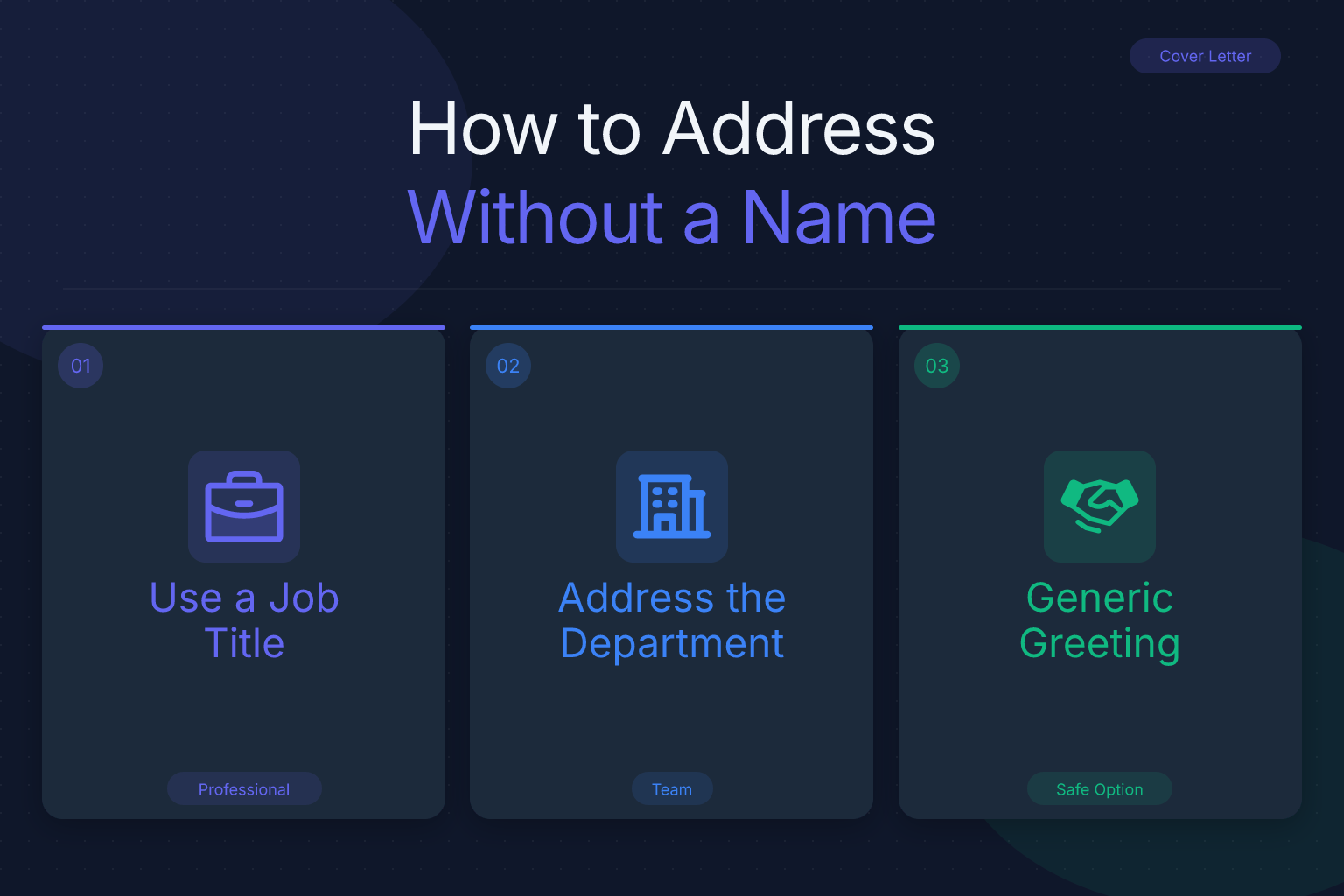
- When the job posting is completely anonymous, address the department or role (e.g., “Dear Marketing Team”) to show you’ve tailored your approach.
- A strong salutation is just the start — pair it with a well-structured cover letter and a resume that passes ATS scans.
Summary Table
| What to Do | Why It Matters | Time |
|---|---|---|
| Use “Dear Hiring Manager” | It’s professional, gender-neutral, and the standard for unknown recipients | Instant |
| Research the name on LinkedIn or the company site | A personalized greeting can grab attention and show initiative | 5–10 minutes |
| Address the department if you can’t find a name | Demonstrates you’ve done some homework and aren’t sending a mass email | 2–3 minutes |
| Avoid “To Whom It May Concern” | It feels stiff and outdated, and many recruiters see it as a red flag | N/A |
| Double-check spelling if you do find a name | A misspelled name is worse than no name at all | 1 minute |
How to Address a Cover Letter When You Don’t Know the Name
You’ve found a job you’re excited about, but the posting doesn’t list a contact person. Maybe it’s a large company using an ATS, or a blind ad from a staffing agency. You still need to open your cover letter with a salutation that feels professional and respectful. The good news: you have several strong options that won’t hurt your chances.
The most important rule is to avoid anything that sounds like you didn’t try. Recruiters read dozens of cover letters a day, and a salutation that screams “I copy-pasted this” can land your application in the “no” pile before they even read your first paragraph.
Here’s how to handle it, step by step.
Why Addressing a Cover Letter Correctly Matters
A cover letter’s salutation is the first thing a hiring manager sees after your contact information. It’s a tiny piece of real estate that signals your professionalism, attention to detail, and willingness to go the extra mile.
When you address someone by name, you create an immediate connection. When you can’t, the way you handle that gap still speaks volumes. A well-chosen generic salutation says, “I know this isn’t ideal, but I’ve made the best choice possible.” A lazy one says, “I didn’t care enough to think about it.”
Consider the psychology at play. Recruiters and hiring managers are human — they respond to being acknowledged as individuals. A personalized salutation triggers a subtle but real shift in how they read the rest of your letter. It signals that you’ve done your homework and that this isn’t just another application in a batch of 200. Conversely, a salutation that feels careless can prime the reader to look for other signs of sloppiness in your materials.
Many companies use applicant tracking systems (ATS) that parse cover letters along with resumes. While the salutation itself rarely determines whether you pass an ATS screen, the human who eventually reads your letter will notice. And in a competitive job market, small details can tip the scales.
If you’re also working on your resume, make sure it’s ATS-friendly. You can check your resume’s ATS score free with ResumeMate’s score checker to catch formatting issues before you apply.
Do You Need an Address in a Cover Letter?
A related question many job seekers ask is whether a cover letter even needs a physical address — yours or the employer’s. The short answer: no, not anymore.
In the era of email applications and online portals, the traditional address block (your street address, the company’s address, and the date) has largely fallen away. Most modern cover letters skip straight from your name and contact details to the salutation. Here’s what that looks like:
Traditional format (rarely needed now):
Jane Doe 123 Main Street Austin, TX 78701 jane.doe@email.com (555) 123-4567
January 15, 2026
Acme Corporation 456 Corporate Drive Austin, TX 78701
Dear Hiring Manager,
Modern format (preferred for email and online applications):
Jane Doe jane.doe@email.com | (555) 123-4567 | linkedin.com/in/janedoe
Dear Hiring Manager,
If you’re emailing your cover letter as an attachment or pasting it into an application portal, skip the full address block. It wastes space and looks dated. The only exception is if you’re applying to a highly traditional industry — law, government, or academia — where formal letter conventions still hold weight. In those cases, include your address and the employer’s address, but even then, the salutation rules in this guide still apply.
5 Professional Salutations to Use When You Don’t Have a Name
When you’ve exhausted your search and still don’t have a name, reach for one of these salutations. Each works in a different context, so pick the one that fits your situation best.
1. “Dear Hiring Manager,”
This is the gold standard. It’s direct, gender-neutral, and universally understood. Use it for most corporate job applications, especially when you’re applying through an online portal and have no other clues.
Example:
Dear Hiring Manager,
I was excited to see the opening for a Senior Graphic Designer at GreenLeaf Agency. With six years of experience in brand identity and digital campaigns, I’m confident I can contribute immediately to your creative team.
2. “Dear [Department] Team,”
If you know which department the role sits in — marketing, engineering, customer success — address the team directly. It shows you’ve read the job description carefully and understand where you’d fit.
Example:
Dear Engineering Team,
As a full-stack developer with a passion for building scalable SaaS products, I was thrilled to find the Software Engineer opening at CloudBase. I’ve been following your work on the Atlas platform and would love to contribute.
3. “Dear [Company Name] Recruiter,”
When you’re confident a recruiter (internal or external) will screen your application first, this salutation acknowledges their role. It’s slightly more personal than “Hiring Manager” and works well for larger companies with dedicated talent acquisition teams.
Example:
Dear InnovateTech Recruiter,
I’m writing to express my interest in the Product Manager position. With a background in both UX research and agile development, I bring a unique blend of skills that align with InnovateTech’s user-first philosophy.
4. “Dear Hiring Team,”
This is a safe, inclusive option when you suspect multiple people will review your application. It’s warm without being overly familiar and avoids singling out one person who may not exist.
Example:
Dear Hiring Team,
I’m reaching out regarding the Customer Success Manager role. Over the past four years, I’ve helped SaaS companies reduce churn by an average of 15% through proactive onboarding and relationship building.
5. “Dear [Job Title] Hiring Committee,”
For academic, government, or highly formal roles, this salutation shows respect for the selection process. It’s a bit more formal than “Hiring Team” and works well when you know a committee will evaluate candidates.
Example:
Dear Assistant Professor Hiring Committee,
I am writing to apply for the tenure-track position in the Department of Biology. My research on epigenetic regulation aligns closely with your department’s focus on molecular mechanisms of disease.
Salutations to Avoid (and Why They Can Hurt Your Application)
Some salutations are so outdated or problematic that they can actively damage your candidacy. Steer clear of these.
- “To Whom It May Concern” — This phrase peaked in the 1990s. Today, it reads as stiff, impersonal, and lazy. Many recruiters say it’s the fastest way to signal you didn’t customize your application at all. The only exception: a few government or legal roles where it’s still the expected format. For everything else, use “Dear Hiring Manager” instead.
- “Dear Sir/Madam” — This assumes a binary gender and can come across as old-fashioned. It also ignores the possibility of a non-binary reader. Stick with gender-neutral options.
- “Dear Sirs” — Even worse. It’s exclusionary and suggests you haven’t considered that women and non-binary people hold hiring roles.
- “Hello” or “Hi” with no name — While casual greetings work in some startups, they’re too informal for a cover letter unless you already have a relationship with the reader. Starting with just “Hello,” feels incomplete and unprofessional.
- “Dear [Misspelled Name]” — If you do find a name, triple-check the spelling. Getting it wrong is more damaging than using a generic salutation. If you’re unsure, it’s better to use “Dear Hiring Manager” than to guess.
- “Dear HR” — This is too abbreviated and can feel dismissive. Human resources professionals have titles and roles; address them with the same respect you’d give a hiring manager.
- “Good morning” or “Good afternoon” — Time-of-day greetings are fine for emails to colleagues, but they’re too casual and time-sensitive for a cover letter. The reader may open your application at any hour.
How to Find the Hiring Manager’s Name (Before You Give Up)
Before you default to a generic salutation, spend a few minutes trying to find the actual name. A personalized greeting can make your application stand out, and the effort often pays off.
Here’s a step-by-step process that takes less than 10 minutes:
- Re-read the job posting carefully. Sometimes the name is buried in the instructions — e.g., “Please send your application to Jane Smith at jane@company.com” or “Reports to the Director of Marketing.” Look for any clue.
- Search LinkedIn. Type the company name and a likely title (e.g., “Marketing Director” or “Talent Acquisition”) into LinkedIn’s search bar. Filter by people who work at the company. If you find someone whose role matches the department you’d report to, that’s a strong candidate. If you see a recruiter who posts about the company’s openings, they may be the point person.
- Check the company’s website. Look for an “About Us” or “Team” page. Smaller companies often list department heads. Even a “Careers” page might mention the recruiting team.
- Call the front desk. This works best for smaller companies. Call the main number, explain you’re applying for a position, and ask who the hiring manager is. Be polite and brief. You might get a name, or at least a department.
- Use the job application email address. If the posting says to email your application to careers@company.com, you can still address the cover letter to “Dear Hiring Manager” — but you could also try searching that email address online to see if it’s associated with a specific person.
- Check the company’s social media. LinkedIn is the obvious choice, but Twitter/X, Instagram, and even Facebook can reveal team members. Companies often tag employees in posts about new hires, promotions, or team events.
- Search for press releases or news articles. If the company recently announced a new department head or a promotion, that person might be your hiring manager. A quick Google search for “[Company Name] hires [Department] director” can surface relevant results.
If after all this you still come up empty, don’t stress. Most hiring managers understand that not every name is findable. A well-chosen generic salutation paired with a strong cover letter will serve you just fine.
What to Do When the Job Posting Is Anonymous
Some job postings are deliberately anonymous — often posted by third-party recruiters or staffing agencies who don’t want candidates bypassing them. In these cases, you won’t even know the company name, let alone the hiring manager.
Here’s how to handle it:
- Address the agency or recruiter. If the posting is from “ABC Staffing,” you can write “Dear ABC Staffing Recruiter,” or “Dear Recruiting Team.” This acknowledges the intermediary.
- Use the job title. “Dear Hiring Manager for the Senior Accountant Role” is specific enough to show you’re not blasting the same letter everywhere.
- Keep the focus on your qualifications. Since you can’t personalize the opening, make sure the rest of your cover letter is tailored to the job description. Mention specific skills and achievements that match the requirements.
If you’re applying to a blind ad and also need to tailor your resume, consider using a free AI resume builder to quickly customize your resume for each application without starting from scratch.
How to Address a Cover Letter for a Blind Application
A blind application is one where you’re submitting your materials without a specific job opening — perhaps to a company’s general talent pool or through a networking contact who said “send me your resume.” In these cases, you have even less to go on.
Option 1: Address the department you’re targeting.
Dear Product Team,
I’m a product manager with five years of experience in B2B SaaS, and I’ve been following your company’s growth. I’d love to explore how my background could support your upcoming initiatives.
Option 2: Use a general but warm salutation.
Dear [Company Name] Team,
I’m reaching out because I admire the work you’re doing in renewable energy and believe my background in project management could be a great fit for future opportunities.
Option 3: If you have a referral, mention them.
Dear Hiring Team,
At the suggestion of Alex Chen, a senior engineer on your team, I’m writing to express my interest in joining the engineering department. Alex thought my experience with distributed systems would align well with your current projects.
In all cases, the key is to show you’ve done your research on the company, even if you don’t have a specific name.
Email Cover Letters vs. Formal Cover Letters: Does the Salutation Change?
The medium matters. An email cover letter — whether pasted into the body of an email or sent as an attachment — has slightly different conventions than a formal printed letter.
Email cover letters:
- A comma after the salutation is standard (“Dear Hiring Manager,”)
- You can skip the full address block
- The subject line does some of the work of the salutation — make it specific (e.g., “Application: Senior Graphic Designer — Jane Doe”)
- A slightly warmer tone is acceptable, but “Dear” is still the safest opener
Formal cover letters (printed or attached as a separate document):
- A colon after the salutation is more traditional (“Dear Hiring Manager:”)
- Include your contact information at the top
- Keep the tone slightly more formal throughout
In practice, most job applications today are submitted online, so the email conventions apply. But if you’re applying to a law firm, government agency, or academic institution, err on the side of formality.
International Considerations: Salutations Across Cultures
If you’re applying for a job in another country — or to a multinational company with offices abroad — be aware that salutation conventions vary.
- United Kingdom and Australia: “Dear Hiring Manager” is widely accepted, but “Dear Sir/Madam” is still more common than in the U.S. It’s not considered as outdated, though gender-neutral options are gaining ground.
- Germany and German-speaking countries: Formal titles matter. If you know the person’s title (e.g., “Dr.” or “Prof.”), use it. “Sehr geehrte Damen und Herren” (Dear Sir or Madam) is the standard when you don’t have a name.
- Japan: Cover letters (often called rirekisho or shokumu keirekisho) follow strict formats. The salutation is typically “Haikei” (Dear Sir/Madam) regardless of whether you know the name.
- France: “Madame, Monsieur” is the standard formal salutation when you don’t know the recipient’s name. It’s not considered outdated.
- Latin America: “Estimados Señores” or “A quien corresponda” (To Whom It May Concern) are still common and acceptable in many industries.
If you’re applying internationally, research the local conventions. What’s outdated in the U.S. might be perfectly standard elsewhere — and vice versa.
Cover Letter Opening Examples for Unknown Recipients
Sometimes the best way to learn is to see real examples. Here are a few opening paragraphs that use the salutations we’ve discussed, paired with strong, tailored content.
Example 1: Corporate job, no name found
Dear Hiring Manager,
With over eight years of experience in supply chain optimization, I was immediately drawn to the Logistics Manager opening at GlobalFreight. In my current role, I reduced shipping costs by 22% while improving on-time delivery rates to 98% — results I’m eager to replicate for your team.
Example 2: Startup, addressing the team
Dear Marketing Team,
I’ve been a fan of BrewGood’s brand voice since your “Morning Ritual” campaign, so when I saw the Content Strategist opening, I knew I had to apply. As the person behind BeanStreet Coffee’s 3x social media growth, I understand how to build community around a product people love.
Example 3: Anonymous agency posting
Dear Talent Acquisition Team,
I’m writing in response to the Financial Analyst position posted through your agency. With a CFA designation and four years of experience in FP&A at a Fortune 500 company, I’m confident I can deliver the analytical rigor your client is seeking.
Example 4: Blind application to a company
Dear Design Team,
I’ve been following PixelPerfect’s work since your award-winning rebrand of EcoEats, and I’d love to contribute to your next project. As a senior visual designer with a focus on sustainable brands, I believe my portfolio aligns closely with your studio’s mission.
Example 5: Government or formal role
Dear Selection Committee,
I am writing to apply for the Program Analyst position with the Department of Health and Human Services. With seven years of experience in public health data analysis and a Master’s in Public Policy, I am well-prepared to support your team’s mission.
Notice how each example gets specific about the company and the role right away. That’s what makes a cover letter compelling — not just the salutation, but the content that follows.
If you’re struggling with how to structure the rest of your cover letter, especially for a career change or a creative role, check out our guides on writing a career change cover letter and crafting a creative cover letter that gets noticed.
Common Mistakes When Addressing a Cover Letter Without a Name
Even with the best intentions, it’s easy to slip up. Here are the most frequent mistakes job seekers make — and how to avoid them.
- Using a generic salutation when the name was findable. If the hiring manager’s name is in the job posting or easily discoverable on LinkedIn, using “Dear Hiring Manager” looks like you didn’t bother. Always do a quick search first.
- Guessing the name and getting it wrong. If you’re not 100% sure, don’t guess. A wrong name is far worse than no name.
- Forgetting to update the salutation when reusing a cover letter. It’s tempting to reuse a well-written cover letter, but if you leave “Dear Marketing Team” when applying to an engineering role, it’s an instant red flag. Always double-check.
- Using a colon instead of a comma. In American business correspondence, a colon after the salutation (“Dear Hiring Manager:”) is more formal; a comma is slightly less formal but still acceptable. Pick one and be consistent. In email cover letters, a comma is fine.
- Making the salutation the only personalized part. If you address the letter to “Dear Hiring Manager” but the rest of the letter is generic, you haven’t gained anything. Tailor the body to the specific job and company.
- Overthinking it. Some job seekers spend more time worrying about the salutation than writing the cover letter itself. Remember: a solid, professional salutation is good enough. The content matters more.
- Using “Dear [Company Name]” without a person or team. “Dear Google” or “Dear Amazon” sounds odd and incomplete. Always pair the company name with a role or team (“Dear Google Recruiting Team”).
- Including the wrong company name. If you’re applying to multiple jobs, it’s easy to accidentally leave “Dear Acme Corp Hiring Manager” when applying to Beta Inc. This is one of the most damaging mistakes you can make — always proofread the salutation specifically.
How to Pair Your Cover Letter with a Strong Resume
Your cover letter gets you in the door, but your resume is what lands the interview. Once you’ve nailed the salutation and written a compelling letter, make sure your resume is equally polished.
Here’s a quick checklist:
- Match the formatting. If your cover letter uses a clean, modern font, your resume should too. Consistency signals attention to detail.
- Tailor your resume to the same job. The skills and achievements you highlight in your cover letter should appear on your resume as well, backed by numbers where possible.
- Check for ATS compatibility. Many companies use software to screen resumes before a human ever sees them. A poorly formatted resume can get rejected even if you’re qualified. Use a tool like ResumeMate’s free score checker to see how your resume stacks up.
- Save both as PDFs. Unless the application specifically asks for a Word document, a clean PDF preserves your formatting and ensures your resume and cover letter look the way you intended.
If you’re building your resume from scratch or need to update it quickly, ResumeMate’s free AI resume builder lets you create a professional, ATS-friendly resume in minutes — and you can download it as a PDF right away.
FAQ
Q: Is it okay to use “Dear Hiring Manager” if I could have found the name?
A: It’s always better to use the actual name if you can find it. But if you’ve done a reasonable search (LinkedIn, company website, job posting) and come up empty, “Dear Hiring Manager” is perfectly acceptable. Recruiters understand that not every name is public.
Q: What’s the best salutation for a cover letter when applying through a job board like Indeed or LinkedIn?
A: “Dear Hiring Manager” is the safest bet. These platforms often strip out contact information, so you rarely see a name. If the job description mentions a department, you can use “Dear [Department] Team” to add a touch of personalization.
Q: Can I use “Dear Recruiter” instead of “Dear Hiring Manager”?
A: Yes, especially if you know a recruiter will be the first to read your application. “Dear Recruiter” is slightly less common but still professional. “Dear Hiring Manager” is more universally recognized, so it’s the safer default.
Q: Should I ever leave the salutation blank?
A: No. A cover letter without a salutation looks incomplete and rushed. Even a simple “Dear Hiring Team” is better than nothing. Always include a salutation.
Q: What if the job posting says “apply to [email]” but doesn’t give a name?
A: Use “Dear Hiring Manager” or “Dear [Company Name] Team.” You can also try searching the email address online — sometimes it’s associated with a specific person on LinkedIn or in a company directory.
Q: Is “To Whom It May Concern” ever acceptable?
A: In most industries, no. It’s considered outdated and impersonal. The only exceptions are certain government, legal, or academic positions where it’s still the expected format. For 99% of private-sector jobs, use “Dear Hiring Manager” instead.
Q: How do I address a cover letter if I’m applying to a startup with a flat structure?
A: Startups often appreciate a slightly warmer tone. “Dear [Company Name] Team” or “Hello [Company Name] Hiring Team” can work well. If the startup’s culture is very casual, you might even use “Hi there,” but only if you’re certain it fits — when in doubt, stick with “Dear Hiring Manager.”
Q: What if I don’t know the company name either (blind ad from a staffing agency)?
A: Address the agency or the role. “Dear Recruiting Team” or “Dear Hiring Manager for the [Job Title] Role” both work. The key is to make the rest of your cover letter specific to the job description so it’s clear you’re not sending a mass email.
Q: Do I need to include a physical address in my cover letter?
A: No. For most modern applications — especially email and online portal submissions — you can skip the full address block. Just include your name, email, phone number, and LinkedIn URL at the top, then go straight to the salutation. The only exception is highly traditional industries like law or government.
Q: What’s the difference between “Dear Hiring Manager” and “Dear Hiring Team”?
A: “Dear Hiring Manager” implies a single person is reviewing your application, while “Dear Hiring Team” acknowledges that multiple people may be involved. Both are professional and safe. Use “Hiring Manager” for most corporate roles; use “Hiring Team” when you suspect a panel or committee will review applications.
Q: Can I use “Dear Sir or Madam” in 2026?
A: It’s not recommended. While it’s still used in some countries and industries, it’s increasingly seen as outdated and exclusionary in the U.S. and many other markets. Gender-neutral options like “Dear Hiring Manager” are safer and more modern.
Q: How do I address a cover letter when I have a referral but don’t know the hiring manager’s name?
A: Use “Dear Hiring Manager” or “Dear Hiring Team,” then mention your referral in the first sentence. For example: “At the suggestion of Alex Chen, a senior engineer on your team, I’m writing to apply for the Software Engineer position.” The referral mention does more work than a name would.
Q: What if I find two possible names and I’m not sure which one is the hiring manager?
A: Don’t guess. If you can’t determine with confidence who will read your letter, use “Dear Hiring Manager” or “Dear [Department] Team.” A wrong name is worse than no name. If you have a strong lead, you could address the letter to that person and note in the body that you’re also copying the relevant team.
Q: Should the salutation be different for an email cover letter vs. an attached cover letter?
A: The salutation itself can be the same. The main difference is punctuation: a comma is standard for email (“Dear Hiring Manager,”), while a colon is more formal for a printed or attached letter (“Dear Hiring Manager:”). Both are acceptable in either context, so don’t overthink it.
Track Every Application While You Job Hunt
Stop losing track of where you’ve applied. The ResumeMate Job Tracker is a free Chrome extension that tracks every application, deadline, and follow-up in one place — right from your browser.