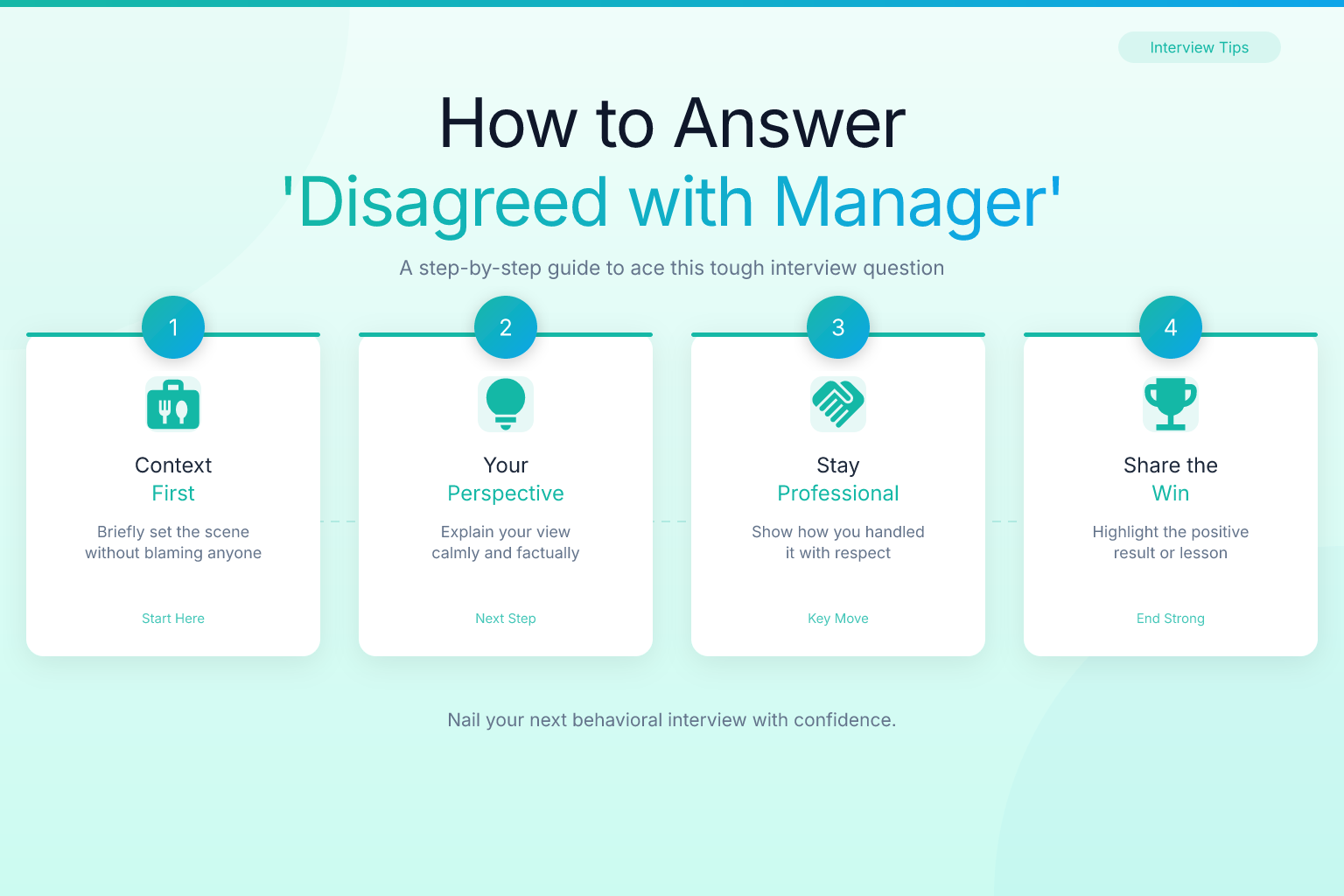
How to Answer ‘Describe a Time You Disagreed with a Manager’
When an interviewer asks you to describe a time you disagreed with a manager, they aren’t looking for a story about how you were right and your boss was wrong. They want to see how you handle conflict, communicate with authority, and maintain professionalism under pressure. This question is a staple of behavioral interviews because it reveals your maturity, judgment, and ability to navigate workplace relationships without burning bridges.
Below, you’ll find a complete guide to crafting an answer that shows you’re collaborative, respectful, and capable of pushing back constructively — exactly the kind of employee every company wants.
Key Takeaways
When interviewers ask you to describe a disagreement with a manager, they’re testing your conflict resolution skills, not your ability to win an argument. The best answers show that you can push back respectfully, back up your perspective with data, and maintain a collaborative relationship. Below are the core principles to keep in mind, followed by a quick example of what that looks like in practice.
- Interviewers ask this question to assess your conflict resolution skills, not to catch you badmouthing a former boss.
- Use the STAR method (Situation, Task, Action, Result) to structure your answer clearly and concisely.
- Choose a real but low-stakes disagreement where you handled the situation professionally and the outcome was positive.
- Never blame the manager or portray yourself as a victim; focus on your thought process and the resolution.
- If you’ve never disagreed with a manager, you can adapt a situation where you offered a different perspective or suggested an improvement.
| What to Do | Why It Matters | Time |
|---|---|---|
| Pick a low-stakes, resolved disagreement | Shows you can handle conflict without drama | 5 min to recall |
| Use the STAR method (Situation, Task, Action, Result) | Keeps your answer structured and easy to follow | 2 min to deliver |
| Emphasize listening and understanding the manager’s view | Demonstrates respect and emotional intelligence | 1 min |
| Highlight the positive outcome or lesson learned | Proves you turn conflict into growth | 1 min |
| Practice out loud before the interview | Ensures a smooth, confident delivery | 10 min |
For instance, imagine you suggested a new project management tool to your manager, who was hesitant due to cost. You presented a cost-benefit analysis, listened to their concerns about training time, and proposed a small pilot with one team. The pilot succeeded, and the tool was adopted. That’s the kind of story that demonstrates initiative, respect, and a focus on results.
Why Interviewers Ask This Question
This question is a behavioral interview classic, right up there with “Tell me about a time you failed” or “Describe a time you showed leadership.” When an interviewer asks you to describe a time you disagreed with a manager, they’re not trying to trap you. They’re evaluating several things at once:
- Your conflict resolution skills. Can you handle disagreement without damaging the relationship?
- Your communication style. Do you listen first, or do you bulldoze your own opinion?
- Your respect for authority. Can you push back while still acknowledging the manager’s role?
- Your self-awareness. Do you recognize when to stand your ground and when to let go?
- Your ability to learn. Did the experience make you better at your job?
Hiring managers know that no workplace is free of disagreements. They want to see that you can navigate those moments with grace. A candidate who says “I’ve never disagreed with a manager” can seem either dishonest or passive. A candidate who tells a story about a screaming match raises red flags. The sweet spot is a story that shows you handled a difference of opinion like a pro.
How to Structure Your Answer (STAR Method & Step-by-Step Framework)
Behavioral questions demand structured answers. The STAR method — Situation, Task, Action, Result — is the gold standard. It works just as well for this question as it does for “tell me about a time you were successful.” Here’s how to apply it, along with a step-by-step framework that includes choosing the right example.
Situation: Set the scene. Give just enough context so the interviewer understands the project, the stakes, and your role. Keep it to two or three sentences.
Task: What was the specific point of disagreement? What did your manager want, and what did you believe was the better approach? Frame this neutrally — no “my manager was being unreasonable.”
Action: This is the most important part. Walk through exactly what you did. Did you request a private meeting? Did you present data? Did you suggest a compromise? Show your communication and problem-solving skills.
Result: End with the outcome. Ideally, the result is positive: the project improved, the manager appreciated your input, or you learned something valuable. If the outcome wasn’t perfect, focus on what you learned and how you applied it later.
Before you build your story, pick the right example. Use these criteria:
- It was resolved professionally. Avoid stories that ended with hard feelings or you leaving the company.
- The stakes were moderate. A disagreement over a multi-million-dollar strategy where you went over your manager’s head is too risky. A minor disagreement about a meeting time is too trivial. Aim for something in between — a project approach, a resource allocation, a client communication tactic.
- You can show respect. The story should demonstrate that you listened to your manager’s perspective, even if you ultimately disagreed.
- You learned something. The best answers include a reflection on how the experience made you better.
If you’re early in your career and haven’t had many direct disagreements, you can use a situation where you suggested an improvement or offered an alternative idea that was initially met with resistance. The key is that you handled it constructively.
Now, follow these steps to build a compelling, interview-ready response:
- Start with a concise situation. “In my previous role as a marketing coordinator, my manager wanted to launch a new campaign using only email, but I believed we’d get better results by adding a social media component.”
- Explain your reasoning without criticizing. “I had analyzed our recent campaign data and saw that our social channels were driving 40% more engagement than email alone. I understood my manager’s concern about budget, but I thought a small test on social could prove the concept without much risk.”
- Describe how you approached the conversation. “I scheduled a brief one-on-one and shared the data. I said, ‘I see why you’re leaning toward email-only, and I want to respect that. Would you be open to looking at some numbers on social engagement? I think a small pilot could give us useful data either way.’”
- Show the outcome and what you learned. “My manager agreed to a limited test. The social posts ended up generating 25% more leads than the email-only approach, and we adopted a multi-channel strategy for future campaigns. More importantly, I learned that presenting data calmly and acknowledging the other person’s viewpoint makes disagreement feel like collaboration, not conflict.”
This framework works for almost any industry. The details change, but the structure stays the same: respect, data, dialogue, resolution.
Sample Answers for Different Scenarios
Here are three full sample answers you can adapt. Each follows the STAR method and emphasizes professionalism.
Example 1: Disagreeing on a Project Timeline
Situation: As a software developer, my manager set a deadline that I believed was unrealistic without sacrificing code quality. Task: I needed to communicate the risk without sounding like I was making excuses. Action: I mapped out the remaining tasks with time estimates and showed my manager where the bottlenecks were. I proposed two options: extend the deadline by one week, or reduce the scope of one feature. I made it clear I was committed to hitting the original date if that was the final decision, but I wanted to flag the trade-off. Result: My manager appreciated the transparency. We agreed to trim a low-priority feature and delivered on time with clean code. After that, I was often asked to review timelines before they were finalized.
Example 2: Disagreeing on a Client Communication Approach
Situation: Working in account management, my manager wanted to send a blunt email to a frustrated client. I felt a phone call would de-escalate the situation better. Task: I had to suggest a different approach without undermining my manager’s authority. Action: I said, “I completely agree we need to address this quickly. I’m worried an email might come across colder than we intend. Would it be okay if I drafted a call script and we could review it together? I think hearing our tone might help.” I offered to take the lead on the call. Result: My manager agreed. The call went well, the client calmed down, and we retained the account. My manager later told me she valued having someone who thinks about communication nuances.
Example 3: Disagreeing on a Process Improvement
Situation: In an operations role, my manager insisted on a manual reporting process that took hours each week. I believed we could automate it. Task: I needed to propose a change without implying the current process was a waste of time. Action: I built a simple prototype using a tool we already had and showed my manager how it could cut the reporting time by 70%. I framed it as, “I know the manual process gives you control. What if we ran both in parallel for two weeks to compare accuracy?” Result: The automated reports were just as accurate. We switched over, and I was able to take on higher-value analysis work. The experience taught me that showing is more powerful than telling.
Common Mistakes and How to Practice
Even a good story can fall flat if you make these errors. Avoid them, then use the practice routine below to polish your delivery.
- Blaming or badmouthing the manager. Never say “my manager was clueless” or “they didn’t listen.” Frame it as a difference in perspective.
- Choosing a story where you “won” but damaged the relationship. The interviewer wants to see that you can disagree and still work together effectively.
- Being vague. “We disagreed, I talked to them, and it worked out” tells the interviewer nothing. Specifics build trust.
- Picking a disagreement that was never resolved. Unresolved conflict can signal avoidance or poor follow-through.
- Making yourself the hero at the manager’s expense. The best answers show mutual respect and a shared goal.
- Skipping the result. Always close the loop. If you can’t share a positive business outcome, share a personal learning — but share something.
If you’re struggling to avoid these pitfalls, reviewing how to answer other behavioral questions like “tell me about a time you failed” can help you see the pattern of owning your part and focusing on growth.
Practice routine:
- Write out your STAR bullet points. Don’t script every word — you’ll sound robotic. Just capture the key details for each part.
- Say it out loud three times. The first time, you’ll stumble. The second time, you’ll smooth it out. The third time, you’ll sound confident.
- Record yourself on your phone. Listen for filler words, defensive tone, or places where you rush. Adjust.
- Time yourself. Aim for 90 seconds to 2 minutes. Any longer and you risk losing the interviewer’s attention.
- Get feedback. If you have a trusted friend or mentor, ask them to listen and tell you if you sound respectful and clear.
If you’re preparing for a second interview, you might face this question again in a deeper form. Our guide on second interview questions can help you anticipate what’s coming.
What If You’ve Never Disagreed with a Manager?
Some candidates worry they don’t have a good story. Maybe you’re early in your career, or you’ve had very supportive managers. You can still answer this question effectively by broadening your definition of “disagreement.”
Consider these alternatives:
- A time you suggested an improvement that was initially met with hesitation. You didn’t argue, but you advocated for a different approach.
- A situation where you had a different perspective on a project’s priority. You shared your view, and the team adjusted.
- A moment when you asked clarifying questions that led the manager to reconsider a decision. You didn’t say “I disagree,” but your questions prompted a change.
Frame it honestly: “I’ve been fortunate to work with managers who were open to input, so I haven’t had a major conflict. But I can share a time when I saw a different path and how I brought it up.” Then tell your story using the same respectful structure.
This approach shows self-awareness and adaptability — two traits interviewers value highly. If you’re also working on other challenging questions, our guide on “how to deal with a difficult coworker interview question” uses a similar framework for navigating interpersonal challenges.
FAQ
Q: What if my disagreement with a manager ended badly?
A: Choose a different example if possible. If you must use it, focus on what you learned and how you’d handle it differently now. Take ownership of any part you played in the breakdown, and avoid blaming the manager. The interviewer wants to see growth, not a grudge.
Q: Can I use an example where I disagreed with a manager in a different department?
A: Yes, as long as the person had some authority over the situation. A cross-functional disagreement can work well because it shows you can navigate complex organizational dynamics. Just make sure the story still highlights your communication and conflict-resolution skills.
Q: Should I mention that I eventually went along with the manager’s decision?
A: It depends. If you presented your case, the manager decided otherwise, and you supported the decision professionally, that can be a strong answer. It shows you can disagree and commit — a highly valued trait. Just be clear that you voiced your perspective respectfully first.
Q: How do I answer if I’m interviewing for a management role?
A: For leadership roles, choose an example that shows you can push back on a superior while maintaining alignment with company goals. Emphasize how you balanced advocating for your team with respecting the broader strategy. The stakes can be higher, but the principles are the same.
Q: Is it okay to use a disagreement from a non-work setting, like a volunteer role?
A: Work-related examples are best, but if you’re early in your career, a volunteer or academic setting can work. Just make sure the dynamics mirror a workplace: you had a person in authority, you disagreed, and you resolved it professionally. Frame it to highlight transferable skills.
Q: What if the interviewer presses for more details about the conflict?
A: Stay calm and stick to the facts. You can say, “It was a professional difference of opinion. We both wanted the best outcome, just had different ideas on how to get there.” Never get drawn into negative commentary about the manager. The follow-up is often a test of your discretion.
Track Every Application While You Job Hunt
Stop losing track of where you’ve applied. The ResumeMate Job Tracker is a free Chrome extension that tracks every application, deadline, and follow-up in one place — right from your browser.