How to Answer “Tell Me About Yourself” in an Interview
You’ve sat down, exchanged pleasantries, and then the interviewer leans forward and says: “Tell me about yourself.” It’s the most common opener in any job interview — and often the one that sets the tone for everything that follows. Yet most candidates either ramble through their life story or freeze and recite their resume bullet points. Neither approach works. This guide gives you a repeatable framework, real sample answers, and a way to tie your answer directly to the resume you built with ResumeMate.
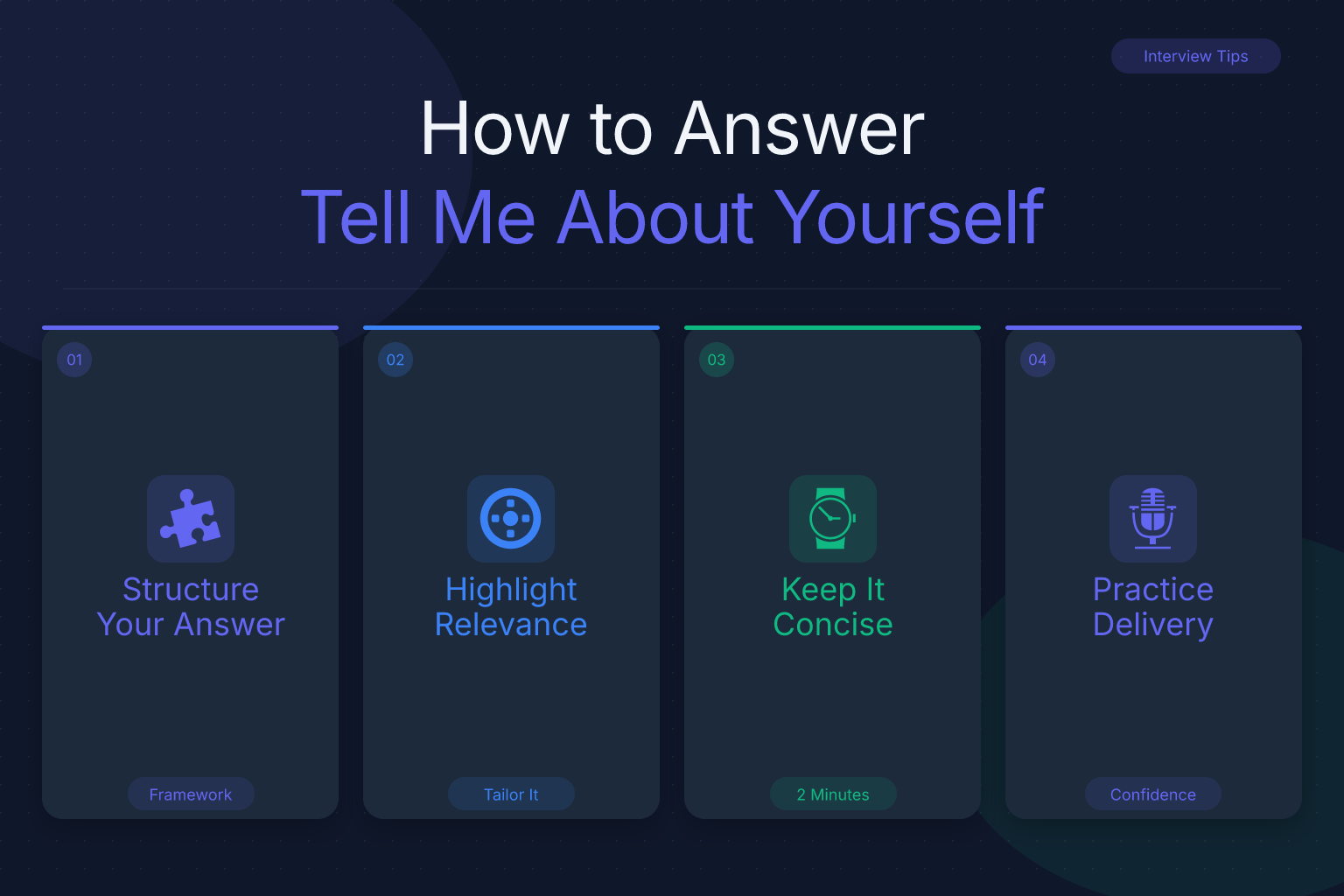
| What to Do | Why It Matters | Time |
|---|---|---|
| Use a Past-Present-Future structure | Keeps your answer focused and easy to follow | 2 minutes max |
| Tailor your story to the role | Shows you understand what the job needs | 10–15 minutes prep |
| Practice out loud, not just in your head | Builds muscle memory so you sound natural | 15 minutes daily for 3 days |
| Pull key themes from your resume | Creates consistency between your application and your interview | 5 minutes |
What Does “Tell Me About Yourself” Mean in an Interview?
When an interviewer says “tell me about yourself,” they aren’t asking for your biography. They’re giving you the floor to connect your background to the job you’re sitting in front of them for. In most cases, the question means: Walk me through the professional experiences and decisions that led you to apply for this role, and show me why you’re a strong fit.
This isn’t a trick question, but it is a test. Recruiters and hiring managers use it to assess three things quickly:
- Communication skills: Can you organize your thoughts and speak clearly under pressure?
- Relevance: Do you understand what matters for this position, or will you waste time on unrelated details?
- Self-awareness: Can you articulate your strengths and career narrative without sounding arrogant or vague?
According to interview training materials from the University of California, Berkeley Career Center, the most effective answers are concise (under two minutes), professional (not personal unless it directly ties to work), and forward-looking. That means you skip your childhood, your hobbies, and your entire life philosophy — unless you can connect them to the job in a single sentence.
Why Interviewers Ask This Question First
It’s not just a warm-up. The “tell me about yourself” prompt serves several practical purposes for the interviewer:
- It buys them time. Many interviewers glance at your resume only moments before you walk in. Your answer lets them scan your background while you talk.
- It reveals your priorities. The details you choose to highlight — and the ones you leave out — tell them what you value most in your career.
- It sets the agenda. A well-structured answer gives the interviewer natural follow-up points. If you end with “and that’s why I’m excited about this role,” they can pivot straight into job-specific questions.
Because this question comes first, it also shapes your own confidence. Nail it, and you’ll feel in control for the rest of the conversation. Fumble it, and you may spend the next 30 minutes trying to recover.
How to Structure Your Answer: The Past-Present-Future Formula
The most reliable framework — recommended by career coaches and used in MBA interview prep — breaks your answer into three clear segments:
- Past (30–40 seconds): Summarize the key experiences that built your foundation. Don’t list every job; pick the 2–3 milestones most relevant to the role you’re targeting. For example, if you’re interviewing for a project manager position, mention the first time you led a cross-functional team, not your summer job in retail.
- Present (40–50 seconds): Describe what you’re doing now and what you’ve achieved recently. Use a concrete accomplishment — a metric, a project outcome, a skill you’ve mastered. This is where you prove you can deliver results today, not just talk about the past.
- Future (20–30 seconds): Explain why you’re here. Connect your past and present to this specific opportunity. Mention something about the company or role that genuinely excites you, and frame it as the logical next step in your story.
This structure works because it mirrors how people naturally process information: context, evidence, conclusion. It also prevents the two biggest mistakes — rambling and reciting your resume.
Step-by-Step: Crafting Your Answer from Your Resume
You don’t need to memorize a script. You need a flexible outline that you can adapt to any interviewer. Here’s how to build one using your own resume as the source material.
Step 1: Identify Your Three Key Themes
Open your resume (if you don’t have one optimized for interviews, use the free ResumeMate resume builder to create a clean, ATS-friendly version). Look for patterns: What skills or achievements show up repeatedly? Maybe you’re consistently the person who improves processes, or you’ve led teams through change, or you’ve grown revenue in every role. Pick three themes that align with the job description. For more on tailoring your resume to specific roles, read our resume customization guide.
Step 2: Write One Sentence for Each Theme
For each theme, craft a single sentence that ties a past experience to a result. Example: “I’ve spent the last five years helping SaaS companies reduce churn — at my last role, I cut voluntary churn by 18% in six months.” This becomes the backbone of your Past and Present sections.
Step 3: Draft Your Future Statement
Research the company. Find one specific reason you want to work there — a product you admire, a mission that resonates, a challenge they’re facing that matches your skills. Write one sentence that connects your themes to that reason. Example: “I’m drawn to this role because your team is scaling customer success operations, and that’s exactly the kind of build-out I’ve done twice before.”
Step 4: Assemble and Trim
Combine your sentences into a flowing narrative. Read it aloud and time it. Cut anything that doesn’t directly support your fit for the job. Aim for 90–120 seconds. If you’re over two minutes, you’re including too much.
Step 5: Practice with Variations
You’ll face different interviewers — a recruiter, a hiring manager, a peer. Adjust your emphasis: recruiters care about career progression and fit; hiring managers care about skills and results; peers care about collaboration and work style. Keep the same structure, but shift which themes you lead with.
Sample Answers for Different Career Stages
Here are three sample answers built with the Past-Present-Future formula. Use them as templates, not scripts — plug in your own details.
Entry-Level Candidate (Recent Graduate)
“I studied marketing at State University, where I ran social media for the student government and grew our Instagram following from 800 to 4,200 in one semester. That hands-on work taught me more than any textbook. Since graduating, I’ve been freelancing for two local businesses, managing their email campaigns and seeing open rates climb above 30%. I’m looking for a full-time role where I can learn from a seasoned team, and your agency’s focus on data-driven creative is exactly where I want to build my career.”
Career Changer (Moving from Sales to HR)
“I spent six years in B2B sales, consistently hitting over 110% of quota. But the part of the job I loved most wasn’t closing deals — it was onboarding new reps and watching them succeed. I started volunteering to lead training sessions, then pursued my SHRM-CP certification last year. Now I’m ready to move fully into people operations. Your company’s emphasis on employee development stood out to me because I’ve seen firsthand how good onboarding reduces turnover.”
Experienced Professional (Senior Engineer)
“I’ve been building backend systems for fintech companies for over a decade. At my last role, I led the migration from a monolithic architecture to microservices, which cut downtime by 60% and let us ship features three times faster. Currently, I’m the tech lead on a team of eight, mentoring junior engineers and setting our API standards. I’m excited about this opportunity because you’re tackling real-time payment processing at scale — a challenge I’ve been wanting to sink my teeth into since I first worked on payment gateways five years ago.”
Common Mistakes That Derail Your Answer
Even with a solid structure, small missteps can weaken your first impression. Avoid these:
- Starting with your birthplace or family. Unless you’re in a field where personal background is directly relevant (e.g., social work, community organizing), skip it. Interviewers want professional context.
- Reciting your resume chronologically. “I graduated in 2010, then worked at X, then Y, then Z…” is boring and wastes time. The interviewer already has your resume. Your job is to connect the dots, not list them.
- Going over two minutes. Attention spans drop sharply after 90 seconds. A long answer signals poor communication skills. Practice with a timer.
- Being too humble or too boastful. Avoid “I was just lucky” and “I single-handedly saved the company.” Stick to factual, results-oriented language: “I led a project that reduced costs by 15%.”
- Using jargon or buzzwords. Phrases like “synergize,” “thought leader,” or “passionate about leveraging” sound rehearsed and insincere. Speak like a human.
- Not tailoring to the company. A generic answer works for any job, which means it impresses no one. Mention the company by name and reference something specific.
How to Practice and Deliver Your Answer Confidently
Writing a great answer is half the battle. Delivering it naturally is the other half.
- Record yourself on your phone. Play it back and listen for filler words (“um,” “like”), pacing, and tone. You’ll catch things you don’t notice while speaking.
- Practice with a friend or mentor. Ask them to play the role of an interviewer and give you honest feedback. Can they repeat your main points back to you? If not, your message isn’t clear.
- Don’t memorize word-for-word. Memorizing creates a robotic delivery and makes you panic if you lose your place. Memorize your structure and key phrases, not every syllable.
- Prepare for different formats. A video call feels different from an in-person interview. Practice on camera to get comfortable with eye contact through a lens. For phone interviews, your voice carries everything — vary your pitch and pace to keep the listener engaged.
- Use a pre-interview ritual. Take three deep breaths before you start. Sip water. Remind yourself: this is a conversation, not an interrogation.
For a complete step-by-step preparation plan, visit our interview readiness checklist.
Using Your Resume to Build a Stronger Answer
Your resume and your “tell me about yourself” answer should feel like two parts of the same story. When they align, you come across as consistent and prepared. When they don’t — say, your resume highlights data analysis but your answer focuses on team leadership — the interviewer gets confused about what you actually do.
Before you craft your answer, run your resume through the ResumeMate score checker. It gives you section-by-section feedback on what’s strong and what’s missing. Use that insight to identify the themes you should emphasize in your interview. If the score checker flags that your skills section is thin, you know to weave more skill mentions into your answer. If your experience bullets lack metrics, you’ll want to prepare a few quantifiable achievements to share verbally.
If you’re in the middle of a job search and juggling multiple interviews, the ResumeMate Job Tracker Chrome extension helps you log every conversation, follow-up date, and stage — so you never walk into an interview unprepared or miss a thank-you note.
FAQ
Q: What is “tell me about yourself” in an interview?
A: It’s the opening question where the interviewer asks you to summarize your professional background and explain why you’re a fit for the role. The best answers follow a Past-Present-Future structure and stay under two minutes.
Q: What should “tell me about yourself” include?
A: Include a brief overview of your most relevant past experiences, a concrete recent achievement, and a clear statement of why you’re interested in this specific job. Leave out personal details unless they directly connect to the work.
Q: What is a good “tell me about yourself” sample answer?
A: A strong sample answer sounds like: “I’ve spent the last four years in customer success at SaaS companies, most recently reducing churn by 20% at my current role. I’m looking to bring that experience to a larger team, and your company’s focus on enterprise clients is exactly the challenge I want next.” Tailor it to your own background.
Q: What does “tell me about yourself” mean in Tagalog?
A: In Tagalog, the phrase translates to “Sabihin mo sa akin ang tungkol sa iyong sarili.” In a Filipino job interview context, the expectation is the same: give a professional summary focused on your work experience and skills, not your personal life story.
Q: How long should my answer be?
A: Aim for 90 seconds to two minutes. Anything shorter feels underprepared; anything longer risks losing the interviewer’s attention. Practice with a timer until your answer lands consistently in that window.
Q: Can I use the same answer for every interview?
A: You can use the same structure, but you should customize the content for each role. Swap in different achievements, emphasize different skills, and mention something specific about the company you’re interviewing with. A generic answer is easy to spot and easy to forget.
Q: Should I mention personal hobbies or interests?
A: Only if they directly relate to the job or company culture and you can make the connection in one sentence. For example, “I run a weekly board game group, which sharpened my facilitation skills — something I use constantly in my scrum master role.” Otherwise, keep it professional.
Related articles:
- How to Answer ‘What Motivates You?’ in an Interview
- How to Answer ‘Tell Me About a Time You Were Successful’
- Tell Me About a Time You Failed: How to Answer (Examples)
- What Are Your Weaknesses? How to Answer in an Interview
- Second Interview Questions and How to Answer Them
- Explain Employment Gap in Interview: Sample Answers
- Interview Questions & Best Answers: Prep & Respond in 2025
Track Every Application While You Job Hunt
Stop losing track of where you’ve applied. The ResumeMate Job Tracker is a free Chrome extension that tracks every application, deadline, and follow-up in one place — right from your browser.