How to Answer “Walk Me Through Your Resume” (With Examples)
“Walk me through your resume” is one of the most common interview openers — and one of the easiest to fumble. You know your own background, but condensing years of experience into a tight, compelling 2-minute story under pressure is harder than it sounds. This guide gives you a proven structure, industry-specific examples, and practice drills so you can answer with confidence and set the tone for the rest of the interview.
Key Takeaways
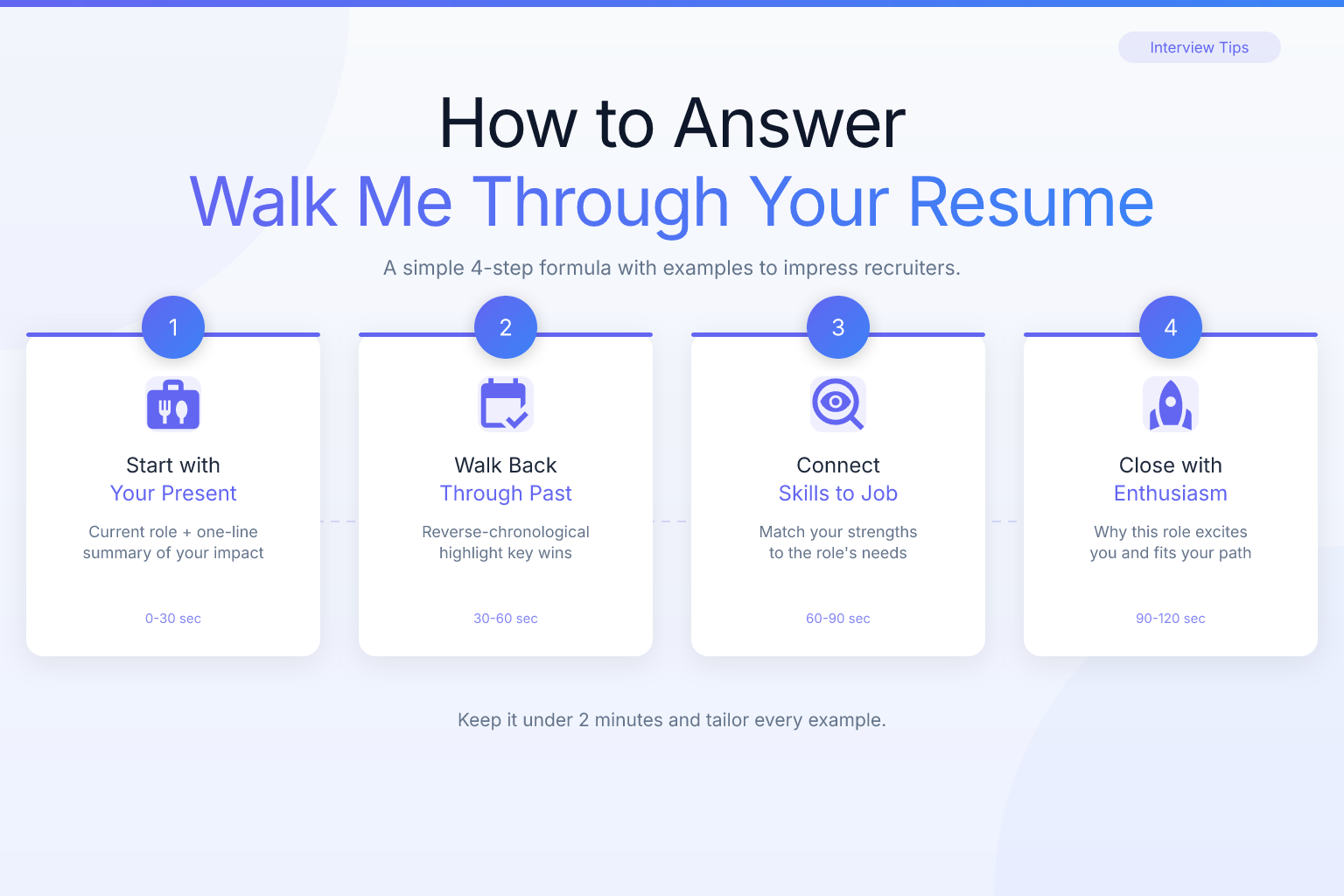
- A strong answer follows a simple three-part structure: present role, past experience, future fit — delivered in 2–3 minutes.
- Tailor your answer to the job description, highlighting only the 3–5 most relevant experiences rather than reciting your entire resume.
- Avoid reading your resume line by line; instead, tell a story that connects your past achievements to the role you’re interviewing for.
- For banking, consulting, and MBA interviews, end with a specific “why this industry/role” pivot that shows you’ve done your research.
- Practice out loud with a timer and record yourself; aim for 90 seconds to 2 minutes for most roles, up to 3 minutes for senior or technical positions.
| What to Do | Why It Matters | Time |
|---|---|---|
| Start with your current role and one key achievement | Grabs attention and shows immediate relevance | 30 sec |
| Walk backward through 2–3 past roles, each tied to a skill the job needs | Proves you have the right experience without rambling | 60–90 sec |
| End with why you’re excited about this specific role and company | Demonstrates genuine interest and preparation | 30 sec |
| Practice with a timer and record yourself | Eliminates filler words and keeps you on track | 15 min/day |
| Tailor your answer for each interview | Shows you understand the role and aren’t using a generic script | 10 min before interview |
What Interviewers Really Want When They Ask “Walk Me Through Your Resume”
This question is rarely a test of your memory. The interviewer already has your resume in front of them — they don’t need you to read it back. What they’re actually evaluating is:
- Can you synthesize? Can you pull the most relevant parts of your career into a coherent narrative, or do you get lost in the weeds?
- Do you understand what matters for this role? A strong answer filters your experience through the lens of the job description. If you’re applying for a marketing role, you highlight campaigns and metrics, not your summer job from college.
- Are you self-aware? You should be able to explain why you made certain career moves and what you learned from them.
- Can you communicate clearly under pressure? This is often the first question, so it sets the tone. A rambling, unfocused answer signals you’ll be equally scattered in the role.
Think of it as your 2-minute elevator pitch for your entire career. The interviewer is giving you the floor to frame your story — use it strategically.
The 3-Step Formula: Present, Past, Future
The most reliable structure for answering “walk me through your resume” is a simple three-part framework. It works for nearly every industry and experience level.
Step 1: Start with Your Current (or Most Recent) Role
Open with one sentence about what you do now, then immediately give one concrete achievement with a number if possible. This anchors the interviewer in your present and shows you can deliver results.
Example: “I’m currently a senior financial analyst at [Company], where I lead budgeting for a $20M product line. Last year, I identified a cost-saving opportunity that reduced overhead by 12%.”
Step 2: Walk Backward Through 2–3 Past Roles
Go back in time, but don’t cover every job. Pick the 2–3 experiences most relevant to the role you’re interviewing for. For each, give one sentence of context and one achievement that demonstrates a skill the job requires.
Example: “Before that, I spent three years at [Previous Company] as a business analyst, where I built financial models that supported two successful product launches. And earlier in my career, I worked in operations at [Earlier Company], which taught me how to work cross-functionally with sales and engineering.”
Step 3: Pivot to the Future — Why This Role, Why This Company
End with a clear bridge to the opportunity in front of you. Explain why you’re excited about this specific role and company, and what you bring that makes you a strong fit. This is where you show you’ve done your homework.
Example: “I’m excited about this opportunity at [Target Company] because your focus on [specific initiative or value] aligns with the work I’ve done in [relevant area]. I’m confident my background in [skill] and [skill] would let me contribute from day one.”
This structure keeps you focused, relevant, and under three minutes. For a deeper dive on how this differs from the classic “tell me about yourself” question, see our guide on how to answer “tell me about yourself” in an interview.
How to Structure Your Answer: A Section-by-Section Breakdown
Let’s break down each part of the answer with more detail and example language you can adapt.
Opening Line (5–10 seconds)
Don’t start with “Well, I was born in…” or “So, my resume says…” Instead, give a crisp summary of who you are professionally.
Weak: “Okay, so I graduated in 2018 and then I got a job at…” Strong: “I’m a product manager with six years of experience building B2B SaaS tools, most recently at [Company] where I led a team of five.”
Current Role (30–45 seconds)
State your title, company, and one or two key responsibilities. Then give one quantified achievement. If you don’t have hard numbers, describe the scope or impact qualitatively — but be specific. For help turning vague duties into measurable wins, check out how to add numbers to your resume when you don’t have data.
Previous Roles (60–90 seconds)
Choose 2–3 past positions that are most relevant. For each:
- One sentence of context (what the company did, your role).
- One achievement or skill you developed that maps to the job description.
- Skip roles that are irrelevant or too old unless they fill a specific gap.
Education (10–20 seconds, if relevant)
For experienced candidates, mention education briefly — just degree, school, and any standout honors. For new grads or MBA candidates, spend more time here, connecting your coursework or projects to the role.
Closing Pivot (20–30 seconds)
End with why you’re interested in this specific role and company. Reference something you learned from the job description, the company’s website, or a recent news article. This shows you’re not just blasting out applications.
Before you practice, run your resume through the free ResumeMate score checker to see how an ATS reads it. A clean, well-structured resume makes your walk-through smoother because you can quickly find the achievements you want to highlight.
“Walk Me Through Your Resume” Examples for Different Industries
Here are condensed scripts for four common scenarios. Replace the bracketed placeholders with your own details.
General Corporate Role
“I’m currently a marketing manager at [Company], where I oversee a team of four and manage a $500K annual budget. Last quarter, I launched a content campaign that increased organic traffic by 35%. Before that, I was a marketing specialist at [Previous Company], where I built our email automation system from scratch, growing our subscriber list by 20,000. Earlier, I worked in sales at [Earlier Company], which taught me how to speak directly to customer pain points. I’m excited about this role at [Target Company] because your focus on data-driven marketing matches my background, and I’d love to bring my experience in both strategy and execution to your team.”
Investment Banking
“I’m currently an analyst at [Bank], where I’ve worked on five M&A transactions totaling over $2 billion in deal value. My most recent deal was a sell-side advisory for a healthcare company, where I built the operating model and managed the data room. Before that, I interned at [Boutique Bank], where I gained experience in leveraged finance and learned how to work under tight deadlines. I also completed a summer at [Consulting Firm], which sharpened my analytical and presentation skills. I’m pursuing investment banking at [Target Bank] because of your strength in the [specific sector] space, and I believe my deal experience and technical skills would let me contribute immediately.”
Consulting
“I’m currently a business analyst at [Company], where I lead process improvement projects for manufacturing clients. Last year, I identified a bottleneck that reduced production time by 15%, saving the client $1.2M annually. Before that, I worked in operations at [Previous Company], where I managed a team of 10 and implemented a new inventory system. I also have a background in data analysis from my time at [Earlier Company], where I built dashboards for executive reporting. I’m drawn to consulting at [Target Firm] because of your focus on operational strategy, and I think my blend of hands-on operations experience and analytical rigor would be a strong fit for your client work.”
MBA Interview
“I’m currently a senior engineer at [Company], where I lead a cross-functional team of eight and have shipped three major product features in the past year. Before that, I was a software engineer at [Previous Company], where I developed a machine learning model that improved user retention by 10%. I also spent two years as a technical lead at [Earlier Company], which taught me how to manage stakeholders and prioritize competing demands. I’m pursuing an MBA at [Target School] because I want to transition into product management, and your program’s strength in entrepreneurship and technology strategy is exactly what I need to bridge my technical background with business leadership.”
Common Mistakes That Kill Your Answer
Even with a good structure, these errors can derail your response.
1. Reciting Your Resume Line by Line
The interviewer can read. Your job is to add context, connect dots, and highlight what matters. If you say “I worked at X from 2019 to 2021, then Y from 2021 to 2023,” you’re wasting their time.
Fix: For each role, give one achievement and one reason it’s relevant to this job.
2. Going Too Long
Most interviewers start to lose focus after two minutes. If you’re still talking about your first job out of college at the three-minute mark, you’ve lost them.
Fix: Time yourself. Aim for 90 seconds to 2 minutes for most roles. Senior or technical roles can go up to 3 minutes, but no longer.
3. Including Irrelevant Details
Your summer job scooping ice cream doesn’t belong in a walk-through for a finance role — unless it’s the only experience you have. Every sentence should serve the job you’re applying for.
Fix: Before the interview, highlight the 3–5 experiences on your resume that map directly to the job description. Only talk about those.
4. Not Tailoring Your Answer
Using the same script for every interview is a missed opportunity. If you’re applying to a startup, emphasize agility and ownership. If it’s a large corporation, highlight process and scale.
Fix: Spend 10 minutes before each interview adjusting your examples to match the company’s values and the role’s requirements.
5. Speaking Negatively About Past Employers
Even if you left a job because of a toxic manager, the walk-through is not the place to air grievances. It makes you look unprofessional and raises red flags.
Fix: Frame every transition as a positive step toward growth. “I left to pursue a role with more ownership” sounds better than “I hated my boss.”
6. No Clear Ending
If you trail off with “…and yeah, that’s my background,” you’ve missed the chance to connect your story to the role. Always end with a forward-looking pivot.
Fix: Memorize a closing line that ties your experience to the company’s needs.
How to Adapt Your Answer for Different Interview Formats
The core structure stays the same, but delivery changes depending on the format.
Phone or Video Interview
- Shorter is better. Without visual cues, interviewers lose attention faster. Aim for 90 seconds.
- Put energy in your voice. Smile while you speak — it comes through even on audio.
- Have your resume in front of you. You can glance at it, but don’t read from it.
Panel Interview
- Address all interviewers. Start by making eye contact with the person who asked, then sweep the room as you speak.
- Pause between sections. This gives panel members a chance to jot notes or ask follow-ups.
- Keep it slightly more formal. Avoid casual language or jokes until you’ve read the room.
Technical or Senior Role
- Emphasize technical skills and leadership. For technical roles, spend more time on specific projects, tools, and outcomes. For senior roles, focus on strategic impact, team leadership, and cross-functional collaboration.
- Use metrics liberally. Numbers carry more weight at senior levels.
Practice Tips to Nail Your Delivery
Knowing the structure is only half the battle. You need to practice until it sounds natural, not rehearsed.
- Write it out first. Draft your full answer in writing, then condense it to bullet points. This forces you to prioritize.
- Record yourself. Use your phone to record a practice run. Listen for filler words (“um,” “like,” “you know”), pacing, and clarity.
- Time it. If you’re over 2 minutes, cut a role or an achievement. If you’re under 60 seconds, add more detail to your current role.
- Practice with a friend or mentor. Ask them to interrupt you with follow-up questions — this simulates a real interview.
- Use the STAR method for individual achievements. For each achievement you mention, be ready to expand with Situation, Task, Action, Result if the interviewer asks for more detail.
- Update your resume first. A cluttered or outdated resume makes it harder to walk through your story. Use the free ResumeMate resume builder to create a clean, single-column resume that’s easy to scan and talk through.
FAQ
Q: How long should my answer to “walk me through your resume” be?
A: Aim for 90 seconds to 2 minutes for most roles. Senior or technical positions can go up to 3 minutes, but anything longer risks losing the interviewer’s attention. Practice with a timer and cut ruthlessly.
Q: What if I have a gap in my resume?
A: Address it briefly and positively. One sentence is enough: “I took a year off to care for a family member, and during that time I completed a certification in [skill].” Then pivot back to your relevant experience. For more guidance, see how to list layoffs on your resume without stigma.
Q: How is this different from “Tell me about yourself”?
A: “Tell me about yourself” is broader and often invites personal details, while “walk me through your resume” is specifically about your professional history. The walk-through should be more structured and chronological, with less emphasis on hobbies or personal background. See our guide on how to answer “tell me about yourself” for a full comparison.
Q: How do I answer for investment banking specifically?
A: Focus on deal experience, technical skills (modeling, valuation), and your ability to work long hours under pressure. End with a clear “why banking” and “why this bank” statement. Use numbers for deal sizes and your specific contributions.
Q: How do I answer for an MBA interview?
A: Emphasize leadership, career progression, and why you need an MBA now. Connect your past roles to your post-MBA goals, and show you’ve researched the specific program. Admissions committees want to see self-awareness and a clear rationale for the degree.
Q: What if I’m a recent graduate with little experience?
A: Lead with your education, relevant coursework, internships, and projects. For each, highlight a skill or achievement that maps to the job. End with why you’re excited about the role and what you can contribute despite limited full-time experience.
Q: Can I use the same answer for every interview?
A: No. You should tailor the examples and the closing pivot for each company and role. A generic answer signals low effort and reduces your chances. Spend 10 minutes before each interview adjusting your script.
Track Every Application While You Job Hunt
Stop losing track of where you’ve applied. The ResumeMate Job Tracker is a free Chrome extension that tracks every application, deadline, and follow-up in one place — right from your browser.