How to Answer “What Is Your Adaptability?” (With Examples)
Interviewers often ask how to answer what is your adaptability to see if you can handle change, learn quickly, and stay effective when things don’t go as planned. It’s a question that trips up many candidates because adaptability feels abstract — you can’t just say “I’m adaptable” and expect the interviewer to believe you. You need a concrete story that proves it.
This guide breaks down exactly what the question means, why hiring managers ask it, and how to structure a compelling answer using the STAR method. You’ll get example answers for different situations, common mistakes to avoid, and a simple preparation routine so you walk into the interview ready.
Key Takeaways
- Adaptability questions test your ability to handle change, learn new skills, and stay productive when priorities shift.
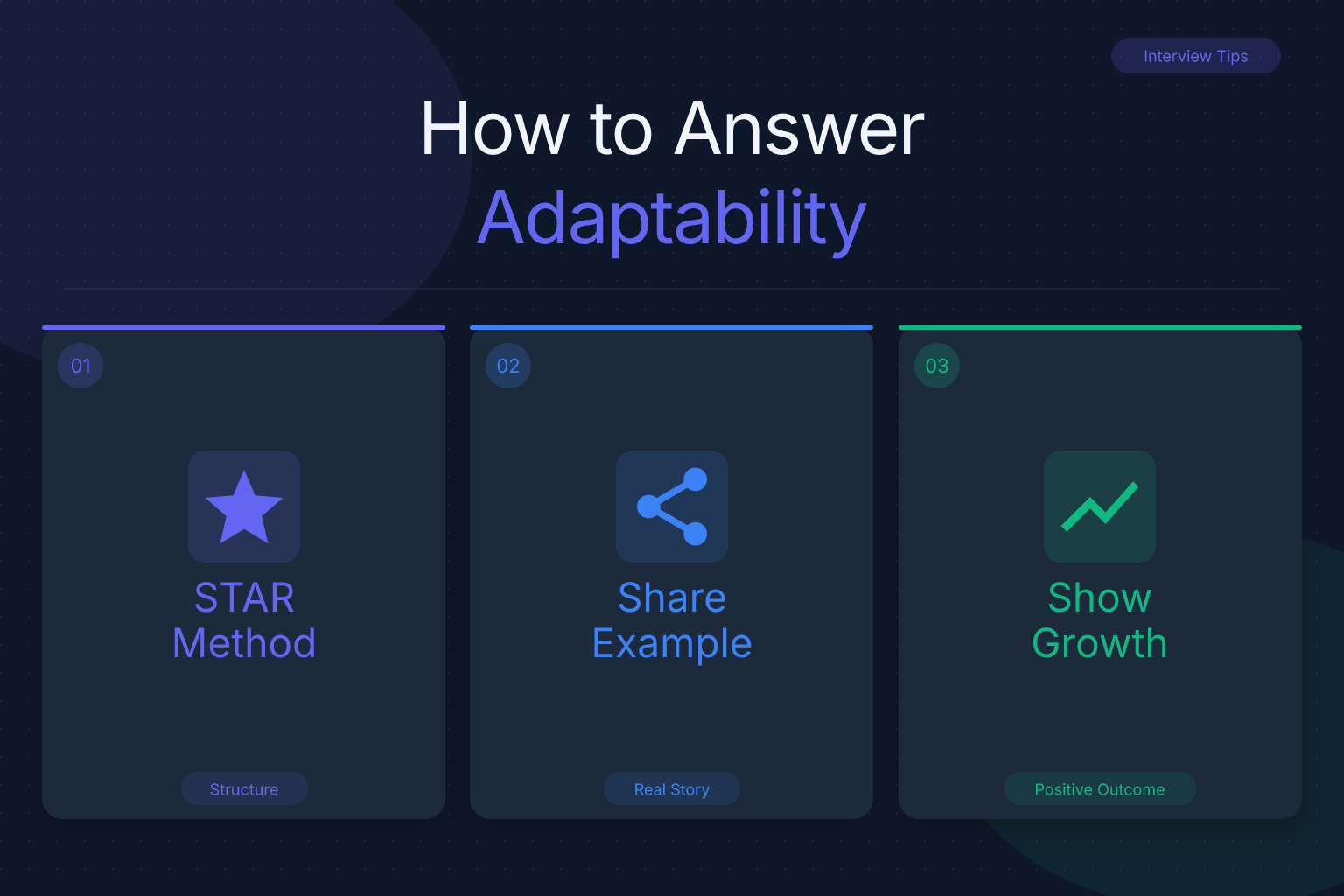
- Use the STAR method (Situation, Task, Action, Result) to structure a specific example from your past.
- Focus on a real change you faced, the actions you took to adapt, and a measurable outcome.
- Avoid vague claims like “I’m very adaptable” — always back it up with a concrete story.
- Prepare two or three adaptability stories in advance so you can tailor your answer to the role.
| What to Do | Why It Matters | Time |
|---|---|---|
| Identify a real change you faced | Shows you have actual experience, not just a claim | 10 min |
| Structure your story with STAR | Keeps your answer clear and focused | 5 min |
| Quantify the result | Proves your adaptability had impact | 5 min |
| Practice out loud | Reduces nerves and improves delivery | 15 min |
How to Answer “What Is Your Adaptability?”
The question “What is your adaptability?” rarely comes as a standalone query. More often, interviewers phrase it as:
- “Tell me about a time you had to adapt to a change.”
- “How do you handle unexpected changes in your work?”
- “Describe a situation where you had to learn something new quickly.”
- “What do you do when your priorities shift suddenly?”
All of these are variations of the same core question: Can you handle change without falling apart? The interviewer wants evidence that you won’t resist new processes, crumble under shifting deadlines, or become unproductive when the plan changes.
Your answer should follow a simple formula: a specific example + the actions you took + the positive result. That’s the STAR method, and it works for almost every behavioral question. We’ll break it down in detail below, but first, understand why this question matters so much to employers.
Why Interviewers Ask About Adaptability
Adaptability is one of the most sought-after soft skills in the modern workplace. Roles change, tools evolve, teams reorganize, and market conditions shift. Employers know that a candidate who can’t adapt will struggle — no matter how strong their technical skills are.
When an interviewer asks about adaptability, they’re evaluating several things at once:
- Resilience: Can you bounce back when a project fails or a plan changes?
- Learning agility: How quickly can you pick up a new tool, process, or responsibility?
- Emotional regulation: Do you stay calm and constructive under pressure, or do you get frustrated?
- Flexibility: Are you willing to take on tasks outside your job description when needed?
- Problem-solving: When the original approach no longer works, can you find a new one?
This question also overlaps with other common interview topics. If you’ve already prepared answers for what is your problem-solving style or what is your communication style, you’ll notice similar themes. Adaptability is the thread that ties many soft skills together.
The STAR Method for Adaptability Answers
The STAR method is the gold standard for behavioral interview questions. It stands for Situation, Task, Action, Result. Here’s how to apply it specifically to an adaptability question:
Situation
Set the scene. Describe a specific time when you faced a change or unexpected challenge. Keep it brief — one or two sentences. Avoid generic setups like “In my last job, things changed a lot.” Instead, be concrete: “In my role as a marketing coordinator, our company switched from a traditional campaign model to an agile sprint system with only two weeks’ notice.”
Task
Explain what you needed to do in response to the change. What was your responsibility? What was at stake? For example: “I was responsible for three ongoing campaigns that suddenly had to be replanned under the new sprint framework, and I had to keep my team on track without missing any deadlines.”
Action
This is the most important part. Describe the specific steps you took to adapt. Be detailed about your thought process and behaviors. Did you ask questions? Did you seek training? Did you reorganize your workflow? Did you communicate with stakeholders? The more concrete, the better.
For example: “I scheduled a meeting with my manager to clarify the new expectations, then created a simple tracking sheet to map my existing tasks to the sprint cycles. I also spent two evenings watching tutorial videos on the new project management tool and asked a colleague who had used it before to walk me through the basics. Within a week, I had restructured my workflow and was running my campaigns through the new system.”
Result
Close with the outcome. Whenever possible, quantify it. Did you meet the deadline? Did you improve efficiency? Did you learn a skill that later helped the team? For example: “As a result, all three campaigns launched on time, and my team actually reduced our planning time by 20% because the sprint system forced us to prioritize more effectively. My manager later asked me to train two new hires on the new process.”
A strong STAR answer takes about 60–90 seconds to deliver. That’s enough time to show depth without rambling.
Example Answers for Different Scenarios
Here are three full example answers you can adapt to your own experience. Each one follows the STAR structure and highlights a different type of adaptability.
Example 1: Adapting to a New Tool or Process
Situation: “In my previous role as a customer support specialist, our team switched from email-based ticketing to a live chat platform with almost no training period.”
Task: “I had to learn the new system while still handling my normal ticket volume, and I was expected to maintain the same response time and customer satisfaction scores.”
Action: “I spent my first two days exploring every feature of the chat platform, reading the help documentation, and testing it with a colleague. I created a cheat sheet of keyboard shortcuts and common responses, which I shared with the rest of the team. I also asked my supervisor for a 30-minute check-in at the end of the first week to get feedback on my performance.”
Result: “Within two weeks, my average response time dropped by 15% compared to the old email system, and my customer satisfaction score stayed above 90%. The cheat sheet I made was adopted by the whole team and became part of our onboarding materials.”
Example 2: Adapting to a Sudden Change in Priorities
Situation: “As a project coordinator at a mid-sized agency, I was leading a website redesign for a client when they suddenly cut the budget by 40% and moved the deadline up by three weeks.”
Task: “I had to re-scope the entire project, renegotiate with vendors, and keep my team motivated despite the setback.”
Action: “I immediately called a team meeting to explain the new constraints and asked everyone to identify which features were absolutely essential versus nice-to-have. I then created a revised project plan with a phased approach — we would deliver the core site first and add enhancements later. I also communicated the changes to the client in a clear, non-defensive way, explaining what we could still deliver and what would need to be postponed.”
Result: “We delivered the core website on the new deadline, and the client was so impressed with how we handled the change that they signed a follow-up contract for the additional features. My manager cited my flexibility as a key reason for the project’s success.”
Example 3: Adapting to a New Role or Responsibility
Situation: “When my company went through a restructuring, my role as a data analyst expanded to include managing a small team of three junior analysts — something I had never done before.”
Task: “I had to quickly learn basic people management skills while still delivering my own analysis work, and I had no formal training.”
Action: “I asked my manager for a list of key management competencies and found a free online course on leading small teams. I scheduled weekly one-on-ones with each team member to understand their workloads and challenges. I also set up a shared dashboard so everyone could see project status at a glance, which reduced the number of status update meetings.”
Result: “Within two months, my team’s productivity increased by 25%, and two of my junior analysts were promoted. I discovered that I actually enjoyed mentoring, and I’ve since taken on more leadership responsibilities.”
Common Mistakes to Avoid
Even well-intentioned candidates make these errors when answering adaptability questions. Watch out for them.
1. Giving a Vague or Generic Answer
Saying “I’m very adaptable — I go with the flow” tells the interviewer nothing. They’ve heard that from every candidate. Without a specific example, your claim carries no weight.
Fix: Always anchor your answer in a real story. If you don’t have a work example, use one from school, volunteering, or a personal project.
2. Choosing a Trivial Example
Adapting to a new coffee machine in the break room is not a compelling story. The change you describe should have some stakes — a deadline, a team, a client, or a measurable outcome.
Fix: Pick a situation where the change was significant enough that your response mattered. If you’re early in your career, a group project where a teammate dropped out or a sudden shift in a class schedule can work.
3. Focusing Only on the Problem, Not Your Action
Some candidates spend 80% of their answer describing how chaotic or unfair the change was, then say “but I managed to deal with it.” That doesn’t show adaptability — it shows complaining.
Fix: Spend most of your time on the Action and Result sections. The interviewer wants to see what you did, not what happened to you.
4. Forgetting to Mention the Result
If you don’t close the loop with an outcome, the interviewer is left wondering whether your adaptation actually worked. Did the project succeed? Did you meet the deadline? Did you learn something?
Fix: Always end with a concrete result, even if it’s qualitative. “The client was satisfied” is better than nothing, but “the client renewed their contract for another year” is much stronger.
5. Sounding Rehearsed or Robotic
You want to be prepared, but you don’t want to sound like you’re reading from a script. If your answer is too polished, it can come across as insincere.
Fix: Practice your story out loud until you know the key beats, but leave room for natural pauses and slight variations. The goal is to sound conversational, not memorized.
How to Prepare Your Adaptability Story
Preparation is the difference between a rambling answer and a confident one. Here’s a step-by-step routine you can do in under an hour.
Step 1: Brainstorm Three Adaptability Moments
Think back over your work, school, or volunteer history. List any time you faced a change, setback, or unexpected challenge. Examples include:
- A new software system or tool
- A sudden change in project scope or deadline
- A team member leaving or joining mid-project
- A shift in company strategy or priorities
- Taking on a new responsibility outside your job description
- Learning a skill from scratch under time pressure
Write down at least three. You want options so you can choose the best one for the specific role you’re interviewing for.
Step 2: Apply the STAR Framework to Each
For each story, write one or two sentences for Situation, Task, Action, and Result. Don’t write a full script — just bullet points. This keeps your answer flexible and natural.
Step 3: Quantify Where Possible
Look at your Result section. Can you add a number? Even an estimate helps: “reduced time by about 20%,” “handled 30% more tickets,” “completed the project two days early.” Numbers make your answer memorable.
Step 4: Practice Out Loud
Say your answer out loud three times for each story. Time yourself. Aim for 60–90 seconds. If you’re over two minutes, trim the Situation or Task sections — they should be brief.
Step 5: Connect Adaptability to the Job Description
Before the interview, review the job posting. Look for keywords like “fast-paced,” “changing priorities,” “cross-functional,” or “startup environment.” If the role explicitly values adaptability, choose the story that best matches that context.
If you’re also updating your resume to highlight adaptability, you can use the free resume score checker to see if your resume mentions key soft skills and where you might improve.
Adaptability in Other Interview Questions
Adaptability doesn’t only show up as a direct question. Interviewers often probe for it indirectly through questions like:
- “Tell me about a time you failed.” (How did you recover?)
- “What’s your biggest weakness?” (Often answered with a story about learning to adapt.)
- “How do you handle stress?” (Adaptability under pressure.)
- “Why do you want to work here?” (You might mention the company’s fast-changing environment.)
If you’ve already prepared answers for what are your weaknesses or tell me about a time you failed, you may find that your adaptability story overlaps. That’s fine — you can reuse the same example as long as you emphasize the adaptability angle.
Final Tips for a Strong Answer
- Be honest. Don’t invent a story. Interviewers can often tell when you’re exaggerating, and a follow-up question will expose gaps.
- Keep it recent. A story from five years ago is less relevant than one from the last year or two. If you’re a recent graduate, a college project is fine.
- Show enthusiasm for change. Frame adaptability as a positive trait, not a burden. Say things like “I actually enjoy learning new systems” or “I see change as an opportunity to improve.”
- End with a forward-looking statement. After your STAR answer, you can add one sentence like “That experience taught me to embrace change, and I’ve applied that mindset ever since.” This leaves a strong impression.
Adaptability is a skill you can demonstrate, not just claim. With a well-prepared story and the STAR structure, you’ll answer this question with confidence and stand out from candidates who only offer vague platitudes.
FAQ
Q: What does “what is your adaptability” mean in an interview?
A: It’s a behavioral question asking you to prove that you can handle change, learn new things, and stay effective when circumstances shift. The interviewer wants a specific example from your past, not a definition of the word.
Q: How do I answer adaptability questions without sounding generic?
A: Use the STAR method to tell a concrete story about a real change you faced, the actions you took, and the measurable result. Avoid phrases like “I’m very adaptable” without evidence.
Q: Can I use a personal example for adaptability?
A: Yes, especially if you’re early in your career or the personal example is highly relevant. A story about adapting to a sudden move, a family responsibility, or a volunteer project can work as long as you focus on your actions and the outcome.
Q: What if I don’t have a work example of adaptability?
A: Draw from school projects, internships, volunteer work, or even a personal challenge like learning a new skill under a deadline. The key is to show a change, your response, and a positive result.
Q: How long should my adaptability answer be?
A: Aim for 60–90 seconds. That’s enough time to cover Situation, Task, Action, and Result without rambling. Practice out loud and time yourself.
Q: What are some adaptability skills to mention in my answer?
A: Learning agility, flexibility, resilience, problem-solving under pressure, openness to feedback, and the ability to reprioritize quickly. Mention these as behaviors you demonstrated, not just as buzzwords.
Track Every Application While You Job Hunt
Stop losing track of where you’ve applied. The ResumeMate Job Tracker is a free Chrome extension that tracks every application, deadline, and follow-up in one place — right from your browser.