How to Answer ‘What Is Your Notice Period?’ If You’re Unemployed (With Proven Examples)
When a recruiter or hiring manager asks how to answer what is your notice period, they aren’t just checking a box — they’re gauging your availability, your professionalism, and sometimes even how you handle commitments. Your answer can influence whether you get an offer, when you start, and how flexible the employer will be. This guide covers exactly what to say in every situation, from being currently employed to between jobs, and how to phrase it on a job application form.
Key Takeaways
- If you’re employed, state your contractual notice period honestly but express willingness to negotiate a shorter handover if possible.
- If you’re unemployed, say you’re available immediately — no need to over-explain.
- On a job application form, write the exact number of weeks or “immediate” rather than leaving it blank.
- Never lie about your notice period; it can backfire during reference checks or when your start date doesn’t match.
- Use the question as a chance to show you’re organized and respectful of your current employer’s needs.
| What to Do | Why It Matters | Time |
|---|---|---|
| State your notice period clearly (e.g., “4 weeks”) | Avoids confusion and sets realistic expectations | During interview or on application |
| Mention if you can negotiate an earlier release | Shows flexibility without overpromising | When you want to start sooner |
| If unemployed, say “I’m available immediately” | Removes any doubt about your readiness | Any time you’re between jobs |
| On a form, write the number of weeks or “immediate” | Prevents your application from being filtered out | When filling out online applications |
| Avoid vague answers like “it depends” | Recruiters need a concrete timeline to plan | Always |
What Does “Notice Period” Mean?
A notice period is the amount of time you’re required to continue working after you formally resign from your job. It’s typically outlined in your employment contract and serves as a buffer for your employer to find a replacement or redistribute your work. In many industries, a two-week notice is standard, but it can range from one week to three months depending on your role, seniority, and local labor laws.
When an interviewer asks “What is your notice period?”, they want to know how soon you can start if they offer you the job. It’s a practical question, not a trick. But your answer can reveal more than just a number — it can show whether you’re transparent, realistic, and respectful of your current obligations.
Why Employers Ask About Your Notice Period
Hiring managers ask this question for three main reasons:
- To plan onboarding and team integration. They need to know when you’ll be available to start training, join projects, or fill a gap. If you have a three-month notice period, they may need to adjust their timeline or consider whether they can wait.
- To assess your professionalism. How you talk about leaving your current job hints at how you’ll handle transitions in the future. A candidate who says “I’ll just walk out tomorrow” raises red flags, while someone who respects their notice period shows reliability.
- To gauge flexibility. Some roles need to be filled urgently. If you can negotiate a shorter notice period or have already started the handover process, that can make you a more attractive candidate.
Understanding these motivations helps you frame your answer strategically. It’s not just about the number — it’s about showing you’re a considerate, organized professional.
How to Answer If You’re Currently Employed
This is the most common scenario. You have a job, and you need to give notice before you can start a new one. The key is to be honest about your contractual obligation while signaling that you’re eager to join and willing to work with both employers to find a smooth transition.
Step-by-step approach
- State your official notice period. For example: “My contract requires a four-week notice period.”
- Add context if it helps. If you’ve already discussed your departure with your manager or you’re in a handover phase, mention it. “I’ve already started documenting my projects, so a smooth transition is possible.”
- Express flexibility (if genuine). You might say: “I’m happy to discuss an earlier start date if my current employer agrees to a shorter notice. I’d also be open to overlapping for a few days if that helps.”
- Reinforce your enthusiasm. End with something like: “I’m really excited about this role and will do everything I can to start as soon as possible.”
Example answers
Standard notice period:
“I have a four-week notice period in my current role. I plan to submit my resignation as soon as I have a formal offer, and I’m confident I can wrap up my key responsibilities within that time. If there’s any flexibility to start earlier, I’m open to discussing it.”
Longer notice period (e.g., 3 months):
“My notice period is three months, which is standard for my seniority level. I understand that’s a significant wait, and I’m willing to negotiate a shorter handover if my current employer agrees. I can also make myself available for part-time onboarding or knowledge transfer during the notice period if that helps bridge the gap.”
Already serving notice:
“I’ve already handed in my notice, so I have two weeks remaining. I’ll be available to start immediately after that.”
If you’re worried about a long notice period hurting your chances, remember that many employers expect it for specialized or senior roles. Being upfront is better than surprising them later. For more on handling tricky interview questions, see our guide on how to answer what are your weaknesses in an interview.
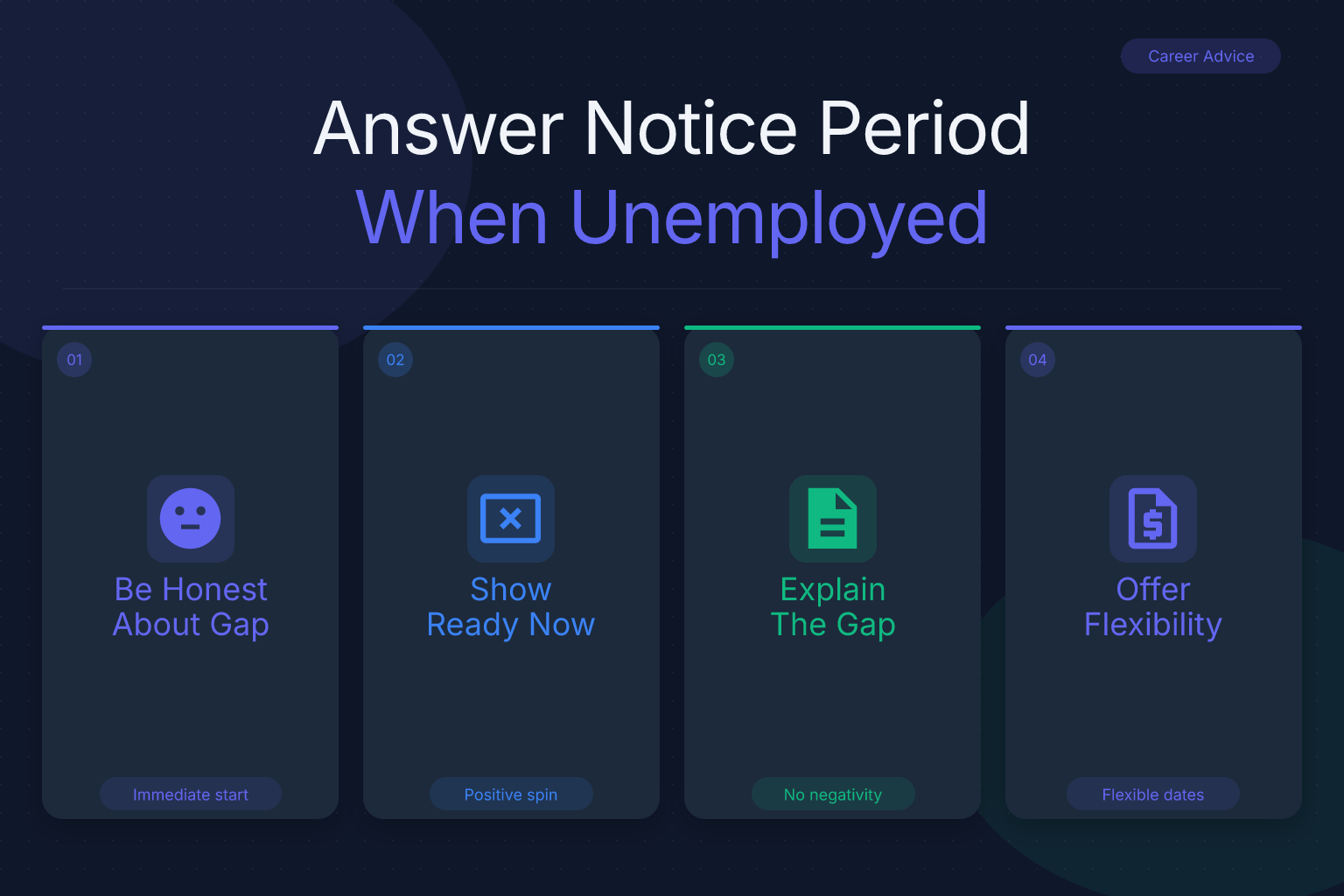
How to Answer If You’re Unemployed or Between Jobs
If you’re not currently working, the answer is straightforward: you’re available immediately. But you still need to phrase it in a way that doesn’t invite unnecessary follow-up questions about why you left your last job or how long you’ve been out of work.
What to say
- “I’m available to start immediately.” This is the simplest and most effective answer. It tells the employer exactly what they need to know.
- If you’re finishing up a freelance project or have a prior commitment, you can add: “I’m available immediately, though I have a short-term commitment on [date] that I’d like to work around.”
What to avoid
- Don’t over-explain. You don’t need to say “I was laid off three months ago and have been job hunting ever since.” That can shift the focus to your unemployment gap rather than your availability.
- Don’t say “I can start tomorrow” if you actually need a week to relocate or handle personal matters. Be realistic.
Example answer
“I’m currently between roles, so I’m available to start immediately. I can be flexible with the start date to align with your onboarding schedule.”
This answer is confident, concise, and leaves no room for doubt. If the interviewer asks about your previous job, you can pivot to a positive reason for leaving. For help framing that conversation, read our post on how to answer reasons for leaving a job.
How to Answer If You’re on a Contract or Freelancing
Contractors and freelancers often have more flexibility, but the answer isn’t always “immediately.” You may have ongoing projects, client commitments, or a contract end date that you need to honor.
Key points to cover
- Clarify your current status. Are you on a fixed-term contract that’s ending soon, or are you working on a project basis with no set end date?
- State your availability honestly. If your contract ends in two weeks, say so. If you’re freelancing and can wrap up within a week, mention that.
- Show professionalism. Even as a contractor, leaving a client in the lurch can damage your reputation. Employers respect candidates who honor their commitments.
Example answers
Fixed-term contract ending soon:
“My current contract ends in three weeks, and I’m not planning to renew it. I’ll be available to start immediately after that date.”
Freelancing with flexible projects:
“I’m currently freelancing, so I have some flexibility. I’d need about a week to hand off my active projects to other freelancers or wrap them up. After that, I can start full-time.”
Open-ended contract with notice clause:
“My contract requires a two-week notice period. I’m ready to give that notice as soon as we agree on terms, so I could start in about two weeks.”
If you’re transitioning from contract to permanent work, your resume should reflect that shift clearly. Our guide on contract vs permanent resume tailoring can help you present your experience in the best light.
How to Answer on a Job Application Form
Online application forms often have a field labeled “Notice Period” or “Availability.” This is not the place for lengthy explanations. You need to give a clear, scannable answer that won’t get your application filtered out by an applicant tracking system (ATS) or a busy recruiter.
What to write
- If you’re employed: Enter the number of weeks (e.g., “4 weeks”) or select the closest option from a dropdown. If the form allows a text field, you can write “4 weeks (negotiable)” if you have flexibility.
- If you’re unemployed: Write “Immediate” or “Immediately available.”
- If you’re a student or have a future start date: Write the date you’ll be available, e.g., “Available from June 15, 2026.”
Common mistakes
- Leaving the field blank. This can look like you missed it or are hiding something.
- Writing “ASAP” when you actually have a notice period. Be specific.
- Entering “0 weeks” if you’re employed but willing to quit without notice. That can raise concerns about your reliability.
Example entries
| Your Situation | What to Write |
|---|---|
| Employed, 1-month notice | “4 weeks” |
| Employed, 2-week notice | “2 weeks (negotiable)” |
| Unemployed | “Immediate” |
| Contract ending in 3 weeks | “3 weeks” |
| Student graduating in May | “Available from May 20, 2026” |
Before you even reach the application stage, make sure your resume is ready to pass ATS scans. You can check your resume’s ATS score for free with ResumeMate’s score checker and fix any issues that might hold you back.
What If You Need to Negotiate Your Start Date?
Sometimes the employer wants you to start sooner than your notice period allows, or you want to start later to take a break between jobs. Negotiation is possible, but it requires tact.
How to negotiate a shorter notice period
- Ask your current employer first. Before you promise a shorter notice to the new employer, have a conversation with your current manager. You might say: “I’ve received an offer that requires me to start in two weeks. Is there any way we can work out an earlier release? I’m happy to help train my replacement or document processes before I go.”
- Offer solutions. Propose a handover plan, offer to be available for questions after you leave, or suggest working a few extra hours in your final weeks to wrap things up.
- Be prepared for a “no.” If your current employer insists on the full notice period, don’t burn bridges. Tell the new employer honestly and see if they can accommodate.
How to negotiate a later start date
If you want a gap between jobs — for rest, relocation, or personal reasons — you can say:
“My notice period is four weeks, but I’d ideally like to start about six weeks from now to allow for a short break and relocation. Would that timeline work for you?”
Most employers will appreciate the honesty. If they can’t wait, they’ll tell you, and you can decide whether to adjust your plans.
Negotiating a start date is similar to negotiating other job terms. For more strategies, see our article on how to negotiate a job title without changing your role.
Common Mistakes to Avoid When Answering
Even a simple question can trip you up if you’re not careful. Here are the most frequent missteps and how to avoid them.
1. Lying about your notice period
Saying you have a two-week notice when your contract requires two months will backfire. The new employer will expect you to start on a certain date, and when you can’t, you’ll lose credibility — and possibly the offer.
2. Being vague
Answers like “it depends” or “I’m not sure” make you look unprepared. Know your notice period before the interview. Check your contract or employee handbook if you’re unsure.
3. Sounding resentful about your current job
Avoid saying things like “I can’t wait to get out of there” or “I’ll give them the minimum and leave.” It makes you seem unprofessional. Even if you’re unhappy, frame your departure respectfully.
4. Forgetting to mention handover plans
If you have a long notice period, proactively mention how you’ll ensure a smooth transition. This shows you’re thinking about the employer’s needs, not just your own.
5. Not being ready to discuss start date logistics
If you need to relocate, have a pre-planned vacation, or require visa processing, factor that into your availability. Don’t promise a start date you can’t meet.
How to Prepare Your Answer Before the Interview
You don’t want to be caught off guard. Here’s a quick preparation checklist:
- Review your employment contract. Find the exact notice period clause. If it’s not in writing, check your company’s policy or ask HR discreetly.
- Decide on your ideal start date. Consider any personal commitments, relocation needs, and whether you want a break between jobs.
- Think about flexibility. Could you negotiate a shorter notice? Would you be willing to start part-time or do some onboarding remotely during your notice period?
- Practice your answer out loud. Keep it to two or three sentences. The more concise, the better.
- Prepare for follow-up questions. The interviewer might ask, “Can you start any sooner?” or “What would it take to reduce your notice period?” Have a response ready.
If you’re still polishing your interview skills, our guide on how to answer what motivates you in an interview covers another common question you’ll likely face.
Frequently Asked Questions
Q: How to answer what is your notice period if unemployed?
A: Say “I’m available immediately.” You don’t need to explain why you’re unemployed unless asked. Keep it simple and confident.
Q: How to answer what is your notice period question on a job application?
A: Enter the number of weeks (e.g., “4 weeks”) or write “Immediate” if you’re not working. If the form allows, you can add “(negotiable)” if you have flexibility.
Q: How to answer what is your notice period if employed?
A: State your contractual notice period honestly, then express willingness to discuss an earlier start if possible. For example: “My notice period is one month, but I’m open to negotiating a shorter handover.”
Q: How to answer what is your notice period meaning?
A: The question means “How soon can you start working for us after you accept an offer?” Your answer should reflect any notice you need to give your current employer or other commitments.
Q: How to answer what is your notice period in weeks?
A: Convert your notice period into weeks. For example, “one month” becomes “4 weeks.” If your notice period is 2 months, say “8 weeks.” This gives the employer a precise timeline.
Q: How to reply what is your notice period when you can start immediately?
A: Simply say “I’m available to start immediately” or “I can start right away.” If you’re currently employed but willing to leave without notice, be cautious — that can raise concerns about your reliability.
Q: Can I say my notice period is negotiable if I’m not sure?
A: Yes, but only if you genuinely have flexibility. You can say “My official notice is 4 weeks, but I believe I can negotiate an earlier release if needed.” Don’t promise something you can’t deliver.
Related articles:
- How to Answer ‘Walk Me Through Your Resume’ (With Examples)
- How to Answer “What Is Your Adaptability?” (With Examples)
- What Is Your Problem-Solving Style? How to Answer
- What Is Your Communication Style? How to Answer
Track Every Application While You Job Hunt
Stop losing track of where you’ve applied. The ResumeMate Job Tracker is a free Chrome extension that tracks every application, deadline, and follow-up in one place — right from your browser.